










Nespresso-compatible capsules: aluminium, plastic or compostable?
By the Mush n Go editorial team - 15 October 2026
By the Mush n Go editorial teamPublished 15 October 202614 min read
Capsule guide
For Nespresso-compatible capsules®, aluminium is the material that best protects coffee from air, and it can be recycled endlessly, provided it is sorted. Plastic is light but less airtight and less often recycled. Compostable capsules avoid metal, but keep the aroma for less time and need the right disposal route. No material is perfect: it all comes down to sorting.

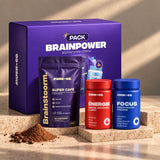
Brainstoorm
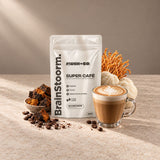
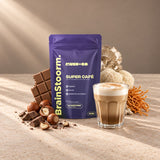
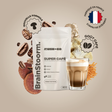
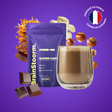
The recipe arriving in capsule form on 2 October: lion's mane, cordyceps and chaga at 1,000 mg each, maca, ashwagandha and chicory, with 20 mg of caffeine per cup. Made with a spoon, hot or cold.
Discover Brainstoorm →
Coffee Pack
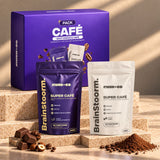
Brainstoorm Coffee and Brainstoorm Chocolate-Hazelnut together. To switch depending on your mood, or share with someone who prefers chocolate to coffee.
Discover the pack →The Original format
Nespresso®-compatible capsules: what are we talking about?
A "compatible" capsule is made by a different brand from the machine's, but designed to work in it. The market opened up in the early 2010s, when some of the patents protecting the system entered the public domain. Since then, dozens of brands, from supermarkets to artisan roasters, have offered their own capsules.
First, you need to tell apart two systems, which are not interchangeable:
Nespresso® Original
The classic format, a small cone. This is the one the vast majority of compatible capsules target. It is also used in machines from Krups, Magimix, De'Longhi, Sage and KitchenAid.
Nespresso® Vertuo
A newer, wider, dome-shaped format, read by a barcode on the rim. Compatible capsules for it are much rarer.
This guide covers the Original format. Before buying, simply check the name of your machine: Essenza, Pixie, CitiZ, Inissia, Lattissima and Creatista, for example, are Original machines. Dolce Gusto, Tassimo and Senseo machines use other, incompatible systems.
The three materials
Aluminium, plastic, compostable: head to head.
At a glance, all compatible capsules look alike. What really sets them apart is their material, which determines three things: how fresh the coffee stays, how well it works in the machine, and what happens to the capsule once used.
| Aluminium | Plastic | Compostable | |
|---|---|---|---|
| Aroma protection | Complete barrier to air, light and moisture | Variable, often needs extra packaging | Weaker, almost always needs extra packaging |
| End of life | Recycling bin, endlessly recyclable | Recycling bin, but rarely recycled in practice | Suitable composter or food-waste collection |
| In the machine | Rigid, pierces cleanly | Works well if the capsule is well designed | Can swell or deform with moisture |
| Weight | Very light | Light | Often thicker |
| Weak point | Making new aluminium is very energy-intensive | Small item, hard to recycle | Shorter shelf life, disposal routes still limited |
This table describes general trends. Two capsules made of the same material can be very different depending on their design, thickness and packaging.
Aluminium
The aluminium capsule, the original benchmark.
The Original format was designed for aluminium from the start, and not by chance. Aluminium is one of the best barriers there is: it lets through neither oxygen, light nor moisture. Once sealed, the capsule protects the ground coffee for many months, with no extra packaging.
It is also rigid and thin. In the machine, the capsule is pierced cleanly at the back, then its front opens under the water pressure. That is what ensures an even extraction, and the characteristic crema of an espresso.
Its big environmental advantage is its end of life. Aluminium can be recycled endlessly without losing its qualities. And recycling aluminium takes around 95% less energy than producing new metal, according to European Aluminium, the industry's European association.
Its big drawback is precisely the production of new aluminium, which uses a lot of energy. An aluminium capsule that ends up in general waste is therefore a real waste. All its value depends on sorting.
What about health? The question of aluminium coffee capsules and health comes up often. Materials in contact with food are strictly regulated by European law, and the inside of capsules is usually protected by a thin food-grade lacquer. The contact between hot water and the capsule lasts only a few dozen seconds.
Plastic
The plastic capsule, light and affordable.
Many compatible capsules sold in supermarkets are made of plastic, usually polypropylene. It is a light, cheap, easy-to-mould material, which allowed the compatible capsule market to grow very quickly.
On freshness, it all depends on the design. Plain plastic lets a little oxygen through over the weeks. To protect the coffee, manufacturers sometimes add a barrier layer to the wall, or pack the capsules in an airtight pouch, sometimes under a protective atmosphere. If your capsules are sold loose in a cardboard box, with no pouch, that is a clue: the aroma may fade faster once the box is open.
At end of life, plastic comes off worst. In France, since 2023, all plastic packaging can go in the recycling bin. But a small capsule, soiled with coffee grounds, is hard to sort and recycle in practice. It often slips through the machines at sorting centres.
That does not make a plastic capsule a bad capsule: it can deliver very good coffee. But environmentally, it rarely comes out ahead.
Compostable and bio-based
Compostable, biodegradable, bio-based capsules: untangling the terms.
This is the fastest-growing category, and the one where the vocabulary is most confusing. Searches for "biodegradable coffee capsules" and "aluminium-free coffee capsules" show it. Three words, three realities.
Bio-based
The material comes from plant resources: maize starch, sugar cane, wood fibres. That says nothing about its end of life: a bio-based plastic is not necessarily compostable.
Compostable
The capsule turns into compost under conditions defined by a standard. It is the only claim with a precise meaning.
Biodegradable
Too vague a term. In France, the anti-waste law (AGEC) has in fact banned it on products and packaging since 2022.
Aluminium-free
An aluminium-free capsule may be made of plastic, paper or compostable material. The claim alone does not tell you which.
For compostable capsules, there are two levels to distinguish clearly. The European standard EN 13432 covers industrial composting: at around 58 °C, in a specialised facility, at least 90% of the material must biodegrade within six months. Home composting, on the other hand, happens at ambient temperature, much more slowly. It is certified by labels such as "OK compost HOME", or by the French standard NF T51-800.
In practice, a capsule that is only "industrially" compostable will not break down properly in your garden composter. And not every local authority accepts capsules in its food-waste collection. Check your council's rules before relying on it.
In the cup, compostable capsules have come a long way. But their walls let more air and moisture through: they are almost always sold in an airtight pouch, and keep for less time once the pouch is open.
Keeping the aroma
Coffee's enemy is air.
As soon as it is ground, coffee starts to lose its aromas. Oxygen oxidises them, moisture dulls them, light breaks them down. That is why an open bag of ground coffee loses its fragrance within days. The capsule was invented precisely to lock in the coffee at the moment it is ground, all the way to the cup.
Sealed aluminium
A near-total barrier. The capsule protects its contents on its own, with no extra packaging, for its whole shelf life.
Plastic with a barrier layer
Good protection if the wall includes an oxygen barrier, or if the capsules are packed in an airtight pouch.
Compostable
Weaker protection from the wall alone. The pouch does most of the work: once it is open, it is best to use the capsules quickly.
Whatever the material, keep your capsules away from heat, moisture and direct sunlight. Avoid the windowsill or the top of the machine, which gets warm. And respect the best-before date: after it, the coffee is not dangerous, but it has lost some of its flavour.
Recycling in France
How do you recycle a coffee capsule in France?
It is the question everyone asks in front of the bin. The answer has changed a lot in recent years. What follows describes the French system; elsewhere, rules vary, so check with your local council.
The recycling bin. Since 1 January 2023, sorting rules have been extended across France: all packaging, including small metal and plastic packaging, can go in the recycling bin. In equipped sorting centres, aluminium capsules are separated from other waste by eddy current separators, which detect and eject non-magnetic metals such as aluminium.
Collection points. Some brands also run their own collection, in store, at pick-up points or with a return bag. The recovered coffee grounds can then be composted and the aluminium recycled separately.
Compost. Capsules certified as compostable go in a home composter if they carry a home-composting label, or in the food-waste collection if your local authority accepts them.
Read the packaging
In France, the Triman logo and Info-tri label show the right bin. They are mandatory on household packaging.
Check locally
In France, Citeo's sorting guide, online or as an app, gives the exact rule for your town. Elsewhere, check your local council's website.
Loose, not bagged
Put capsules in the bin loose, not shut inside a bag, so the sorting centre can detect them.
Grounds left in the capsule do not interfere with sorting in most equipped centres. There is no need to rinse or empty your capsules, unless your local authority says otherwise.
What is changing
Capsules and the new European rules.
The framework is moving fast. Adopted at the end of 2024 and published in early 2025, the EU regulation on packaging and packaging waste, known as the PPWR, applies directly in every EU country. Its aim is clear: that all packaging placed on the EU market be recyclable by 2030, with increasingly demanding recyclability criteria.
For capsules, this means two things. First, capsules that fit into no recycling or composting route will find it harder and harder to have a place. Second, vague environmental claims will be tolerated even less: a material will have to prove its end of life, not just claim it. The text also leaves member states some room for manoeuvre on what happens to coffee capsules, between recycling and composting.
In France, the AGEC law was already ahead: extended sorting rules, the Triman logo, a ban on the word "biodegradable", separate food-waste collection. For you as a consumer, the rule stays the same: a good material is one your local authority knows how to process.
Refillable capsules
Reusable capsules: a real alternative?
Between the single-use capsule and whole beans, there is a third way: the refillable capsule, in stainless steel or rigid plastic, which you fill yourself with ground coffee before closing it with a foil lid or cap.
On paper, it is the solution that produces the least waste. In practice, it takes more effort: dosing, tamping, cleaning. The ground coffee you put in is exposed to air from the moment you open the bag, and extraction is sometimes less even than with an industrial capsule. Many people use one at home, and keep sealed capsules for the office or rushed mornings.
If you go this way, choose a stainless steel model, which lasts longer, and a finely ground coffee suited to espresso.
What about your machine?
Do compatible capsules damage the machine?
It is a common worry, and largely unfounded if the capsule is well designed. A compatible capsule matches the dimensions of the Original format: it slots in, gets pierced and is ejected just like the original.
Problems, when there are any, mostly come from poorly calibrated capsules: capsules that jam, leak, pierce badly or deform under heat and pressure. Rigid aluminium capsules are the least affected. Some compostable capsules, more sensitive to moisture, can swell if they have been badly stored.
As for the warranty, the use of compatible capsules was addressed by the French competition authority in 2014. If in doubt, reread your machine's warranty terms. And to look after your machine, whatever the type of capsule, descale it regularly.
Choosing well
Six criteria for choosing your compatible capsules.
- The right format: Original or Vertuo, depending on the name of your machine.
- A material that fits your recycling: aluminium if your local authority sorts it, compostable if you have the right route.
- Clear freshness protection: an airtight capsule or freshness pouch, with a legible best-before date.
- A transparent composition: what is in the capsule, in grams, and where it comes from.
- Precise claims: "compostable" with its standard, rather than vague promises.
- Finally, taste: a capsule that ends up half-drunk is good for no one.
This last point matters more than it seems. Several life-cycle assessments of coffee make the point: a large part of a cup's environmental impact comes from the coffee itself, from growing to roasting, more than from its packaging. Wasted coffee often weighs more than a properly sorted capsule.
Mush Caps
Why we chose aluminium.
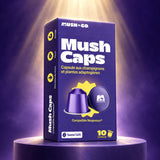
At Mush n Go, our mushroom coffee Brainstoorm has always been made with a spoon. On 2 October, its recipe arrives as a Nespresso® Original-compatible capsule: Mush Caps.

For the capsule, we chose aluminium, for the reasons explained above. Our recipe is not just coffee: it also contains mushroom and plant extracts, which are as sensitive to air and moisture as coffee itself. The aluminium capsule protects them without extra packaging, and it goes in the recycling bin.
In the meantime, the recipe already exists as a powder: Brainstoorm in the coffee flavour, and the Coffee Pack to get the Chocolate-Hazelnut too. To find out what goes into a mushroom coffee, read what is mushroom coffee, and our six criteria for spotting a genuine product.
Your questions
Everything you ask us about compatible capsules.
What are the best Nespresso®-compatible capsules?
There is no single best capsule. First choose the right format, Original or Vertuo, then a material that fits your recycling, good freshness protection and, above all, a coffee you enjoy. An airtight, properly sorted capsule has it all.
Do compatible capsules damage the machine?
No, if they match the format properly. Problems mostly come from poorly calibrated capsules that jam or leak. Rigid aluminium capsules are the least affected. Descale your machine regularly.
Are aluminium capsules recyclable?
Yes. Aluminium can be recycled endlessly. In France, since 2023, capsules can go in the recycling bin, where equipped centres separate them with eddy current separators. Elsewhere, check your local council's rules.
Should you empty capsules before throwing them away?
Generally, no. Grounds do not interfere with sorting in most equipped centres. Put capsules in the bin loose, unless your local authority says otherwise.
Can a compostable capsule go in my composter?
Only if it is certified for home composting, for example with the OK compost HOME label or the NF T51-800 standard. A capsule that is only industrially compostable, under EN 13432, will not break down properly in the garden.
What is the difference between a biodegradable and a compostable capsule?
"Compostable" refers to a precise standard, industrial or home. "Biodegradable" is too vague, and in France the AGEC law has banned it on packaging since 2022.
Are there aluminium-free coffee capsules?
Yes: in plastic, paper or compostable materials. They avoid metal, but generally protect the aroma less well and are often sold in a freshness pouch.
Do compatible capsules work in a Vertuo machine?
No. Original-format capsules do not work in Vertuo machines, which use larger capsules read by a barcode. A few Vertuo-compatible capsules exist, but they are much rarer.
How long do coffee capsules keep?
Several months for a sealed aluminium capsule. Plastic or compostable capsules depend on their pouch: once it is open, use them quickly. Store them somewhere dry, away from heat and light.
Sources
- French Law No. 2020-105 of 10 February 2020 on the fight against waste and the circular economy (AGEC law).
- Standard NF EN 13432: Packaging. Requirements for packaging recoverable through composting and biodegradation.
- Standard NF T51-800: Plastics. Specifications for plastics suitable for home composting.
- Regulation (EU) 2025/40 on packaging and packaging waste (PPWR).
- European Aluminium: data on the energy savings of aluminium recycling.
Keep reading
Go further.
Capsule or powder, what is inside counts as much as the container. Discover our other guides, or browse our range of mushroom coffees.
Nespresso® is a registered trademark of a third party, unconnected to Mush n Go.

Discover our mushroom and adaptogenic plant supplements
Our vegan formulas, made in Toulouse by a French manufacturer.