




















Chicory Coffee: Why Mix Chicory with Coffee, and in What Ratio
By the Mush n Go editorial team - 12 November 2026
By the Mush n Go editorial teamPublished 12 November 202613 min read
Chicory and coffee
Mixing chicory with coffee is mainly a way to drink less caffeine without changing your routine: roasted chicory contains none, and it brings a rounded bitterness that softens the coffee. A 70/30 blend takes about 30% of the caffeine out of your cup, a 50/50 blend half of it. Here are the ratios that work, and who they suit.
The complete guide: mushroom coffee, benefits and side effects →

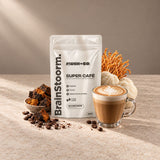
Brainstoorm
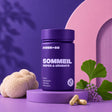
A base of roasted chicory and organic cacao, Lion's Mane, Cordyceps and Chaga at 1,000 mg each, and just 20 mg of microencapsulated caffeine per cup.
Discover Brainstoorm →
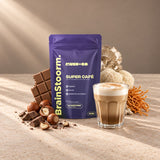
Brainstoorm Coffee
The same formula in a properly coffee-flavoured version, for anyone who wants the taste of their morning cup with four times less caffeine than an espresso.
Discover Brainstoorm Coffee →What chicory is
A roasted root, not a coffee.
Coffee chicory comes from the root of Cichorium intybus var. sativum, a cousin of endive and wild chicory, in the daisy family (Asteraceae). The root is harvested in autumn, cut into chips, dried, then roasted like a coffee bean. It is this roasting that gives it its brown colour, its caramel notes and its bitterness.
It comes in three forms: roasted granules, to brew on their own or mix with ground coffee; instant powder, made by extracting the roasted chicory and then drying the extract; and liquid, which is rarer. None of them contains caffeine. That is the big difference from coffee, and it is what makes chicory the ideal partner for coffee when you want to drink less of it.
To find out everything about chicory on its own, its benefits, side effects and dangers, our article chicory root benefits and side effects covers the subject in full. Here, we look at how it pairs with coffee.
A French story
From the Continental Blockade to Ricoré, two centuries of blending.
Roasted chicory first spread through the Netherlands and Flanders in the 18th century, as a cheap substitute for coffee. It took off in France under the Continental Blockade imposed by Napoleon from 1806: colonial coffee became scarce and expensive, and the root, which grows very well in the soils of northern France, took over. The Nord and Pas-de-Calais became the main growing region, and still are today.
18th century
Roasted root appears in the Netherlands and Flanders, at first to replace coffee for those who cannot afford it.
From 1806
The Continental Blockade cuts France off from colonial coffee. Chicory takes hold in the countryside and towns of the north.
The two world wars
With rationing, the family “coffee” is often a blend, or even pure chicory. The taste becomes a habit.
1953
Nestlé launches Ricoré, an instant blend of coffee and chicory, which becomes the breakfast drink of several generations in France.
Today
The blend is coming back, this time by choice: less caffeine, a gentler cup, and the pleasure of a taste many people knew as children.
So the logic has been turned around. In the past, people added chicory to coffee to save on coffee. Today, they do it to cut down on caffeine, and because many coffee drinkers find the blend tastes better.
What changes in the cup
Less caffeine, more roundness.
Adding chicory to coffee changes three things. The first is mechanical: every spoonful of chicory that replaces a spoonful of coffee removes the matching caffeine. The second is taste: chicory adds body and a rounded bitterness, without the acidity of some coffees. The third concerns fibre: raw root is very rich in inulin, but roasting breaks down a good share of it, so a cup provides little.
Caffeine
It falls in proportion to the coffee you take out. This is the clearest effect, and the only one guaranteed in every cup.
Taste
Rounder, more “toasted”, less acidic. Chicory masks the sourness of a cheap coffee and softens a very dark roast.
Inulin
A fibre that bacteria in the colon ferment. Found mostly in raw root; the doses studied are counted in grams.
Price
Chicory costs much less than coffee per kilo. So a blend also lightens the bill.
What chicory does not do: it does not “neutralise” the caffeine from the coffee left in the cup. If you keep the same amount of coffee and add chicory on top, you drink as much caffeine as before. It all comes down to replacing. To find out how much caffeine each drink contains, see our guide caffeine: how long it lasts, doses and effects.
The right ratios
Chicory and coffee: what ratio?
There is no ideal ratio, only yours. The right benchmark depends on what you are after: keeping the taste of coffee, cutting caffeine sharply, or having a cup in the evening. Here is what the most common blends give, for a large cup of filter coffee with about 90 mg of caffeine.
| Coffee / chicory | Caffeine, approx. | Taste | Who it's for |
|---|---|---|---|
| 100 / 0 | 90 mg | Pure coffee | The starting point |
| 80 / 20 | 72 mg | Coffee, barely rounder | Starting without noticing a thing |
| 70 / 30 | 63 mg | Coffee-led, toasted finish | Cutting down day to day, the most popular blend |
| 50 / 50 | 45 mg | Balanced, very rounded | Halving the caffeine, afternoon cups |
| 30 / 70 | 27 mg | Chicory-led | Sensitive people, late in the day |
| 0 / 100 | 0 mg | Pure chicory | Pregnancy, evening, stopping caffeine completely |
Simplified calculation based on the EFSA benchmark (about 90 mg per 200 ml of filter coffee), assuming chicory replaces coffee weight for weight. Actual levels vary with the coffee, the grind and the brewing method.
70/30 is a good entry point: most people barely notice the difference in taste, and the cup loses nearly a third of its caffeine. After two weeks, many move to 60/40 and then 50/50 without effort. It is a gentle way to cut down, much easier to stick to than stopping outright. If you are wondering how far to go, our article on how many cups of coffee a day sets out the official benchmarks.
A tip on taste: chicory extracts faster than coffee and adds more colour. Volume for volume, it seems stronger. If your first blend tastes too bitter, use a little less chicory rather than adding sugar.
What the studies say
Chicory: three trials worth knowing.
Research on chicory as a drink is still modest. Here are three controlled trials that are often cited, with their limitations. The full references are at the bottom of the page.
Nishimura et al., 2015 · Japan
47 healthy adults drank 300 ml of a drink made from roasted chicory root extract, or a placebo drink with a similar taste, every day for 4 weeks. The authors observed a drop in glycated haemoglobin in the chicory group, with no difference in fasting blood glucose or lipids, and a trend towards better stools. Limitation: a short trial, a small sample, and a drink enriched with inulin.
Schumacher et al., 2011 · intervention trial
27 healthy volunteers drank 300 ml of caffeine-free “chicory coffee” every day for a week. The researchers measured a fall in blood and plasma viscosity and better red blood cell deformability. Limitation: no comparable placebo group, only one week, and biological markers rather than health outcomes.
Micka et al., 2017 · controlled trial
Adults with constipation took 12 g a day of chicory inulin or a placebo for 4 weeks. Stool frequency increased with inulin. Limitation: this was purified inulin in sachets, at a dose far beyond what a cup of roasted chicory provides.
These trials show that chicory is not a neutral drink, but they do not allow any health benefits to be attributed to it. Its proven value in a blend remains simple: it replaces part of the coffee, and so part of the caffeine.
The homemade recipe
Chicory coffee blend, in three steps.
The simplest approach is to start from your usual method, filter, cafetière or stovetop pot, and replace part of the ground coffee with roasted chicory granules. Chicory granules are coarser than ground coffee: they mix well and do not clog filters.
Weigh
For a 250 ml mug, allow about 15 g in total: 10 g of ground coffee and 5 g of chicory granules for a blend of roughly 70/30.
Mix dry
Mix the coffee and chicory in the filter or cafetière before pouring the water, for an even extraction.
Brew as usual
Water just off the boil, around 90 °C, your usual brewing time. Taste, then adjust the share of chicory from one cup to the next.
You can also make up a jar in advance: 700 g of ground coffee to 300 g of chicory granules, well mixed, and you no longer have to think about it. With milk, the chicory coffee blend makes an excellent café au lait, its roundness going very well with milk or an oat drink.
With instant, it is even quicker: one teaspoon of instant coffee and one teaspoon of instant chicory in a cup of hot water, for a blend close to 50/50. That is the idea behind ready-made blends. Our chicory page details the forms of the root and how to use them.
Instant, granules, capsule
Chicory coffee: which format to choose?
The blend now comes in every coffee format. Each has its advantages, depending on your machine and how patient you are in the morning.
| Format | Advantage | Limitation |
|---|---|---|
| Chicory granules + ground coffee | Ratios down to the gram, the boldest taste | Needs a filter machine, cafetière or stovetop pot |
| Instant chicory + instant coffee | Instant, no equipment | Less rich taste, less control over the coffee used |
| Ready-made instant blend | Convenient, consistent taste | Fixed ratios, check the label |
| Chicory capsule | The familiar capsule machine routine | Choice still limited, compatibility to check |
| Chicory-based mushroom coffee | Little caffeine, mushrooms and plants in the same cup | A different taste from pure coffee, worth discovering |
A pure chicory capsule contains zero caffeine; by alternating with your coffee capsules, you set your own ratio over the day.
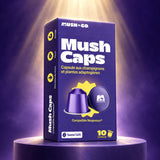
If you have a capsule machine, our guide to the Nespresso®-compatible chicory capsule explains how to choose one. And if you want to go further than a simple blend, Brainstoorm starts from a base of roasted chicory and cacao, with 20 mg of caffeine per cup and mushrooms at 1,000 mg each. Several customers mention its taste first.
“I love your coffee with that little hint of chicory, I'm hooked now.”
★★★★★ Didier P. · 28 August 2026
“The coffee is really good, a bit different from traditional coffee, it has a very mild little roasted taste […]”
★★★★★ Nancy D. · 31 August 2026
Trustpilot reviews published about Brainstoorm, quoted as written.
Who it's for
A chicory coffee blend is for you if…
- You want to cut down on coffee without giving it up or changing your morning habits.
- You get palpitations, jitters or clammy hands after your second coffee.
- You still drink a coffee after 2pm, and you sleep less well than you would like.
- Coffee irritates your stomach or speeds up your gut too much, and you want to drink less of it.
- You are coming off caffeine and looking for a cup with a similar taste, with little or no caffeine.
- You simply love that rounded, toasted taste, the one from childhood breakfasts.
For sleep, the reasoning is simple: pure chicory or a very chicory-heavy blend lets you keep a hot drink in the afternoon without delaying sleep. Our article coffee and sleep: what time to stop caffeine helps you set your cut-off time.
For cutting down gradually, chicory is the ideal tool: reducing the share of coffee by 10% a week avoids withdrawal headaches. Our guide caffeine withdrawal: symptoms, how long it lasts and how to stop gently explains this method. And on the digestion side, the article coffee and diarrhoea explains why coffee sends you to the toilet.
Precautions
A safe root, with a few exceptions.
Roasted chicory has been consumed in Europe for more than two centuries, and it poses no problem for the vast majority of people at one or two cups a day. A few situations do, however, call for caution.
Be careful with chicory, or ask for advice, if:
- You are allergic to plants in the daisy family, such as ragweed, mugwort or chamomile: cross-reactions are possible.
- You have irritable bowel syndrome or follow a low-FODMAP diet: inulin is a fructan, which can cause bloating.
- You have gallstones: chicory is traditionally said to stimulate bile flow, so talk to your doctor.
- You are pregnant or breastfeeding: pure chicory is a caffeine-free alternative, but stick to usual amounts and keep coffee below 200 mg of caffeine a day, as EFSA recommends.
A word on acrylamide, which is often mentioned: this substance forms during roasting, in coffee as in chicory, and chicory often contains more of it. The European Union has set benchmark levels for both products, which manufacturers must monitor. At one or two cups a day, there is no reason to worry, but it is one more argument for varying your drinks.
If coffee makes you bloated, chicory can do the same in some people, because of its inulin. Our article coffee and bloating helps you work out which is which.
Your questions
Chicory coffee: your questions.
Why mix coffee and chicory?
To drink less caffeine without changing your routine or giving up the taste of coffee. Roasted chicory contains no caffeine: every share of coffee it replaces removes the same share of caffeine. It also brings a rounded bitterness that softens the cup.
How much chicory should you put in coffee?
70/30, meaning 70% coffee and 30% chicory, is the best starting point: the taste changes little and caffeine falls by about 30%. To halve the caffeine, move to 50/50. Beyond that, chicory dominates the taste.
Does chicory contain caffeine?
No. Roasted chicory, whether granules or instant, contains no caffeine. Only coffee and chicory blends contain any, in proportion to the coffee they include.
Does chicory reduce the effects of coffee?
Not if you keep the same amount of coffee. Chicory does not neutralise the caffeine in the cup. It only reduces your intake if it replaces part of the coffee.
Can you drink chicory every day?
Yes, for most people, at one to a few cups a day. People who are allergic to plants in the daisy family, prone to bloating or who have gallstones should be more careful and ask for advice.
How do you make chicory coffee?
Replace part of the ground coffee with roasted chicory granules, for example 10 g of coffee and 5 g of chicory for a mug, then brew as usual. With instant, mix one spoonful of each in a cup of hot water.
Is chicory better for the stomach than coffee?
It contains no caffeine and many people find it gentler. Replacing part of the coffee with chicory therefore reduces what irritates some people. On the other hand, its inulin can cause bloating in people with a sensitive gut.
Can you drink chicory in the evening?
Yes. With no caffeine, pure chicory does not get in the way of falling asleep. A coffee and chicory blend, however, still contains caffeine and is best drunk before mid-afternoon.
Is chicory safe during pregnancy?
Pure chicory is a common alternative to coffee during pregnancy, since it contains no caffeine. Stick to usual amounts and ask your midwife or doctor for advice if in doubt.
Sources
- Nishimura M., Ohkawara T., Kanayama T. et al. (2015). Effects of the extract from roasted chicory (Cichorium intybus L.) root containing inulin-type fructans on blood glucose, lipid metabolism, and fecal properties. Journal of Traditional and Complementary Medicine, 5(3), 161-167.
- Schumacher E., Vigh É., Molnár V. et al. (2011). Thrombosis preventive potential of chicory coffee consumption: a clinical study. Phytotherapy Research, 25(5), 744-748.
- Micka A., Siepelmeyer A., Holz A., Theis S., Schön C. (2017). Effect of consumption of chicory inulin on bowel function in healthy subjects with constipation: a randomized, double-blind, placebo-controlled trial. International Journal of Food Sciences and Nutrition, 68(1), 82-89.
- EFSA NDA Panel (2015). Scientific opinion on the safety of caffeine. EFSA Journal, 13(5):4102.
- Commission Regulation (EU) 2017/2158 of 20 November 2017 establishing mitigation measures and benchmark levels for the reduction of the presence of acrylamide in food. Official Journal of the European Union, L 304.
Keep reading
Further reading.
Chicory is just one of the ways to drink less caffeine. Discover our other guides, or our page devoted to the root.

Discover our mushroom and adaptogenic plant supplements
Our vegan formulas, made in Toulouse by a French manufacturer.