




How many cups of coffee a day? The caffeine dose
Par Rédaction Mush n Go - 22 September 2026

Coffee
How many cups of coffee a day? The caffeine dose
By the Mush n Go editorial teamUpdated 24 September 202614 min read
Coffee and caffeine
How many cups of coffee a day? For a healthy adult, the European Food Safety Authority (EFSA) sets the reference at 400 mg of caffeine a day — about four or five espressos — and no more than 200 mg at once. Pregnant or breastfeeding, the ceiling drops to 200 mg a day. Beyond the dose, the hour counts too.

Brainstoorm
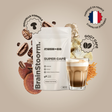
Our mushroom coffee: 6,040 mg of actives per cup, including lion's mane, cordyceps and chaga at 1,000 mg each, and only 20 mg of NewCaff® caffeine. With no mushroom taste at all.
Discover Brainstoorm →
BrainPower Pack
Focus and Energy in capsules, caffeine-free, plus a Brainstoorm. Enough to replace some of your coffees without giving up the morning cup.
Discover the pack →The answer in cups
400 mg of caffeine — how many coffees is that?
Talking in cups misleads: a short espresso, a mug of filter coffee and a pod do not deliver the same dose. That is why health authorities reason in milligrams of caffeine, not in numbers of coffees.
The good news is that the conversion is simple once you have the right reference points. Here is what EFSA's 400 mg represents using the average values it publishes itself.
| Your coffee | Caffeine per cup | 400 mg is about |
|---|---|---|
| Espresso (60 ml) | 80 mg | 5 espressos |
| Filter coffee (200 ml) | 90 mg | 4 or 5 cups |
| Large mug of filter (400 ml) | About 180 mg | 2 mugs |
| Decaf coffee | A few milligrams | No practical limit from caffeine |
| Brainstoorm | 20 mg | Well beyond normal consumption |
These are average values. The real content varies with the variety (a robusta carries around twice the caffeine of an arabica), the grind, the brewing method and the amount of coffee used.
Keep the order of magnitude: for most adults, three to four coffees a day, spread between morning and early afternoon, sit comfortably within the reference points. Five espressos is the upper limit. Two large, well-loaded mugs of filter can already reach it.
The official reference points
What EFSA concluded about caffeine.
In 2015, the European Food Safety Authority published a reference opinion on the safety of caffeine, covering all its sources: coffee, tea, soft drinks, energy drinks, chocolate and supplements. Its conclusions remain the reference in Europe today.
Healthy adults
Up to 400 mg of caffeine a day, spread across the day, does not raise a safety concern. A single dose of up to 200 mg — about 3 mg per kilo for a 70 kg adult — does not either.
Pregnancy and breastfeeding
Up to 200 mg a day does not raise a safety concern for the foetus or the breastfed infant. Above that, caution is advised.
Children and adolescents
The reference is 3 mg per kilo of body weight per day. For a 50 kg teenager that is 150 mg, less than two espressos.
Sleep
A dose of about 100 mg — 1.4 mg per kilo — taken late in the day can lengthen time to fall asleep and shorten sleep in some adults.
Two important caveats. First, these reference points are for healthy people: a heart rhythm disorder, marked anxiety or certain medications justify asking your doctor. Second, EFSA is talking about all the caffeine in your day, not just the coffee.
Hidden caffeine
Coffee is not the only source.
Many people count their coffees and forget everything else. But the office tea, the soft drink at lunch, the square of chocolate and the afternoon energy drink all add up. Here are EFSA's reference values for the most common sources.
| Source | Serving | Caffeine |
|---|---|---|
| Filter coffee | 200 ml | 90 mg |
| Espresso | 60 ml | 80 mg |
| Energy drink | 250 ml | 80 mg |
| Tea | 220 ml | 50 mg |
| Cola | 355 ml | 40 mg |
| Dark chocolate | 50 g | 25 mg |
| Brainstoorm Coffee or Choco-hazelnut | 1 cup | 20 mg |
| Milk chocolate | 50 g | 10 mg |
Think about supplements too: some fat burners, pre-workouts or "energy" capsules contain caffeine, sometimes in substantial amounts, under the names anhydrous caffeine, guarana, maté or green tea extract. Read the label. Our Energy formula, for instance, contains none: it combines cordyceps, maca, ginger and vitamin C.
Work out your total
Do the sums in three minutes.
The simplest approach is to write down a typical day, changing nothing. You may be surprised either way: some heavy coffee drinkers stay under 400 mg, while "moderate" drinkers brush against it because of hidden sources.
Note everything
Every coffee, tea, soft drink, energy drink and square of chocolate in the day, with the time.
Convert
Use the reference points in the table. A mug counts double, a double espresso too.
Look at the times
Beyond the total, spot everything you drink in the six hours before bed.
A concrete example: a large filter coffee on waking (about 180 mg), an espresso at 10 am (80 mg), a soft drink at lunch (40 mg), a tea at 4 pm (50 mg). Total: 350 mg. That is within the reference points, but the 4 pm tea falls inside the sensitive window for sleep if you go to bed around 10 pm.
The same day with a cup of Brainstoorm instead of the espresso, and a herbal tea instead of the tea: 240 mg. Two changes are enough to shift the total clearly, without cutting the morning coffee.
What caffeine does
Why coffee wakes you up, then tires you out.
Caffeine works mainly by blocking adenosine, a molecule that builds up in the brain over waking hours and drives the urge to sleep. Caffeine takes its place on the receptors without activating them: the feeling of tiredness recedes.
It is absorbed quickly, with a blood peak generally 30 to 60 minutes after the cup. The body then clears it slowly: its half-life, the time needed to eliminate half of it, is around five hours in an adult, with enormous differences from one person to another.
The flip side is tolerance. When you drink coffee every day, the brain adapts, among other things by multiplying its adenosine receptors. It then takes more caffeine for the same effect, and its absence is felt: that is the mechanism behind the headache and the tiredness when you skip the morning coffee.
0 to 60 min
Caffeine passes into the blood. The effect is felt, the peak is reached.
About 5 h
Half the caffeine is still present, on average. In some people, considerably more.
About 10 h
A quarter is still there. A 2 pm coffee is still doing something at bedtime.
The next day
In a habitual drinker, the lack is felt on waking, and the first cup mostly serves to make up for it.
The famous afternoon slump is not necessarily caused by coffee, but it is often amplified by a high morning dose followed by a trough as it wears off.
Why we are not equal
In the face of caffeine, we are not all equal.
Two people can drink the same amount of coffee to very different effect. It is not just a matter of willpower or habit: several factors change the speed at which the body clears caffeine.
Genetics. Caffeine is largely cleared by a liver enzyme, CYP1A2. Depending on the variants of its gene, some people metabolise caffeine fast and others slowly. A study published in JAMA in 2006 (Cornelis et al.) observed that in slow metabolisers, high coffee consumption was associated with a greater risk of heart attack, which was not the case in fast metabolisers.
Pregnancy
Caffeine clearance slows markedly, above all late in pregnancy. Hence the 200 mg a day reference.
Oral contraception
The pill also slows caffeine clearance. An afternoon coffee can act for longer.
Smoking
Smoking speeds up caffeine clearance. On quitting, the same dose of coffee can suddenly seem far stronger.
Medication
Some medicines interfere with CYP1A2. If you are on long-term treatment, ask your pharmacist.
So there is no universal right amount. EFSA's 400 mg is a ceiling for the general population, not a target. Your right dose is the one that lets you sleep, stay calm, and go without a coffee with no headache.
The hour of the last coffee
What time should you stop drinking coffee?
For sleep, the hour of the last coffee counts almost as much as the amount. One American study is often cited on this point: Drake and colleagues gave 400 mg of caffeine to volunteers at bedtime, three hours or six hours before. Even taken six hours before bed, caffeine cut sleep by more than an hour, measured with a device at home.
The dose tested was high, the equivalent of four or five coffees at once. But the message holds for lower doses in sensitive people: caffeine's effect lasts far longer than you notice.
| You go to bed around | Last coffee before | After that |
|---|---|---|
| 10 pm | 4 pm at the latest, 2 pm if you are sensitive | Decaf, chicory, herbal tea |
| 11 pm | 5 pm at the latest, 3 pm if you are sensitive | Decaf, chicory, herbal tea |
| Midnight | 6 pm at the latest, 4 pm if you are sensitive | Decaf, chicory, herbal tea |
If you fancy a hot drink late in the afternoon, a cup of Brainstoorm brings 20 mg of caffeine, four times less than an espresso. For difficult nights, read our file on mushrooms and sleep, and discover Sleep +, our evening formula.
The signs of excess
You may be drinking too much coffee if…
The body sends fairly clear signals when caffeine goes past what it tolerates. None is serious in itself, but their accumulation is reason to review your intake, even if you are under 400 mg.
- Your hands shake, your heart races or you feel palpitations after the second or third cup.
- You feel edgy, irritable or anxious, especially mid-morning.
- You take a long time to fall asleep, or wake in the night for no reason.
- You get heartburn or digestive discomfort after coffee.
- You get a headache on the days you drink less.
- You need more coffee than before for the same effect.
When caffeine becomes dangerous:
- Serious poisonings almost never come from coffee, but from concentrated caffeine: pure caffeine powders, tablets, energy drink abuse.
- Do not mix energy drinks with intense exertion or with alcohol in quantity.
- Strong palpitations, chest pain or a blackout after taking caffeine are reason to call the emergency services.
- With a heart disorder, uncontrolled high blood pressure, significant anxiety or pregnancy, ask your doctor what dose suits you.
What the research says
Three or four coffees a day: what the studies say.
Coffee had a bad press for a long time. Large observational studies have nuanced that picture.
Poole et al., 2017 · BMJ
A broad synthesis bringing together more than 200 meta-analyses on coffee and health. Conclusion: at usual doses, coffee is more often associated with a benefit than a risk, and the most favourable associations appeared around three or four cups a day, above all for all-cause mortality. Two exceptions flagged: pregnancy, and a slightly higher fracture risk in women.
Drake et al., 2013 · United States
400 mg of caffeine taken six hours before bed still cuts sleep by more than an hour, measured with a device at home. The dose was high, but the message holds for smaller doses in sensitive people.
Cornelis et al., 2006 · JAMA
Depending on CYP1A2 gene variants, some people metabolise caffeine fast and others slowly. In slow metabolisers, high coffee consumption was associated with a greater risk of heart attack.
How to read these results
They are associations, not proof of cause and effect: coffee drinkers differ from non-drinkers in many other ways. They are no reason to start drinking coffee, or to drink more. They simply reassure those who drink it in moderation.
Another useful point: some of those associations are also found with decaffeinated coffee. Which suggests caffeine is not the only compound at play, and that you can cut caffeine without giving up the pleasure of the cup. References at the bottom of the page.
Drinking less without suffering
Cutting the caffeine, without giving up the cup.
If you are over your reference points, or if your nights demand it, there is no need to stop dead: the withdrawal headache puts most people off within two days. Better to substitute, one cup at a time.
Keep the first one
The morning coffee is the one that counts most for most people. Start with the afternoon cups.
Swap one cup
For a decaf, a chicory or a 20 mg Brainstoorm. Same gesture, same warmth, far less caffeine.
Hold for a week
Let your body settle before swapping a second cup. The progression counts more than the speed.
Brainstoorm was designed for that role. One cup brings 6,040 mg of actives: lion's mane, cordyceps and chaga at 1,000 mg each, 3,000 mg of maca, ashwagandha, on a chicory base, with 20 mg of microencapsulated NewCaff® caffeine. You can drink three a day and stay below the dose of a single espresso. The principle is set out in our file on mushroom coffee, and decaf in decaffeinated coffee.
« What I appreciate most is the steadier energy it gives: no jitters, no crash »
★★★★★ Nawel F. · 7 January 2026
« Very good product; in my case the afternoon slump has gone »
★★★★★ Franck C. · 6 September 2026
Everyone is different: these reviews describe our customers' experience, translated from French without editing, not a guaranteed result. The whole range is under mushroom coffee.
By profile
Your caffeine routine, profile by profile.
The right amount of coffee also depends on what you expect from it. Here are three typical routines, all below EFSA's reference points.
| Profile | Suggested routine | Total caffeine |
|---|---|---|
| Big fan who sleeps badly | A coffee on waking, a Brainstoorm around 11 am, nothing caffeinated after 2 pm | About 100 to 110 mg |
| Heavy work days | Two coffees in the morning, Focus at breakfast, a Brainstoorm in the early afternoon | About 180 to 200 mg |
| Athlete | A coffee before training, Energy at breakfast, no energy drinks | About 80 to 90 mg |
Focus and Energy contain no caffeine. The BrainPower Pack brings them together with a Brainstoorm. The cordyceps in Energy is presented on our Cordyceps page.
Your questions
Everything you ask us about how many coffees a day.
How many coffees a day at most?
For a healthy adult, EFSA sets the reference at 400 mg of caffeine a day, about four or five espressos or four 200 ml cups of filter coffee. No more than 200 mg in a single dose.
How much caffeine a day during pregnancy?
200 mg a day at most during pregnancy and breastfeeding, according to EFSA — about two espressos, counting every source of caffeine. Ask your midwife or doctor.
How much caffeine is in a coffee?
About 80 mg in a 60 ml espresso and 90 mg in a 200 ml cup of filter coffee, using EFSA's values. The real content varies with the variety, the grind and the brewing.
Is 5 coffees a day bad?
Five espressos is about 400 mg of caffeine, the upper limit for a healthy adult. Not dangerous in itself, but if you sleep badly, feel edgy or get palpitations, that is a sign to cut back.
What dose of caffeine is dangerous?
Adverse effects such as jitteriness, insomnia or palpitations appear in many people above EFSA's reference points. Serious poisonings mainly involve concentrated caffeine, in powder or tablets, not coffee.
What time should you stop drinking coffee?
Ideally six hours before bed, or eight if you are sensitive. One study showed that a high dose of caffeine taken six hours before still cut sleep by more than an hour.
Does decaf count towards the 400 mg?
Barely. A cup of decaf contains a few milligrams of caffeine, against 80 or 90 mg for an ordinary coffee. Even several decafs a day weigh very little in the total.
How much caffeine for a teenager?
EFSA uses 3 mg per kilo of body weight per day for children and adolescents. For a 50 kg teenager that is 150 mg, less than two espressos, energy drinks included.
How much caffeine is in a cup of Brainstoorm?
20 mg of microencapsulated NewCaff® caffeine per cup, in both the Coffee and Choco-hazelnut versions. That is four times less than an espresso, for 6,040 mg of actives per cup in the Coffee version.
Sources
The references cited in this article.
- EFSA NDA Panel (2015). Scientific opinion on the safety of caffeine. EFSA Journal, 13(5):4102.
- Poole R., Kennedy O. J., Roderick P., Fallowfield J. A., Hayes P. C., Parkes J. (2017). Coffee consumption and health: umbrella review of meta-analyses of multiple health outcomes. BMJ, 359:j5024.
- Drake C., Roehrs T., Shambroom J., Roth T. (2013). Caffeine effects on sleep taken 0, 3, or 6 hours before going to bed. Journal of Clinical Sleep Medicine, 9(11).
- Cornelis M. C., El-Sohemy A., Kabagambe E. K., Campos H. (2006). Coffee, CYP1A2 genotype, and risk of myocardial infarction. JAMA, 295(10).
To go further
What to read next.

Découvrez nos compléments aux champignons et plantes adaptogènes
Nos formules vegan, aux recettes façonnées à Toulouse par un façonnier français.


