




















Caffeine: How Long It Lasts, How Much Is Safe and Its Effects
By the Mush n Go editorial team - 09 November 2026
By the Mush n Go editorial teamPublished 9 November 202614 min read
Caffeine
Caffeine kicks in 30 to 60 minutes after your cup and stays in the blood for a long time: its half-life is about five hours, ranging from two to more than eight depending on the person. EFSA sets the benchmark at 400 mg a day for an adult, 200 mg in a single dose. An espresso contains about 80 mg.
The complete guide: mushroom coffee, benefits and side effects →

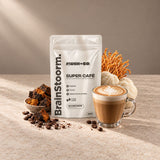
Brainstoorm
20 mg of microencapsulated caffeine instead of 80, in a low-acid chicory and cacao base, with 6,040 mg of active ingredients per cup.
Discover Brainstoorm →
Energy
Cordyceps, maca, ginger and vitamin C in capsules, without a drop of caffeine. Vitamin C contributes to the reduction of tiredness and fatigue.
Discover Energy →How caffeine works
Caffeine does not create energy, it blocks the tiredness signal.
Caffeine, or 1,3,7-trimethylxanthine, is a molecule made naturally by the coffee plant, the tea plant, the cacao tree, guarana and maté to defend themselves against insects. In humans, it is almost entirely absorbed by the gut and passes easily into the brain.
There, it takes the place of adenosine, a molecule that builds up during the day and signals tiredness. Caffeine binds to its receptors, called A1 and A2A, without activating them. The message “time to slow down” is no longer received. The result: more alertness, a shorter reaction time, and effort that feels less hard.
- It does not replace sleep: the need to sleep is still there, just masked.
- It also stimulates the release of adrenaline, which is why some people's hearts race.
- It increases movement in the colon, which explains the trip to the loo after your morning coffee.
- It has a mild diuretic effect, offset by the water in the drink in regular drinkers.
When caffeine is cleared, the built-up adenosine hits you all at once: that is the slump that makes you reach for another cup. Our article on the 4pm slump explains this mechanism and how to get out of it.
How long it lasts
How long caffeine lasts: a peak within an hour, a tail of ten.
Caffeine enters the blood within minutes. Its concentration peaks between 30 and 60 minutes after your cup on average, sometimes up to two hours if you have eaten. Then the liver clears it slowly: it takes about five hours to eliminate half of it. That is what is called the half-life.
| After the cup | What happens | Of an 80 mg espresso, about this much remains |
|---|---|---|
| 10 to 15 min | First effects felt | Caffeine reaches the blood |
| 30 to 60 min | Peak concentration, maximum alertness | 80 mg |
| 5 h | The stimulant effect fades, the slump is lurking | 40 mg |
| 10 h | Barely noticeable effect, but still active on sleep | 20 mg |
| 15 h | Almost cleared | 10 mg |
Simplified calculation for a half-life of five hours. In a slow metaboliser, the remaining amounts are higher; if you drink several coffees, they add up.
That is why a 4pm coffee is still there at 11pm: a little under half of it remains. Even if you fall asleep, your deep sleep can suffer. Our guide to coffee and sleep works out the cut-off time based on when you go to bed.
Slow and fast metabolisers
A half-life of two to eight hours: we are not all equal.
About 95% of caffeine is processed by a single liver enzyme, CYP1A2. Depending on a variation in its gene, some people clear it quickly, others slowly. Other factors speed up or slow down this work, sometimes dramatically.
What slows it down
Pregnancy (up to 15 hours of half-life in the third trimester), the contraceptive pill, some liver diseases, and medicines such as fluvoxamine or certain antibiotics in the quinolone family.
What speeds it up
Smoking, which stimulates CYP1A2 and roughly halves the half-life. Smokers who quit often find their usual coffee suddenly too strong.
Brain sensitivity
Regardless of clearance, a variation in the A2A receptor gene makes some people more prone to anxiety after a coffee.
Age
Older people are often more sensitive to the effects on sleep. Children clear caffeine differently and have their own benchmark.
You do not need a genetic test to know where you stand. If a coffee at lunchtime stops you sleeping, or if a single cup makes you jittery, you are probably on the sensitive side. Our article on coffee and anxiety explains the signs to look out for.
What the studies say
Caffeine: four studies that change how you drink your coffee.
Here are four landmark studies, with their exact conditions. Full references are at the bottom of the page.
Cornelis et al., 2006 · Costa Rica
2,014 people who had had a heart attack, compared with 2,014 controls. In slow caffeine metabolisers, drinking 2 to 3 cups or more a day was associated with a higher risk of heart attack. In fast metabolisers, it was not. Limitation: an observational study, which shows an association and not a cause.
Childs et al., 2008 · United States
Around a hundred healthy adults were given caffeine doses of up to 450 mg, or a placebo. Carriers of a variant of the A2A receptor gene reported more anxiety after caffeine. Limitation: effect measured in the laboratory, on single doses.
Drake et al., 2013 · United States
12 adults who slept well were given 400 mg of caffeine at bedtime, 3 hours or 6 hours before. Even six hours before, caffeine shortened the night by more than an hour, without participants always noticing. Limitation: small sample, high dose.
Juliano and Griffiths, 2004 · United States
This review pooled the experimental studies on withdrawal. Symptoms appear 12 to 24 hours after the last dose, peak between 20 and 51 hours and last 2 to 9 days. Headache is the most common. A habitual intake of 100 mg a day is enough to feel them.
Remember three things: caffeine stays active much longer than you feel it, everyone tolerates it differently, and the body gets so used to it that it starts to demand it.
Mg per drink
How much caffeine is in an espresso, a tea or a cola?
The amount of caffeine depends on the drink, the serving and the preparation. An espresso is concentrated but small; a mug of filter coffee often contains more. Here are the benchmarks published by EFSA, supplemented for the drinks it does not detail.
| Drink or food | Serving | Caffeine, approx. |
|---|---|---|
| Filter coffee | 200 ml | 90 mg |
| Espresso | 60 ml | 80 mg |
| Energy drink | 250 ml | 80 mg |
| Instant coffee | one cup | 60 mg, depending on the amount of powder |
| Black tea | 220 ml | 50 mg |
| Matcha | 1 g of powder | 20 to 40 mg |
| Cola | 355 ml | 40 mg |
| Dark chocolate | 50 g | 25 mg |
| Brainstoorm Coffee or Chocolate hazelnut | 1 cup | 20 mg |
| Decaf coffee | one cup | a few mg |
| Chicory, herbal teas | one cup | 0 mg |
EFSA benchmarks (2015) for filter coffee, espresso, energy drinks, black tea, cola and chocolate. Instant coffee and matcha: orders of magnitude, highly variable between brands. Brainstoorm: dose set by the recipe.
The “theine” in tea is exactly the same molecule as the caffeine in coffee. Tea contains less per cup and its effect seems gentler, partly because it is drunk more diluted. To compare matcha and mushroom coffee on this point, see our article on matcha or mushroom coffee. And if you are looking for a caffeine-free drink with a roasted taste, chicory is the closest to coffee.
200 mg, 400 mg: the benchmarks
What do 200 mg and 400 mg of caffeine look like?
In 2015, the European Food Safety Authority published its reference opinion on caffeine. It concludes that, for a healthy adult, up to 400 mg a day raises no safety concerns. Nor does a single dose of up to 200 mg, or about 3 mg per kilo. During pregnancy and breastfeeding, the benchmark drops to 200 mg a day.
200 mg is
Two and a half espressos, or two cups of filter coffee, or four cups of black tea.
400 mg is
Five espressos, or four to five cups of filter coffee, or a 500 ml mug of filter coffee in the morning and two espressos afterwards.
In the evening
According to EFSA, 100 mg taken close to bedtime can already disturb some adults' sleep: a single espresso after dinner.
Teenagers
For children and teenagers, EFSA uses about 3 mg per kilo per day, or 150 mg for 50 kg.
These benchmarks add up all sources: coffee, tea, fizzy drinks, energy drinks, chocolate and some painkillers. To count it cup by cup, our article on how many cups of coffee a day offers a detailed calculation.
Effects by dose
The effects of caffeine: it is all about the dose.
At low doses, caffeine improves alertness and attention, especially when you are tired. The higher the dose, the more the adverse effects take over. The threshold varies from person to person, but the progression is almost always the same.
| Dose at one time | Effects sought | Possible adverse effects |
|---|---|---|
| 20 to 80 mg | Alertness, attention, less drowsiness | Rare, except in very sensitive people |
| 100 to 200 mg | Concentration, reaction time, endurance | Jitters, needing to urinate, lighter sleep if taken late |
| 200 to 400 mg | Sports performance (3 to 6 mg per kilo) | Anxiety, palpitations, tremors, digestive problems |
| Above 1,000 mg | No additional benefit | Poisoning: vomiting, tachycardia, agitation |
The US FDA states that toxic effects such as seizures can occur with about 1,200 mg taken quickly, which mainly happens with pure caffeine powder or tablets.
For sport, the International Society of Sports Nutrition recommends 3 to 6 mg per kilo, an hour before exercise, to improve endurance. Our article on coffee before a workout explains the method. And if coffee stresses you out instead of helping you concentrate, bear in mind that the timing of your cup matters too, particularly on waking.
Tolerance and withdrawal
The body gets used to it, then it demands it.
When you drink coffee every day, your brain makes more adenosine receptors to compensate. The same cup has less effect: that is tolerance. It sets in within a few days for some effects, such as the rise in blood pressure or the buzz, and explains why the first coffee of the morning mostly serves to get you back to normal.
If you stop abruptly, these extra receptors are left with no caffeine to block them. Here is how a typical withdrawal unfolds, according to the review by Juliano and Griffiths.
12 to 24 hours
First symptoms: headache, tiredness, reduced alertness, low mood.
20 to 51 hours
The peak. The headache is often at its worst, sometimes with difficulty concentrating and flu-like symptoms.
2 to 9 days
Symptoms gradually fade. Sleep often improves from the first week.
To avoid this difficult phase, simply cut down gradually, for example by a quarter of the dose each week, or replace every other cup with a low-caffeine drink. Our guide to caffeine withdrawal offers a three-week plan.
Who should be careful
Situations where caffeine calls for caution.
For most adults, caffeine is safe at usual doses. Some situations, however, justify cutting down, or talking to a health professional.
Cut down on caffeine, or ask your doctor, if:
- You are pregnant or breastfeeding: 200 mg a day at most according to EFSA, from all sources combined.
- You have heart rhythm problems, poorly controlled high blood pressure, anxiety or panic disorder.
- You have gastro-oesophageal reflux or an ulcer: coffee can make the symptoms worse.
- You take a medicine that slows down caffeine clearance, such as fluvoxamine, or a theophylline-based treatment.
- You sleep badly: start by cutting out caffeine after 2pm.
- For children and teenagers, avoid energy drinks.
Regular caffeine consumption is not an addiction in the medical sense, but it does create real physical dependence, as the withdrawal symptoms show. That is not serious in itself; it is just better to know before stopping everything overnight.
Finding your dose
Finding your right caffeine dose, in three steps.
There is no universal ideal dose. The right one is the one that helps you in the morning without making you jittery, and that leaves your nights alone. Here is a simple method to find it.
Count
For three days, note down every caffeinated drink and the time. Use the table above to estimate the milligrams.
Shift
Keep caffeine for the morning and early afternoon. After that, switch to a low-caffeine or caffeine-free drink.
Lighten
If you go over 400 mg or feel jittery, replace every other cup with a lighter version.
That is the idea behind our Brainstoorm: keeping the ritual and the roasted taste, with 20 mg of microencapsulated caffeine per cup, four times less than an espresso, on a base of chicory and cacao. For those who want to stop completely, our Energy capsules are caffeine-free. All our drinks are gathered in our mushroom coffee collection.
“I was sceptical and in the end I'm won over. Less caffeine and yet I'm full of energy and my mood is steady”
★★★★★ Maïté S. · 4 April 2026
“I particularly appreciate the steadier energy it gives: no jitters and no slump.”
★★★★★ Nawel F. · 7 January 2026
Real Trustpilot reviews of Brainstoorm, quoted as written.
Your questions
Caffeine: your questions.
How long does caffeine last?
Effects appear within 10 to 15 minutes and peak between 30 and 60 minutes. The half-life of caffeine is about five hours in adults: half a coffee is still in your blood five hours later, a quarter after ten hours. In slow metabolisers, it takes longer.
How much caffeine is in an espresso?
About 80 mg for a 60 ml espresso, according to EFSA benchmarks. The actual content varies with the coffee, the grind and the length of the shot: a ristretto contains a little less, a double espresso twice as much.
How much is 200 mg of caffeine?
About two and a half espressos, or two 200 ml cups of filter coffee. It is the maximum single dose considered safe by EFSA for an adult, and the daily benchmark during pregnancy.
How many coffees is 400 mg of caffeine?
About five espressos or four to five cups of filter coffee. It is EFSA's daily benchmark for a healthy adult, from all sources combined: tea, fizzy drinks and chocolate included.
What does caffeine do to your body?
It increases alertness and attention, speeds up the heart slightly, stimulates the colon and has a mild diuretic effect. At high doses, it can cause jitters, palpitations, digestive problems and insomnia. The effects depend a great deal on the dose and on each person's sensitivity.
How long does caffeine withdrawal last?
Symptoms start 12 to 24 hours after the last cup, peak between 20 and 51 hours and last 2 to 9 days. Headache is the most common. Cutting down gradually over two or three weeks largely avoids them.
Why does caffeine no longer have any effect on me?
Because your brain has adapted: when you drink coffee every day, it makes more adenosine receptors. The same dose then has less effect. A break or a reduction for a few weeks partly restores sensitivity.
Is caffeine dangerous?
Not at usual doses in healthy adults. The risks appear with high doses, especially pure caffeine powder or tablets: the FDA reports possible seizures at around 1,200 mg taken quickly. Pregnant women and people with heart problems or anxiety should limit their intake.
Are theine and caffeine the same thing?
Yes, it is exactly the same molecule. Tea simply contains less per cup than coffee, about 50 mg for a black tea. Its effect seems gentler partly because it is drunk more diluted.
Can you have caffeine in the evening?
It is best avoided in the 8 to 9 hours before bedtime. According to EFSA, 100 mg close to bedtime can already disturb some adults' sleep. In the evening, choose decaf, chicory or a herbal tea.
Sources
- EFSA NDA Panel (2015). Scientific opinion on the safety of caffeine. EFSA Journal, 13(5):4102.
- Nehlig A. (2018). Interindividual differences in caffeine metabolism and factors driving caffeine consumption. Pharmacological Reviews, 70(2).
- Cornelis M. C., El-Sohemy A., Kabagambe E. K., Campos H. (2006). Coffee, CYP1A2 genotype, and risk of myocardial infarction. JAMA, 295(10).
- Childs E., Hohoff C., Deckert J., Xu K., Badner J., de Wit H. (2008). Association between ADORA2A and DRD2 polymorphisms and caffeine-induced anxiety. Neuropsychopharmacology, 33(12).
- Drake C., Roehrs T., Shambroom J., Roth T. (2013). Caffeine effects on sleep taken 0, 3, or 6 hours before going to bed. Journal of Clinical Sleep Medicine, 9(11).
- Juliano L. M., Griffiths R. R. (2004). A critical review of caffeine withdrawal: empirical validation of symptoms and signs, incidence, severity, and associated features. Psychopharmacology, 176(1).
- Guest N. S. et al. (2021). International Society of Sports Nutrition position stand: caffeine and exercise performance. Journal of the International Society of Sports Nutrition, 18(1).
- U.S. Food and Drug Administration. Spilling the beans: how much caffeine is too much? Consumer page, fda.gov.
Keep reading
Further reading.
Caffeine affects sleep, stress and digestion. Our other guides cover each of these, and our Brainstoorm helps you lighten the dose.

Discover our mushroom and adaptogenic plant supplements
Our vegan formulas, made in Toulouse by a French manufacturer.