







Low-caffeine Nespresso capsules: decaf, chicory or mushroom coffee?
By the Mush n Go editorial team - 17 October 2026
By the Mush n Go editorial teamPublished 17 October 202615 min read
Capsules and caffeine
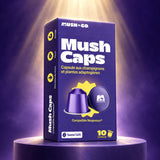
For a low-caffeine Nespresso® capsule, you have three options. A decaf capsule keeps the taste of coffee with a few milligrams of caffeine at most. Chicory has none at all. Mushroom coffee, such as Mush Caps, provides 17 mg, compared with about 80 mg in a classic espresso. Here is the full comparison.

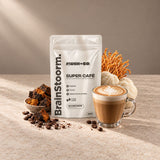
Brainstoorm
The Mush Caps recipe as a powder: lion's mane, cordyceps and chaga at 1,000 mg each, 3,000 mg of maca, ashwagandha and chicory, with 20 mg of NewCaff® caffeine per cup.
Discover Brainstoorm →
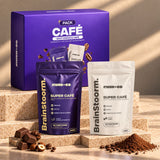
Coffee Pack
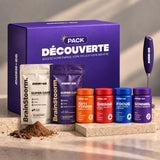
Brainstoorm Coffee and Brainstoorm Chocolate-Hazelnut together: one bag for the morning, one for the afternoon, always with 20 mg of caffeine per cup and no mushroom taste.
Discover the pack →Why cut down
Keep the capsule, lower the caffeine.
The capsule machine is part of the morning, the office, the end of a meal. You do not necessarily want to give it up. What you want to change is what is in the cup: less caffeine, without losing the pleasure of coffee.
The reasons are often the same. Sleep that suffers when the last coffee is too late. Palpitations, jitters or a stomach that complains after the third cup. Pregnancy, during which health authorities advise cutting down. Or simply wanting to stop relying on a cup to get the day going.
The good news: between a classic espresso and a caffeine-free chicory drink, there is a whole range of capsules. The key is knowing what each one really contains, because the box does not always say.
If you are looking more broadly at what to drink instead of coffee, our guide covers the alternatives, in capsules or not. Here, we stick with the machine you already have.
Caffeine benchmarks
How much caffeine is a lot?
Before comparing capsules, you need a reference point. The most solid one in Europe is the opinion of the European Food Safety Authority (EFSA), published in 2015 after reviewing all available data.
| Situation | EFSA benchmark | In practice |
|---|---|---|
| Healthy adult, over the day | Up to 400 mg | About five espressos, all sources combined |
| Adult, in a single dose | Up to 200 mg | About two espressos in a row |
| Pregnancy and breastfeeding | Up to 200 mg a day | About two espressos over the day |
| Close to bedtime | 100 mg may be enough | To disturb some adults' sleep |
These benchmarks count all the caffeine in your day: coffee, tea, fizzy drinks, chocolate, energy drinks. Coffee is only part of the total.
The last point is the one most often forgotten. Even well under 400 mg a day, a classic capsule in the late afternoon can be enough to delay falling asleep. Caffeine is cleared slowly: its half-life, the time it takes to clear half of it, is measured in hours in adults.
The classic capsule
What a coffee capsule really contains.
A Nespresso® Original capsule contains a few grams of ground coffee. Once brewed, it gives a cup with a caffeine content close to that of an espresso: about 80 mg according to the EFSA benchmark. But that figure varies, and not always in the way you would expect.
Intensity is not caffeine
The intensity number printed on boxes mainly describes the roast, body and bitterness. A capsule rated 12 is not necessarily higher in caffeine than one rated 6.
Arabica or robusta
This is the real factor. Robusta contains about twice as much caffeine as arabica. A robusta-rich blend therefore weighs more in your day.
Short or long
A lungo runs more water through the same grounds. Extraction is more complete, and the cup often has slightly more caffeine than a ristretto.
The roast
A dark roast does not make coffee higher in caffeine. It changes the taste far more than the content.
Remember this above all: to cut caffeine, switching to a "mild" capsule in a classic range is not enough. You need to switch capsule family. That is what the following table compares.
The comparison
Low-caffeine capsules, side by side.
Four families of Nespresso® Original capsules, from most to least caffeine. The amounts are orders of magnitude, except for Mush Caps, whose dose is set by the recipe.
| Capsule type | Caffeine per cup | Taste | What is inside | Ideal for |
|---|---|---|---|---|
| Classic | About 80 mg | Coffee, from mild to strong | Ground coffee | Your first coffee of the morning, if you tolerate it well |
| Mush Caps mushroom coffee | 17 mg | Short, intense coffee, with crema | Chicory, 3 mushrooms, 2 adaptogenic plants, NewCaff® caffeine | All day, without the spike or the slump |
| Decaf | A few mg at most | Coffee, often a little rounder | Decaffeinated ground coffee | Evenings, pregnancy, the taste of coffee without the effect |
| Chicory or grains | 0 mg | Roasted, bitter, no acidity | Roasted chicory, barley or a grain blend | Zero caffeine, sensitive stomachs |
This table shows something simple: there is no one right capsule, but a right capsule for each moment. Decaf and chicory remove the caffeine. Mushroom coffee cuts it sharply and adds something else to the cup. We go through each family just below.
The decaf capsule
Decaf Nespresso® capsules: almost caffeine-free.
The decaf capsule is the closest to classic coffee. Same bean, same roast, same routine: only the caffeine has been removed from the green coffee, before roasting. It is the first instinct of most coffee lovers who want to cut down.
Almost, not entirely. Decaffeination does not remove 100% of the caffeine. The rules set a ceiling: roasted coffee sold as decaffeinated must not exceed 0.1% caffeine. Do the maths on a 5-gram capsule: at most 5 mg of caffeine in the capsule, and even less in the cup, since extraction only recovers part of it. Analyses published in the United States found small, measurable amounts of caffeine in most of the decaffeinated coffees tested: a long way from an espresso, but not zero.
| Process | How it works | What to know |
|---|---|---|
| Water | The green coffee soaks in water, a filter captures the caffeine, then the aroma-rich water goes back onto the beans | Solvent-free, often highlighted on boxes |
| CO2 | Pressurised carbon dioxide extracts the caffeine selectively | Solvent-free, an expensive industrial process |
| Solvent | An approved solvent dissolves the caffeine, then it is removed by rinsing and heat | The process is not always stated on the packaging |
Taste-wise, decaf is often a little rounder and less sharp than the original coffee, because caffeine contributes to bitterness. If the process matters to you, look for it on the box or ask the brand.
The decaf capsule is the right choice if you want the taste of coffee, just the taste, with nothing else added. It works well for an evening coffee and for times when you want to go as low as possible, such as pregnancy.
Chicory and grains
Zero caffeine, a roasted taste.
If you really want zero milligrams, you have to step away from coffee. Chicory is the best-known option in France: a roasted, bitter root that long served as a coffee substitute and contains no trace of caffeine. Capsules of pure chicory, or of roasted grain blends such as barley, exist in the Original format.
The taste is different, and it is worth being frank about it: the roasted notes and the bitterness, but not the aroma of coffee. The advantage is a drink that is less acidic than coffee, often appreciated by sensitive stomachs.
Watch out for blends. Not all "chicory" capsules are caffeine-free.
- A chicory and coffee blend contains the caffeine from its coffee share, often with no figure on the box.
- Only a capsule of pure chicory, or pure grains, is naturally caffeine-free.
- If the content is not shown, check the ingredients list: the word "coffee" tells you all you need.
Chicory is also the base of our mushroom coffees. It brings the roundness and bitterness of coffee, without its caffeine, and leaves room for the other ingredients. That is the next family.
Mushroom coffee
Less caffeine, more inside.
Mushroom coffee in a capsule starts from a different idea. Instead of taking caffeine out of coffee, the cup is built differently: a base of roasted chicory, mushrooms and adaptogenic plants, and a small dose of caffeine as a top-up. If the subject is new to you, our article what is mushroom coffee? covers the basics.
That is what Mush Caps does, our Nespresso® Original-compatible capsule, available from Friday 2 October. The same recipe as the Brainstoorm Coffee bag, dosed for one cup.
*dried mushroom / dried plant equivalent. Other ingredients: acacia fibre, coffee flavouring. About 10 kcal and 2.1 g of carbohydrate per capsule.
At 17 mg, a Mush Caps capsule provides about five times less caffeine than an espresso. It is not zero, and that is deliberate: caffeine is only a top-up. The cup's energy also relies on cordyceps and maca, and ashwagandha is the plant associated with calm. Our guide to mushrooms and adaptogenic plants presents each species in detail.
So the difference from decaf is what is added. Decaf takes something away from coffee. A mushroom coffee capsule replaces part of the caffeine with other ingredients. To find out all about this format, our guide mushroom coffee Nespresso®-compatible capsule sets out the criteria for choosing.
Microencapsulated caffeine
17 mg, released gradually.
In a cup of classic coffee, the caffeine is free. It passes quickly into the blood and usually peaks within the hour. That is what gives the jolt, and sometimes the jitters when the dose is high.
Microencapsulated caffeine works differently. Each particle is coated so that the caffeine is released gradually, rather than all at once. In Mush Caps, as in Brainstoorm, we use NewCaff® caffeine, at 17 mg per capsule and 20 mg per cup of powder.
A small dose
17 mg, compared with about 80 mg in an espresso. Even several capsules stay well below EFSA's benchmarks.
A gradual release
The coated caffeine is released gradually, for a cup with no sudden spike or quick crash.
Ingredients around it
Cordyceps, maca and ashwagandha go with the caffeine: it is no longer the only thing in the cup.
What our customers describe most often is the end of the famous afternoon slump. These reviews are about Brainstoorm powder, the same recipe as Mush Caps.
"Very good product, for me the afternoon crash has gone"
★★★★★ Franck C. · 6 September 2026
"I was sceptical and in the end I'm won over. Less caffeine and yet I have plenty of energy and a steady mood"
★★★★★ Maïté S. · 4 April 2026
Reviews published on Trustpilot, quoted as written and translated from French. Brainstoorm is rated 4.8/5 on Trustpilot, with more than 50,000 customers.
A capsule for every moment
Which capsule, at what time?
Cutting down on caffeine does not mean changing everything at once. The simplest method is to keep your favourite capsule where it matters and replace the others. Here is a sample day, to adapt to your bedtime.
Morning
Your classic capsule if you tolerate it well, or a Mush Caps to start with 17 mg of caffeine plus the mushrooms.
Mid-morning
Often the second cup, the one out of habit. A low-caffeine capsule does the job very well.
After lunch
The point where a classic capsule starts to weigh on the night. Switch to mushroom coffee or decaf.
Afternoon
Slump time. A cup of Brainstoorm or Brainstoorm Chocolate-Hazelnut, with 20 mg of caffeine, rather than a third espresso.
Evening
Decaf or pure chicory, for the pleasure of a cup with nothing to delay sleep.
If you drink four classic capsules a day today, this plan takes you from about 320 mg of caffeine to under 150 mg, without giving up a single cup. And if sleep is your real concern, our sleep range, with Sleep+, is there for the evening.
A word of caution: if you have been drinking a lot of coffee for a long time, cut down in stages. Stopping abruptly can cause headaches and fatigue for a few days. Replacing one cup at a time, over one or two weeks, avoids most of this.
Reading the box
Five checks before you buy.
In the compatible capsules aisle, promises come fast. "Mild", "light", "intensity 4": none of these words tells you how much caffeine you will drink. Here is what to look for on the packaging.
- The caffeine content, in milligrams per capsule. If it is missing, the ingredients list is your only clue.
- The word "decaffeinated" on a coffee, not "mild" or "light", which only describe the taste.
- The ingredients list: coffee, even in a small share, means caffeine.
- The format: Nespresso® Original or Vertuo, which are not interchangeable.
- The capsule material: aluminium, plastic or compostable, which protect the contents from air more or less well.
For a functional capsule, add a sixth question: are the active ingredients named and dosed? Our guide to the 6 criteria that separate a genuine mushroom coffee from a scam applies to capsules too. And to see every ingredient we use, visit the page of our active ingredients.
Your machine
Original or Vertuo: check first.
"Nespresso®-compatible" does not mean compatible with every machine the brand makes. The vast majority of compatible capsules, whether decaf, chicory or mushroom, are in the Original format, the classic one.
To find out which machine you have, look at the capsule you already use. Small, cone-shaped, with a flat lid: you have an Original. Wide and domed, with a barcode strip around the edge: you have a Vertuo, a separate system that an Original capsule does not fit.

Mush Caps works in all Nespresso® Original and compatible machines, including portable machines in the same format. It does not work in the Vertuo range or in other capsule systems.
Who it suits
Which capsule is right for you?
To finish, a quick way to decide, based on what you are really looking for in your cup.
You want the taste of coffee, nothing else
The decaf capsule. It keeps the coffee aroma and goes as low as possible on caffeine.
You want zero caffeine, truly
Pure chicory or roasted grains. A different taste, but no caffeine.
You want a little energy, without the spike
Mush Caps mushroom coffee: 17 mg of caffeine, with mushrooms and adaptogenic plants.
You do not have a capsule machine
Brainstoorm powder, the same recipe, hot or cold, with water or milk.
And nothing stops you from combining: mushroom coffee in the morning, decaf in the evening. That is often the formula that lasts. To understand why so many people are switching to coffee with mushrooms and adaptogenic plants, read why you might replace your coffee with a mushroom and adaptogenic plant coffee.
Your questions
Low-caffeine Nespresso® capsules: your questions.
How much caffeine is in a decaf Nespresso® capsule?
Very little. Decaffeinated roasted coffee must not exceed 0.1% caffeine, so at most 5 mg in a 5-gram capsule, and even less in the cup. That is a long way from the roughly 80 mg in a classic espresso, but it is not zero.
Are there Nespresso® capsules with no caffeine at all?
Yes, if you step away from coffee: a capsule of pure chicory or roasted grains contains no caffeine. Decaf coffee always keeps a small trace.
Which capsule has the least caffeine?
Pure chicory, at 0 mg. Next comes decaf, at a few milligrams at most, then mushroom coffee such as Mush Caps, at 17 mg, and finally the classic capsule, at around 80 mg.
Does a low-intensity capsule contain less caffeine?
Not necessarily. Intensity mainly describes the roast, body and bitterness. Caffeine content depends above all on the coffee variety: robusta contains about twice as much as arabica.
Is decaf coffee bad for your health?
No, not according to the available data. The approved processes, using water, CO2 or a solvent, are regulated, and any solvent is removed before sale. If the process matters to you, look for it on the box.
Can you drink a decaf capsule in the evening?
Yes, that is actually its most common use. Its very low caffeine content makes it suitable for the evening for the vast majority of people. Very sensitive people may prefer chicory.
How much caffeine is in a Mush Caps capsule?
17 mg of NewCaff® microencapsulated caffeine, released gradually. For comparison, an espresso contains about 80 mg. Mush Caps is available from Friday 2 October.
Does Mush Caps taste of mushrooms?
No. It is a short, intense coffee, with crema, on a base of roasted chicory and coffee flavouring. The mushrooms are in there, but you cannot taste them.
Pregnant: which capsule should I choose?
EFSA recommends not exceeding 200 mg of caffeine a day during pregnancy and breastfeeding. Decaf and pure chicory let you keep the ritual. For supplements and plants, ask your doctor or midwife.
Do low-caffeine capsules work in a Vertuo machine?
Compatible capsules are almost all in the Nespresso® Original format. Mush Caps works in all Original and compatible machines, but not in the Vertuo range.
Sources
- EFSA NDA Panel (2015). Scientific opinion on the safety of caffeine. EFSA Journal, 13(5):4102.
- McCusker R. R., Fuehrlein B., Goldberger B. A., Gold M. S., Cone E. J. (2006). Caffeine content of decaffeinated coffee. Journal of Analytical Toxicology, 30(8).
Keep reading
Go further.
Caffeine is only part of the question. Discover mushroom coffee in detail, or browse our whole range of mushroom coffees.
Nespresso® is a registered trademark of a third party, unconnected to Mush n Go. Mush Caps is a capsule compatible with Nespresso® Original machines, not the Vertuo range.

Discover our mushroom and adaptogenic plant supplements
Our vegan formulas, made in Toulouse by a French manufacturer.