









Mushroom coffee: benefits, side effects and our honest take
By Kevin CANAL - 23 March 2026

Mushrooms
Mushroom coffee
benefits, side effects and our honest take
By the Mush n Go editorial teamUpdated 24 September 202614 min read
Coffee and mushrooms
Mushroom coffee is ordinary coffee with concentrated mushroom extracts added — lion's mane, cordyceps, chaga, reishi — and often less caffeine. At supplement doses there is no known danger for a healthy adult: the caveats concern mushroom allergy, a few drug interactions and, above all, the very variable quality of products. What really changes from one brand to another is the part of the mushroom used and the dose actually present in the cup.

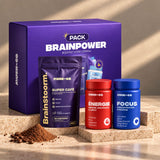
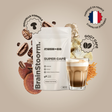
Brainstoorm
Lion's mane, cordyceps and chaga at 1,000 mg each, 3,000 mg of maca, organic cocoa, chicory, ashwagandha — and 20 mg of NewCaff® caffeine per cup.
Discover Brainstoorm →
Brainstoorm Coffee
The same formula in a distinctly coffee-forward version, for those who do not want to give up the taste of their morning cup.
Discover Brainstoorm Coffee →What it really is
Neither a coffee grown on mushrooms, nor a mushroom that tastes like coffee.
Mushroom coffee is a blend: coffee — often speciality arabica — with concentrated extracts of so-called functional mushrooms added. The mushrooms are milled to a very fine powder and mixed into ground or instant coffee. The taste barely moves: an earthy, sometimes umami note that most people do not detect blind.
The idea is nothing new. In Finland during the Second World War, chaga was used as a coffee substitute when coffee ran short. What has changed since are standardised extracts and measured doses.
- It is not a psychoactive mushroom: the species used — lion's mane, cordyceps, chaga, reishi — are edible mushrooms or mushrooms of traditional pharmacopoeia.
- It is not decaf: caffeine is still there, simply often less of it, since the mushrooms take up part of the cup.
- It is not a medicine: it is a food supplement, with no claim to treat anything.
Why the effect is different
Less caffeine at once, and not the same energy curve.
Caffeine blocks adenosine receptors, adenosine being the molecule that builds up through the day and signals fatigue. While they are blocked, you feel awake. When the effect fades, the accumulated adenosine binds all at once: that is the familiar crash, often mid-morning or around 4 pm.
Tolerance adds to this. The body adapts, one cup is no longer enough, then two, then three — and you end up drinking coffee less for pleasure than to avoid withdrawal symptoms. Lowering the caffeine load without dropping the ritual breaks that cycle without going through abrupt withdrawal.
An espresso
80 mg of caffeine delivered in a few minutes. Fast rise, short plateau, marked fall.
A cup of Brainstoorm
20 mg of NewCaff® microencapsulated caffeine, released gradually, in a base that also brings mushroom and plant extracts.
Microencapsulation does not change the amount of caffeine, only the speed at which it is released.
What each mushroom brings
Four species, four reasons to be there.
A serious blend does not put ten mushrooms in the same cup. One to three is enough, provided they are dosed. Here is what each one is there for, and the state of the research on it.
| Species | What is studied | Level of evidence |
|---|---|---|
| Lion's mane Hericium erinaceus |
Cognitive function, working memory | A few randomised trials, small numbers (30 to 80 people) |
| Cordyceps Cordyceps sinensis / militaris |
Oxygen use during exercise, endurance | Controlled trials in small groups, mixed results |
| Chaga Inonotus obliquus |
Polyphenol and beta-glucan content | Mostly in vitro work, few human trials |
| Reishi Ganoderma lucidum |
Perceived sleep quality, perceived fatigue | Documented traditional use, limited clinical trials |
None of these species has an authorised health claim in Europe. We present here what is being studied, not guaranteed effects.
Is there a danger?
The real risk is not the mushroom, it is the product.
The species used have well-documented safety profiles, from centuries of food or traditional use and from modern studies. At supplement doses, the literature reports no serious toxicity. The adverse effects described are digestive and transient: bloating, loose stools, especially when starting at full dose.
Where the gaps are real is manufacturing. Part of the market uses mycelium grown on grain: the mushroom grows on rice or oats, and the final powder mostly contains grain starch. Others state doses so low that the question of an effect does not even arise. Below we explain how to sort them out.
The four precautions
The cases where you should seek advice.
Better to avoid mushroom coffee, or to discuss it with your doctor, if:
- You are allergic to edible mushrooms. Reactions are rare but possible: itching, rash, swelling.
- You take an anticoagulant. Reishi and lion's mane have mild effects on coagulation.
- You have treated diabetes. Cordyceps may influence blood sugar and calls for monitoring.
- You have a history of kidney stones: chaga is rich in oxalates.
- You are pregnant or breastfeeding. Beyond the caffeine — EFSA sets 200 mg a day during pregnancy — the effects of mushrooms and adaptogenic plants are not documented in this situation.
And the simplest precaution: a mushroom coffee is still a coffee. If you are very sensitive to caffeine or your blood pressure is not controlled, the same rules apply as with ordinary coffee — bearing in mind that the load per cup is often far lower.
What the studies say
Three trials, and one safety reference.
Few studies have looked at mushroom coffee as a drink. The species it contains, however, have been tested individually. Here is what is actually documented, with its limits.
Mori et al., 2009 · Japan
Randomised double-blind placebo-controlled trial, 30 adults aged 50 to 80 with mild cognitive impairment. 3 g of Hericium erinaceus a day for 16 weeks: higher scores on a cognitive function scale in the supplemented group. The gap disappears 4 weeks after stopping.
Chen et al., 2010 · United States
20 sedentary adults aged 50 to 75, 3 g a day of a Cordyceps sinensis extract (Cs-4) for 12 weeks. The ventilatory threshold measured during exercise rose by 10.5 % in the treated group, against a fall in the placebo group. Very small numbers.
Nagano et al., 2010 · Japan
30 women, biscuits containing Hericium erinaceus for 4 weeks. Scores on two self-assessment questionnaires were lower than with placebo. Self-reported measures, short duration, small sample.
EFSA, 2015 · European Union
The European Food Safety Authority sets 400 mg of caffeine a day for a healthy adult, and 200 mg in a single intake. That is the equivalent of five espressos a day, or twenty cups of Brainstoorm.
In short: interesting signals in small samples, nothing that allows a promise. Full references at the bottom of the page.
Spotting a good product
Six criteria, and half the market falls away.
- Fruiting body, not mycelium on grain. This is the criterion that separates products most clearly.
- Dual extraction, hot water and alcohol: beta-glucans and triterpenes do not dissolve in the same solvent.
- Dose stated per serving, in milligrams. A blend that only says "mushroom complex" generally hides a low dose.
- At least 500 mg of extracts per serving, all species combined. Below that, the interest is mostly marketing.
- Organic certification on the coffee as on the mushrooms.
- Transparency: origin, analyses, full list. A brand that does not publish its figures rarely has good reasons.
Brainstoorm states per cup 1,000 mg of lion's mane, 1,000 mg of cordyceps and 1,000 mg of chaga, 3,000 mg of maca, 1,400 mg of organic cocoa, 200 mg of ashwagandha and 25 mg of rhodiola, with vitamin B5 — 6,040 mg of actives in total. That is twelve times the 500 mg threshold above. The formula is developed in Toulouse.
Our honest take after testing
What convinced us, and what does not hold up.
After several months of use and hundreds of customer reports, our position is positive, with reservations we would rather state upfront.
What works
Energy is steadier and the afternoon dip clearly softened. Digestive comfort is better: several people who had given up coffee because of heartburn were able to resume a daily ritual.
What does not work
It is not a miracle product. Four hours of sleep a night cannot be made up by any supplement. The taste sometimes takes a few days to get used to. And the price per cup is higher than supermarket coffee.
« I was sceptical and in the end I am won over. Less caffeine and yet I have energy and a steady mood »
★★★★★ Maïté S. · 4 April 2026
« Very good product, for me the afternoon crash has disappeared »
★★★★★ Franck C. · 6 September 2026
« my stomach hurt with normal coffee, now the bloating is gone and I feel great »
★★★★★ Sonia L. · 27 August 2026
Real Trustpilot reviews of Brainstoorm, translated from French and left unedited. These are individual experiences, not clinical evidence.
The comparison in figures
Classic coffee, entry-level blend and Brainstoorm.
| Criterion | Classic coffee | Entry-level blend | Brainstoorm |
|---|---|---|---|
| Caffeine per cup | 80 mg (espresso) | 40 to 90 mg depending on brand | 20 mg, microencapsulated |
| Mushroom extracts | None | Often not quantified | 3,000 mg, three species |
| Part used | — | Frequently mycelium on grain | Fruiting body |
| Total actives | None | Rarely disclosed | 6,040 mg per cup |
| Taste profile | Bitter, sometimes acidic | Often flavoured or sweetened | Mild, cocoa and hazelnut, no bitterness |
| Additives | Varies by roaster | Sugar and flavourings common | No additives |
The "entry-level" column describes what is commonly seen on the market, without targeting any particular brand. Always check the label of the product in your hand.
Preparing it properly
Three steps, and the result genuinely changes.
Water at 80 °C
Never boiling. Above that, part of the extract compounds degrades. No thermometer? Bring to the boil, then wait a minute.
One level spoon
About 8 g for 250 ml. If you are starting out, begin with a quarter of a spoon and build up over ten days or so.
In two stages
Pour the powder into a little hot water, stir for thirty seconds, then top up. That is what prevents lumps.
Plant milk, honey or cinnamon do not interfere with the extracts: customise freely. The two classic mistakes are overdosing, which speeds nothing up, and stacking four or five species in the same cup. And above all: consistency matters more than quantity. Allow three weeks of daily use before judging. To vary the format, dip into our mushroom drink recipes.
Who it is for, who it is not
Three profiles where it is worth it, one where it is not.
You drink 4 cups or more
This is where the change shows fastest: replacing two cups with mushroom coffee halves the caffeine load without touching the ritual.
Coffee makes you jittery
Palpitations, shaky hands, anxiety late morning: a 20 mg base changes things. See also our article on high cortisol.
Your stomach can no longer keep up
Heartburn, reflux, bloating after the morning coffee: start by reading coffee on an empty stomach, then try a less acidic base.
You want a kick
Then no. If you want the punch of a double espresso before a meeting, a mushroom coffee will disappoint you: that is not what it is for.
Your questions
Everything you ask us about mushroom coffee.
Is mushroom coffee dangerous?
No, not for a healthy adult at supplement doses. The species used have documented safety profiles and the literature reports no serious toxicity. The reservations concern mushroom allergy, anticoagulants, treated diabetes, kidney stones, pregnancy and breastfeeding.
What does mushroom coffee taste like?
Very close to classic coffee, with a slight earthy, umami note. Most people do not detect the mushrooms blind. Chaga brings a vanilla touch, reishi a discreet bitterness, lion's mane is almost neutral.
Can you drink it every day?
Yes, and that is how it is meant to be used: mushroom and plant extracts show their value over time. One to three cups a day is a reasonable rhythm, as with any coffee.
How long before you feel anything?
The caffeine effect is immediate, 15 to 30 minutes. For the rest, allow two to four weeks of daily use: that is the order of magnitude of the available clinical trials, which run 4 to 16 weeks.
Is it compatible with intermittent fasting?
Taken black, without milk or sugar, a mushroom coffee brings very few calories and does not break the fast. Take care if your stomach is delicate: see our article on coffee on an empty stomach.
How much caffeine does a cup contain?
It depends entirely on the brand: 40 to 90 mg for most blends, 20 mg for Brainstoorm. The only way to know is the label; if the figure is not there, that is already information.
Can you drink it in the evening?
A 20 mg cup is far easier to fit into the end of the day than an espresso, but sensitivity varies a great deal. If in doubt, stop caffeine after 2 pm and read mushrooms for sleep?
Mycelium or fruiting body: what is the difference?
Mycelium is the filamentous part, often grown on rice or oats; the resulting powder contains a large share of grain starch. The fruiting body is the visible part, the one you eat. That is where the beta-glucans are concentrated.
Sources
The references cited in this article.
- Mori K. et al. (2009). Improving effects of the mushroom Yamabushitake (Hericium erinaceus) on mild cognitive impairment: a double-blind placebo-controlled clinical trial. Phytotherapy Research, 23(3), 367-372.
- Chen S. et al. (2010). Effect of Cs-4 (Cordyceps sinensis) on exercise performance in healthy older subjects: a double-blind, placebo-controlled trial. Journal of Alternative and Complementary Medicine, 16(5), 585-590.
- Nagano M. et al. (2010). Reduction of depression and anxiety by 4 weeks Hericium erinaceus intake. Biomedical Research, 31(4), 231-237.
- EFSA NDA Panel (2015). Scientific Opinion on the safety of caffeine. EFSA Journal, 13(5):4102.
To go further
What to read next.

Discover our mushroom and adaptogenic plant supplements
Our vegan formulas, made in Toulouse by a French manufacturer.