























Tea vs Coffee Caffeine: Is Theine the Same Molecule? Tea, Matcha and Coffee Compared
By the Mush n Go editorial team - 13 November 2026
By the Mush n Go editorial teamPublished 14 November 202611 min read
Theine or caffeine
Tea vs coffee caffeine: theine, the caffeine in tea, is one and the same molecule, 1,3,7-trimethylxanthine. A cup of black tea contains about 50 mg according to EFSA, compared with 80 to 90 mg for a coffee. If tea feels gentler, it is mainly because it provides less, because we drink it slowly, and because it contains L-theanine, an amino acid that coffee does not have.
The complete guide: mushroom coffee, benefits and side effects →
The complete guide: quitting coffee →

Brainstoorm
Our mushroom coffee: 20 mg of NewCaff® caffeine per cup, less than a black tea, in a base of roasted chicory and organic cacao, with Lion's Mane, Cordyceps and Chaga.
Discover Brainstoorm →
Focus
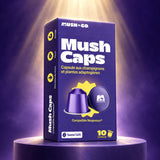
Lion's Mane, saffron, bacopa monnieri, ginkgo biloba and maritime pine in capsules. A thirty-day course, without a drop of caffeine.
Discover Focus →One single molecule
Theine and caffeine: exactly the same thing.
The word “theine” is a relic of the 19th century. In the early 1820s, chemists isolated a bitter alkaloid from coffee and called it caffeine. A few years later, a substance was isolated from tea and named theine, in the belief that a new molecule had been found. Later analyses showed it was the same compound. The name has stuck in everyday language, especially in France.
Chemically, there is no difference: it is 1,3,7-trimethylxanthine, whether it comes from a tea leaf, a coffee bean, a cola nut or a guarana seed. In the body, it does the same thing: it blocks the receptors for adenosine, the molecule that signals tiredness to the brain, and so delays the feeling of sleepiness.
What is identical
The molecule, the way it acts on adenosine, its half-life of about five hours on average in adults, and the EFSA benchmarks: 400 mg a day, 200 mg in a single dose.
What changes
The amount per cup, the other compounds in the drink, the way it is drunk. This is what explains the impression that “theine” is gentler.
The same confusion exists for other plants. The “guaranine” in guarana and the “mateine” in maté are also just caffeine under another name. A label announcing “caffeine-free, with guaranine” is therefore playing with words. Cocoa, for its part, contains mainly theobromine, a related molecule that is much less stimulating, and a little caffeine.
This has a practical consequence: a tea that is “strong” in theine does not exist as such. There are teas that are more or less rich in caffeine, depending on the variety, the amount of leaves and the brewing. For how caffeine works in the body, our article caffeine: how long it lasts covers everything.
Why tea feels gentler
Tea and caffeine: three reasons for the difference you feel.
Many people who do not get on with coffee drink tea without any problem. It is not an illusion, but the explanation is not the one you often hear. Here is what really matters, in order of importance.
The dose
A cup of black tea contains about 50 mg of caffeine, a cup of green tea often less, compared with 80 to 90 mg for a coffee. This is the main reason.
L-theanine
This amino acid, found almost exclusively in tea, is studied for its effects on attention and relaxation. Combined with caffeine, it seems to soften the stimulation.
The pace
Tea is drunk hot, slowly, often over a long period. The caffeine arrives in small amounts rather than in a single concentrated dose.
What about tannins? You often read that the tannins in tea “trap” caffeine and slow its absorption. The idea is widespread, but there is little evidence for it. The available data suggest that the caffeine in tea enters the bloodstream in much the same way as that in coffee. Tannins do, however, have a very real effect on something else: drunk with a meal, they reduce the absorption of plant iron.
Caffeine cup by cup
How much caffeine is in tea, matcha and coffee?
Here are the most reliable benchmarks for one cup of each drink. These are averages: the actual content varies a lot with the variety, the amount and the preparation.
| Drink | Serving | Caffeine, approx. |
|---|---|---|
| Filter coffee | 200 ml | 90 mg |
| Espresso | 60 ml | 80 mg |
| Matcha | 1 to 2 g of powder | 20 to 90 mg |
| Black tea | 220 ml | 50 mg |
| Brewed green tea | 240 ml | 30 mg |
| Brainstoorm Coffee or Choc-hazelnut | 1 cup | 20 mg |
| Decaf coffee | 1 cup | A few mg |
| Rooibos, chamomile, verbena | 1 cup | 0 mg |
Coffee and black tea: EFSA benchmarks (2015). Green tea: FoodData Central database of the US Department of Agriculture. Matcha: analyses by Koláčková et al. (2020), from 19 to 44 mg per gram of powder. Brainstoorm: dose set by the recipe.
Two surprises in this table. First, matcha can contain as much caffeine as a coffee, because you drink the whole leaf ground into a powder, not just an infusion. Second, a strong cup of black tea comes close to a small espresso. So tea is not automatically light.
What changes the dose
Caffeine in green or black tea: it all depends on the brew.
The colour of a tea says little about its caffeine content. A shaded Japanese green tea can contain more than a light black tea. Four factors count for more than the tea family.
- The amount of leaves: this is the first factor. Doubling the amount of tea roughly doubles the caffeine.
- Brewing time: a five-minute brew extracts noticeably more caffeine than a two-minute one.
- Water temperature: boiling water extracts more caffeine than water at 70°C, which is often used for green teas.
- The part of the plant: buds and young leaves are richer in caffeine than older leaves. So some white teas made from buds are not that light.
- Shaded teas: gyokuro and matcha come from plants grown in the shade before harvest, which are richer in caffeine and theanine.
A tip does the rounds for “decaffeinating” your tea: throw away the first 30-second infusion. It removes only a small part of the caffeine, most of which passes into the water over the following minutes. If you really want to avoid caffeine in the evening, a decaffeinated tea, a rooibos or a herbal tea is a better bet.
What the studies say
Tea, theanine and caffeine: four studies worth knowing.
Research has focused mainly on the combination of caffeine and L-theanine, the duo unique to tea. The full references are at the bottom of the page.
Owen et al., 2008 · United Kingdom
27 adults received 50 mg of caffeine combined with 100 mg of L-theanine, or a placebo. With the duo, their accuracy on a task requiring them to switch between instructions improved, they reported feeling more alert and were less bothered by distractions. Limitation: an effect measured one hour after intake, in a small group.
Giesbrecht et al., 2010 · Netherlands
44 young adults took 40 mg of caffeine and 97 mg of L-theanine, doses close to those of two cups of tea, or a placebo. The duo improved accuracy on attention tasks and perceived alertness. Limitation: a trial funded by a tea company, on a single dose.
Einöther and Martens, 2013 · Netherlands
This review brought together the trials on the effects of tea on attention and mood. The authors conclude that tea, and in particular the combination of caffeine and theanine, fairly consistently improves attention in the hours that follow. Limitation: short trials, often run by industry.
Koláčková et al., 2020 · Czech Republic
Researchers analysed the composition of several commercial matchas. Caffeine ranged from about 19 to 44 mg per gram of powder, depending on the sample. With one to two grams per bowl, a matcha can therefore come close to the caffeine in a coffee. Limitation: a small number of products analysed.
These studies do not prove that tea is better than coffee. They show that the combination of caffeine and theanine, in small doses, gives an alertness that participants describe as calmer.
Peak or plateau
Coffee gives a peak, tea more of a plateau.
The difference you feel between an espresso and a pot of tea does not come from a different molecule, but from the way the caffeine arrives. An espresso delivers 80 mg in a few sips. A pot of tea drunk over an hour delivers the same amount, or less, in small doses. The body does not react in the same way.
The espresso peak
A concentrated dose, absorbed quickly. Alertness rises sharply, then drops a few hours later, sometimes with a slump. This is also when jitters are most common.
The tea plateau
Smaller, spread-out doses. Alertness is more moderate and more even, and theanine seems to dampen the feeling of being wired in some people.
Anxiety
People prone to anxiety react mainly to the dose. Less caffeine per serving means less risk of a racing heart and inner tension.
Sleep
The caffeine in a 5pm tea is the same as in coffee: it stays in the blood for hours. A late black tea can make it harder to fall asleep.
If coffee makes you jittery, our article coffee and anxiety explains why, and how to adjust the dose. For sleep, our guide coffee and sleep applies to tea too: count the caffeine, not the name of the drink.
Matcha or mushroom coffee
Matcha is not a light tea.
Matcha is often presented as the gentle alternative to coffee. That is true for theanine, which it provides in quantity. It is less true for caffeine: with one to two grams of powder, a bowl of matcha can contain 20 to 90 mg of caffeine, sometimes as much as a coffee.
Mushroom coffee follows a different logic. A cup of Brainstoorm contains 20 mg of caffeine, less than a black tea, in a base of roasted chicory and organic cacao, with Lion's Mane, Cordyceps and Chaga at 1,000 mg each. It keeps the taste of a roasted drink, whereas matcha tastes grassy. It contains no theanine.
We have compared the two drinks in detail, caffeine, taste, preparation, uses, in our article matcha or mushroom coffee. For all our drinks, see our mushroom coffee page.
Choosing by time of day
Tea, coffee or something else: it all depends on the time.
Since it is the same molecule, the right choice depends mainly on the dose you need and how long you have left before bed. Here is a typical day for someone who goes to bed around 11pm.
On waking
The time for your most caffeinated drink, if you want one: coffee, black tea or matcha.
Mid-morning
A green tea or a second black tea, to prolong alertness without a peak.
Around 2pm
The last properly caffeinated drink. Any later, and the caffeine will still be there at bedtime.
Around 4pm
Slump time: a low-caffeine drink such as Brainstoorm, a light white tea, or a short walk outside.
In the evening
Rooibos, chamomile, verbena or chicory: zero caffeine.
If the afternoon slump is your real issue, our article on the 4pm slump explains its causes, which are not just about caffeine. And to add up your whole day, our guide how many coffees a day totals all the sources.
Precautions
Tea or coffee: the same limits.
Since theine is caffeine, the official benchmarks are the same for tea and coffee. You need to add up all the sources in your day.
Limit caffeine, tea included, or ask your doctor's advice, if:
- You are pregnant or breastfeeding: EFSA recommends not exceeding 200 mg of caffeine a day from all sources, or about four cups of black tea.
- You suffer from anxiety, palpitations, poorly controlled high blood pressure or heart rhythm disorders. Our article coffee and blood pressure looks at blood pressure in detail.
- You are low in iron: drink tea and coffee away from meals, as their polyphenols reduce the absorption of plant iron.
- You sleep badly: stop all caffeinated drinks, tea included, in the early afternoon.
- It is for a child: EFSA sets the benchmark at 3 mg of caffeine per kilo of body weight per day.
Your questions
Theine or caffeine: your questions.
How much caffeine is in tea?
About 50 mg for a 220 ml cup of black tea according to EFSA, and often around 30 mg for a cup of green tea. The content varies a lot with the amount of leaves, the brewing time and the water temperature.
Are theine and caffeine the same thing?
Yes. It is exactly the same molecule, 1,3,7-trimethylxanthine. The word theine dates from the 19th century, when people thought tea contained a different substance from coffee.
Does green tea have caffeine?
Yes, often a little less than black tea, around 30 mg per cup on average. Some shade-grown Japanese green teas, such as gyokuro or matcha, contain considerably more.
Why does tea give you less of a buzz than coffee?
Mainly because a cup of tea contains less caffeine than a coffee. Tea also provides L-theanine, an amino acid associated with calmer alertness in trials, and it is drunk slowly, which spreads out the intake.
Does matcha have more caffeine than coffee?
It can. Matcha contains about 19 to 44 mg of caffeine per gram of powder. With two grams, a bowl can come close to the caffeine in a coffee. With one gram, it contains rather less.
Which tea has the least caffeine?
A decaffeinated tea, or a lightly brewed tea with few leaves. Rooibos and herbal teas such as chamomile or verbena contain none at all, because they are not teas in the botanical sense.
Can you drink tea in the evening?
A black or green tea in the evening can disturb sleep, like a small coffee, because caffeine stays in the blood for several hours. In the evening, choose a rooibos, a herbal tea or a decaffeinated tea.
Does rinsing tea remove the caffeine?
Very little. Throwing away a first 30-second infusion removes only a small part of the caffeine, which keeps passing into the water for several minutes. To avoid caffeine, a decaffeinated tea or a herbal tea is more reliable.
How many cups of tea a day is too many?
For a healthy adult, EFSA sets the benchmark at 400 mg of caffeine a day, or about eight cups of black tea if that is your only source of caffeine. During pregnancy, the benchmark drops to 200 mg, or about four cups. Remember to add coffee, chocolate and fizzy drinks.
Sources
- EFSA NDA Panel (2015). Scientific opinion on the safety of caffeine. EFSA Journal, 13(5):4102.
- Owen G. N., Parnell H., De Bruin E. A., Rycroft J. A. (2008). The combined effects of L-theanine and caffeine on cognitive performance and mood. Nutritional Neuroscience, 11(4).
- Giesbrecht T., Rycroft J. A., Rowson M. J., De Bruin E. A. (2010). The combination of L-theanine and caffeine improves cognitive performance and increases subjective alertness. Nutritional Neuroscience, 13(6).
- Einöther S. J., Martens V. E. (2013). Acute effects of tea consumption on attention and mood. American Journal of Clinical Nutrition, 98(6 Suppl).
- Koláčková T., Kolofiková K., Sytařová I. et al. (2020). Matcha tea: analysis of nutritional composition, phenolics and antioxidant activity. Plant Foods for Human Nutrition, 75(1).
- U.S. Department of Agriculture. FoodData Central: beverages, tea, green, brewed.
Keep reading
Further reading.
Caffeine hides in many drinks. Explore our other guides, or our mushroom coffee Brainstoorm.

Discover our mushroom and adaptogenic plant supplements
Our vegan formulas, made in Toulouse by a French manufacturer.