






















Coffee and Blood Pressure: Does Coffee Raise Your Blood Pressure?
By the Mush n Go editorial team - 13 November 2026
By the Mush n Go editorial teamPublished 14 November 202614 min read
Coffee and blood pressure
The link between coffee and blood pressure is more nuanced than most people think: a coffee raises blood pressure by a few mmHg for one to three hours, especially in people who rarely drink it. In regular drinkers, tolerance builds up and habitual intake does not increase the risk of high blood pressure. People whose blood pressure is poorly controlled, however, still need to keep an eye on it.

Brainstoorm
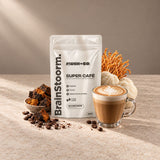
20 mg of microencapsulated caffeine instead of 80 in an espresso, in an organic chicory and cacao base, with Lion's Mane, Cordyceps and Chaga at 1,000 mg each.
Discover Brainstoorm →
Energy
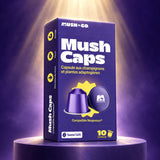
Cordyceps, maca, ginger and vitamin C in capsules, without a drop of caffeine. Vitamin C contributes to the reduction of tiredness and fatigue.
Discover Energy →What happens after a coffee
Yes, coffee raises blood pressure, but not for long.
Caffeine blocks receptors for adenosine, a molecule that, among other things, helps blood vessels relax. It also stimulates the release of adrenaline. The result: blood vessels narrow slightly and blood pressure rises. It is a real, measurable effect, and it kicks in quickly.
The key meta-analysis on the subject, published by Mesas and colleagues in 2011, pooled trials carried out in people with high blood pressure. A dose of 200 to 300 mg of caffeine, or two to three espressos, raised systolic pressure by about 8 mmHg and diastolic pressure by about 6 mmHg. The effect appeared within the first hour and lasted at least three hours.
| After the coffee | What happens | Effect on blood pressure |
|---|---|---|
| 15 to 45 minutes | Caffeine enters the bloodstream | Pressure starts to rise |
| About 1 hour | Caffeine peaks in the blood | Maximum rise, of a few mmHg |
| 1 to 3 hours | Caffeine stays high | The rise persists, then fades |
| Beyond that | The liver clears the caffeine, half-life of about 5 hours | Gradual return to your usual blood pressure |
Average timeline. The size of the effect depends on the dose, how used you are to coffee and how sensitive you are. For a detailed look at how long caffeine works, see our article caffeine: how long it lasts.
This rise of a few points is about the same as the one caused by climbing a flight of stairs or a heated conversation. It is nothing to worry about in a healthy person. It matters more if your blood pressure is already high, or if you measure it straight after your cup.
Tolerance
Regular drinkers get used to caffeine.
The question “does coffee raise blood pressure?” does not have the same answer for everyone. The effect is strongest in people who don't drink it, or who have a coffee after several days without. In people who drink it every day, it is markedly blunted: the body partly adapts to the repeated presence of caffeine.
The occasional drinker
A one-off coffee raises blood pressure more noticeably. This is also the person in whom caffeine causes the most jitters and palpitations.
Regular drinkers
The rise is smaller, sometimes barely measurable. In the Noordzij meta-analysis, coffee drunk daily for several weeks raised blood pressure by only about 1 mmHg.
After a break
A few days without coffee are enough for sensitivity to partly return. The first coffee back can therefore have more effect than expected.
Pure caffeine
In tablets or energy drinks, caffeine alone raises blood pressure more than coffee, which also contains polyphenols.
Large studies following tens of thousands of people for years point the same way: drinking coffee regularly is not associated with a higher risk of developing high blood pressure. In this data, coffee does not behave like salt or alcohol.
If you have high blood pressure
Coffee and high blood pressure: how many cups a day?
Nearly one adult in three has high blood pressure in France, and around half of them don't know it, according to the French public health agency Santé publique France. If that is you, the question is a fair one. Cardiologists' answer is fairly reassuring for blood pressure that is well controlled by treatment, and more cautious when it is not.
The European guidelines on hypertension (ESC and ESH) do not ask people to stop drinking coffee: moderate intake is considered compatible with treated hypertension. The emphasis is on other, far more powerful levers: salt, weight, alcohol, physical activity and taking your treatment regularly. A Japanese study published in 2023 does, however, add an important nuance for very high blood pressure (see below).
- Normal or well-controlled blood pressure: one to three cups a day pose no known problem. Stay below the EFSA reference of 400 mg of caffeine a day.
- Uncontrolled high blood pressure: cut back on coffee and talk to your doctor, who knows your readings and your treatment.
- Severe hypertension, at 160/100 mmHg or above: in the Teramoto study, drinking two or more coffees a day was associated with roughly twice the cardiovascular mortality. Cutting down is sensible, in agreement with your doctor.
- In all cases: avoid energy drinks and high-caffeine supplements, which add a lot of caffeine in one go.
On medication or unsure? Ask your doctor for advice. To work out where you stand in milligrams, our article how many cups of coffee a day lists the caffeine in different drinks and the thresholds worth knowing.
What the studies say
Coffee and blood pressure: four studies worth knowing.
Here is the most solid research on the subject, with its conditions and limitations. Full references are at the bottom of the page.
Mesas et al., 2011 · Spain
Meta-analysis of trials and cohort studies in people with high blood pressure. A dose of 200 to 300 mg of caffeine raised blood pressure by about 8 mmHg systolic and 6 mmHg diastolic, for at least three hours. By contrast, habitual coffee drinking was not associated with more cardiovascular disease. Limitation: short-term trials.
Noordzij et al., 2005 · Netherlands
Meta-analysis of randomised trials lasting several weeks. Caffeine tablets, at around 400 mg a day, raised systolic blood pressure by about 4 mmHg. Coffee, at comparable doses, raised it by only about 1 mmHg. Limitation: heterogeneous trials, with mostly healthy participants.
Teramoto et al., 2023 · Japan
18,609 adults aged 40 to 79 followed for about 19 years. In people with severe hypertension, at 160/100 mmHg or above, drinking two or more coffees a day was associated with roughly twice the cardiovascular mortality. No such link was seen in the other participants, or with green tea. Limitation: an observational study, which does not prove causation.
Marcus et al., 2023 · United States
100 adults fitted with a heart monitor drank or avoided coffee on randomly assigned days over two weeks. On coffee days, they had no more premature beats from the atria, but slightly more premature ventricular beats, walked more and slept about 36 minutes less. Limitation: a short trial, in healthy people.
The overall picture is consistent: a real but modest acute effect, tolerance in regular drinkers, and particular vigilance for very high blood pressure.
Coffee and your heart
Is coffee good for your heart? Broadly neutral, perhaps better.
For a long time, people with heart conditions were told to give up coffee. Large population studies have nuanced that advice. In the UK Biobank, which follows several hundred thousand British adults, drinking two to three cups a day was associated with the lowest cardiovascular risk and mortality, compared with no coffee.
These results are encouraging, but they need to be read with caution. They are associations: coffee drinkers may differ from non-drinkers in many other ways. And people who tolerate coffee poorly, because it makes them jittery or gives them palpitations, tend to drink less of it, which muddies the comparisons.
Filter coffee holds back diterpenes (cafestol, kahweol), compounds that can raise LDL cholesterol. Unfiltered coffee, such as boiled coffee or cafetière coffee, contains more of them. If your cholesterol is high, a paper filter is a simple choice.
In short: for a healthy heart, coffee is not the enemy. For a heart with a condition, it is up to the cardiologist to set the rule, based on heart rhythm, blood pressure and treatment.
Palpitations
Coffee and a racing heart: what is normal and what is not.
Feeling your heart beat harder or faster after a coffee is common, especially at high doses, on an empty stomach, or when you are tired or anxious. Caffeine stimulates the nervous system and can trigger ectopic beats (extrasystoles), those early beats you feel as a skipped beat or a thud in the chest.
Often harmless
A few isolated irregular beats, a brief speeding up after a double espresso. In the UK Biobank, coffee was not associated with more heart rhythm disorders, if anything slightly fewer.
Worth mentioning
Palpitations that come back often, last several minutes, or appear even with very little coffee. Talk to your doctor, who may suggest a heart monitor recording.
Urgent
Palpitations with chest pain, feeling faint, breathlessness or loss of consciousness: call 112.
If coffee regularly gives you palpitations, the first thing to do is reduce the dose and avoid drinking it on an empty stomach. The link between coffee, jitters and a racing heart is covered in our article coffee and anxiety.
Measuring your blood pressure
Don't measure your blood pressure straight after a coffee.
Many people monitor their blood pressure at home, often in the morning, often after breakfast. If your cup of coffee comes before the reading, the figure may be artificially raised by a few points. Blood pressure measurement guidelines advise avoiding caffeine, smoking and exertion in the 30 minutes beforehand.
Before your coffee
Measure your blood pressure in the morning before coffee and breakfast, or at least 30 minutes after your last cup.
Somewhere calm
Seated, back supported, arm resting at heart level, after five minutes' rest. No talking during the reading.
Three readings
Take three readings one or two minutes apart, morning and evening, for three days, and write them down for your doctor.
This is the home monitoring method recommended in France. It stops you mistaking a passing effect of coffee for high blood pressure, and vice versa.
Eye pressure
Coffee and eye pressure: a separate question.
Eye pressure, or intraocular pressure, has nothing to do with blood pressure. It is the pressure of the fluid inside the eye. When it is too high, it can damage the optic nerve: this is glaucoma. Caffeine raises this pressure slightly and briefly after a cup.
A 2021 study of more than 120,000 UK Biobank participants clarified the picture. Overall, caffeine intake was not associated with higher eye pressure. But in people with the highest genetic predisposition to glaucoma, high intake, above 480 mg a day, or about four to five coffees, was associated with slightly higher pressure and more frequent glaucoma.
If you have glaucoma, or a family history of glaucoma, talk to your ophthalmologist about how much coffee you drink. For everyone else, moderate intake poses no known problem.
Decaf and alternatives
Less caffeine, without giving up the cup.
If your doctor advises you to cut down, or if you simply want to limit blood pressure spikes during the day, you don't have to give up the ritual. You just need to adjust the amount of caffeine per cup.
| Drink | Serving | Caffeine, approx. |
|---|---|---|
| Filter coffee | 200 ml | 90 mg |
| Espresso | 60 ml | 80 mg |
| Black tea | 220 ml | 50 mg |
| Brainstoorm Coffee or Choc-hazelnut | 1 cup | 20 mg |
| Decaf coffee | 1 cup | A few mg |
| Roasted chicory | 1 cup | 0 mg |
EFSA reference values (2015) for coffee and tea. The Brainstoorm dose is set by the recipe.
Decaffeinated coffee has practically no effect on blood pressure, since caffeine is what causes it. Chicory contains none at all. In between, our mushroom coffee keeps a little caffeine, 20 mg per cup, four times less than an espresso, in a base of roasted chicory and cacao. An option for keeping your morning coffee as it is and replacing the ones that follow.
A typical day
A day designed to limit the spikes.
Here is one way to organise your caffeine if you want to keep coffee without stacking up blood pressure rises through the day. To be adapted, of course, to your doctor's advice.
On waking
A large glass of water. If you are monitoring your blood pressure, this is the time to measure it, before any caffeine.
At breakfast
Your morning coffee, with something to eat rather than on an empty stomach, which also limits the jitters.
Mid-morning
If you want a second cup, switch to a lower-caffeine drink, such as Brainstoorm, or to a decaf.
In the afternoon
Decaf, chicory or herbal tea. Afternoon caffeine also weighs on your night, and poor sleep does your blood pressure no favours.
Sleep and stress also affect blood pressure. If you feel you are making up for short nights with coffee, our article coffee and sleep will help you set your cut-off time, and our guide coffee and cortisol explains the link between caffeine and stress hormones.
When to see a doctor
When your doctor's advice comes first.
This article gives general guidance. Already being treated for blood pressure or a heart condition? Your doctor remains your best guide.
Ask your doctor before keeping your coffee habits if:
- Your blood pressure regularly exceeds 140/90 mmHg on home readings, or if you are at 160/100 mmHg or above.
- You have a known heart rhythm disorder, coronary heart disease or heart failure.
- You experience frequent palpitations, dizziness or unusual breathlessness. If you have chest pain or feel faint, call 112.
- You are pregnant: EFSA recommends not exceeding 200 mg of caffeine a day, and blood pressure is monitored closely during pregnancy.
- You have glaucoma or a family history of glaucoma.
- You take medicines or supplements containing caffeine, or stimulants: the doses add up.
Suddenly cutting back on heavy coffee drinking can cause headaches and fatigue for a few days. If you need to reduce, do it gradually, replacing one cup at a time.
Your questions
Coffee and blood pressure: your questions.
Can I drink coffee if I have high blood pressure?
Yes, generally, if your blood pressure is well controlled: one to three cups a day are considered compatible. With severe or poorly controlled hypertension, it is better to limit coffee and talk to your doctor, who knows your readings and your treatment.
Does coffee raise blood pressure?
Yes, temporarily. A dose of 200 to 300 mg of caffeine raises blood pressure by a few mmHg for one to three hours. In regular drinkers, this effect fades markedly with habit.
How long does coffee raise blood pressure for?
The effect appears within the first hour and generally lasts at least three hours, then fades as the liver clears the caffeine. That is why it is best to measure your blood pressure before coffee, or at least 30 minutes after.
Is coffee good for your heart?
For a healthy heart, it seems broadly neutral, or even favourable: in large studies, two to three cups a day are associated with the lowest cardiovascular risk. These are associations, though, not proof of cause and effect.
Can coffee cause palpitations?
Yes, especially at high doses, on an empty stomach or in sensitive people. It can trigger ectopic beats, which are usually harmless. Frequent or prolonged palpitations should be reported to your doctor, and chest pain means calling 112.
Does decaf coffee raise blood pressure?
Practically not. Caffeine is what raises blood pressure, and a decaf contains only a few milligrams per cup. It is a good option for keeping the taste of coffee while limiting spikes.
Does coffee raise eye pressure?
Slightly and briefly. For most people, this is not a problem. In people predisposed to glaucoma, high intake, above 480 mg of caffeine a day, is associated with slightly higher eye pressure.
Should I stop drinking coffee if I have high blood pressure?
Not necessarily. The European guidelines do not ask people to give up moderate coffee drinking. Salt, alcohol, weight, physical activity and treatment matter far more. Your doctor may, however, advise cutting down if your blood pressure is very high.
Does tea raise blood pressure like coffee?
It also contains caffeine, about 50 mg per cup of black tea according to EFSA, which is less than a coffee. Its effect on blood pressure is therefore smaller. In the Japanese Teramoto study, green tea was not associated with higher mortality in people with severe hypertension.
Sources
- Mesas A. E., Leon-Muñoz L. M., Rodriguez-Artalejo F., Lopez-Garcia E. (2011). The effect of coffee on blood pressure and cardiovascular disease in hypertensive individuals: a systematic review and meta-analysis. American Journal of Clinical Nutrition, 94(4).
- Noordzij M., Uiterwaal C. S., Arends L. R. et al. (2005). Blood pressure response to chronic intake of coffee and caffeine: a meta-analysis of randomized controlled trials. Journal of Hypertension, 23(5).
- Teramoto M., Yamagishi K., Muraki I. et al. (2023). Coffee and green tea consumption and cardiovascular disease mortality among people with and without hypertension. Journal of the American Heart Association, 12(2).
- Marcus G. M., Rosenthal D. G., Nah G. et al. (2023). Acute effects of coffee consumption on health among ambulatory adults. New England Journal of Medicine, 388(12).
- Kim E. J., Hoffmann T. J., Nah G. et al. (2021). Coffee consumption and incident tachyarrhythmias: reported behavior, mendelian randomization, and their interactions. JAMA Internal Medicine, 181(9).
- Chieng D., Canovas R., Segan L. et al. (2022). The impact of coffee subtypes on incident cardiovascular disease, arrhythmias, and mortality: long-term outcomes from the UK Biobank. European Journal of Preventive Cardiology, 29(17).
- Kim J., Aschard H., Kang J. H. et al. (2021). Intraocular pressure, glaucoma, and dietary caffeine consumption: a gene-diet interaction study from the UK Biobank. Ophthalmology, 128(6).
- Perrine A. L., Lecoffre C., Blacher J., Olié V. (2018). L'hypertension artérielle en France : prévalence, traitement et contrôle en 2015. Bulletin épidémiologique hebdomadaire, Santé publique France, 10.
- EFSA NDA Panel (2015). Scientific opinion on the safety of caffeine. EFSA Journal, 13(5):4102.
Keep reading
Further reading.
Caffeine has many other effects besides blood pressure. Explore our other guides, or our mushroom coffee Brainstoorm.

Discover our mushroom and adaptogenic plant supplements
Our vegan formulas, made in Toulouse by a French manufacturer.