
















Coffee on an empty stomach: good or bad idea?
By the Mush n Go editorial team - 24 September 2026

Coffee
Coffee on an empty stomach
good or bad idea?
By the Mush n Go editorial teamPublished 24 September 202615 min read
Coffee and mornings
Drinking coffee on an empty stomach is not dangerous for most healthy adults. But with nothing in the stomach, coffee can sharpen acidity, heartburn, the sudden urge to visit the bathroom and jitteriness in sensitive people. The sensible routine: a large glass of water first, coffee a little later, and ideally with something to eat.

Brainstoorm
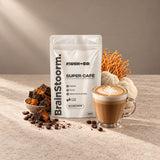
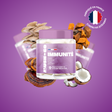
Our super mushroom coffee: lion's mane, cordyceps and chaga at 1,000 mg each, maca, chicory, ashwagandha, and only 20 mg of NewCaff® caffeine per cup. No mushroom taste at all.
Discover Brainstoorm →
Energy
Cordyceps, maca, ginger and vitamin C in capsules, without a drop of caffeine. The 30-day course for those whose stomach no longer tolerates the wake-up coffee.
Discover Energy →The verdict
Coffee on an empty stomach: good or bad idea?
The question deserves better than a flat "never" or "no problem at all". The honest answer comes in two parts.
For most people, drinking coffee on an empty stomach causes no particular trouble. No serious study shows that a black coffee before breakfast damages the stomach of a healthy person.
For some people, though, coffee on an empty stomach triggers very concrete signals: heartburn, reflux, a rumbling gut, accelerated transit, shaky hands or a racing heart. It is not "in your head". Coffee is an acidic drink, rich in compounds that stimulate digestion, and caffeine acts more sharply when nothing buffers it.
So the real question is not "is it bad?" but "is it bad for me?". Pay attention to what you feel in the hour after your first cup.
- No symptoms after your morning coffee: you can carry on, staying within the caffeine references.
- Heartburn, nausea or a bloated stomach: move the coffee to during or after breakfast, or make it weaker.
- Jitters, palpitations, anxiety: it is the caffeine that needs to come down, not just the timing.
The stomach and acidity
Why empty-stomach coffee burns some people's stomachs.
Coffee is naturally acidic. It contains chlorogenic acids from the bean and other compounds formed during roasting. It also stimulates the release of gastrin, the hormone that tells the stomach to produce its own acid. When the stomach is full, that acid works on the meal. When it is empty, it has little to digest.
In most people the lining takes it without complaint. But in those prone to reflux, gastritis or a "sensitive" stomach, this extra acidity is felt. Coffee can also slightly relax the sphincter that closes the top of the stomach, which encourages reflux.
One interesting point: the link between coffee and reflux is less clear-cut than people assume. A meta-analysis by Kim and colleagues, published in 2014, found no significant association between coffee consumption and gastro-oesophageal reflux across the studies it pooled. Coffee is a trigger for some, not for everyone.
| What you feel | What is happening | What you can do |
|---|---|---|
| Heartburn, acidity | Coffee's acidity adds to that of an empty stomach | Drink the coffee during or after breakfast |
| Reflux | The stomach sphincter relaxes a little | Avoid lying down after coffee, lighten the dose |
| Nausea | Empty stomach and a concentrated, often very hot drink | A glass of water first, a longer coffee or with milk |
| Bloating | Digestion stimulated with nothing to digest | Breakfast, even a light one, before the cup |
Roasting matters too: a very light roast is often perceived as more acidic in the mouth than a darker one.
The effect on digestion
The morning coffee, a wake-up call for the gut.
You may have noticed that your morning coffee is often followed by a trip to the bathroom. That is not an impression. Coffee stimulates colonic motility, and the effect is particularly marked in the morning, when the gut is waking up too.
A study by Rao and colleagues, published in 1998, measured colon activity directly after different drinks. Caffeinated coffee stimulated the colon as much as a 1,000-kilocalorie meal, and clearly more than hot water. Decaf had an effect too, a weaker one: caffeine does not explain everything, other coffee compounds are involved. To go further, see how to cut back on coffee gently.
On an empty stomach this effect is more direct, since nothing else is occupying digestion. For some it is rather convenient. For others, particularly people with irritable bowel syndrome, it means cramps, bloating or urgency, sometimes diarrhoea. If that is your case, empty-stomach coffee is probably not your best ally.
Empty-stomach coffee and cortisol
Morning cortisol, really a problem?
"Never drink your coffee as soon as you wake up, your cortisol is already at its peak": the argument is everywhere on social media. There is some truth in it, and a lot of exaggeration.
What is true: cortisol, often called the stress hormone, follows a daily rhythm. It rises sharply in the half hour after waking — that is the cortisol awakening response — then declines gradually until evening. And caffeine can raise cortisol too.
What needs nuance: the study by Lovallo and colleagues, published in 2005, showed that caffeine raises cortisol mostly in people who consume little or none. In regular drinkers this response is clearly blunted, without disappearing entirely. The body adapts.
What is exaggerated: the idea that a coffee at 7 am instead of 9 am "disrupts" your hormones for the day, or makes you gain weight, does not rest on solid studies. The "wait 90 minutes" rule circulates widely, but has never been shown to be necessary.
Waiting a little before your first coffee remains a good habit to test, not a law. If the subject interests you, we covered it in detail in our article on how to lower cortisol, and in the one on the symptoms of high cortisol.
What the studies say
Four studies that actually clarify things.
Few studies have looked closely at coffee on an empty stomach. These are the ones that genuinely move the question forward.
Rao et al., 1998 · United States
In volunteers, caffeinated coffee stimulated colonic motility as much as a 1,000 kcal meal, more than decaf and far more than hot water. The simplest explanation for the morning "bathroom effect".
Lovallo et al., 2005 · United States
Caffeine raises cortisol across the day, but this response is much weaker in regular consumers than in non-drinkers. A partial tolerance sets in.
Kim et al., 2014 · meta-analysis
Pooling several studies, the researchers found no significant association between coffee consumption and gastro-oesophageal reflux. An individual trigger, not a general rule.
Smith et al., 2020 · United Kingdom
29 adults at the University of Bath. After a disrupted night, a strong coffee before breakfast raised the blood-sugar response to that breakfast by around 50 %, compared with the same meal without prior coffee.
In short: real effects, but highly variable from one person to another. Full references at the bottom of the page.
Morning blood sugar
Empty-stomach coffee and blood sugar, especially after a bad night.
This is the most cited study on the subject. Researchers at the University of Bath compared three situations: a good night, a night broken up by awakenings, then a broken night followed by a strong black coffee before breakfast.
The disrupted night alone changed little. The strong coffee before eating, however, clearly raised the blood-sugar response to breakfast. The problem was not the lack of sleep, but the reflex of compensating for it with a strong coffee on an empty stomach.
Let us keep the scale in mind: 29 healthy adults, a single morning. The study does not say morning coffee causes diabetes. Above all it gives common-sense advice: if you slept badly, eat first and have your coffee afterwards.
After a good night
Coffee before or after breakfast changes little for most people. Listen to your stomach above all.
After a broken night
This is when a strong coffee on an empty stomach is least advisable. Breakfast first, coffee after.
If you monitor your blood sugar
Talk to your doctor, and avoid sweetened coffee on an empty stomach, which stacks both effects.
If you fast
Black coffee, without sugar or milk, remains the drink most compatible with a fasting window.
Jitters and the crash
The peak, then the fall.
An empty stomach does not change how much caffeine you absorb: almost all of it reaches the bloodstream either way. What it changes is the speed. Without a meal, caffeine reaches the intestine, where it is absorbed, faster, and its effect lands more abruptly.
For some people that fast start means shaky hands, a racing heart, a feeling of agitation, even anxiety. And a few hours later, when the effect fades, comes the familiar late-morning or mid-afternoon crash.
The higher the dose, the sharper the cycle. Two espressos back to back on waking is already close to 160 mg, near the 200 mg per single intake reference set by the European Food Safety Authority (EFSA).
The answer is not necessarily to give up coffee, but to flatten the curve: less caffeine at once, caffeine released more slowly, and a little food alongside. That is precisely the idea behind the NewCaff® microencapsulated caffeine in Brainstoorm: 20 mg per cup, released gradually, with cordyceps and maca alongside.
« my stomach hurt with normal coffee, now the bloating is gone and I feel great »
★★★★★ Sonia L. · 27 August 2026
« Very good product, for me the afternoon crash has disappeared »
★★★★★ Franck C. · 6 September 2026
Real Trustpilot reviews of Brainstoorm, translated from French and left unedited.
Are there any benefits?
The benefits of empty-stomach coffee: what holds up.
You also read the opposite: that coffee on an empty stomach helps you lose weight and wakes you up better. Here is what can reasonably be said.
For weight loss, caffeine slightly raises energy expenditure for a few hours, but the effect is modest and does not depend on fasting. Empty-stomach coffee for weight loss is not a method in itself. And if coffee leaves you hungry by late morning, it may even work against you.
In short: no magic benefit, but no disaster either.
Who should avoid it
Why you should not drink coffee on an empty stomach, in certain cases.
In some situations caution is warranted, on an empty stomach as during the day.
Better to avoid coffee on an empty stomach, or seek medical advice, if:
- You have gastro-oesophageal reflux, gastritis or an ulcer, or take medication for your stomach.
- You have irritable bowel syndrome and coffee triggers cramps, bloating or diarrhoea.
- You are prone to anxiety, panic attacks or palpitations: caffeine on an empty stomach amplifies these sensations.
- You are pregnant or breastfeeding: EFSA recommends not exceeding 200 mg of caffeine a day during pregnancy.
- You are on medication: some drugs interact with caffeine, or should be taken away from coffee.
- You have a heart rhythm disorder or poorly controlled high blood pressure.
The right routine
How to drink your morning coffee without paying for it.
You do not need to give up your ritual. Here is the order that suits most people.
Water first
A large glass of water on waking. You are coming out of seven or eight hours without drinking, and your stomach will appreciate a neutral liquid before the acidity of coffee.
Something to eat
Even a little: a yoghurt, a piece of fruit, a slice of bread, a few nuts. Enough to occupy the stomach and slow the arrival of caffeine.
Then the coffee
During or just after breakfast, warm rather than scalding, and keeping an eye on cup size.
On waking
A large glass of water, lukewarm if you prefer.
30 min later
Breakfast, then your cup. A cup of Brainstoorm if you want less caffeine, with chicory for the taste.
After 2 pm
Ease off the caffeine to protect your sleep. A herbal tea, water, or a decaf.
In the evening
Time to wind down. Reishi, a mushroom traditionally associated with relaxation, is taken in the evening, for example in Sleep +.
The alternatives
What can replace the morning coffee?
If empty-stomach coffee really does not agree with you, here is a comparison to choose according to what bothers you.
| Drink | Caffeine | For the stomach | Worth knowing |
|---|---|---|---|
| Classic espresso | Around 80 mg | Acidic, to avoid fasted if you are sensitive | Fast onset, fast drop |
| Coffee with milk | Depends on the coffee dose | Better tolerated, milk buffers the acidity | Less suitable if you digest lactose poorly |
| Decaf | A few milligrams | Still somewhat acidic | Keeps the effect on digestion, more gently |
| Chicory | None | Mild, low acidity | Roasted flavour close to coffee, without caffeine |
| Brainstoorm | 20 mg, released gradually | Chicory base, no mushroom taste | Lion's mane, cordyceps, chaga, maca, ashwagandha |
| Energy in capsules | None | Nothing to drink, nothing acidic | Cordyceps, maca, ginger, vitamin C |
Chicory is often the first option for delicate stomachs: it has the roasted, bitter side of coffee, without the caffeine and with less acidity. It is in fact one of the bases of Brainstoorm, which adds three mushrooms and two adaptogenic plants, including maca and ashwagandha. To go further, our article on coffee alternatives reviews every option.
Our version of the morning coffee
Brainstoorm, a coffee that is gentler on an empty stomach.
We designed Brainstoorm for people who love the coffee ritual but no longer love its side effects. And to know what is really in a mushroom coffee, read our honest take on its benefits and its limits.
- 20 mg of NewCaff® microencapsulated caffeine per cup, against roughly 80 mg in an espresso.
- A roasted chicory base, mild and low in acidity, that keeps the taste of coffee.
- Lion's mane, cordyceps and chaga at 1,000 mg each, plus 3,000 mg of maca: 6,040 mg of actives per cup.
- Ashwagandha, an adaptogenic plant traditionally associated with calm.
- No mushroom taste, hot or cold, with water or milk. Formulated in Toulouse.
Prefer chocolate to coffee? Brainstoorm Choco-hazelnut uses the same mushrooms with cocoa and rhodiola, and the Coffee Pack brings both flavours together. No caffeine at all? The Energy course takes over. One-off purchase or monthly subscription (−30 %), with a 60-day money-back guarantee.
Before a blood test
Can you drink coffee before a fasting blood test?
Here the answer is stricter. When a laboratory asks you to come fasted, it is so that certain results, such as blood sugar or blood lipids, are not distorted by what you have consumed.
As a rule, only still water is allowed. Coffee, even black and unsweetened, is usually advised against: caffeine can alter some parameters, and added sugar or milk even more. The fasting period required is most often 8 to 12 hours, depending on the test.
Follow your doctor's or the laboratory's instructions to the letter, as they depend on the tests ordered. Your coffee will wait until you are out, with a proper breakfast.
Your questions
Everything you ask us about coffee on an empty stomach.
Is it bad to drink coffee on an empty stomach?
Not for most healthy adults. In sensitive people, however, empty-stomach coffee can cause heartburn, nausea, accelerated transit or jitteriness. If you experience these symptoms, have your coffee during or after breakfast.
Why does empty-stomach coffee upset the stomach?
Coffee is acidic and stimulates both acid production in the stomach and gut motility. Without food to occupy digestion, these effects are felt more strongly, especially if you are prone to reflux or irritable bowel syndrome.
Does empty-stomach coffee raise cortisol?
Caffeine can raise cortisol, mostly in people who rarely drink it. In regular drinkers this effect is clearly blunted. There is no evidence that a coffee taken on waking disrupts hormones for the rest of the day.
How long should you wait after waking before coffee?
There is no official delay. Waiting 30 minutes to an hour, long enough to drink water and eat something, is a good habit for many people, especially those with a sensitive stomach.
Does empty-stomach coffee help you lose weight?
No, not in itself. Caffeine slightly raises energy expenditure for a few hours, fasted or not. Black unsweetened coffee is compatible with intermittent fasting, but it does not replace a balanced diet.
Does empty-stomach coffee affect blood sugar?
A 2020 University of Bath study showed that after a disrupted night, a strong coffee before breakfast raised the blood-sugar response to that meal. So it is better to eat first, especially after a bad night.
Can you drink coffee before a fasting blood test?
Generally no: only still water is allowed before a fasting blood test. Always follow your doctor's or the laboratory's instructions, which depend on the tests requested.
Which coffee in the morning when you have a delicate stomach?
A longer coffee, with a little milk, taken during breakfast, is usually better tolerated. A chicory-based drink such as Brainstoorm, with only 20 mg of caffeine per cup, is another option.
Sources
- Rao S.S. et al. (1998). Is coffee a colonic stimulant? European Journal of Gastroenterology & Hepatology, 10(2).
- Lovallo W.R. et al. (2005). Caffeine stimulation of cortisol secretion across the waking hours in relation to caffeine intake levels. Psychosomatic Medicine, 67(5).
- Kim J. et al. (2014). Association between coffee intake and gastroesophageal reflux disease: a meta-analysis. Diseases of the Esophagus, 27(4).
- Smith H.A. et al. (2020). Glucose control upon waking is unaffected by hourly sleep fragmentation during the night, but is impaired by morning caffeinated coffee. British Journal of Nutrition, 124(10).
- EFSA NDA Panel (2015). Scientific Opinion on the safety of caffeine. EFSA Journal, 13(5):4102.
Keep reading
To go further.
The morning coffee is only one piece of your energy across the day. Explore our other guides, or browse our range of mushroom coffees.

Discover our mushroom and adaptogenic plant supplements
Our vegan formulas, made in Toulouse by a French manufacturer.