














Lion's mane: benefits, dosage and the studies
By Kevin CANAL - 04 March 2026

Species
Lion's mane
benefits, dosage and the studies
By the Mush n Go editorial teamUpdated 24 September 202612 min read
Species
Lion's mane (Hericium erinaceus) is the most studied mushroom for cognitive function. Published trials use 1.8 to 3 g of extract a day, over 4 to 16 weeks, and report higher scores on cognitive function tests — in samples of 30 to 40 people. The gap disappears once you stop: this is a supplement for the long run, not a quick boost.

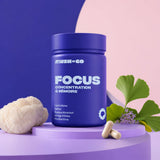
Focus
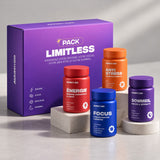
Lion's mane, saffron, bacopa monnieri, ginkgo biloba and maritime pine. The 30-day course for periods when your head has to keep up.
Discover Focus →
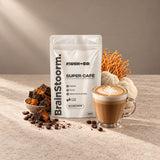
Brainstoorm
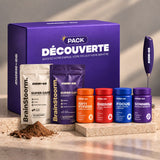
1,000 mg of lion's mane per cup, with cordyceps and chaga at the same dose, and only 20 mg of caffeine.
Discover Brainstoorm →Profile
An edible mushroom, not a lab extract.
It is a mushroom you eat: in Asia it is cooked as a food, with a texture close to crab meat. That long culinary history partly explains its reassuring safety profile.
What is documented, and what is not
The line is clear, and rarely respected.
What is studied in humans
Cognitive function in adults aged 50 to 80, over 16 weeks. Reaction time on a rapid processing task in young adults. Mood questionnaires over 4 weeks. Three trials, of 30 to 41 participants each.
What is not
Nerve regeneration in humans, any effect on any disease, use in children, pregnancy, and any use beyond sixteen weeks. Work on those subjects is cellular or animal.
No health claim is authorised in Europe for lion's mane. What we describe here are trial results, not promised effects.
NGF: what is actually known
The most repeated argument is also the weakest.
You will read everywhere that lion's mane "stimulates NGF", nerve growth factor. The origin of that claim is real: Japanese work showed, in cell cultures, that hericenones and erinacines promote NGF synthesis. It is a solid result — in a Petri dish.
Moving to humans raises two problems that are usually passed over. First, NGF crosses the blood-brain barrier poorly: what happens in a cell culture says nothing about what happens in a brain. Second, no human trial has measured NGF before and after supplementation.
What is measured in humans is scores on cognitive tests. That is less spectacular to tell, and far more honest.
What the studies say
Four human trials.
We include only trials conducted in humans, against placebo, and we state their limits consistently — a sample of thirty people is not proof, it is a signal.
Mori et al., 2009 · Japan
30 adults aged 50 to 80 with mild cognitive impairment, double-blind against placebo. 3 g of Hericium erinaceus a day for 16 weeks. Higher scores on a cognitive function scale in the supplemented group, a gap that disappears 4 weeks after stopping. Small sample.
Docherty et al., 2023 · United Kingdom
41 young adults, Northumbria University. A single 1.8 g dose of extract, then 28 days of supplementation. Shorter reaction time on a rapid processing task after the acute dose; more nuanced results over four weeks. This is the most recent and best-conducted work.
Saitsu et al., 2019 · Japan
31 participants, 12 weeks of oral Hericium erinaceus. Higher scores on cognitive tests compared with placebo. Comparable sample size, same limitation.
Nagano et al., 2010 · Japan
30 women, biscuits containing Hericium erinaceus for 4 weeks. Lower scores on two mood self-assessment questionnaires than with placebo. Entirely self-reported criteria.
Four trials, around a hundred people in total, two countries. That is more than for most supplements — and it remains little. References at the bottom of the page.
Dosage
The trial figures, and what to do with them.
| Parameter | Reference | Where it comes from |
|---|---|---|
| Starting dose | 500 mg a day, for one week | To let digestion adjust |
| Usual dose | 1,000 to 2,000 mg of extract a day | The range of commercial supplements |
| Trial dose | 1.8 to 3 g a day | Docherty 2023 and Mori 2009 |
| Time before judging | 4 weeks minimum | The shortest published trial duration |
| Protocol duration | 12 to 16 weeks | Saitsu 2019, Mori 2009 |
| After stopping | The gap fades within 4 weeks | Mori 2009 |
Raising the dose beyond 3 g has no support in the literature. What carries the results in trials is duration.
Extract, powder or mycelium
Three very different products under the same name.
- Fruiting body extract. The mushroom body, extracted with hot water and alcohol. This is the form used in the trials, and the only one that concentrates hericenones.
- Fruiting body powder. The dried and milled mushroom, without extraction. Less concentrated, so you need more of it for the same amount of actives.
- Mycelium on grain. The mushroom is grown on rice or oats, and the whole thing is milled: the powder mostly contains grain starch. It is legal, it is common, and it is almost never stated clearly.
What to watch for when buying: the words "fruiting body", an extraction ratio, and a beta-glucan figure. If none of the three is on the label, you do not know what you are buying. We set out this sorting in our article on the side effects of adaptogenic mushrooms and plants.
When to take it
In the morning, and every day.
In the morning
That is the logical time: the trials concern cognitive function, so daytime. With breakfast, to limit the digestive discomfort of the first days.
Before a demanding session
Docherty's trial reports a shorter reaction time after a single dose. That is the only argument available for occasional use — and it concerns a speed task, not a six-hour revision session.
In the evening
Possible, with no particular benefit, unless what keeps you awake is mental rumination: that is the only case where an evening dose makes sense.
Over time
That is the real parameter. Four weeks for a first impression, twelve to sixteen to match the conditions of the trials.
What to combine it with
Two combinations that make sense, one that does not.
With caffeine, at a low dose
That is the principle of a mushroom coffee: keep the ritual and the immediate caffeine effect while lowering the load. In Brainstoorm, 1,000 mg of lion's mane for 20 mg of caffeine.
With other cognitive plants
Bacopa monnieri, ginkgo biloba, saffron: that is the composition of our Focus formula. Each has its own body of work, and the combination avoids betting everything on one species.
With four other mushrooms
That is the combination that makes no sense: with five species in the same capsule, each dose falls too low to approach those of the trials. One to three, no more.
Side effects
Rare, digestive, and limited to the first days.
In Mori's trial, 3 g a day for sixteen weeks produced no notable adverse effects. What is reported in everyday use is benign: bloating, loose stools, sometimes digestive discomfort in the first days. Starting at 500 mg for a week is usually enough to avoid it.
The only effect to take seriously is allergic: itching, skin rash. It concerns people sensitive to edible mushrooms and remains rare.
Precautions
The cases where you seek advice.
Ask your doctor before starting if:
- You take an anticoagulant: lion's mane may slightly influence coagulation.
- You are allergic to edible mushrooms.
- You are pregnant or breastfeeding: the data are lacking.
- You are under 18: the trials involve adults.
- You are due to have surgery: stop two weeks before.
Where to find it with us
Two formats, two uses.
In Brainstoorm, lion's mane is dosed at 1,000 mg per cup, alongside cordyceps and chaga at the same dose, 3,000 mg of maca, organic cocoa and chicory — 6,040 mg of actives per cup for 20 mg of microencapsulated caffeine. That is the morning ritual version.
In Focus, it is combined with saffron, bacopa monnieri, ginkgo biloba and maritime pine, in capsules, as a thirty-day course. That is the course version, with no caffeine at all. Our products are developed in Toulouse and every batch is tested by an independent laboratory.
« Boosts focus and even mood »
★★★★★ Caroline S. · verified review of Focus
« I can concentrate and my memory has improved slightly »
★★★★★ Fatima B. · verified review of Focus
Verified customer reviews from the product page, translated from French and left unedited. These are individual experiences, not study results.
Your questions
What you ask us about lion's mane.
What dosage for lion's mane?
1,000 to 2,000 mg of extract a day in ordinary use. Published trials use 1.8 to 3 g a day. Start at 500 mg for a week, long enough for digestion to adjust, then build up.
How long before it works?
Allow four weeks at minimum: that is the shortest published trial duration. The protocols that report the most results run twelve to sixteen weeks. A single dose showed a shorter reaction time in a 2023 trial, but on a speed task only.
Does lion's mane really stimulate NGF?
That was shown in cell cultures, not in humans. No human trial has measured NGF before and after supplementation. What is measured in humans is scores on cognitive tests.
What is the difference between fruiting body and mycelium?
The fruiting body is the mushroom itself; mycelium on grain is grown on rice or oats, and the final powder contains a large share of grain starch. The trials use fruiting body extracts. Look for the wording on the label.
Does lion's mane have a taste?
Very little: it is the most neutral species on the shelf, which makes it easy to blend into a coffee or a plant drink. Unlike reishi, which is distinctly bitter.
Can you take it every day?
Yes, and that is exactly how it was tested: the trials involve daily intake over 4 to 16 weeks. Beyond sixteen weeks, there are no data.
Are there side effects?
Rare and benign: bloating or loose stools in the first days. The only serious effect is allergic, in people sensitive to edible mushrooms. Mori's trial found no notable adverse effects at 3 g a day for sixteen weeks.
Lion's mane or cordyceps?
They are two different fields: lion's mane is studied for cognitive function, cordyceps for exercise and oxygen use. They combine well, and that is exactly what Brainstoorm does.
Sources
The references cited in this article.
- Mori K. et al. (2009). Improving effects of the mushroom Yamabushitake (Hericium erinaceus) on mild cognitive impairment: a double-blind placebo-controlled clinical trial. Phytotherapy Research, 23(3), 367-372.
- Docherty S. et al. (2023). The acute and chronic effects of Lion's Mane mushroom supplementation on cognitive function, stress and mood in young adults. Nutrients, 15(22), 4842.
- Saitsu Y. et al. (2019). Improvement of cognitive functions by oral intake of Hericium erinaceus. Biomedical Research, 40(4), 125-131.
- Nagano M. et al. (2010). Reduction of depression and anxiety by 4 weeks Hericium erinaceus intake. Biomedical Research, 31(4), 231-237.
- Kawagishi H. et al. (1994). Erinacines A, B and C, strong stimulators of nerve growth factor (NGF)-synthesis, from the mycelia of Hericium erinaceum. Tetrahedron Letters, 35(10), 1569-1572. (cell culture work)
To go further
What to read next.

Discover our mushroom and adaptogenic plant supplements
Our vegan formulas, made in Toulouse by a French manufacturer.