
















Natural nootropics: the guide to better focus
By Mush n Go - 05 March 2026

Focus
Natural nootropics
the guide to better focus
By the Mush n Go editorial teamUpdated 24 September 202613 min read
Focus
A natural nootropic is a substance studied for its effect on cognitive function — attention, working memory, processing speed. Only three have controlled human trials with converging results: lion's mane, bacopa monnieri, and the caffeine + L-theanine combination. All three take weeks, not hours. The rest is hypothesis or marketing.

Focus
Lion's mane, bacopa monnieri, ginkgo biloba, saffron and maritime pine. The thirty-day course, without a drop of caffeine.
Discover Focus →
Brainstoorm
1,000 mg of lion's mane per cup, for only 20 mg of microencapsulated caffeine.
Discover Brainstoorm →What a nootropic is
The word dates from 1972, the definition is demanding.
The term was coined by the Romanian pharmacologist Corneliu Giurgea, from the Greek noos (the mind) and tropein (to turn towards). His original definition set strict criteria: improve learning, resist agents that disrupt memory, protect the brain, and above all show very low toxicity.
- A nootropic is not a stimulant. Caffeine wakes you up; it does not change your processing capacity. That is a difference of nature.
- It is not a medicine. The substances we are talking about here are food supplements, with no claim to treat anything.
- It is not immediate. The trials reporting results run four to sixteen weeks. A product promising an effect in an hour is selling a stimulant.
- None has an authorised claim in Europe for memory or concentration. We report trial results, not guaranteed effects.
The table of actives
Eight substances and their real level of evidence.
| Active | What is studied | Trial dose | Level of evidence |
|---|---|---|---|
| Lion's mane | Cognitive function, processing speed | 1.8 to 3 g a day | Three human trials, 30 to 41 participants |
| Bacopa monnieri | Memory, delayed recall | 300 mg a day, 12 weeks | Several trials and a meta-analysis |
| Caffeine + L-theanine | Sustained attention, mood | 40 mg + 97 mg | Replicated acute trials |
| Ginkgo biloba | Cerebral circulation | 120 to 240 mg a day | Many trials, mixed results |
| Rhodiola rosea | Mental fatigue under load | 200 to 400 mg a day | Small trials |
| Saffron | Mood | 28 to 30 mg a day | Trials on mood, not cognition |
| Cordyceps | Physical exertion, oxygenation | 3 g a day | No cognitive trial |
| Maritime pine | Proanthocyanidin content | Variable | Little cognitive data |
This table ranks by available evidence, not by perceived efficacy. An active lower down is not useless: it is less documented.
The three that hold up
If you only remember three.
Lion's mane is the best documented in the mushroom aisle. Three human trials, of 30 to 41 participants each, report higher scores on cognitive tests. Mori's trial runs sixteen weeks — and the gap observed disappears four weeks after stopping, which says clearly that this is continuous intake, not a one-off boost.
Bacopa monnieri is the most tested Ayurvedic plant for memory. Stough's trial, in 46 participants over twelve weeks, reports improved delayed recall — in other words, what you remember later, not what you hold onto in the moment. Kongkeaw's meta-analysis confirms the direction while stressing the heterogeneity of protocols.
The caffeine + L-theanine combination is the only one producing an effect on the day. It is also the least "natural" to formulate, since it means dosing both. Green tea and matcha provide it naturally, in a less precise ratio.
What the studies say
Four human trials.
Filter applied: controlled trial, in humans, against placebo, with a measured cognitive endpoint. It removes most of what circulates on the subject.
Mori et al., 2009 · Japan
30 adults aged 50 to 80 with mild cognitive impairment. 3 g of Hericium erinaceus a day for 16 weeks, double-blind. Higher scores on a cognitive function scale, gap gone 4 weeks after stopping. Small sample.
Docherty et al., 2023 · United Kingdom
41 young adults, Northumbria University. A single 1.8 g dose of extract, then 28 days. Shorter reaction time on a rapid processing task after the acute dose; more nuanced over four weeks. The most recent and best-conducted work of the set.
Stough et al., 2001 · Australia
46 healthy participants, 300 mg of Bacopa monnieri extract a day for 12 weeks against placebo. Improved delayed recall and verbal information processing. No effect before the twelfth week.
Haskell et al., 2008 · United Kingdom
Combining 97 mg of L-theanine and 40 mg of caffeine changes performance on attention tasks compared with caffeine alone, and reduces reported fatigue. This is the basis of green tea's and matcha's reputation.
One lesson runs through all four: except for caffeine, nothing happens before several weeks. References at the bottom of the page.
Caffeine and L-theanine
The only effect you will feel the same day.
Caffeine blocks adenosine receptors, adenosine being the molecule that signals fatigue. It does not make you smarter: it stops you feeling tired. The trade-off is known — jitteriness in sensitive people, and the fall when the effect subsides.
L-theanine, an amino acid found in green tea, changes that profile. In Haskell's trial, the 40 mg caffeine + 97 mg L-theanine combination gives a different result from caffeine alone on attention tasks. That is the explanation for the so-called "calm" alertness attributed to matcha.
The dose matters
An espresso brings 80 mg of caffeine, twice the trial dose. Dividing the dose per intake is often more useful than changing product.
The timing matters
Up to six hours before bed, caffeine still cuts sleep time. And poor sleep cancels any cognitive gain the next day.
The supporting plants
Three that support, without carrying the result.
Ginkgo biloba is one of the most studied plants in the world, with results that vary by population and protocol. Its place in a formula rests on its long history of use and its tolerability, more than on any decisive trial.
Rhodiola rosea is studied for mental fatigue under load — students in exam periods, night work. The trials are small. It has its place when the difficulty is fatigue rather than attention itself.
Saffron, finally, is documented for mood, not cognition. That distinction matters: a steadier mood helps you work, but it is not the same mechanism, and it would be dishonest to present it as a nootropic.
The protocol
Three steps and a lot of patience.
Choose one active, just one
Lion's mane if your difficulty is mental clarity, bacopa if it is memory. Just one: otherwise you will not know what worked.
Hold for twelve weeks
That is the length of the trials. With bacopa, no effect appears before the twelfth week. Any conclusion drawn before six weeks is an impression, not a result.
Note three markers in advance
A daily task, your bedtime, your number of coffees. Comparing against written notes stops you reconstructing, after the fact, the improvement you were hoping for.
A typical day
Four moments, four levers.
Morning, at breakfast
The day's dose: lion's mane or bacopa, with the meal. And the cup, at a reduced load — 20 mg of caffeine rather than 80.
The two hours after
The window for the most demanding task of the day. No supplement makes up for a morning spent in meetings.
Around 2 pm
The last caffeine source. After that, sleep pays the bill — and it is sleep that consolidates what you have learned.
Evening
Nothing cognitive. If your head will not stop, the issue is stress rather than focus: see lowering cortisol.
The false friends
Four promises that do not hold.
- "Effect in 30 minutes." Except for caffeine, no trial reports that. A product promising it is selling a stimulant under another name.
- "A complex of twelve nootropics." Twelve actives in one capsule means twelve doses that are too low. Bacopa alone needs 300 mg.
- "Stimulates NGF." That was shown in cell cultures. No human trial has measured NGF before and after supplementation.
- "No side effects, so no risk." Ginkgo interacts with anticoagulants, bacopa can cause digestive trouble. Natural does not mean neutral.
What matters more than a supplement
Three levers nothing can replace.
This needs saying before selling anything: the gap in cognitive performance between a seven-hour night and a five-hour one far exceeds anything reported by any trial on a supplement. Sleep is the first lever, by a long way.
The second is regular physical activity, whose effect on cognitive function is among the best established in the literature. The third is how you organise work: two hours without notifications weigh more than a capsule.
A supplement comes after those three, not in their place. If your sleep is at five hours, start there — see our article on brain fog.
Precautions
The cases where you seek advice.
Ask your doctor before starting if:
- You take an anticoagulant: ginkgo biloba and lion's mane call for particular care.
- You take an antidepressant: saffron and bacopa may interact.
- You are pregnant or breastfeeding.
- You are under 18.
- You are allergic to edible mushrooms.
- You are due to have surgery: stop two weeks before.
- Your concentration problems appeared suddenly or are getting worse: that should be investigated.
Our formulas
What we put together, and why.
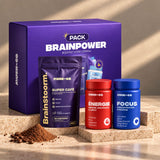
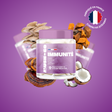
Focus brings together lion's mane and bacopa monnieri — the two best-documented actives in the table — with ginkgo biloba, saffron and maritime pine. Thirty capsules, one a day, caffeine-free, developed in Toulouse and tested batch by batch in an independent laboratory.
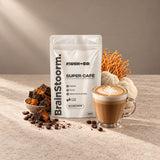
Brainstoorm takes the other route: keeping the morning cup while dividing the caffeine load by four — 20 mg instead of 80 — with 1,000 mg of lion's mane, 1,000 mg of cordyceps and 1,000 mg of chaga in the same cup. The two combine without difficulty.
« I am an entrepreneur and I have never been this focused! »
★★★★★ Raphael G. · verified review of Focus
« Boosts focus and even mood »
★★★★★ Caroline S. · verified review of Focus
Verified customer reviews from the product page, translated from French and left unedited. These are individual experiences, not study results.
Your questions
What you ask us about nootropics.
What is the best natural nootropic?
Three actives have controlled human trials with converging results: lion's mane, bacopa monnieri and the caffeine + L-theanine combination. The choice depends on your difficulty: mental clarity for the first, memory for the second, immediate attention for the third.
How long before you feel the effects?
Except for caffeine, which acts in 15 to 30 minutes, allow several weeks. The bacopa trial reports no effect before the twelfth week; the lion's mane one runs sixteen weeks.
Can you take several at once?
Technically yes, but start with one: it is the only way to know what is working. And be wary of complexes with ten actives, where each dose falls too low to reach those of the trials.
Are natural nootropics safe?
Well tolerated in most cases, but not neutral: ginkgo interacts with anticoagulants, bacopa can cause digestive trouble, saffron and bacopa may interact with an antidepressant. Seek advice if you are on medication.
What is the difference with caffeine?
Caffeine stops you feeling tired by blocking adenosine receptors; it does not change processing capacity. Nootropics are studied on cognitive function itself, and take weeks. They are two different logics.
Is lion's mane a nootropic?
It is the best-documented mushroom for cognitive function, with three human trials. But no claim is authorised in Europe for this species: what we report are trial results in small samples.
Should you take breaks?
Published protocols run up to sixteen continuous weeks, with no reported loss of effect. A one to two week break is common practice, without support in the data — and the effect observed fades within four weeks of stopping.
Are they useful for exams?
Not in the short term. Starting bacopa two weeks before an exam makes no sense given the trial durations. What counts on that timescale: sleep, spacing your revision and your caffeine load.
Sources
The references cited in this article.
- Mori K. et al. (2009). Improving effects of the mushroom Yamabushitake (Hericium erinaceus) on mild cognitive impairment: a double-blind placebo-controlled clinical trial. Phytotherapy Research, 23(3), 367-372.
- Docherty S. et al. (2023). The acute and chronic effects of Lion's Mane mushroom supplementation on cognitive function, stress and mood in young adults. Nutrients, 15(22), 4842.
- Stough C. et al. (2001). The chronic effects of an extract of Bacopa monniera (Brahmi) on cognitive function in healthy human subjects. Psychopharmacology, 156(4), 481-484.
- Kongkeaw C. et al. (2014). Meta-analysis of randomized controlled trials on cognitive effects of Bacopa monnieri extract. Journal of Ethnopharmacology, 151(1), 528-535.
- Haskell C.F. et al. (2008). The effects of L-theanine, caffeine and their combination on cognition and mood. Biological Psychology, 77(2), 113-122.
- EFSA NDA Panel (2015). Scientific Opinion on the safety of caffeine. EFSA Journal, 13(5):4102.
To go further
What to read next.

Discover our mushroom and adaptogenic plant supplements
Our vegan formulas, made in Toulouse by a French manufacturer.