










Mushrooms for sleep: a good idea?
By Pixel Online Création - 19 June 2025

Sleep
Mushrooms for sleep
a good idea?
By the Mush n Go editorial teamUpdated 24 September 202612 min read
Sleep
Yes, it is a good idea if your problem is being unable to switch off in the evening: a racing mind, tension that will not come down, falling asleep that drags on. It is not the right answer if you have sleep apnoea, night-time pain or insomnia that has lasted for months — that calls for a doctor. And it is never a sleeping pill: an evening supplement prepares the ground, it does not trigger sleep.

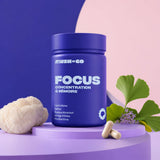
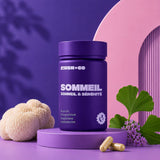
Sleep +
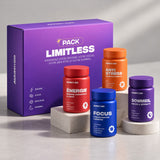
Reishi, valerian, magnesium bisglycinate and melatonin. Melatonin contributes to the reduction of time taken to fall asleep. One capsule thirty minutes before bed.
Discover Sleep + →
Anti-Stress
Ashwagandha and reishi, with holy basil, schisandra and vitamin B6 — for when what keeps you awake actually happens during the day.
Discover Anti-Stress →The verdict
A good idea in three cases, a bad one in three others.
- Yes if you take more than thirty minutes to fall asleep because your mind keeps going.
- Yes if your nights have been deteriorating since a tense period at work or in your personal life.
- Yes if you are trying to recover an evening ritual rather than knock your brain out.
- No if you snore loudly and wake up exhausted: get sleep apnoea investigated first.
- No if pain, reflux or needing the bathroom wakes you: the cause is elsewhere.
- No if the insomnia has lasted more than three months: that is the threshold for chronic insomnia, and it should be treated.
Identifying your problem
Sleeping badly does not mean the same thing for everyone.
In France, the Institut national du sommeil et de la vigilance reports that around one person in three says they have sleep problems. Behind that figure sit three very different situations, which do not call for the same answer.
Sleep will not come
You go to bed tired, and your mind starts up again. More than thirty minutes to fall asleep, several nights a week. This is where an evening ritual makes the most sense.
The night is broken up
You fall asleep fast but wake at 3 am and cannot get back. Look first at evening alcohol, bedroom temperature and the time of your last coffee.
You sleep without recovering
Eight hours on the clock and an exhausted waking. This is the profile where you need to look elsewhere: apnoea, restless legs, a deficiency. A supplement will fix nothing.
What a mushroom does, and does not do
It releases a brake, it does not flip a switch.
A sleeping pill acts on the nervous system to trigger sleep. An evening mushroom supplement does not do that, and it is a difference of nature, not of strength. What is studied is the ability to lower the level of tension that prevents falling asleep — not to produce sleep itself.
The practical consequence is twofold. First, there is no sledgehammer effect: you will not feel yourself "going under" twenty minutes after the capsule. Second, there is no residual effect on waking: no next-day fog, no impaired alertness at the wheel.
No mushroom has an authorised health claim in Europe, including on sleep. In an evening formula, it is melatonin and magnesium that carry authorised claims.
What the studies say
Four reference points, and what they are worth.
Sleep is a field where self-reported studies dominate: participants are asked how they slept. That is data, but it is not a measurement. We flag it every time.
Tang et al., 2005 · China
132 participants, a polysaccharide extract of Ganoderma lucidum for 8 weeks against placebo. More favourable self-reported fatigue and wellbeing scores in the treated group. This is the largest human sample available on reishi; the criteria are entirely self-reported.
Nagano et al., 2010 · Japan
30 women, biscuits containing Hericium erinaceus for 4 weeks. Lower scores on two self-assessment questionnaires than with placebo. Small sample, short duration.
Drake et al., 2013 · United States
400 mg of caffeine taken 6 hours before bed cuts sleep time by about an hour, without participants being aware of it. This is often the first cause to correct, before adding anything.
EU Regulation 432/2012
Melatonin contributes to the reduction of time taken to fall asleep, from 0.5 mg per intake. That is the only authorised claim in this area, and it concerns melatonin, not mushrooms.
In other words: the documented effect of an evening formula rests first on what is added to it, and the mushroom contribution is supported by low-powered work. References at the bottom of the page.
The species involved
Three that belong in the evening, one that does not.
| Species | Place in an evening routine | When |
|---|---|---|
|
Reishi Ganoderma lucidum |
The reference species of evening formulas, and the best documented on this ground. | 30 to 60 min before bed |
|
Lion's mane Hericium erinaceus |
Useful when what keeps you awake is mental rumination rather than physical restlessness. | Morning or evening |
|
Chaga Inonotus obliquus |
No documented effect on sleep. It appears in some formulas for other reasons. | Any time |
| Cordyceps | To avoid in the evening: its research ground is exercise and energy. | Mornings only |
If you want a detailed ranking species by species, we did it here: which is the best mushroom for sleep.
Compared with sleeping pills
Two logics that have nothing in common.
The sleeping pill
It acts fast and strongly. In exchange: possible drowsiness on waking, altered sleep architecture, and a risk of tolerance that explains why such treatments are prescribed for short periods.
The evening supplement
It acts slowly and modestly. In exchange: no next-day fog, no described tolerance, and a logic of groundwork rather than triggering. It takes two weeks to know whether it suits you.
The most important point in this article: if you take a prescribed sleeping pill, never stop it on your own. Abruptly stopping benzodiazepines and related drugs carries a rebound risk. Any reduction is decided and managed with the doctor who prescribed it.
The evening routine
Four time markers that weigh more than the capsule.
After 2 pm
No more coffee. Drake's trial shows that a dose taken six hours before bed costs about an hour of sleep, without you noticing.
Two hours before
The last heavy meal, and the last glass of alcohol. Alcohol makes you drop off and then fragments the second half of the night.
Thirty minutes before
The evening capsule, with a little water. It is also the moment to dim the lights: evening lighting weighs more than most supplements.
At bedtime
A bedroom around 18-19 °C, dark and screen-free. If you are not asleep after twenty minutes, get up and read rather than tossing and turning.
What to sort out first
Three common causes no capsule offsets.
- Residual caffeine. Count your real daily dose, tea and soft drinks included. We did the maths in how many cups of coffee a day.
- The weekend shift. Going to bed and getting up at very different times on Saturday resets the clock every Monday.
- Daytime stress. If your tension never comes down before 11 pm, the lever is during the day, not at bedtime. That is the subject of our article on high cortisol.
Precautions
The cases where you ask first.
Ask your doctor before starting if:
- You take a sleeping pill, an anxiolytic, an antidepressant or an anticoagulant.
- You are pregnant or breastfeeding: melatonin and mushrooms are not advised.
- You are under 18.
- You are allergic to edible mushrooms.
- You have an autoimmune disease or are on immunosuppressive treatment.
- Your nights have been disturbed for more than three months, or those around you report breathing pauses.
Melatonin can also cause drowsiness: do not drive in the hour after taking it.
What we formulated
Sleep +, and why these five ingredients.
« I have been using this product for about three months and it genuinely helps my sleep. »
★★★★★ Patricia R. · verified review of Sleep +
« Calmer when it is time to go to bed »
★★★★★ Mathieu T. · verified review of Sleep +
Verified customer reviews from the product page, translated from French and left unedited. These are individual experiences, not study results.
Your questions
What you ask us about mushrooms and sleep.
Is it a good idea to take mushrooms for sleep?
Yes if your difficulty is switching off in the evening, with falling asleep taking more than thirty minutes. No if you suspect sleep apnoea, if pain wakes you, or if the insomnia has lasted more than three months: those are situations for medical care.
Do they make you sleep like a sleeping pill?
No, and it is a difference of nature. A sleeping pill triggers sleep; an evening formula lowers the tension that prevents it. You will not feel a sledgehammer effect, and you will not have next-day fog.
How long before you see anything?
Allow two weeks for a first impression, four to six for the underlying effect. Melatonin, on the other hand, acts on falling asleep from the first dose.
Can you combine them with a sleeping pill?
That is decided with the doctor who prescribed the sleeping pill, never alone. And never stop an evening medication abruptly: stopping is managed gradually.
Is there a risk of dependence?
No tolerance or withdrawal phenomenon is described for these species. That is one of the important differences from synthetic sleeping pills.
Which mushroom for sleep?
Reishi is the reference species of evening formulas. Lion's mane has its place when mental rumination is involved. Cordyceps, on the other hand, is taken in the morning. We set out the ranking in a dedicated article.
Can you take them every evening?
Published protocols run up to eight continuous weeks. Beyond that, a break is common practice. If you need a supplement every evening for months, that is a sign to see a doctor.
Sources
The references cited in this article.
- Tang W. et al. (2005). A randomized, double-blind and placebo-controlled study of a Ganoderma lucidum polysaccharide extract in neurasthenia. Journal of Medicinal Food, 8(1), 53-58.
- Nagano M. et al. (2010). Reduction of depression and anxiety by 4 weeks Hericium erinaceus intake. Biomedical Research, 31(4), 231-237.
- Drake C. et al. (2013). Caffeine effects on sleep taken 0, 3, or 6 hours before going to bed. Journal of Clinical Sleep Medicine, 9(11), 1195-1200.
- Commission Regulation (EU) No 432/2012 establishing a list of permitted health claims made on foods.
- Institut national du sommeil et de la vigilance (France), annual sleep surveys.
To go further
What to read next.

Discover our mushroom and adaptogenic plant supplements
Our vegan formulas, made in Toulouse by a French manufacturer.