












Does Coffee Help You Lose Weight? What the Studies Actually Show
By the Mush n Go editorial team - 26 November 2026
By the Mush n Go editorial teamPublished 26 November 202614 min read
Coffee and weight
Does coffee help you lose weight? Caffeine slightly increases the energy you burn, by around 3 to 4% for a few hours after 100 mg, and curbs appetite a little, with a clearer effect in people who drink little of it. What really tips the scales is what you put in the cup, and the way coffee affects your sleep.

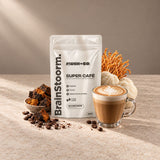
Brainstoorm
Our powdered mushroom coffee: roasted chicory and organic cacao, Lion's Mane, Cordyceps and Chaga at 1,000 mg each, and 20 mg of caffeine per cup. Drink it black or with a dash of milk.
Discover Brainstoorm →
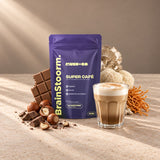
Brainstoorm Coffee
The same formula, in a properly coffee-flavoured version, for anyone who wants to keep the taste of their morning cup with less caffeine.
Discover Brainstoorm Coffee →Caffeine and energy burned
Caffeine makes you burn a bit more, a very little bit.
The idea that coffee helps you lose weight comes from a real effect: caffeine stimulates the nervous system, releases adrenaline and slightly increases the body's heat production, known as thermogenesis. It also promotes the release of stored fat into the blood, to be used as fuel.
The benchmark study dates from 1989. Dulloo and colleagues measured volunteers' energy expenditure after 100 mg of caffeine, the equivalent of a filter coffee. Their resting metabolism rose by 3 to 4% for around two and a half hours. When the dose was repeated every two hours over a day, the extra amounted to a few dozen kilocalories.
What caffeine does
It slightly increases resting energy expenditure and fat mobilisation, for a few hours after the cup.
What that amounts to
A few dozen kilocalories a day, the equivalent of a square of chocolate or a small apple.
Mobilising fat does not mean losing it. If it is not used, through exercise or a calorie deficit, it is stored again. Caffeine slightly improves endurance performance, which is well established: it is during exercise that this mobilised fat is used as fuel. On the sports side, our article coffee before exercise sets out the facts.
Caffeine and appetite
An appetite-suppressing effect that is weak and inconsistent.
Many people notice that a coffee helps them hold out until lunch. Studies confirm an effect, but it is modest and variable. According to literature reviews, caffeine taken before a meal sometimes reduces the amount eaten a little, sometimes not at all, and the effect does not last.
There is also a ritual effect. A morning coffee, hot and bitter and drunk slowly, fills a moment when you might otherwise snack on something. That is useful, provided the cup does not come with pastries or biscuits every time.
- A black coffee before a meal can slightly reduce hunger in some people, not in everyone.
- The effect is clearer in people with excess weight in some studies, but the results remain contradictory.
- Coffee on an empty stomach can also cause heartburn or nausea: our article coffee on an empty stomach explains how to avoid it.
- The slump that follows the caffeine effect sometimes leads to afternoon snacking.
The habit effect
The more coffee you drink, the less it works.
This is the point that slimming promises forget. The body adapts to caffeine taken every day. The clearest effects, on alertness as on energy expenditure, are seen in people who drink little of it. In heavy coffee drinkers, they fade considerably.
The study by Westerterp-Plantenga, published in 2005, illustrates this well. A mixture of green tea and caffeine helped people maintain the weight they had lost, but only among participants who usually consumed little caffeine. Among those who consumed a lot, no benefit appeared. In other words, if you already drink four coffees a day, adding a fifth will change nothing about your weight.
Increasing the dose to get the effect back is not the answer: above 400 mg of caffeine a day, EFSA's benchmark for an adult, jitteriness, palpitations and sleep problems become more common.
What the studies say
Coffee and weight loss: four studies worth knowing.
Here are the most robust studies on the subject, with what they show and what they don't. Full references are at the bottom of the page.
Dulloo et al., 1989 · Switzerland
Lean and formerly obese volunteers were given 100 mg of caffeine. Their resting energy expenditure rose by 3 to 4% for around two and a half hours. Repeated doses throughout the day added a few dozen kilocalories. Limitation: small groups, measured in the laboratory over a single day.
Westerterp-Plantenga et al., 2005 · Netherlands
76 overweight adults followed a four-week diet, then took a mixture of green tea and caffeine or a placebo for three months. The mixture helped them keep the weight off, but only among those who usually consumed little caffeine. Limitation: a single product tested, over a short period.
Lopez-Garcia et al., 2006 · United States
Tens of thousands of men and women followed for 12 years. Those who had increased their caffeine intake had gained slightly less weight than the others, in the order of a few hundred grams. Limitation: an observational study, with a very small difference.
Henn et al., 2023 · United States
Three large American cohorts, more than 150,000 people in total. Each additional cup of unsweetened coffee a day was associated with 0.12 kg less weight gain over four years. Adding a teaspoon of sugar a day was associated, conversely, with 0.09 kg more. Limitation: self-reported data and an association, not proof of cause.
The conclusion is consistent: black coffee is no enemy of your waistline, and might even be a small ally. But its effects are counted in grams, not kilos, and sugar is enough to cancel them out.
What makes you put on weight
It's not the coffee that makes you put on weight, it's what you add to it.
A cup of black coffee provides almost nothing: about 2 kcal. Everything changes with sugar, milk, cream or syrups. A large flavoured latte can provide as much energy as a small meal, without filling you up. Here are some rough figures.
| Drink | Serving | Energy, approx. |
|---|---|---|
| Black coffee, espresso or filter | 1 cup | 2 kcal |
| A sugar cube | 5 g | 20 kcal |
| A dash of semi-skimmed milk | 30 ml | 15 kcal |
| Whole-milk cappuccino | 180 ml | 80 to 110 kcal |
| Large bowl of coffee with whole milk | 300 ml | 150 to 200 kcal |
| A shot of flavoured syrup | 20 ml | 60 to 70 kcal |
| “3-in-1” instant coffee | 1 sachet | 60 to 90 kcal |
Rough figures calculated from the Ciqual food composition table published by the French health agency ANSES, and from common labels. Exact values vary by brand and recipe.
Do the maths over a day: three coffees with two sugars each come to 120 kcal. A large flavoured latte in the afternoon adds another 250 kcal. Over a month, the difference shows. “3-in-1” sachets deserve particular attention: they often list sugar and vegetable fats first. Our article on instant coffee details what they contain.
The myths
Coffee and lemon for weight loss: what you need to know.
Social media is full of recipes for “fat-burning coffee”. None has been validated by a serious study. Here is the truth about the most popular ones.
Coffee with lemon
Lemon mainly makes coffee more acidic, which can bother a sensitive stomach. On the weight side, the caffeine does the work, exactly as in a plain cup.
Coffee with coconut oil or butter
A tablespoon of coconut oil provides about 120 kcal, a knob of butter around a hundred. This coffee fills you up because it is fatty and calorie-rich, not because it melts fat.
Green coffee
Green coffee extract was a huge success after a study published in 2012. It was retracted by its authors in 2014, after an investigation by the US authorities into its data.
“Fat burners”
These supplements often contain a lot of caffeine, sometimes combined with other stimulants. They expose you to high doses in one go, with jitteriness, palpitations and insomnia.
The rule is simple: no drink makes you lose weight on its own. If a recipe promises otherwise, ask yourself who is selling it.
Giving up coffee to lose weight
Giving up coffee to lose weight: good idea or bad idea?
Some people give up coffee thinking they will lose weight. If you drink it black, stopping will do nothing for the scales: on the contrary, you will lose caffeine's small effect on energy expenditure. If you drink it with sugar and milk, stopping can make a difference, but drinking the same coffee without sugar does just as much.
Stopping abruptly also has unpleasant effects: headaches, tiredness and irritability for a few days. And tiredness often leads to snacking. If you want to cut down, it is better to do it gradually, as explained in our article coffee withdrawal: symptoms and how long it lasts.
- You drink your coffee black: keep it, there is nothing to gain from stopping for your weight.
- You sweeten it: cut down on sugar gradually, by half a cube a week. Your taste adapts within a few weeks.
- You drink lattes or flavoured coffees: this is where there is most to gain. Switch to a small size, without syrup.
- Coffee stops you sleeping: that is the best reason to cut down or bring forward the time of your last coffee, as we explain below.
Mushroom coffee and weight loss
Mushroom coffee and weight loss: what can honestly be said.
In several European countries, mushroom coffees are sold with a slimming promise. This is the case with Coffee 2.0, which is widely available in Central and Eastern Europe. We have detailed its composition and doses in our article Coffee 2.0: reviews and composition. Whether we are talking about this brand or another, the rule is the same: no health claim related to weight loss is authorised in Europe for a mushroom.
What really determines a coffee's effect on weight is its caffeine, its sugar and its added ingredients. Before you buy, check the ingredients list: the caffeine dose, whether there is sugar, milk powder or fat, and the actual amount of mushrooms per cup.
Brainstoorm means 20 mg of caffeine per cup, a base of roasted chicory and organic cacao, and Lion's Mane, Cordyceps and Chaga at 1,000 mg each. You keep your hot cup with a quarter of the caffeine of an espresso: drink it without added sugar, that is where the difference with a latte is made.
To compare mushroom coffees on verifiable criteria, such as caffeine, doses and the origin of the extracts, our comparison of mushroom coffees goes through them.
Sleep and cortisol
The real link between coffee and weight runs through the night.
An afternoon coffee has a bigger effect on weight than its few calories: it can cut your night short. And lack of sleep makes you eat more. A meta-analysis by Al Khatib and colleagues in 2017 showed that after a shortened night, participants ate on average around 385 kcal more the next day, without burning any more.
Insufficient sleep disrupts hunger signals and increases cravings for sweet and fatty foods. Chronic stress, with high cortisol, works in the same direction in some people. This is where the idea of “cortisol belly” comes from, which we untangled in our article cortisol belly.
In the morning
Your coffee, black or with a dash of milk, with a breakfast that contains protein and fibre.
Before 2pm
Your last regular coffee, if you go to bed around 11pm.
In the afternoon
A low-caffeine drink such as Brainstoorm, a decaf or a herbal tea, rather than a sweet latte.
In the evening
No caffeine, dimmer screens, a regular bedtime. The best ally for your weight is a full night's sleep.
To set your cut-off time, read our article coffee and sleep. And to understand coffee's effect on the stress hormone, see our in-depth guide coffee and cortisol.
What really matters
Three adjustments that matter more than caffeine.
If your goal is to lose weight, coffee can stay in your life. You just need to make it work for you rather than against you.
What's in the cup
Black coffee, or nearly. Cut down on sugar gradually, swap syrup for a pinch of cinnamon, choose smaller sizes.
When you drink it
Keep caffeine for the morning. A full night's sleep does more for your appetite than any coffee.
The rest of the day
Meals with protein and fibre, daily physical activity, water. That is where most of it is decided.
These adjustments may seem modest, but they are sustainable. Cohort studies suggest as much: over the years, it is small repeated habits, like sugar in your coffee, that make the difference.
Precautions
Coffee and weight loss: the limits to respect.
Using coffee or caffeine as a slimming tool exposes you to excess. Here are the points to watch.
Be careful, and ask your doctor, if:
- You are considering “fat-burning” supplements: they often contain a lot of caffeine. Don't exceed 400 mg of caffeine a day, or 200 mg in a single serving, EFSA's benchmarks.
- You are pregnant or breastfeeding: EFSA recommends not exceeding 200 mg of caffeine a day, and this is not the time for an unsupervised diet.
- You have high blood pressure, a heart rhythm disorder or palpitations: high doses of caffeine can make them worse.
- You regularly use coffee to skip meals or control your hunger: talk to a doctor, as these habits can signal an eating disorder.
- You have gained or lost weight quickly for no obvious reason: see a doctor, as a medical cause needs to be ruled out.
Your questions
Does coffee help you lose weight? Your questions.
Does coffee help you lose weight?
Caffeine slightly increases energy expenditure, by around 3 to 4% for a few hours after 100 mg, and can curb appetite a little. The effect is clearer in people who drink little coffee. At around 2 kcal per cup, black coffee doesn't make you put on weight, and swapping it for a sweetened coffee or a latte cuts calories every day.
Does coffee make you put on weight?
Black coffee provides only about 2 kcal per cup. It is sugar, milk, cream and syrups that make you put on weight. A large flavoured latte can provide more than 200 kcal.
Does coffee with lemon help you lose weight?
Lemon mainly makes coffee more acidic, which can irritate some people's stomachs. For weight, it is the caffeine that works, as in a plain coffee: drink it black, without sugar, preferably in the morning.
Does giving up coffee help you lose weight?
Not if you drink it black. If you sweeten it or take it with milk, cutting down on those additions helps more than giving up coffee itself. Stopping abruptly can even cause tiredness and lead to snacking.
How many cups of coffee a day to lose weight?
One filter coffee, about 100 mg of caffeine, is enough to slightly increase the energy you burn for a few hours. Stay under EFSA's benchmark of 400 mg of caffeine a day for an adult, about four to five coffees, and drink them in the morning rather than later.
Is mushroom coffee a good fit when you are watching your weight?
Drunk without sugar, it replaces a sweetened coffee or a latte, with 20 mg of caffeine per cup for Brainstoorm. What counts is what you add to the cup: keep it plain or use an unsweetened plant-based milk.
Does coffee suppress your appetite?
A little, in some people, and for a short time. Studies give contradictory results. The coffee ritual can also replace a snack, provided it doesn't come with biscuits.
Can coffee stop you losing weight?
Indirectly, if it ruins your sleep. After a shortened night, people eat on average around 385 kcal more the next day. A coffee drunk too late can therefore weigh more through its effects on your night than through its calories.
What coffee should you drink on a diet?
Black coffee, or with a dash of milk, without sugar or syrup, preferably in the morning. In the afternoon, a decaf, chicory or a low-caffeine drink avoids disturbing your sleep.
Sources
- Dulloo A. G., Geissler C. A., Horton T. et al. (1989). Normal caffeine consumption: influence on thermogenesis and daily energy expenditure in lean and postobese human volunteers. American Journal of Clinical Nutrition, 49(1).
- Westerterp-Plantenga M. S., Lejeune M. P., Kovacs E. M. (2005). Body weight loss and weight maintenance in relation to habitual caffeine intake and green tea supplementation. Obesity Research, 13(7).
- Lopez-Garcia E., van Dam R. M., Rajpathak S. et al. (2006). Changes in caffeine intake and long-term weight change in men and women. American Journal of Clinical Nutrition, 83(3).
- Henn M., Glenn A. J., Willett W. C. et al. (2023). Changes in coffee intake, added sugar and long-term weight change: results from three prospective cohort studies. American Journal of Clinical Nutrition, 118(1).
- Al Khatib H. K., Harding S. V., Darzi J., Pot G. K. (2017). The effects of partial sleep deprivation on energy balance: a systematic review and meta-analysis. European Journal of Clinical Nutrition, 71(5).
- Vinson J. A., Burnham B. R., Nagendran M. V. (2012, retracted in 2014). Randomized, double-blind, placebo-controlled, linear dose, crossover study to evaluate the efficacy and safety of a green coffee bean extract in overweight subjects. Diabetes, Metabolic Syndrome and Obesity, 5.
- ANSES (French health agency). Ciqual food composition table.
- EFSA NDA Panel (2015). Scientific opinion on the safety of caffeine. EFSA Journal, 13(5):4102.
Keep reading
Further reading.
Coffee has many other effects besides those on weight. Explore our other guides, or our mushroom coffee Brainstoorm.

Discover our mushroom and adaptogenic plant supplements
Our vegan formulas, made in Toulouse by a French manufacturer.