
























Coffee and Diarrhoea: Why Coffee Makes You Poo, and How to Avoid It
By the Mush n Go editorial team - 31 October 2026
By the Mush n Go editorial teamPublished 31 October 202613 min read
Coffee and your gut
The link between coffee and diarrhoea is very real: coffee stimulates gastrin and colon contractions, and in sensitive people the colon reacts within four minutes, with or without caffeine. Milk, sugar, sweeteners and an empty stomach often make it worse. Here is how to find your trigger and keep your cup.

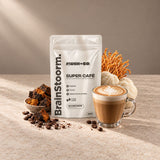
Brainstoorm
Our mushroom coffee: 20 mg of microencapsulated caffeine instead of 80, in a base of roasted chicory and organic cacao, with 6,040 mg of active ingredients per cup.
Discover Brainstoorm →
Energy
Cordyceps, maca, ginger and vitamin C in capsules, without a drop of coffee. Vitamin C contributes to the reduction of tiredness and fatigue.
Discover Energy →The mechanism
Why does coffee make you need the toilet?
You drink your first coffee, and twenty minutes later you can't leave the house without a detour. Don't worry: it is one of the best-described reactions to coffee in research. It does not mean you have poor digestion, nor that coffee necessarily “irritates” you. Above all, it shows that your digestive tract responds quickly to what you swallow.
Coffee does not act through a single lever, but through several at once. Some work via the stomach, others via digestive hormones, others still via nerve reflexes. Here are the four that matter.
- Gastrin. Coffee, caffeinated or decaf, raises this hormone produced by the stomach. It increases acid secretion and speeds up emptying from the stomach into the intestine.
- The gastrocolic reflex. When the stomach fills up, it sends a signal to the colon to empty and make room. A hot drink taken in the morning on an empty stomach triggers this reflex very effectively.
- Cholecystokinin. Coffee stimulates the release of this hormone, which makes the gallbladder contract. Bile reaches the intestine, which helps speed up transit.
- Acidity and coffee compounds. Chlorogenic acids and other molecules formed during roasting act on the gut wall, independently of caffeine.
The result: in some coffee drinkers, colon movements increase markedly in the minutes after the cup. If these movements happen too fast, water does not have time to be reabsorbed in the colon, and stools become soft or liquid. That is coffee diarrhoea.
This mechanism also explains why the morning coffee is often the only one affected. After a night of fasting, the colon is ready to empty, and coffee acts as the trigger. The same coffee drunk after lunch often has much less effect.
Caffeine or not
Decaf does almost the same: caffeine is not alone.
Caffeine often gets the blame. It plays a part, but it does not explain everything. A small American study from 1998, led by Satish Rao, directly measured colon activity in healthy volunteers after different drinks and a meal. Caffeinated coffee stimulated the colon as much as a full 1,000 kcal meal. And decaf stimulated it too, slightly less strongly.
| What was swallowed | Effect on the colon | Key takeaway |
|---|---|---|
| Caffeinated coffee | Comparable to a 1,000 kcal meal | The strongest of the liquids tested |
| Decaf | About 23% less than caffeinated | The effect remains clear without caffeine |
| Hot water | About 60% less than caffeinated | Heat alone is not enough |
| 1,000 kcal meal | Reference | The classic gastrocolic reflex |
Based on Rao et al., 1998. Small sample of healthy volunteers, activity measured by a probe in the colon. The percentages compare the intensity of motor activity.
Two practical lessons follow. First, switching to decaf coffee can reduce the effect, but rarely eliminates it. Second, cutting down on caffeine is still useful: it is what makes the difference between caffeinated and decaf in this study. Reducing the dose does not switch off the reflex, but it often becomes more bearable.
Caffeine also has another effect on the gut: it stimulates the nervous system, and a nervous gut is a faster gut. People who are stressed or anxious know this well. If your coffee also makes you tense, our article coffee and anxiety explains the link.
What the studies say
Coffee and diarrhoea: four studies worth knowing.
Few teams have measured the effect of coffee on the gut, but their results agree. Full references are at the bottom of the page.
Brown, Cann and Read, 1990 · United Kingdom
Of 99 healthy young adults surveyed, 29% said they felt the urge to open their bowels after a coffee, women more often than men. In sensitive volunteers, recordings of the final part of the colon showed increased motor activity from four minutes after the cup, lasting at least thirty minutes. Limitation: a small group recorded, young people only.
Rao et al., 1998 · United States
In healthy volunteers, caffeinated coffee stimulated colon activity as much as a 1,000 kcal meal, 60% more strongly than water and 23% more strongly than decaf. The effect was concentrated on the left side of the colon, the part just before the rectum. Limitation: small sample, one-off measurement.
Acquaviva et al., 1986 · Italy
This team compared the effect of regular and decaf coffee on gastrin, the stomach's digestive hormone. Both raised its blood level. It is one of the explanations for why decaf also affects transit. Limitation: an old study, focused on a single hormone.
Müller et al., 2012 · Germany
80 patients who had colon surgery were randomly given coffee or water three times a day after the operation. In the coffee group, the first bowel movement came sooner, after about 60 hours versus 74. Surgeons have since used coffee as a simple boost for transit. Limitation: a very particular context, far removed from the morning coffee.
In short: the effect of coffee on the gut is real, fast and partly independent of caffeine. But it only affects some drinkers, and its intensity depends a lot on what you add to the cup.
The real culprits
Often, it's not the coffee, it's what comes with it.
Before you give up coffee, look at what goes with it. In many cases, the diarrhoea comes from an added ingredient, or from when you drink it. Four suspects come up again and again.
Milk and lactose
A large proportion of adults do not digest lactose, the sugar in milk, well. A large milky coffee easily provides 5 g or more, as cow's milk contains around 5 g per 100 ml. In those affected, this is enough to cause gas, bloating and loose stools.
Sweeteners
Sorbitol, xylitol, maltitol: these polyols, found in some syrups, sweetener tablets or flavoured pods, draw water into the gut. Products containing more than 10% must in fact carry the statement “excessive consumption may produce laxative effects”.
Sugar in large amounts
A very sweet coffee, a flavoured latte or a creamy frappé brings a load of sugar and fat that also speeds up stomach emptying. These are no longer really coffees, but small desserts.
An empty stomach
Coffee drunk on an empty stomach arrives in an empty stomach and a colon ready to empty. The effect is at its strongest. The same coffee taken during or after breakfast is often much better tolerated.
Other factors also play a part: the total amount of coffee in the day, the morning cigarette that sometimes goes with it, or stress. A gut that is already under strain reacts more strongly. For the bloated-belly side, our article coffee and bloating covers the same culprits, and for when to have your cup, see our guide to coffee on an empty stomach.
Depending on how it's made
Espresso, filter, instant: what really changes.
All coffees stimulate the gut, but not with the same force. Three parameters matter: the caffeine dose, the volume of hot liquid and what you add. Here are the benchmarks to keep in mind, with EFSA's caffeine contents.
| Drink | Caffeine, approx. | What affects the gut |
|---|---|---|
| Espresso (60 ml) | 80 mg | Small volume, concentrated caffeine, often drunk on an empty stomach |
| Filter coffee (200 ml) | 90 mg | Large hot volume, often several cups in a row |
| Instant coffee | Varies with the dose | Often slightly less caffeine, but the same acidic compounds |
| White coffee, latte | Same as the base coffee | Lactose adds to the effect of the coffee |
| Decaf | A few mg | Effect on the colon reduced, not eliminated |
| Brainstoorm (1 cup) | 20 mg | Four times less caffeine than an espresso, chicory and cacao base |
EFSA benchmarks (2015) for espresso and filter coffee. Brainstoorm: dose set by the recipe, NewCaff® microencapsulated caffeine. Actual contents vary with the coffee and the preparation.
A mushroom coffee like Brainstoorm does not switch off the gastrocolic reflex: it is a hot drink, and its effect still depends on an empty stomach and on what you add to it. On the other hand, with 20 mg of caffeine, it removes a good part of the stimulation linked to caffeine. Let's also be honest on one point: chicory provides fibre, including inulin, which can cause some gas in the first few days in sensitive people. Starting with half a dose helps you get used to it.
Many of our customers have switched to it to cut down on caffeine, and mainly describe steadier energy.
“I was sceptical and in the end I'm won over. Less caffeine and yet I'm full of energy and my mood is steady”
★★★★★ Maïté S. · 4 April 2026
“I love your coffee with that little hint of chicory, I'm hooked now.”
★★★★★ Didier P. · 28 August 2026
Trustpilot reviews published about Brainstoorm, quoted as written.
Coffee and your gut
Coffee and constipation, IBS: the same coffee, two effects.
The same mechanism that bothers some people helps others. If you tend to be constipated, your morning coffee may be your best ally. If your gut is sensitive, it may be one trigger among others. Here is how to make sense of it.
Coffee and constipation
In people with slow transit, a coffee after breakfast often helps trigger the morning bowel movement. It does not replace fibre, water and physical activity, but it is a useful addition to them.
Irritable bowel syndrome
In irritable bowel syndrome (IBS), coffee is among the foods often cited as triggers. The reaction is very individual: some people tolerate it well in small amounts, others do not. The test described below helps you decide.
Dehydration
You often hear that coffee “dehydrates” you and causes constipation. In regular drinkers, that is not what trials show: in the one by Killer et al. (2014), four cups a day hydrated as well as the same amount of water.
After surgery
Digestive surgeons sometimes offer coffee after colon surgery, to help get transit going again. This is only done on the advice of the medical team.
Stress also weighs on the gut-brain axis. An irritable bowel is often more reactive in times of tension, and coffee then lands on already sensitive ground. If this rings a bell, our guide on how to lower cortisol ranks the levers that have evidence behind them.
Gas and black stools
Coffee and wind, coffee and black stools: what is normal.
Two questions often come up after the one about diarrhoea. They do not have the same answer.
Intestinal gas. Black coffee itself produces little gas: it contains almost no fermentable sugars. Gas comes more from milk, sweeteners, added fibre or air swallowed when drinking quickly. By speeding up transit, coffee can also send poorly digested food into the colon sooner, where it ferments.
- Gas and a bloated belly after a white coffee: try a week with lactose-free milk or a plant-based drink.
- Gas after a “sugar-free” sweet drink: check the label for sorbitol, xylitol or maltitol.
- Gas after a chicory drink: reduce the dose for a few days, while your gut gets used to the fibre.
- Stools that are simply darker after a lot of coffee: nothing worrying in itself, but a black, sticky appearance is another matter.
Black stools. Coffee does not turn stools black. Black, tarry stools with a very strong smell, known as melaena, can signal bleeding in the upper part of the digestive tract: they warrant prompt medical advice. Other causes are harmless: iron supplements, activated charcoal, bismuth medicines, blueberries, liquorice or black pudding. If you cannot find a simple explanation, don't look for the culprit in your cup: call your doctor.
The 7-day test
Identify your trigger in one week.
Rather than cutting everything out at once, isolate the factors one by one. A week is often enough to understand whether it is the coffee, the milk, the timing or the amount. Each day, note the time of your coffees, what you add to them, what you eat with them, and your trips to the toilet.
Days 1 and 2: the starting point
Change nothing. Simply note your habits and symptoms. You will have an honest baseline for comparison.
Days 3 and 4: coffee after eating
Same coffee, same amount, but drunk during or after breakfast, never on an empty stomach. If symptoms drop clearly, timing was the cause.
Days 5 and 6: no milk or sweetener
Black coffee, or with lactose-free milk. No syrup, no sweetener tablets. If everything calms down, the milk or the polyols were the cause.
Day 7: less caffeine
Replace one cup in two with a decaf or a low-caffeine drink. If your stools return to normal, the caffeine dose was the issue.
If nothing changes by the end of the week, even though you have adjusted the timing, the additions and the dose, coffee is probably not the main cause. It is time to look elsewhere, and to read the next section on the signs that mean you should see a doctor.
Keeping your coffee
How to avoid diarrhoea without giving up coffee.
Once you have identified your trigger, a few adjustments are enough in most cases. There is no need to go beyond EFSA's benchmarks: up to 400 mg of caffeine a day for a healthy adult, and no more than 200 mg in a single dose. Our guide how many cups of coffee a day turns these figures into cups.
Eat first
Have your coffee during or after breakfast, with a food that contains fibre and protein: wholemeal bread, yoghurt, egg, porridge oats.
Lighten your cup
Black coffee or lactose-free milk, no polyol sweetener, a smaller cup. Spread your coffees out instead of having two large ones back to back.
Lower the caffeine
Replace some of your coffees with a decaf, chicory or a low-caffeine drink. The ritual stays, the stimulation drops.
If you want to cut down significantly, do it gradually: stopping suddenly often brings headaches and fatigue for a few days. Our article on caffeine withdrawal explains how to avoid these effects, and our guide coffee alternatives compares the options. For flavour, our chicory selection and our mushroom coffee keep that roasted bitterness with much less caffeine.
When to see a doctor
When it's no longer the coffee.
A loose stool after your morning coffee, with no other symptoms, is nothing to worry about. However, some signs should never be put down to coffee. Diarrhoea is called chronic when it lasts more than four weeks.
See your doctor without delay if:
- You see blood in your stools, or black, tarry stools.
- The diarrhoea wakes you at night, or happens even without coffee.
- It comes with fever, severe abdominal pain or vomiting.
- You are losing weight for no reason, or you are very tired.
- It lasts more than a few weeks despite the adjustments.
- You are over 50 and your bowel habits have changed recently, or there are cases of colorectal cancer in your family.
- You show signs of dehydration: intense thirst, little and dark urine, dizziness.
Pregnant or breastfeeding women have a specific benchmark: EFSA recommends not exceeding 200 mg of caffeine a day, from all sources combined. And if you take any medication, ask your pharmacist whether caffeine can interact with it.
Your questions
Coffee and diarrhoea: your questions.
Why does coffee give me diarrhoea?
Because it stimulates gastrin, a stomach hormone, and the reflex that pushes the colon to empty. In sensitive people, colon activity increases from four minutes after the cup. If transit speeds up too much, water is not reabsorbed and stools become liquid.
Is it normal to need the toilet after a coffee?
Yes. In a British study from 1990, almost a third of the young adults surveyed felt this urge after a coffee, women more often. As long as there is no pain, no blood and no persistent diarrhoea, it is a normal reaction.
Can decaf coffee also cause diarrhoea?
It can, but usually less strongly. In Rao's study (1998), decaf stimulated the colon about 23% less than caffeinated coffee. Compounds other than caffeine, such as those that raise gastrin, also play a part.
Does coffee with milk cause more diarrhoea?
Often, yes, in people who do not digest lactose well. Cow's milk contains about 5 g per 100 ml, enough to cause gas and loose stools. Try a week with lactose-free milk or a plant-based drink to tell the difference.
Can coffee cause constipation?
Rarely. In most people, it tends to speed up transit. In regular drinkers, it does not significantly dehydrate you at moderate doses either. Constipation that sets in almost always has other causes: lack of fibre, water or activity.
Does coffee cause black stools?
No. Black, tarry stools can signal digestive bleeding and require a prompt medical consultation. The most common harmless causes are iron, activated charcoal, bismuth, blueberries or liquorice.
Does coffee give you wind?
Black coffee produces little, as it contains very few fermentable sugars. Gas most often comes from milk, polyol sweeteners or added fibre. By speeding up transit, however, coffee can encourage the fermentation of poorly digested food.
How can you drink coffee without getting diarrhoea?
Drink it during or after a meal rather than on an empty stomach, without milk if you do not digest lactose well, without polyol sweeteners, and in smaller cups. If that is not enough, replace some of your coffees with a decaf or a lower-caffeine drink.
Does coffee on an empty stomach cause more diarrhoea?
Yes, that is when the effect is strongest. After the night, the colon is ready to empty, and hot coffee in an empty stomach fully triggers the gastrocolic reflex. The same coffee after breakfast is often better tolerated.
When should you worry about diarrhoea after coffee?
When it comes with blood, fever, severe pain, night-time waking or weight loss, or when it persists without coffee. Diarrhoea that lasts more than four weeks is called chronic and should be investigated by a doctor.
Sources
- Brown S. R., Cann P. A., Read N. W. (1990). Effect of coffee on distal colon function. Gut, 31(4), 450-453.
- Rao S. S. C., Welcher K., Zimmerman B., Stumbo P. (1998). Is coffee a colonic stimulant? European Journal of Gastroenterology & Hepatology, 10(2), 113-118.
- Acquaviva F. et al. (1986). Effect of regular and decaffeinated coffee on serum gastrin levels. Journal of Clinical Gastroenterology, 8(2), 150-153.
- Douglas B. R. et al. (1990). Coffee stimulation of cholecystokinin release and gallbladder contraction in humans. American Journal of Clinical Nutrition, 52(3), 553-556.
- Müller S. A. et al. (2012). Randomized clinical trial on the effect of coffee on postoperative ileus following elective colectomy. British Journal of Surgery, 99(11), 1530-1538.
- Killer S. C., Blannin A. K., Jeukendrup A. E. (2014). No evidence of dehydration with moderate daily coffee intake: a counterbalanced cross-over study in a free-living population. PLoS ONE, 9(1), e84154.
- Nehlig A. (2022). Effects of coffee on the gastro-intestinal tract: a narrative review and literature update. Nutrients, 14(2), 399.
- EFSA NDA Panel (2015). Scientific opinion on the safety of caffeine. EFSA Journal, 13(5):4102.
- Regulation (EU) No 1169/2011 on the provision of food information to consumers, Annex III (polyol statement).
Keep reading
Further reading.
Coffee and digestion is a whole topic of its own. Explore our other guides, or our mushroom coffee Brainstoorm.

Discover our mushroom and adaptogenic plant supplements
Our vegan formulas, made in Toulouse by a French manufacturer.