























Menopause brain fog: why your memory slips and how to clear your head
By the Mush n Go editorial team - 10 November 2026
By the Mush n Go editorial teamNovember 202613 min read
Perimenopause and memory
Menopause brain fog, those words that slip away, the forgetfulness and the concentration that falters, affects a large share of women in perimenopause. It is real, linked to hormonal changes and broken nights, and it is usually temporary: studies show recovery after menopause. Here is where it comes from, what helps day to day and when to see a doctor.

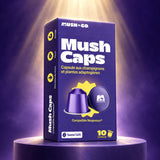
Focus
Lion's Mane from the fruiting body, ginkgo, bacopa, saffron and maritime pine, with vitamins B2 and B3. Niacin contributes to normal psychological function.
Discover Focus →
Brainstoorm
Lion's Mane, Cordyceps and Chaga, maca and ashwagandha, 20 mg of caffeine per cup. Pantothenic acid contributes to normal mental performance.
Discover Brainstoorm →What women experience
Menopause brain fog: you're not imagining it.
You walk into a room and can't remember why. A colleague's name stays on the tip of your tongue. You reread the same paragraph three times. In meetings, the right word arrives a second late. Many women aged 45 to 55 describe exactly these scenes, often with a worry they don't dare put into words: “what if it's the start of something else?”
This fog has a precise context. Perimenopause is the transition period before the last period. It starts on average around 45-47 and lasts about four years, with wide variations from one woman to another. Menopause itself is confirmed after 12 consecutive months without a period, at 51 on average in France. Brain fog is most marked during the transition, not years afterwards.
Words
Word-finding difficulty, or the “tip of the tongue” feeling, is the most common complaint. Proper names go first.
Working memory
Holding a number in your head, following two conversations, keeping track of a task when you're interrupted all take more effort.
Attention
Concentration holds for less time, especially in the afternoon and after a bad night. Careless mistakes increase.
Speed
You do the same things, but more slowly. The feeling of a “head full of cotton wool” dominates, more than any real loss of memories.
What doesn't change, on the other hand, is what matters most: your knowledge, your judgement, your ability to reason. If brain fog interests you beyond menopause, our general article on the causes of and solutions for brain fog reviews every lead, from sleep to the thyroid.
Why menopause clouds your head
Oestrogen also works for your brain.
Oestrogen isn't only about your cycle. The brain has many oestrogen receptors, particularly in the hippocampus, the memory area, and in the prefrontal cortex, the area of attention and organisation. Oestradiol plays a part in how neurons use glucose to produce energy and in the plasticity of connections.
During perimenopause, the problem is not so much a steady decline as a series of rollercoasters: cycles where oestrogen rises very high, others where it collapses, ovulation becoming rarer and progesterone falling. The brain has to keep adapting. It is this phase of instability that coincides with the peak in cognitive complaints.
Premenopause
Cycles still regular, possible first subtle signs: lighter sleep before periods, irritability.
Early perimenopause
Cycles that vary by 7 days or more. Hormones fluctuate strongly. The first memory complaints often appear here.
Late perimenopause
Months without a period, then periods again. Hot flushes and broken nights are common: the fog is often at its worst.
After menopause
Hormones settle at a low level. Studies following the same women over time show performance returning.
These stages follow the international STRAW+10 classification, used by gynaecologists to place a woman within her transition. They overlap, and not all women experience every symptom. For an overview of the whole period, our guide menopause and perimenopause: natural remedies covers each symptom.
The role of broken nights
A foggy head is often a broken night.
The second big driver of menopause brain fog is sleep. Waking at 3 or 4am, night sweats that make you get up, lighter nights: they add up. And sleep is when the brain consolidates what it has learned during the day. A week of fragmented nights is enough to slow anyone down, menopause or not.
Stress does the rest. Perimenopause often comes at a busy time of life, between teenagers, ageing parents and responsibilities at work. Mood also becomes more fragile during the transition, and anxiety or low mood weigh directly on concentration. These three factors, hormones, sleep and mood, feed one another.
- Nights: waking, sweats, light sleep. Our article on menopause insomnia details the levers to repair them.
- Fatigue: it sets in when nights no longer restore you. We covered it in an article dedicated to menopause fatigue.
- Mood: irritability, anxiety, tearfulness. They are not “all in your head”, and they clutter working memory.
- Mental load: the more you carry at once, the more every lapse shows.
It's good news, in a way: while you can't control your hormones, you can control your sleep, your activity and how you organise your days. That is where most of the levers are.
What the studies say
Four studies to understand this fog.
Research on cognition during menopause has come a long way in twenty years. Here are four studies that matter, with their limits. Full references are at the bottom of the page.
Greendale et al., 2009 · United States
In the large SWAN cohort, more than 2,300 women took memory and speed tests over several years. In perimenopause, they no longer improved from one session to the next, as you would expect when repeating a test. After menopause, the improvement resumed. The sign of a difficult passage, not of decline.
Mosconi et al., 2021 · United States
Using brain imaging, this team compared women aged 40 to 65 before, during and after menopause, and men of the same age. The transition came with changes in the brain's structure, connectivity and energy metabolism, partly compensated after menopause. An observational study: it describes, it does not prove a cause.
Maki et al., 2008 · United States
In around thirty women wearing a monitor that objectively detects hot flushes, the more flushes they had, the poorer their verbal memory performance. A small sample, but a direct link between physical symptoms and memory.
Nagano et al., 2010 · Japan
Thirty women ate biscuits containing 2 g of Lion's Mane, Hericium erinaceus, or placebo biscuits for 4 weeks. The Lion's Mane group saw their irritability and anxiety scores fall on questionnaires. A very small sample and a food format different from a capsule: a lead, not proof.
Together, these studies paint a reassuring picture: perimenopause brain fog is measurable, it has identifiable causes, and it tends to lift once the transition is over.
Other causes to check
Before blaming your hormones, check three things.
At 45-55, other common causes produce exactly the same symptoms. They are simple to screen for, and they can be treated. Don't put everything down to menopause without talking to your doctor.
| Possible cause | Signs that point to it | What is checked |
|---|---|---|
| Iron deficiency | Heavy or frequent periods in perimenopause, breathlessness, pallor, brittle nails | Ferritin and full blood count |
| Thyroid | Fatigue, feeling the cold, weight gain, dry skin, slowing down | TSH test |
| Depressed mood | Lasting sadness, loss of interest, early waking with dark thoughts | A conversation with your doctor |
| Sleep apnoea | Snoring, waking with a dry mouth, daytime drowsiness | Questionnaire, then a sleep study |
| Vitamin B12 | Strict plant-based diet, long-term treatment for stomach acid, pins and needles | Blood test on medical advice |
| Medicines | Sleeping pills, antihistamines, some painkillers taken in the evening | Review your prescriptions with your doctor |
Iron deficiency deserves particular attention: periods often become heavier during perimenopause, and fatigue and poor concentration are classic signs of it.
Normal forgetfulness or warning sign
Forgetting a name is not losing your memory.
This is the fear that comes up most often: early Alzheimer's disease. The difference lies in the nature of the lapses. Perimenopause brain fog affects access to information: the word eventually comes back, the forgotten appointment comes back to mind later. A memory disease erases the information itself, and it shows in daily life.
See your doctor if:
- You get lost on a familiar route, or no longer know how to use a familiar appliance.
- Those close to you notice that you repeat the same questions or forget entire conversations.
- The difficulties get markedly worse over a few weeks or months.
- They come with other signs: unusual headaches, speech problems, weakness on one side, vision problems.
- You feel lasting sadness or dark thoughts. If you have suicidal thoughts, call 116 123 (Samaritans), free, 24 hours a day.
In all other cases, a consultation is still useful to take stock of the transition, your periods, your sleep and your mood. Menopausal hormone therapy, when indicated, is discussed with a doctor or a midwife: the French CNGOF and GEMVi guidelines reserve it for bothersome symptoms, and it is not prescribed for memory alone.
Habits that help
Seven habits that clear your head.
These are the best-supported levers. None is specific to menopause, but all of them act on the three drivers of brain fog: sleep, stress and the energy available to the brain.
Protect your sleep
A fixed wake-up time, a cool bedroom at around 18 °C, no screens in the hour before bed. Adults need at least 7 hours a night.
Move every day
The WHO recommends 150 minutes of moderate activity per week, plus two strength sessions. Brisk walking counts, and it helps you sleep too.
Get out into morning light
Twenty minutes outdoors within an hour of getting up helps set your body clock. It's one of the simplest ways to sleep better at night.
Limit alcohol
It weakens the second half of the night, and many women name it among their hot flush triggers. The evening glass often has to be paid for the next morning.
Offload your memory
Lists, a shared calendar, one task at a time. It isn't cheating: it frees your working memory for what matters.
Eat for your brain
Oily fish twice a week, pulses, berries, nuts. Our list of foods for memory covers each food group.
Talk about it
Telling the people around you that this is a difficult time reduces the pressure. Cognitive behavioural therapies have shown their value for how menopause symptoms are experienced.
If concentration at work is your main concern, our guide to concentration problems offers practical methods to organise a demanding working day.
Supplements
Lion's Mane, saffron, B vitamins: what we know.
Many supplements sold for menopause target hot flushes. For your head, other ingredients are being studied. Here is what the data say, without embellishment.
| Ingredient | What the studies show | Level of evidence |
|---|---|---|
| Lion's Mane | One trial in 30 women: lower irritability and anxiety scores in 4 weeks; a Japanese trial in adults aged 50 to 80 with memory complaints | Small trials, to be confirmed |
| Saffron | One trial in 86 women in perimenopause: a greater fall in anxiety and low mood than with placebo over 12 weeks, with no effect on hot flushes | One controlled trial, specific extract |
| Bacopa | A plant from the Ayurvedic tradition, studied for memory in adults and older people | Several trials, modest effects |
| Vitamins B2, B3, B5 | Official claims: niacin contributes to normal psychological function; pantothenic acid contributes to normal mental performance | Claims authorised by the EU |
| Soy isoflavones | Studied mainly for hot flushes; data on memory are contradictory | Inconclusive for the brain |
The saffron in the 2021 trial was a specific extract, at 28 mg per day. Focus contains 14 mg of a different saffron extract: the results of one trial do not automatically carry over to another formula.
To go further on the most studied functional mushroom for the brain, read our guide Lion's Mane: dosage and studies, or our page on Lion's Mane. Saffron and bacopa also have their own pages. And if you are comparing menopause supplements on the market, our comparison of menopause supplements says which one targets what.
A routine for your head
Focus and Brainstoorm, in their rightful place.
We have no product for hot flushes, and we don't claim to. Our formulas are about your head and your days: foggy mornings, concentration that gives out, the need for a coffee that doesn't make you jittery. Here is how they fit into a perimenopause day.
When you get up
Daylight, a big glass of water. A cup of Brainstoorm instead of a first coffee: Lion's Mane, Cordyceps and Chaga, 6 mg of vitamin B5 and 20 mg of caffeine, against around 80 mg for an espresso.
At breakfast
One capsule of Focus with a glass of water. Lion's Mane, ginkgo, bacopa, saffron, maritime pine, vitamins B2 and B3. Riboflavin contributes to normal functioning of the nervous system.
Mid-morning
The time for the tasks that need the most concentration. One at a time, phone face down.
Around 2pm
Last regular coffee. After that, caffeine weighs on the night, and the night on the next day's fog.
In the evening
Low light, a list for tomorrow, screens put away. If nights are your weak point, see our article on menopause insomnia.
To cover morning, daytime and evening in a single order, our Perimenopause Pack brings together Brainstoorm, Anti-Stress and Sleep+.
Precautions:
- Focus is not recommended for pregnant or breastfeeding women, if you take antidepressants or in case of epilepsy. Some antidepressants are prescribed for hot flushes: if that applies to you, Focus is not for you.
- Ask your doctor's advice if you take an anticoagulant, because of the ginkgo.
- Brainstoorm contains caffeine and is not recommended in case of thyroid, liver or heart problems.
- A food supplement should not replace a varied and balanced diet. Do not exceed the stated daily dose.
Focus is taken as a 30-day course, and you have 60 days to change your mind, even on opened boxes. To understand the family of ingredients it belongs to, our guide to natural nootropics sets out the facts.

The Perimenopause Pack
Brainstoorm in the morning, Anti-Stress during the day, Sleep+ in the evening: all three products together in a 30-day ritual, cheaper than buying them separately, as a one-off purchase or a subscription.
Discover the Perimenopause Pack →Your questions
Menopause brain fog: your questions.
Can menopause cause brain fog?
Yes. Fluctuations in oestrogen during perimenopause act on the brain areas linked to memory and attention, and broken nights make it worse. Menopause brain fog is common, real and measurable in studies.
How long does menopause brain fog last?
It is most marked during perimenopause, which lasts about four years on average. In the SWAN cohort, memory performance resumed its improvement after menopause. The duration varies a lot from one woman to another.
Is menopause memory loss a sign of Alzheimer's?
In the vast majority of cases, no. Menopause brain fog affects access to words and attention, and the information eventually comes back. See a doctor if you get lost on a familiar route, if those close to you are worried or if the problems get worse quickly.
What are the symptoms of brain fog in perimenopause?
Words on the tip of your tongue, forgotten appointments, difficulty keeping track of a task, slower thinking and a feeling of a head full of cotton wool. These symptoms are often stronger after a bad night.
Which supplement should I take for memory during menopause?
No supplement has proven an effect on menopause brain fog. Lion's Mane and saffron have been tested in small trials in women, with encouraging results on mood. B vitamins have official claims: niacin contributes to normal psychological function.
Does hormone therapy improve memory?
It is not prescribed for memory alone. By relieving hot flushes and night sweats, it can improve sleep, and therefore concentration. The decision is made with your doctor, based on your symptoms and medical history.
Does lack of sleep make brain fog worse?
Yes, markedly. Sleep serves to consolidate memory, and a few fragmented nights are enough to slow your thinking. During menopause, repairing your nights is often the most effective lever against brain fog.
Can a deficiency explain my concentration problems?
It's possible. Heavy periods in perimenopause encourage iron deficiency, and a lack of vitamin B12 or an underactive thyroid also cause concentration problems. A blood test prescribed by your doctor can check this.
Can I drink coffee if I have brain fog?
Yes, in moderation and in the morning. Caffeine helps alertness in the moment, but a coffee after 2pm can damage the following night. A less caffeinated coffee in the afternoon, or a drink with 20 mg of caffeine, limits this effect.
Sources
- Assurance Maladie (French national health insurance). Ménopause : définition, symptômes et diagnostic. ameli.fr.
- McKinlay S. M., Brambilla D. J., Posner J. G. (1992). The normal menopause transition. Maturitas, 14(2), 103-115.
- Harlow S. D. et al. (2012). Executive summary of the Stages of Reproductive Aging Workshop + 10: addressing the unfinished agenda of staging reproductive aging. Menopause, 19(4), 387-395.
- Greendale G. A. et al. (2009). Effects of the menopause transition and hormone use on cognitive performance in midlife women. Neurology, 72(21), 1850-1857.
- Mosconi L. et al. (2021). Menopause impacts human brain structure, connectivity, energy metabolism, and amyloid-beta deposition. Scientific Reports, 11, 10867.
- Maki P. M. et al. (2008). Objective hot flashes are negatively related to verbal memory performance in midlife women. Menopause, 15(5), 848-856.
- Nagano M. et al. (2010). Reduction of depression and anxiety by 4 weeks Hericium erinaceus intake. Biomedical Research, 31(4), 231-237.
- Mori K. et al. (2009). Improving effects of the mushroom Yamabushitake (Hericium erinaceus) on mild cognitive impairment: a double-blind placebo-controlled clinical trial. Phytotherapy Research, 23(3), 367-372.
- Lopresti A. L., Smith S. J. (2021). The effects of a saffron extract (affron) on menopausal symptoms in women during perimenopause: a randomised, double-blind, placebo-controlled study. Journal of Menopausal Medicine, 27(2), 66-78.
- Watson N. F. et al. (2015). Recommended amount of sleep for a healthy adult: a joint consensus statement of the American Academy of Sleep Medicine and Sleep Research Society. Sleep, 38(6), 843-844.
- Ayers B. et al. (2012). Effectiveness of group and self-help cognitive behavior therapy in reducing problematic menopausal hot flushes and night sweats (MENOS 2): a randomized controlled trial. Menopause, 19(7), 749-759.
- CNGOF, GEMVi (2021). Recommandations pour la pratique clinique : prise en charge de la femme ménopausée (clinical practice guidelines on the management of menopausal women).
- World Health Organization (2020). WHO guidelines on physical activity and sedentary behaviour.
- Commission Regulation (EU) No 432/2012 establishing a list of permitted health claims made on foods (riboflavin, niacin, pantothenic acid).
- Laboratoire FGnutra. Product technical data sheet “Focus”, 1 April 2026 edition; technical data sheet “Brainstoorm Café 180 g”, 28 January 2026 edition.
Keep reading
Further reading.
Menopause brain fog plays out at night as much as during the day. Our other guides in the series, or our formula Focus.

Discover our mushroom and adaptogenic plant supplements
Our vegan formulas, made in Toulouse by a French manufacturer.