









KSM-66 vs Sensoril vs Whole-Root Ashwagandha: What's the Difference?
By the Mush n Go editorial team - 17 November 2026
By the Mush n Go editorial teamPublished 17 November 202613 min read
Ashwagandha
KSM-66 ashwagandha is a root-only extract, standardised to 5% withanolides and dosed at 300–600 mg a day in studies. Sensoril combines root and leaves, at 10% withanolides, dosed at 125 to 500 mg. The results of one extract cannot be transferred to another, nor to whole-root powder.

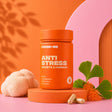
Anti-Stress
Ashwagandha standardised for withanolides and reishi standardised for polysaccharides in the same capsule, with holy basil, schisandra and vitamin B6.
Discover Anti-Stress →
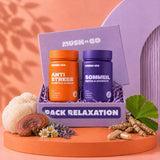
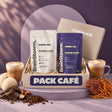
Relaxation Pack
Anti-Stress in the morning (Ashwagandha, Reishi, Holy Basil, Vitamin B6, Schisandra) and Sleep+ in the evening, together in one pack.
Discover the pack →The plant at a glance
An Indian root, a family of molecules.
Ashwagandha, Withania somnifera, is a small shrub in the nightshade family (Solanaceae), like tomatoes and aubergines. It grows in India, the Middle East and North Africa. Ayurvedic medicine has used its root for centuries, under the name “Indian ginseng”.
Withanolides are the molecules researchers track most closely. Their content is the unit used to compare extracts. But they are not the only thing that matters, and that is where manufacturers set themselves apart. For the studied effects of the plant itself, our article ashwagandha benefits and studies reviews them one by one.
Whole root or extract
Whole root, KSM-66, Sensoril: three different products.
The same word, “ashwagandha”, covers both dried, ground root and concentrated extracts made by manufacturers under a registered trademark. They differ in composition, in dose and in the studies behind them.
| Root powder | KSM-66 | Sensoril | |
|---|---|---|---|
| Part of the plant | Root | Root only | Root and leaves |
| Withanolides | Low, not standardised | 5% minimum | 10% minimum |
| Dose in studies | Several grams, traditional use | 300 to 600 mg a day | 125 to 500 mg a day |
| Manufacturer | Many | Ixoreal Biomed, India | Natreon, United States |
| Published trials | Few | Many | Several |
Minimum levels stated by the manufacturers. Other patented extracts exist, such as Shoden, which is highly concentrated in withanolide glycosides.
Whole-root powder is the form closest to traditional use. It is cheap, but you need a lot of it, it tastes earthy, and its withanolide content varies with cultivation, harvest and drying. Standardised extracts guarantee a minimum content, which makes it possible to reproduce the dose used in a study.
KSM-66
KSM-66 ashwagandha: root only, full spectrum.
KSM-66 is an extract sold by the Indian company Ixoreal Biomed. It is the most studied ashwagandha extract in the world, and the one you see most often on European labels. Its manufacturer highlights four features.
- Root only, with no leaves, in line with traditional Ayurvedic use.
- Full spectrum: the extraction aims to preserve the balance of compounds in the root, rather than isolating a single molecule.
- 5% withanolides minimum, measured by high-performance liquid chromatography (HPLC), the most accurate method.
- An extraction process presented as free of chemical solvents, using milk and water.
In studies, the most common dose is 600 mg a day, taken as two doses of 300 mg, for 8 to 12 weeks. The most cited trials on perceived stress, sleep and muscle strength were carried out with KSM-66. The producer also highlights certified organic raw material: if that matters to you, look for the EU organic logo on the finished product, the only commitment that applies directly to you.
Sensoril
Sensoril: root and leaves, more concentrated.
Sensoril is a patented extract from the company Natreon. It combines root and leaves, which gives it a higher withanolide content, at least 10%. It is therefore dosed lower: generally 125 to 250 mg a day, up to 500 mg in some trials.
The root
The part used traditionally. Rich in withanolide A and in a range of compounds, lower in withaferin A.
The leaves
More concentrated in withaferin A, a molecule that is very active in the laboratory. Their use is more recent and attracts more regulatory caution.
The presence of leaves is not a flaw in itself. But it changes the chemical profile of the extract. Several authorities, in Europe and in India, have raised questions about the safety of leaf-based preparations, and some manufacturers exclude them on principle. The regulatory position in France is covered in our article is ashwagandha banned in France?.
Which studies, which extract
Four trials, four different extracts or doses.
Here are four frequently cited controlled trials, with the exact extract each one used. Full references are at the bottom of the page.
Chandrasekhar et al., 2012 · India
64 stressed adults, 300 mg of KSM-66 twice a day for 60 days, against placebo. The perceived stress score fell by 44% in the ashwagandha group, against 5.5% on placebo; blood cortisol fell by 27.9%. Limitation: small sample, study funded by the manufacturer.
Auddy et al., 2008 · India
Around a hundred adults under chronic stress, Sensoril at 125, 250 or 500 mg a day for 60 days. Stress markers, including cortisol, changed more favourably than on placebo, and more so at higher doses. Limitation: published in a specialist journal, links with the manufacturer.
Wankhede et al., 2015 · India
57 young men starting resistance training, 300 mg of KSM-66 twice a day for 8 weeks. The ashwagandha group gained more strength and muscle size than the placebo group. Limitation: men only, 8 weeks.
Lopresti et al., 2019 · Australia and India
60 stressed adults, 240 mg a day of a third extract, Shoden, for 60 days. Anxiety measured by questionnaire fell more than on placebo, as did morning cortisol. Limitation: no significant difference on some questionnaires.
These trials point in the same direction, but each one tests a specific product at a specific dose. They tell us nothing about root powder, or about an unidentified extract.
Why results don't transfer
A study applies to its own extract, not to every ashwagandha.
When a label says “ashwagandha has been shown to lower cortisol by 27.9%”, it is almost always citing the Chandrasekhar trial, carried out with 600 mg of KSM-66 a day. If the product contains 150 mg of an unspecified extract, that figure does not apply to it. Three differences stop results from transferring.
The part of the plant
Root only, or root and leaves: the withanolide profile is not the same, particularly for withaferin A.
The concentration
At 5% or 10% withanolides, or with no standardisation, the same dose in mg does not deliver the same amount of active molecules.
The process
The solvent, temperature and extraction time change the fine composition. Two extracts at 5% are not necessarily identical.
The rule for consumers is simple: a manufacturer that cites a study should use the extract and dose from that study, or say clearly if it does not. For ashwagandha, as for other plants, this is one of the best signs of a serious brand.
How to read a label
Six things to look for on a tub of ashwagandha.
A good ashwagandha label tells you exactly what you are taking. Here is what it should include, and what you can do if a piece of information is missing.
- The daily dose of extract, in mg, not just “ashwagandha” in a list of ingredients.
- The percentage of withanolides, ideally with the measurement method: HPLC rather than gravimetry, which often overestimates the content.
- The part of the plant: root only, or root and leaves.
- The name of the extract if it is a patented extract, KSM-66, Sensoril or another, or the extraction ratio if it is generic.
- The origin of the plant and where the supplement is made.
- The test results: heavy metals, pesticides, microbiological contaminants. A serious manufacturer will share them on request.
An organic label guarantees how the plant was grown, not its active content. An organic ashwagandha can perfectly well be a low-dose root powder. The two pieces of information complement each other; neither replaces the other. Our own test results are available on our lab analyses page.
Powder, capsules, gummies
Ashwagandha powder or capsules: convenience matters.
The form does not change the nature of the ashwagandha, but it does change the dose you can reasonably take every day, and therefore what actually reaches your body.
Powder
Ground root or loose extract, to stir into warm milk or a smoothie. Economical, but the taste is bitter and earthy, and dosing by the spoonful is approximate.
Capsules
Precise dose, no taste, easy to carry. This is the form used in almost all clinical trials, with standardised extracts.
Gummies
Pleasant, but often low-dose and sugary. Check the dose of extract per gummy and how many you need to reach the dose used in studies.
The bioavailability of withanolides has been little studied in humans, and there is no evidence that one form is better absorbed than another at the same dose. Taking it with a meal often improves digestive tolerance. The best choice is the one you will take regularly, at the right dose.
Cost per mg of withanolides
Comparing two products: the calculation that doesn't lie.
The price of a tub tells you nothing. What matters is the amount of withanolides you get each day, and what it costs you. The calculation takes a minute.
| Product | Dose per day | Content | Withanolides per day |
|---|---|---|---|
| KSM-66, study dose | 600 mg | 5% | 30 mg |
| Sensoril, typical dose | 250 mg | 10% | 25 mg |
| KSM-66, half dose | 300 mg | 5% | 15 mg |
| Extract with no stated content | 500 mg | unknown | impossible to calculate |
Formula: daily dose of extract × percentage of withanolides. Then divide the price of a course by the number of days, then by the mg of withanolides: you get a cost per mg that you can compare from one product to another.
This calculation does not tell the whole story, since two extracts with the same content are not necessarily equivalent. But it stops you paying a high price for a low-dose product, and helps you spot labels that do not give enough information to be compared.
What's in Anti-Stress
Our ashwagandha, in a multi-plant formula.
In Anti-Stress, we use an ashwagandha extract standardised for withanolides, combined with reishi standardised for polysaccharides, holy basil, schisandra, vitamin B6 and acacia fibre. Vitamin B6 contributes to the reduction of tiredness and fatigue and to normal functioning of the nervous system.
Anti-Stress is a complete formula: three plants and a mushroom brought together in a single capsule, for a simple daily routine. To compare the two main options for the day, see also our article reishi or ashwagandha, and for the plant itself, our page ashwagandha.
In the morning
One Anti-Stress capsule with a glass of water at breakfast, as a 30-day course.
In the evening
For those whose tense days spill over into the night, the Relaxation Pack adds Sleep+.
Precautions
Whatever the extract, the same precautions.
KSM-66, Sensoril or root powder: the precautions are the same. Cases of liver injury have been reported with ashwagandha supplements, rare but documented, notably in a case series published in 2020 by Björnsson and colleagues.
Do not take ashwagandha without medical advice if:
- You are pregnant, breastfeeding or trying to conceive.
- You have a thyroid condition or take thyroid medication: ashwagandha can alter thyroid hormones.
- You have liver disease, or you notice intense fatigue, jaundice or dark urine while taking it: stop and see a doctor.
- You have an autoimmune disease or a hormone-dependent cancer, or you are due to have surgery.
- You take sedatives, anti-anxiety medication, antidepressants, immunosuppressants, or treatment for diabetes or blood pressure.
Do not combine several products containing ashwagandha, and stick to the dose on the label. Our article ashwagandha side effects and dangers covers each situation in detail.
Your questions
KSM-66 vs Sensoril ashwagandha: your questions.
What is KSM-66 ashwagandha?
It is a patented ashwagandha root extract, produced in India by Ixoreal Biomed. It is standardised to at least 5% withanolides and has been used in many clinical trials, most often at 600 mg a day taken in two doses.
What is the difference between KSM-66 and Sensoril?
KSM-66 comes from the root only and contains at least 5% withanolides. Sensoril combines root and leaves and contains at least 10%, which allows lower doses, generally 125 to 250 mg a day. Their studies are not interchangeable.
What is the best ashwagandha extract?
There is no outright winner. KSM-66 is the most studied, Sensoril the most concentrated. The best product is the one that clearly states the extract, the dose and the withanolide content, and whose dose matches the one used in studies.
Is there organic KSM-66 ashwagandha?
The producer of KSM-66 highlights certified organic raw material, and some supplements that use it carry an organic label. Check for the EU organic logo on the finished product. The label guarantees how the plant was grown, not its withanolide content.
Is ashwagandha powder as effective as the extract?
There is no way to say so. Root powder contains far fewer withanolides per gram, and its content varies. Almost all clinical trials have been carried out with standardised extracts, at precise doses.
How much KSM-66 should I take a day?
Studies have most often used 600 mg a day, taken as two doses of 300 mg, for 8 to 12 weeks. Some have tested 300 mg. Always follow the dose stated on your product's label.
Are ashwagandha leaves dangerous?
They are not dangerous in themselves, but they are richer in withaferin A and their use is more recent than that of the root. Several authorities call for caution with these preparations. Root-only extracts are the most conservative choice.
How can I tell which extract my supplement contains?
Look at the ingredients list and the nutrition table: a patented extract is almost always named, with its trademark symbol. If only “ashwagandha” or “root extract” appears, ask the manufacturer for the withanolide content and the measurement method.
What ashwagandha is in Anti-Stress?
Anti-Stress contains an ashwagandha extract standardised for withanolides, combined with reishi standardised for polysaccharides, holy basil, schisandra, vitamin B6 and acacia fibre. It is a multi-plant formula, taken as one capsule in the morning.
Sources
- Chandrasekhar K., Kapoor J., Anishetty S. (2012). A prospective, randomized double-blind, placebo-controlled study of safety and efficacy of a high-concentration full-spectrum extract of ashwagandha root in reducing stress and anxiety in adults. Indian Journal of Psychological Medicine, 34(3).
- Auddy B. et al. (2008). A standardized Withania somnifera extract significantly reduces stress-related parameters in chronically stressed humans: a double-blind, randomized, placebo-controlled study. Journal of the American Nutraceutical Association, 11(1).
- Wankhede S. et al. (2015). Examining the effect of Withania somnifera supplementation on muscle strength and recovery: a randomized controlled trial. Journal of the International Society of Sports Nutrition, 12.
- Lopresti A. L., Smith S. J., Malvi H., Kodgule R. (2019). An investigation into the stress-relieving and pharmacological actions of an ashwagandha (Withania somnifera) extract. Medicine, 98(37).
- Björnsson H. K. et al. (2020). Ashwagandha-induced liver injury: a case series from Iceland and the US Drug-Induced Liver Injury Network. Liver International, 40(4).
- Langade D. et al. (2019). Efficacy and safety of ashwagandha (Withania somnifera) root extract in insomnia and anxiety: a double-blind, randomized, placebo-controlled study. Cureus, 11(9).
Keep reading
Further reading.
The extract is only part of the question. Dose, timing, precautions: our other guides cover the rest, and our Anti-Stress formula is ready when you are.

Discover our mushroom and adaptogenic plant supplements
Our vegan formulas, made in Toulouse by a French manufacturer.