





Reishi or ashwagandha: which is better for stress
By Kevin CANAL - 23 March 2026

Stress
Reishi or ashwagandha
which is better for stress
By the Mush n Go editorial teamUpdated 24 September 202611 min read
Stress and adaptogens
Reishi is a mushroom, ashwagandha an Ayurvedic root. They are the two most studied actives in the anti-stress aisle, and they do not work on the same ground: ashwagandha is the one whose drop in cortisol is best documented, reishi the one that turns up in evening formulas. If you have to choose, start from your main symptom: daytime anxiety, or nights that no longer restore you.

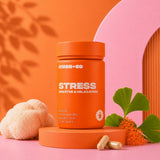
Anti-Stress
Ashwagandha standardised for withanolides and reishi standardised for polysaccharides in the same capsule, with holy basil, schisandra and vitamin B6.
Discover Anti-Stress →
Sleep +
Reishi, valerian, magnesium bisglycinate and melatonin — one capsule thirty minutes before bed.
Discover Sleep + →The answer in three lines
If you have only thirty seconds, here is the criterion.
- Daytime anxiety, constant tension, a need for something fast: ashwagandha. It is the active whose drop in cortisol is best measured, and the trials describe changes from the second week.
- Broken nights, unrefreshing sleep, background exhaustion: reishi. Its ground is evening protocols and recovery periods.
- Both at once: the most common case. Ashwagandha in the morning, reishi in the evening — they do not get in each other's way.
What follows explains why, with the studies behind each claim and their limits.
Reishi: what it is for
Two thousand years of use, and recent trials.
Reishi is one of the most documented mushrooms in the world, with several hundred publications. The important caveat: the vast majority concern cell or animal models. Human trials exist, but they are few and their samples are small.
Ashwagandha: what it is for
The most studied root in the aisle.
"Ashwagandha" means "horse smell" in Sanskrit, after the scent of its fresh root. Today it is the best-selling anti-stress supplement in the world, and the one with the most placebo-controlled human trials.
Two different mechanisms
One works on the stress axis, the other on calm.
Ashwagandha
Withanolides are studied for their action on the hypothalamic-pituitary-adrenal axis, the circuit that regulates cortisol secretion. That is why the marker followed in the trials is almost always cortisol in blood or saliva.
Reishi
Triterpenes and beta-glucans are studied along other routes, and human trials follow mostly self-reported endpoints: perceived sleep quality, perceived fatigue. The exact mechanism is still debated.
Neither is a sedative, and neither has an authorised health claim in Europe. They are food supplements, not treatments.
What the studies say
Four pieces of work, and what they do not say.
We report only trials run in humans, against placebo. The limits are stated each time: they are part of the result.
Chandrasekhar et al., 2012 · India
64 adults reporting stress, allocated double-blind. 300 mg of ashwagandha root extract twice a day for 60 days. Blood cortisol falls 27.9% in the treated group, against 7.9% on placebo. Modest sample, Indian population, two months' duration.
Salve et al., 2019 · India
60 healthy adults, 250 mg or 600 mg of root extract a day for 8 weeks. Blood cortisol drops in both treated groups, more markedly at 600 mg. Funded by an extract manufacturer — worth keeping in mind.
Pratte et al., 2014 · United States
Systematic review of published trials on ashwagandha and anxiety. The authors conclude that the results point in the same direction, but stress the heterogeneity of the protocols and the small group sizes. That is the state of the art: convergent, not conclusive.
Tang et al., 2005 · China
132 participants, a Ganoderma lucidum polysaccharide extract for 8 weeks, against placebo. More favourable self-reported fatigue and wellbeing scores in the treated group. Entirely self-reported endpoints.
Worth remembering: ashwagandha has a measured biological marker, reishi has perceived endpoints. That does not rank them, it says what we know how to measure. References at the bottom of the page.
Point-by-point comparison
Eleven lines to decide without kidding yourself.
| Criterion | Reishi | Ashwagandha |
|---|---|---|
| Nature | Mushroom (Ganoderma lucidum) | Root (Withania somnifera) |
| Tradition | Chinese medicine | Ayurveda |
| Marker followed in trials | Self-report questionnaires | Cortisol in blood or saliva |
| Number of human trials | Few | About a dozen, plus a systematic review |
| Timescale described | 2 to 4 weeks | 1 to 2 weeks |
| Usual timing | Evening | Morning |
| Dose in the protocols | 1,000 to 2,000 mg of extract | 300 to 600 mg of standardised extract |
| Ground of choice | Sleep and recovery | Daytime anxiety, performance stress |
| Point to watch | Anticoagulants | Thyroid, pregnancy, sedatives |
| Taste / format | Very bitter as a powder, hence the capsule | Bitter too, capsule likewise |
| At Mush n Go | Anti-Stress and Sleep + | Anti-Stress, and 200 mg in Brainstoorm |
Which one for your profile
Start from the symptom, not the trend.
Your head spins all day
Looping thoughts, tension in the shoulders, no ability to switch off even at the weekend: that is ashwagandha's ground, in the morning.
You sleep badly
You take a long time to drop off, you wake at 3 am, you do not feel rested: start with reishi in the evening, and read our comparison of mushrooms for sleep.
You are exhausted
Tiredness that rest does not shift, low defences, nothing that recharges: sleep first, so reishi, before adding anything else.
You have a deadline coming
An exam, a viva, a heavy stretch in a fortnight: ashwagandha acts sooner. It is still not a last-minute product — allow two weeks.
How to take them together
The protocol that covers the twenty-four hours.
Reishi and ashwagandha do not compete: they occupy neither the same moment of the day nor the same ground. That is why our Anti-Stress formula contains both, and why a good share of published protocols pair them.
Morning
Ashwagandha with breakfast, with some fat: withanolides are fat-soluble. This is the moment to take the tension out of the day ahead.
Afternoon
Nothing more. If the day is long, a second dose of ashwagandha in the early afternoon is possible — never after 4 pm.
Evening
Reishi thirty to sixty minutes before bed, away from dinner. That is the dose that works on the night.
Three weeks minimum before judging, and one variable at a time: if you start both alongside three other changes, you will know nothing.
Dose and timing
What the protocols say, in figures.
| Parameter | Reishi | Ashwagandha |
|---|---|---|
| Starting dose | 500 mg of extract | 250 to 300 mg of standardised extract |
| Dose in trials | 1,000 to 2,000 mg | 300 to 600 mg |
| Standardisation to check | Polysaccharides, triterpenes | Withanolides (5% minimum) |
| Timing | 30 to 60 min before bed | Morning, with food |
| Time before judging | 4 weeks | 2 to 3 weeks |
| Preferred form | Fruiting-body extract | Root extract, not leaf |
The extraction ratio (15:1 in our reishi, 50:1 in our ashwagandha) tells you how much raw material it took to obtain one unit of extract. It does not replace standardisation, it complements it.
Precautions
The situations where you seek advice first.
Ask your doctor before starting if:
- You take an anticoagulant: reishi may have a slight influence on clotting.
- You have a thyroid disorder, particularly hyperthyroidism: ashwagandha calls for monitoring.
- You take a sedative, an anxiolytic or an immunosuppressant.
- You are pregnant or breastfeeding: ashwagandha is not advised during pregnancy.
- You are being treated for an anxiety or depressive disorder. A supplement does not replace medical follow-up.
And the general limit: if your stress has been damaging your work, your relationships or your sleep for months, the first move is an appointment, not an order.
Our formulas
What we put in the capsule.
Anti-Stress — morning
Ashwagandha standardised for withanolides (50:1), reishi standardised for polysaccharides (15:1), holy basil, schisandra and vitamin B6 in its active P5P form. Vitamin B6 contributes to normal functioning of the nervous system and to the reduction of tiredness. 30 capsules, one to two a day.
Sleep + — evening
Reishi (15:1), valerian, magnesium bisglycinate, acacia fibre and melatonin. Melatonin contributes to the reduction of time taken to fall asleep. One capsule thirty minutes before bed.
The two together
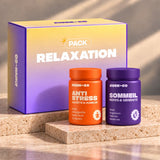
That is the Relaxation Pack: day and night cover, for a one-month course.
« I was sceptical because I thought I'd need a huge dose to feel anything, but halfway through the course, taking the maximum recommended, I felt real calm and the stress and anxiety have almost gone. I recommend it. »
★★★★★ Richard W. · verified review of Anti-Stress
« It lets me sleep well and quiet my head. I recommend it to people around me very often. »
★★★★★ Vesque V. · verified review of Sleep +
Verified customer reviews, published on the product pages and translated from French without editing the content. These are individual experiences.
Your questions
What you ask us about these two actives.
Which is better, reishi or ashwagandha?
The question has no general answer, because they are not measured on the same yardstick. Ashwagandha is the one whose effect on cortisol is best documented, with a 27.9% fall in blood cortisol over 60 days in Chandrasekhar's trial. Reishi is followed through sleep and fatigue questionnaires. Choose according to your main symptom.
Can you take both at once?
Yes, and it is even the most common routine: ashwagandha in the morning, reishi in the evening. Our Anti-Stress formula in fact contains both. As with any supplement, ask your doctor if you are on medication.
How long before you notice anything?
The published trials run 8 to 12 weeks and describe changes from the second week with ashwagandha, and the fourth with reishi. Three weeks of daily use is a minimum before forming a view.
Does ashwagandha make you sleepy?
It is not a sleeping aid, despite its species name somnifera. It is studied on daytime anxiety. For sleep, reishi, valerian and melatonin are the usual actives in evening formulas.
Should you take breaks?
Published protocols run up to twelve continuous weeks. Beyond that, a one to two week break is common practice, without the data allowing anyone to say it is necessary. Seek advice if you are thinking of prolonged use.
Is reishi taken as a powder or in capsules?
In capsules in the vast majority of cases: reishi powder is frankly bitter and dissolves poorly. It is the opposite of lion's mane or cordyceps, which blend easily into a drink.
Do they replace an anxiolytic?
No, and you should never stop a prescribed treatment to try them. They are food supplements: at best they accompany medical follow-up, never replace it.
Sources
The references cited in this article.
- Chandrasekhar K., Kapoor J., Anishetty S. (2012). A prospective, randomized double-blind, placebo-controlled study of safety and efficacy of a high-concentration full-spectrum extract of ashwagandha root in reducing stress and anxiety in adults. Indian Journal of Psychological Medicine, 34(3), 255-262.
- Salve J. et al. (2019). Adaptogenic and anxiolytic effects of ashwagandha root extract in healthy adults: a double-blind, randomized, placebo-controlled clinical study. Cureus, 11(12):e6466.
- Pratte M.A. et al. (2014). An alternative treatment for anxiety: a systematic review of human trial results reported for the Ayurvedic herb ashwagandha (Withania somnifera). Journal of Alternative and Complementary Medicine, 20(12), 901-908.
- Tang W. et al. (2005). A randomized, double-blind and placebo-controlled study of a Ganoderma lucidum polysaccharide extract in neurasthenia. Journal of Medicinal Food, 8(1), 53-58.
To go further
What to read next.

Discover our mushroom and adaptogenic plant supplements
Our vegan formulas, made in Toulouse by a French manufacturer.