








Adaptogenic mushrooms: side effects and real risks
By Julien Gresset - 16 January 2025

Safety
Adaptogenic mushrooms
side effects and real risks
By the Mush n Go editorial teamUpdated 24 September 202612 min read
Safety and misconceptions
Adaptogenic mushrooms and plants contain no psychoactive molecule, are legally sold as food supplements in Europe, and do not create dependence. At supplement doses, the literature reports no serious toxicity. The real caveats lie elsewhere: mushroom allergy, three families of drug interaction, pregnancy — and above all the very uneven quality of the products on sale.
The short answer
Four common fears, and how things actually stand.
- "It's a drug." No. The species used — lion's mane, reishi, cordyceps, chaga, maitake, oyster mushroom — contain neither psilocybin nor any known psychoactive molecule.
- "It's illegal." No. They fall under the food supplement regime in the European Union, with the labelling, traceability and contaminant-limit obligations that go with it.
- "You get hooked." No. No mechanism of dependence or withdrawal is described for these species.
- "It's dangerous." Not at supplement doses, for a healthy adult on no medication. The real caveats are set out below, one by one.
The allergy risk
Real, rare, and easy to test.
Around 1 % of the population is sensitive to mushrooms — a figure that covers all varieties, including wild mushrooms and moulds, not only the species used in supplements. Concentrated, processed extracts contain fewer allergenic proteins than a fresh mushroom.
The reactions described are cutaneous and digestive: itching, rash, more rarely swelling. The approach is simple: if you know you tolerate edible mushrooms badly, give it a miss. If in doubt, start with a fraction of the dose and wait twenty-four hours.
Drug interactions
Three families of medication that call for advice.
| Species | Medication concerned | What to do |
|---|---|---|
| Reishi, lion's mane | Anticoagulants (warfarin and others) | Seek medical advice before starting. These species may slightly influence coagulation. |
| Cordyceps | Antidiabetics | Monitor blood sugar more closely in the first weeks. |
| Reishi, maitake, turkey tail | Immunosuppressants | Do not combine without the agreement of the doctor managing the treatment. |
| Chaga | History of kidney stones | Avoid: chaga is rich in oxalates. |
| Ashwagandha | Thyroid medication, sedatives | Seek advice, particularly in cases of hyperthyroidism. |
This list does not replace advice from a pharmacist or doctor who knows your full medication.
Can you take too much?
The trial doses, and what follows from them.
The published controlled trials use doses well above those of commercial supplements, without reporting notable adverse effects. That is the best reference available.
In other words: increasing the dose brings nothing demonstrated, and the protocols that obtain results do so through duration, not quantity. We set out this trade-off in our guide to microdosing.
Can you become dependent?
The confusion comes from the word "mushroom".
Psychoactive mushrooms owe their effects to psilocybin. None of the species used in supplements contains any: not reishi, not lion's mane, not cordyceps, not chaga. Their studied compounds — polysaccharides, beta-glucans, triterpenes — do not act on perception.
On dependence, there is no description of tolerance, of needing to raise doses, or of symptoms on stopping for these species. In Mori's trial, the gap observed simply disappears four weeks after stopping: the effect fades, it is not missed. That is the exact opposite of what is seen with caffeine, where abrupt stopping causes headaches and fatigue — see our article on caffeine withdrawal.
What the studies say
Four pieces of work on tolerance.
We only include trials conducted in humans. They are what documents safety in use, and their limits are part of the result.
Mori et al., 2009 · Japan
30 adults aged 50 to 80, 3 g of Hericium erinaceus a day for 16 weeks, double-blind against placebo. No notable adverse effects reported over the period. This is the longest documented exposure for this species.
Wachtel-Galor et al., 2004 · Hong Kong
A follow-up study of biological markers in volunteers supplemented with Ganoderma lucidum. The parameters tracked, including liver and kidney markers, stayed within usual values. Small numbers, short duration.
Chen et al., 2010 · United States
20 adults aged 50 to 75, 3 g a day of Cordyceps sinensis extract for 12 weeks. No notable adverse effects reported, at a dose far above that of a typical supplement.
Tang et al., 2005 · China
132 participants, polysaccharide extract of Ganoderma lucidum for 8 weeks against placebo. The largest human sample available on reishi. Self-reported criteria.
What these studies do not say: nothing about pregnancy, nothing about use beyond a few months, nothing about combining several species. References at the bottom of the page.
Is it legal?
Yes, and the framework is fairly precise.
- In Europe these species fall under the food supplement regime, governed by Directive 2002/46/EC and its national transposition.
- They are distinct from controlled substances: the absence of psilocybin places them outside narcotics law.
- Labelling must state the species name, the daily portion and the warnings.
- No health claim is authorised for the mushrooms themselves: a brand promising to cure something is outside the rules.
- Limits on heavy metals, pesticides and contaminants apply as they do to any foodstuff.
The practical consequence: a serious seller will talk about species, standardisation and testing. A seller who talks about curing is mostly telling you they do not know the regulations.
The real danger: quality
It is not the mushroom that is the problem.
The main gap between two products is not safety, it is what is actually in the capsule. Three flaws come up constantly.
Mycelium on grain
The mushroom is grown on rice or oats, and the whole thing is milled. The final powder mostly contains grain starch. It is legal, it is common, and it is almost never stated clearly.
No standardisation
"Mushroom complex, 500 mg" says nothing about beta-glucan content. Without standardisation there is no way to compare two products.
Raw powders
Isolated reports of liver disturbances have been published with non-extracted mushroom powders. They remain rare and occasional, but they justify preferring a standardised extract to a raw powder, and seeking advice if you have a liver condition.
Contaminants and testing
What a good supplier must be able to show.
| What is tested | Why | What you should be able to obtain |
|---|---|---|
| Heavy metals | Mushrooms concentrate what their substrate contains | A certificate of analysis per batch |
| Pesticides | Possible contamination of the growing substrate | Organic certification and testing |
| Beta-glucans | They are the marker of real mushroom content | A figure, not a mention |
| Starch | A high level signals mycelium on grain | The level, or failing that the part used |
| Species identification | Species mix-ups do happen in bulk buying | The full Latin name on the label |
The effects people report
What people actually feel.
The first days
Bloating, loose stools, sometimes passing digestive discomfort. This is by far the most frequent, and it usually settles on its own. Starting at half dose for three days generally avoids it.
Beyond that
Nothing in particular in the vast majority of cases. If discomfort persists beyond a week, stop: this is not a product worth pushing through.
Precautions
The situations where you abstain.
Do not take them, or seek medical advice first, if:
- You are pregnant or breastfeeding: the data are lacking, caution applies.
- You are under 18.
- You take an anticoagulant, an immunosuppressant, an antidiabetic or thyroid medication.
- You are allergic to edible mushrooms.
- You have a known liver or kidney condition.
- You are due to have surgery: stop two weeks before, as with any supplement that may influence coagulation.
What we do
Our answers to the three flaws.
The raw material
Fruiting body extracts, not mycelium on grain, with an extraction ratio stated for each species — 15:1 for reishi, 50:1 for ashwagandha.
The testing
Every batch is tested by an independent laboratory. Our products are developed in Toulouse, with non-GMO, vegan and gluten-free ingredients.
The figures
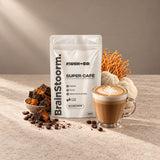
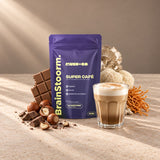
Quantities are stated per serving, species by species. For Brainstoorm: 1,000 mg of lion's mane, 1,000 mg of cordyceps, 1,000 mg of chaga, 6,040 mg of actives in total per cup.

Brainstoorm
Lion's mane, cordyceps and chaga at 1,000 mg each, maca, organic cocoa, chicory — and 20 mg of microencapsulated caffeine per cup.
Discover Brainstoorm →
Immunity
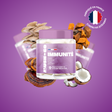
Chaga, reishi and oyster mushroom, as a 30-day course. The vitamin C in the formula contributes to the normal function of the immune system.
Discover Immunity →Your questions
What you ask us about the risks.
Are adaptogenic mushrooms and plants dangerous?
Not at supplement doses, for a healthy adult on no medication. Published trials use up to 3 g a day for 16 weeks without reporting notable adverse effects. The real caveats concern mushroom allergy, anticoagulants, immunosuppressants, antidiabetics, pregnancy and breastfeeding.
Are they legal in Europe?
Yes. They fall under the food supplement regime in the European Union. They contain no psilocybin and are therefore not classified as narcotics. However, no health claim is authorised for mushrooms: a brand promising to cure is in breach.
Can you get hooked?
No. No tolerance, dependence or withdrawal phenomenon is described for these species. In the trials, the effect observed simply fades on stopping, with no withdrawal symptoms.
Is there a risk to the liver?
Isolated reports of liver disturbances have been published, associated with raw mushroom powders rather than standardised extracts. They remain rare. If you have a liver condition, seek medical advice and prefer a standardised extract to an unprocessed powder.
Can you take them during pregnancy?
No, as a precaution: the data are lacking in pregnant or breastfeeding women. That applies to all the species, and ashwagandha is explicitly not advised during pregnancy.
Can children take them?
These supplements are formulated for adults and the studies involve adults. There is no dose reference in children: do not give them without medical advice.
Should you take breaks?
Published protocols run up to sixteen continuous weeks. Beyond that, a one to two week break is common practice, without the data showing it is necessary.
How do you spot a poor-quality product?
Three signals: the part of the mushroom is not stated (it is often mycelium on grain), there is no beta-glucan standardisation, and the Latin species name is missing from the label. A certificate of analysis per batch should be available to you.
Sources
The references cited in this article.
- Mori K. et al. (2009). Improving effects of the mushroom Yamabushitake (Hericium erinaceus) on mild cognitive impairment: a double-blind placebo-controlled clinical trial. Phytotherapy Research, 23(3), 367-372.
- Wachtel-Galor S. et al. (2004). Ganoderma lucidum ('Lingzhi'); acute and short-term biomarker response to supplementation. International Journal of Food Sciences and Nutrition, 55(1), 75-83.
- Chen S. et al. (2010). Effect of Cs-4 (Cordyceps sinensis) on exercise performance in healthy older subjects: a double-blind, placebo-controlled trial. Journal of Alternative and Complementary Medicine, 16(5), 585-590.
- Tang W. et al. (2005). A randomized, double-blind and placebo-controlled study of a Ganoderma lucidum polysaccharide extract in neurasthenia. Journal of Medicinal Food, 8(1), 53-58.
- Chandrasekhar K. et al. (2012). A prospective, randomized double-blind, placebo-controlled study of safety and efficacy of a high-concentration full-spectrum extract of ashwagandha root. Indian Journal of Psychological Medicine, 34(3), 255-262.
- Directive 2002/46/EC of the European Parliament and of the Council on the approximation of the laws of the Member States relating to food supplements.
To go further
What to read next.

Discover our mushroom and adaptogenic plant supplements
Our vegan formulas, made in Toulouse by a French manufacturer.