























PMS (Premenstrual Syndrome): The Complete Guide
By the Mush n Go editorial team - 20 November 2026
Guide no. 14 · 12 chapters
PMS (premenstrual syndrome): the complete guide
Premenstrual syndrome (PMS) brings together physical and mood signs that appear in the days before your period and fade once it arrives: bloating, tender breasts, tiredness, irritability, cravings. Regular sleep, less caffeine, a steady diet and movement all help. If PMS weighs on your life, see your doctor and bring your cycle diary.
The complete guide: menstrual cycle phases →
By the Mush n Go editorial team · Updated 20 November 2026 · 18 min read
Where to start?
Your situation, your starting point
 D−7
“I'm exhausted the week before”
You sleep, yet everything feels heavy.
 4 am
“I sleep badly before my period”
Slow to fall asleep, waking at 4 am.
 D−3
“I snap over nothing”
One wrong word, and everything spills over.
 5 pm
“I eat everything in sight”
At 5 pm, the cupboard calls.
 3 days
“My jeans don't fit any more”
Bloated stomach, tender breasts, three days a month.

01Definition
Premenstrual syndrome (PMS): the definition, and how long before your period.
PMS is not “being in a bad mood before your period”. It is a set of physical and emotional symptoms that return every cycle, always at the same time: during the second half of the cycle, the luteal phase, between ovulation and your period. They disappear within four days of your period starting, then leave a week or two of relief.
The American College of Obstetricians and Gynecologists (ACOG) uses a precise definition: at least one emotional or physical symptom present in the five days before your period, over three consecutive cycles, serious enough to affect work, relationships or social life. According to a 2014 meta-analysis, almost one woman in two, 47.8%, reports these symptoms at some point in her life, with large differences from one country to another.
When does PMS start before your period? Most often five to seven days before, sometimes from ovulation, so roughly 15 days before your period on a 28-day cycle. What matters is not the length but the repetition: same signs, same timing, cycle after cycle.
D1 to D5: your period
PMS symptoms fade within the first four days.
D6 to D14: the follicular phase
Oestrogen rises, and energy often follows. This is the window without symptoms.
Around D14: ovulation
Progesterone takes over. In some women, the first signs already appear.
D22 to D28: the end of the luteal phase
Hormones drop before your period: this is the PMS week, the most marked.
02The symptoms
PMS symptoms: the checklist.
More than 150 symptoms have been described in the medical literature, but a dozen recur in most women. How do you know if you have premenstrual syndrome? Tick the ones you recognise, then check they follow your cycle: present the week before, absent the week after.
- The body: bloating, tender or painful breasts, temporary weight gain, headaches, back or leg aches, spots.
- The mind: irritability, mood swings, feeling like crying, anxiety, feeling overwhelmed, difficulty concentrating.
- Appetite and sleep: cravings, a desire for sugar or salt, marked tiredness, lighter sleep or, on the contrary, needing more sleep.
- Withdrawal: less desire to see people, to go out, or to do what you usually enjoy.
Which symptoms are possible just before your period? All of those on this list, to very different degrees. Some women feel only one or two, mildly; others have all three groups. The only reliable tool to tell PMS from background tiredness is the cycle diary: each evening, a score from 0 to 3 for six signs, for two cycles. If your scores rise before your period and then fall, the link is clear. If they stay high all month, the cause lies elsewhere, and that is valuable information for your doctor.
03Belly and breasts
Bloating, tender breasts, headaches before your period: the physical signs.
Bloating before your period is the most searched physical sign, and one of the most common. Progesterone slows digestion and encourages water retention; the feeling of bloating can start a week earlier and peak the day before your period. Tender breasts, headaches and nausea follow the same hormonal logic.
| Sign | What happens | The helpful habit |
|---|---|---|
| Bloating | Slower digestion and water retention late in the cycle | Less salt, more water, cooked vegetables, a walk after meals |
| Tender breasts | Tissues react to the hormones of the second half of the cycle | A soft bra at night, less salt and caffeine |
| Headaches | Oestrogen falls just before your period | Regular meals, enough water, a fixed bedtime |
| Nausea | Slower digestion, sometimes linked to prostaglandins | Small meals, ginger, never an empty stomach |
| Back ache, spots | Prostaglandins and sebum stimulated by hormones | Warmth, stretching, gentle skin cleansing |
Coffee can heighten the feeling of a tight belly in sensitive people: we explain why in coffee and bloating. A bloated stomach that lasts all month, or pain that forces you to stop, goes beyond PMS: see the chapter when to see a doctor.
The full articleCoffee and bloating: why coffee makes your stomach swell, and what to do→04Mood
PMS and mood: irritability, low mood, feeling like crying.
Emotional symptoms are often the hardest to bear. A passing remark that sets you off, tears for no clear reason, a sense that everything is too much: many women say they no longer recognise themselves during these few days. It is neither a lack of willpower nor a personality flaw.
What happens
The brain of women affected reacts more strongly to normal hormone changes. The drop in progesterone and oestrogen late in the cycle alters serotonin activity, a chemical messenger of mood.
What makes it worse
Short nights, built-up stress, alcohol and days without a break. Everyday mental load weighs more heavily when your emotional margin shrinks.
What helps
Spot your sensitive days in the diary, lighten your schedule, let people around you know, move every day and keep a fixed bedtime.
How do you fight low mood before your period? By anticipating it. When you know day 25 is often hard, you can schedule fewer appointments, a simple dinner and a quiet evening. A sentence prepared in advance for those close to you (“I'm in my sensitive week, I'm going to bed early”) avoids a lot of tension. If your background stress is high, our guide on mental load and the one on lowering cortisol give you tools for the whole month. If anxiety rises with coffee, read coffee and anxiety.
The full articleMental load: the complete guide→The full articleCoffee and anxiety: why coffee stresses some people→05Fatigue and sleep
Fatigue and insomnia before your period: why you feel exhausted.
Heavy tiredness before your period is one of the most cited symptoms. It has several sources that add up. Progesterone has a mildly sedative effect during the day, body temperature stays higher at night during the luteal phase, and sleep becomes lighter, with more waking. A 2018 review on the cycle and sleep found that women with PMS report poorer sleep quality in the days before their period.
Result: you sleep, but the night restores less, and tiredness sets in just when your mood is fragile. What to do about heavy tiredness before your period? Protect your sleep rather than forcing it with coffee.
A fixed bedtime
In the week before your period, keep the same schedule every night, weekends included. Regularity matters more than duration.
Your last coffee before 2 pm
Caffeine stays in the body for several hours and lightens sleep that is already fragile. In the morning, a lighter cup keeps the ritual.
A cooler bedroom
The body runs warmer at night late in the cycle. A room at 18 °C, a lighter duvet and a lukewarm shower in the evening help you fall asleep.
If your nights stay difficult outside that week, our guide insomnia: what to do sets out the reference method, and 15 evening habits reviews each habit. Tiredness that lasts all month deserves a check-up: see our article on persistent fatigue.
The full articleInsomnia: the complete guide→The full articleChronic fatigue: the complete guide→Free
The 21-day plan for a more serene cycle
- A week-by-week plan: observe, prepare, get through the days before your period
- A cycle diary to print: six signs noted each evening, over two cycles
- The markers that tell you when to see a doctor, and what to show them
Sent! The 21-day plan will reach your inbox within a few minutes. Check your Promotions tab too.
Oops, the sign-up didn't work. Check your address and try again.
Sent by email as a PDF. Unsubscribe in one click.
06Hunger and cravings
Hunger and sugar cravings before your period: where the cravings come from.
Feeling hungrier before your period is not your imagination. During the luteal phase, resting energy expenditure rises slightly, and appetite follows. The drop in serotonin late in the cycle pushes you towards sweet foods, which lift it for a while. Tiredness does the rest: a body that slept badly craves quick energy.
The aim is not to resist at all costs, but not to arrive at 5 pm starving in front of the cupboard. Here is the plate for the ten days before your period:
Protein at every meal
Eggs, yoghurt, pulses, fish or meat: they keep you full for longer and smooth out the afternoon hunger.
Wholegrain starches
Wholemeal bread, porridge oats, brown rice: their energy releases slowly, without the slump that follows sugar.
A planned snack at 4 pm
A handful of almonds, a piece of fruit, a square of dark chocolate. Planned, it replaces the snacking that happens at 5 pm.
To understand the mechanism in detail, read our article on sugar cravings, which has a section on the days before your period. If you want to cut down on sugar over time, our guide to quitting sugar sets out a gradual method.
The full articleSugar cravings: why they arrive, and how to calm them→The full articleQuitting sugar: the complete guide→07PMS or pregnancy
PMS or pregnancy: how to tell the difference.
It is one of the most frequently asked questions, and for good reason: the first signs of pregnancy look a lot like PMS. Tender breasts, tiredness, bloating, mood swings, small cramps: both come from progesterone, which stays high early in pregnancy instead of falling.
| Sign | More likely PMS | More likely early pregnancy |
|---|---|---|
| Periods | They arrive, and symptoms disappear within a few days | They don't arrive |
| Bleeding | Normal periods | Sometimes a few light pink or brown spots (implantation bleeding) |
| Breasts | Tender, easing once your period arrives | Tender and sensitive, and increasingly so |
| Nausea | Rare | Frequent, especially from the5th or6th week |
| Appetite | A desire for sweet or salty food | New aversions, smells that are hard to bear |
How do you tell PMS from early pregnancy for certain? A urine pregnancy test, reliable from the day your period was due. If in doubt, repeat it a few days later or ask your doctor for a blood test. Can you have PMS symptoms and be pregnant? Yes, the sensations of early pregnancy can look exactly like PMS: only the test settles it.
Pregnant, trying for a baby or breastfeeding: the food supplements mentioned in this guide, including those in our routine, are not recommended for you. Speak to your doctor or midwife.
08The causes
Why PMS happens, and why it intensifies after 40.
Women with PMS do not have more hormones than other women, nor fewer: their levels are usually normal. The difference lies in how sensitive the brain is to changes in those hormones. Why is PMS stronger in some women? Three factors combine.
The hormones of the second half of the cycle
After ovulation, progesterone and its derivatives rise, then fall before your period. In sensitive women, this drop is enough to trigger symptoms.
Serotonin
This messenger of mood, sleep and appetite fluctuates with hormones. That is why mood, nights and cravings move together.
The background
Chronic stress, lack of sleep, a sedentary life, smoking and alcohol make symptoms stronger. Family history counts too.
Does PMS get stronger with age? Often, yes. Many women notice longer and more marked PMS from the late thirties. With perimenopause, cycles become irregular and hormones swing more abruptly, which can heighten tiredness, broken nights and mood swings. If you are over 40 and your cycles are changing, read our guide to the menopause and its natural solutions and our article on menopause fatigue.
And on the pill? Pills that block ovulation suppress the large hormonal swings: for many women, symptoms decrease. Others feel similar signs during the pill-free week. If you feel your contraception affects your mood, talk to your doctor or gynaecologist, without stopping on your own.
The full articlePerimenopause: the complete guide→09Natural treatment
PMS: natural treatment and 7 habits that help.

How do you ease pain and discomfort before your period without medication? Medical recommendations put lifestyle first, for all mild to moderate PMS. These seven habits are the most cited; they matter most during the ten days before your period.
- A fixed bedtime: sleep is the first buffer for mood and tiredness. Keep it during the sensitive week, weekends included.
- Less caffeine: caffeine heightens breast tenderness and nervousness in some women, and lightens sleep. Keep to one cup, in the morning, before 2 pm. To find your doses, read caffeine: effects, duration and dose and coffee and sleep: when to stop.
- A plate that holds: protein and wholegrain starches at every meal, and a planned snack in the afternoon.
- Movement every day: thirty minutes of brisk walking, cycling or swimming. Regular activity improves mood and sleep.
- Less salt and alcohol: salt sustains water retention, and alcohol breaks up the second half of the night and weighs on next-day mood.
- Five minutes of breathing: when tension rises, a longer exhale than inhale slows the heart and calms the body.
- The cycle diary: six signs noted each evening. It shows your sensitive days, helps you anticipate, and forms the basis of a consultation.
Naturopathy and homeopathy are often cited for PMS. The most studied supplements are vitamin B6, magnesium, saffron and chaste tree: here is what the trials say.
The full articleCaffeine: how long it lasts, doses and effects→The full articleCoffee and sleep: when should you stop caffeine?→10The studies
Vitamin B6, magnesium, saffron, chaste tree: what the studies show.
These four leads come up in most reviews on premenstrual syndrome. Here is what was tested, on how many women and at what dose. Full references are in footnotes.
Vitamin B6 · Wyatt et al., 1999 · United Kingdom
Review of 9 trials, 940 women, at doses of 50 to 100 mg a day. Women taking vitamin B6 were more than twice as likely to see their overall symptoms improve as those on placebo, including depressive symptoms. Limitation: older trials of uneven quality.
Magnesium · Facchinetti et al., 1991 · Italy
32 women took 360 mg of magnesium a day, from the 15th day of the cycle until their period, for two cycles. The mood symptom score fell more than on placebo from the second cycle. Limitation: small sample.
Saffron · Agha-Hosseini et al., 2008 · Iran
50 women, 30 mg of saffron extract a day for two cycles. 76% of participants saw their symptoms fall by at least half, against 8% in the placebo group. Limitation: a single centre, short duration.
Chaste tree · Schellenberg, 2001 · Germany
170 women, one 20 mg tablet of chaste tree extract a day for three cycles. 52% saw their symptoms fall by at least half, against 24% on placebo. Limitation: only one extract was tested; results need confirming with other preparations.
Chaste tree acts on hormones and calls for medical advice, especially with hormonal contraception. To compare evening plants, read valerian or melatonin; for the precautions with ashwagandha, our article ashwagandha: risks and side effects.
The full articleValerian or melatonin: which to choose to sleep better?→11The 21-day plan
A more serene cycle: the 21-day plan.

How do you feel ten days before your period? For many women, still fine, and this is the right time to act. This plan builds habits before you need them. Start a week after the first day of your period: on a 28-day cycle, the third week then falls on the sensitive days. Cycle longer or irregular? Start whenever you like; the diary realigns everything.
Week 1: observe
Open your cycle diary: six signs scored 0 to 3 each evening (tiredness, sleep, mood, hunger, belly, pain). Review your last two cycles in your calendar. Set your wake-up time and push your first coffee back by an hour.
Week 2: prepare
Fixed bedtime, screens off an hour before. Last coffee before 2 pm, a lighter cup in the morning. Protein at every meal and a planned snack at 4 pm. Three 30-minute walks, and less salt and alcohol by the end of the week.
Week 3: get through it
Lighten your schedule on the three days you have identified. Let your circle know. Breathe for five minutes when it rises. Eat dinner early. On the last evening, compare your diary notes with those of the previous cycle.
After three weeks, you know your window, your dominant signs and the habits that matter for you. Keep the same plan for two or three cycles to lock it in. If your scores stay high regardless, take the diary to your doctor: it is worth more than any description.
12When to see a doctor
Severe premenstrual syndrome, PMDD, strong pain: when to see a doctor.
Severe PMS is not inevitable, and it can be treated. In about 1.6% of women, emotional symptoms are so intense that they match premenstrual dysphoric disorder (PMDD): deep sadness, anxiety, anger or a feeling of losing control, at least five symptoms in the week before the period, with real impact on daily life. Medical treatments exist, including certain antidepressants taken only in the second half of the cycle, and some pills.
Make an appointment with your GP or gynaecologist if:
- your symptoms stop you working or damage your relationships;
- the sadness, anxiety or anger are intense every month;
- your periods are so painful you have to stop, or so heavy;
- your cycles are very irregular, with acne or increased hair growth (PCOS possible);
- you have pain during sex or when going to the toilet during your period (endometriosis possible);
- your symptoms last all month, not only before your period;
- you are on treatment: check with a professional before taking any supplement.
The French health insurance site ameli.fr and the association EndoFrance give reliable benchmarks on painful periods and endometriosis. If you have dark thoughts, call 116 123, a free helpline open 24 hours a day.
Our routine
Morning, day, evening: the routine for a more serene cycle.
At Mush n Go, we have brought together three formulas with mushrooms and adaptogenic plants to support the three moments of the day, to take continuously or to start ten days before your period.
The morning
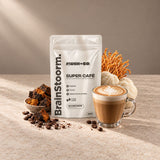
Brainstoorm, our mushroom coffee: 20 mg of caffeine per cup, against around 80 mg for an espresso. You keep the coffee ritual, with far less caffeine, at the moment your sleep needs it.
The day
Anti-Stress: ashwagandha, reishi, holy basil, schisandra and 2 mg of vitamin B6 per capsule. Vitamin B6 contributes to the reduction of tiredness and fatigue.
The evening
Sleep+: 1.9 mg of melatonin, magnesium bisglycinate, valerian and reishi. Melatonin contributes to the reduction of time taken to fall asleep; magnesium, to the reduction of tiredness.
For the morning and the evening: Brainstoorm and Sleep+.
Food supplements, to be used as part of a varied and balanced diet and a healthy lifestyle. Not recommended for pregnant women, women trying to conceive or breastfeeding women. Ask your doctor if you have a thyroid or endocrine disorder, or if you take a sedative, anxiolytic or antidepressant. Sleep+ is not recommended in case of an inflammatory or autoimmune disease; medical advice for people with epilepsy, asthma or mood disorders.

The pack in this guide
Pack Cycle Serein
The cycle has a rhythm, and so does the pack: the morning cup, the daytime capsule and the evening one, combined in a single box, delivered every 4 weeks on subscription.
- Morning: Brainstoorm, coffee or chocolate, 20 mg of caffeine per cup
- Day: Anti-Stress, ashwagandha, reishi, holy basil, schisandra, vitamin B6
- Evening: Sleep+, melatonin 1.9 mg, magnesium, valerian, reishi
€99.90or €69.90 on subscription, −30% every 4 weeks
60-day money-back guarantee
Your questions
Premenstrual syndrome: your questions.
When does PMS appear?
During the second half of the cycle, between ovulation and your period. Symptoms most often appear five to seven days before your period, sometimes from ovulation, so about two weeks before on a 28-day cycle. They disappear within four days of your period starting.
How do you know if you have premenstrual syndrome?
Note each evening, for two cycles, six signs from 0 to 3: tiredness, sleep, mood, hunger, belly, pain. If the scores rise in the days before your period, fall when it arrives and stay low the following week, it is very probably PMS. This diary is also the best document to show your doctor.
How do you feel 10 days before your period?
It depends on the length of the cycle. On a 28-day cycle, ten days before your period falls in the middle of the luteal phase: some women still feel fine, others already notice early signs, such as tender breasts, more marked tiredness or lighter sleep. Symptoms generally peak in the last few days.
Which symptoms are possible just before your period?
Bloating, tender breasts, headaches, back ache, spots, tiredness, irritability, mood swings, feeling like crying, anxiety, cravings and sleep disturbances. Most women feel only a few of these, always at the same point in the cycle.
How do you tell PMS from early pregnancy?
The signs look very alike, because they come from the same hormone, progesterone. With PMS, your period arrives and the symptoms disappear. In early pregnancy, your period does not come, your breasts stay sensitive and nausea often appears. A urine test, reliable from the day your period was expected, settles it.
Why is PMS stronger for some women?
The brain of some women reacts more strongly to normal hormone changes late in the cycle, particularly through serotonin. Stress, lack of sleep, a sedentary life, alcohol and smoking strengthen symptoms. If PMS clearly gets worse, talk to your doctor about it.
Does premenstrual syndrome (PMS) get stronger with age?
Often, yes. Many women notice longer and more marked PMS from the late thirties. As the menopause approaches, cycles become irregular and hormones swing more abruptly, which can heighten tiredness, broken nights and mood swings.
Which plant for premenstrual syndrome?
Chaste tree and saffron are the two most studied plants. In a German trial from 2001, 52% of women taking chaste tree saw their symptoms fall by at least half, against 24% on placebo; in a 2008 trial, 76% of women taking saffron, against 8%. Among vitamins, vitamin B6 is the one most often studied for PMS.
What to do about heavy tiredness before your period?
Protect your sleep: a fixed bedtime, a cool bedroom and your last coffee before 2 pm. Eat protein at every meal and walk every day, even briefly. Magnesium and vitamin B6 contribute to the reduction of tiredness and fatigue. If tiredness lasts all month, check in with your doctor.
How do you fight low mood before your period?
Spot your sensitive days in a cycle diary so you can anticipate them: lighter schedule, quiet evenings, people around you warned. Move every day, sleep at a fixed time and limit alcohol. If sadness is intense every month, see your doctor: it may be premenstrual dysphoric disorder, which can be treated. If you have dark thoughts, call 116 123.
Neighbouring guides
If your issue is elsewhere
The whole guide
All the articles of the guide
Body and mind
Fatigue, nights and hunger
Caffeine, plants and age
Sources
- Direkvand-Moghadam A. et al. (2014). Epidemiology of premenstrual syndrome (PMS): a systematic review and meta-analysis study. Journal of Clinical and Diagnostic Research, 8(2), 106-109.
- American College of Obstetricians and Gynecologists (2023). Management of premenstrual disorders. Clinical Practice Guideline no. 7. Obstetrics & Gynecology, 142(6), 1516-1533.
- Yonkers K. A., O'Brien P. M. S., Eriksson E. (2008). Premenstrual syndrome. The Lancet, 371(9619), 1200-1210.
- Reilly T. J. et al. (2024). The prevalence of premenstrual dysphoric disorder: systematic review and meta-analysis. Journal of Affective Disorders, 349, 534-540.
- American Psychiatric Association (2013). Diagnostic and Statistical Manual of Mental Disorders, 5th edition (DSM-5): premenstrual dysphoric disorder.
- Baker F. C., Lee K. A. (2018). Menstrual cycle effects on sleep. Sleep Medicine Clinics, 13(3), 283-294.
- Wyatt K. M. et al. (1999). Efficacy of vitamin B-6 in the treatment of premenstrual syndrome: systematic review. BMJ, 318(7195), 1375-1381.
- Facchinetti F. et al. (1991). Oral magnesium successfully relieves premenstrual mood changes. Obstetrics & Gynecology, 78(2), 177-181.
- Agha-Hosseini M. et al. (2008). Crocus sativus L. (saffron) in the treatment of premenstrual syndrome: a double-blind, randomised and placebo-controlled trial. BJOG, 115(4), 515-519.
- Schellenberg R. (2001). Treatment for the premenstrual syndrome with agnus castus fruit extract: prospective, randomised, placebo controlled study. BMJ, 322(7279), 134-137.
- Marjoribanks J. et al. (2013). Selective serotonin reuptake inhibitors for premenstrual syndrome. Cochrane Database of Systematic Reviews, (6), CD001396.
- Commission Regulation (EU) No 432/2012: authorised health claims (vitamin B6, magnesium, melatonin).

Discover our mushroom and adaptogenic plant supplements
Our vegan formulas, made in Toulouse by a French manufacturer.