





Best mushroom for sleep: comparison and doses
By Kevin CANAL - 23 March 2026

Sleep
Best mushroom for sleep
comparison and doses
By the Mush n Go editorial teamUpdated 24 September 202610 min read
Comparison
It is reishi (Ganoderma lucidum): the only species with a human trial of acceptable size on this ground, and the one that appears in almost every evening formula. Lion's mane comes next, useful when what stops you sleeping is a mind that will not stop. Cordyceps, by contrast, is a morning species — never at night.
The ranking
Four species, in order.
| Rank | Species | What is documented | When |
|---|---|---|---|
| 1 | Reishi Ganoderma lucidum | One controlled trial of 132 participants over 8 weeks, on self-reported fatigue and wellbeing endpoints. That is the best level of evidence available for a mushroom on this ground. | Evening |
| 2 | Lion's mane Hericium erinaceus | Two small trials on mood and cognitive function. No trial on sleep itself: its interest is indirect, by way of a racing mind. | Morning or evening |
| 3 | Chaga, maitake, oyster mushroom | Nothing specific on sleep. They appear in some formulas for other reasons, not for the night. | Either |
| 4 | Cordyceps | Studied on exertion and oxygen use. Reserved for the morning: it is not an evening species. | Morning |
None of these species has an authorised health claim in Europe. This ranking compares the level of evidence available, not guaranteed effects.
How we ranked them
Three criteria, and nothing else.
- A human trial has to exist. In vitro work and animal studies explain a mechanism; they say nothing about what happens in you.
- The size of the sample. Thirty participants is not nothing, but it is not a hundred and thirty-two either. We state it each time.
- The nature of the endpoint measured. A sleep questionnaire filled in by the participant is not a polysomnogram. On this subject almost everything is self-reported — better to say so.
A fourth criterion does not weigh on the ranking but does weigh on you: practicality. Reishi is very bitter as a powder, which destines it for the capsule. Lion's mane, by contrast, blends into a drink without difficulty.
1. Reishi
The reference species of evening formulas.
Reishi has been used for more than two thousand years in traditional Chinese medicine, where it is associated with calm and longevity. What has put it at the head of modern formulas is the combination of three things: a documented traditional use, a reassuring safety profile, and Tang's trial, still the largest human work available on this species.
The mechanism, on the other hand, is still debated. Animal work points to an action on the GABAergic system, the brain's main brake. Those are animal studies: they explain a hypothesis, they do not demonstrate it in humans.
2. Lion's mane
Useful when what will not stop is your head.
Lion's mane is not a sleep species, and it would be dishonest to present it as one. No trial measures its effect on sleep duration or quality. What is documented are two small trials on mood and cognitive function — including Nagano's, in 30 women over four weeks.
Its interest is therefore indirect, and it concerns one specific profile: the person who cannot drop off because their head is still turning over the day that has ended. If your difficulty is physical restlessness or waking at 3 am, this is not the route.
Lion's mane makes sense if
You go to bed tired and your brain starts up with the list of things left undone. The day will not close.
It does not if
You fall asleep quickly but wake in the night, or sleep without recovering. Those are other causes.
3. Chaga, maitake, oyster mushroom
Present in the formulas, absent from the subject.
These three species often appear in "wellbeing" blends sold for the evening. It has to be said plainly: none has any work on sleep in humans. Chaga is studied for its polyphenol content, maitake and oyster mushroom for other reasons entirely.
Their presence in an evening formula is not a fault in itself — as long as the seller does not attribute to them an effect they do not have. A frequent argument runs that inflammation disturbs sleep, and therefore that an antioxidant improves it. That is a line of reasoning, not a result.
4. Cordyceps, to avoid at night
The right species, at the wrong moment.
Cordyceps is one of the best-documented species in the aisle — but on exertion. In Chen's trial, 3 g a day for twelve weeks raises the ventilatory threshold by 10.5% in sedentary adults. That is an interesting result, and it has nothing to do with the night.
Taking it in the evening is not dangerous, it is simply counterproductive. Cordyceps belongs in the morning, possibly before a training session. It can in fact serve the night indirectly: a day where your energy holds without three coffees ends better than a day spent compensating.
What the studies say
Four pieces of work, and what they actually cover.
On sleep, almost everything rests on questionnaires filled in by the participants. That is useful data, not an objective measure. We say so each time.
Tang et al., 2005 · China
132 participants, a Ganoderma lucidum polysaccharide extract for 8 weeks against placebo. More favourable self-reported fatigue and wellbeing scores in the treated group. The largest human sample available on reishi; self-reported endpoints.
Chu et al., 2007 · China
Animal work: a Ganoderma lucidum extract potentiates pentobarbital-induced sleep, by a GABAergic route. This is the origin of the mechanistic hypothesis you read everywhere — but it is an animal study, not a human trial.
Nagano et al., 2010 · Japan
30 women, biscuits containing Hericium erinaceus for 4 weeks. Lower scores on two self-assessment questionnaires than on placebo. Small sample, short duration, self-reported endpoints.
Chen et al., 2010 · United States
20 sedentary adults, 3 g a day of Cordyceps sinensis extract for 12 weeks. Ventilatory threshold 10.5% higher. Cited here to place cordyceps: its ground is exertion, not the night.
This ranking therefore does not rest on solid evidence, but on comparatively better evidence. It is honest to say so. References at the bottom of the page.
What goes with reishi
The three actives that do carry a claim.
A point most comparisons skip: in an evening formula, it is not the mushrooms that carry the authorised wording, but the nutrients alongside them. Here is what may be said, and about whom.
| Ingredient | What may be claimed | From |
|---|---|---|
| Melatonin | Contributes to the reduction of time taken to fall asleep | 0.5 mg per dose |
| Magnesium | Contributes to normal functioning of the nervous system and to the reduction of tiredness | At the reference amount |
| Valerian | A traditional plant, long used in the evening | No authorised claim |
| Reishi | No authorised claim in Europe | — |
A brand promising that its reishi "improves deep sleep" is stepping outside the regulatory frame. That is a signal about how serious the rest of its communication is.
Dose and timing
Three markers to remember.
The dose
1,000 to 2,000 mg of reishi extract, which is the range of the published protocols. Start at 500 mg for a week, then go up.
The timing
Thirty to sixty minutes before bed, away from dinner. Not as you get into bed: the capsule takes a little while.
The duration
Two weeks for a first impression, four to six for the underlying effect. The reference trial runs eight weeks: that is the order of magnitude.
And a practical note: reishi powder is frankly bitter, far more so than lion's mane or cordyceps. In a drink you notice it. That is why almost every evening formula comes in capsules.
Precautions
The cases where you should seek advice.
Ask your doctor before starting if:
- You take an anticoagulant: reishi may have a slight influence on clotting.
- You take a sleeping aid, an anxiolytic or an antidepressant — and never stop an evening treatment on your own.
- You are pregnant or breastfeeding.
- You are under 18.
- You are on immunosuppressant treatment.
- Your nights have been disrupted for more than three months, or someone has noticed you stop breathing: then it needs investigating, not supplementing.
Our formula
What we put in Sleep +.
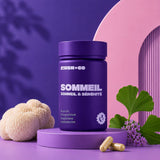
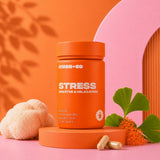
Our reading of the comparison above fits in one sentence: reishi as the base, and for the rest the actives that do carry an authorised claim. The formula therefore combines a reishi extract standardised for polysaccharides (15:1 ratio), valerian, magnesium bisglycinate — the best-tolerated form digestively — and melatonin. Thirty capsules, one a night, formulated in Toulouse.

Sleep +
Reishi, valerian, magnesium bisglycinate and melatonin. One capsule thirty minutes before bed.
Discover Sleep + →
Relaxation Pack
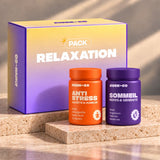
Anti-Stress in the morning, Sleep + in the evening. For when what stops you sleeping is actually settled during the day.
Discover the Relaxation Pack →« It lets me sleep well and quiet my head. I recommend it to people around me very often. »
★★★★★ Vesque V. · verified review of Sleep +
« I've been using it for about three months and it really is good for sleep. »
★★★★★ Patricia R. · verified review of Sleep +
Verified customer reviews from the product page, translated from French without editing the content.
Your questions
What you ask us about this ranking.
What is the best mushroom for sleep?
Reishi (Ganoderma lucidum). It is the only species with a human trial of acceptable size on this ground — 132 participants over 8 weeks — and the one that appears in almost every evening formula. Lion's mane comes next, with an indirect interest for a racing mind.
Does lion's mane make you sleepy?
No trial measures its effect on sleep. What is documented concerns mood and cognitive function, in small samples. Its interest is indirect: it concerns people who cannot drop off because their head is still turning.
Can you take cordyceps in the evening?
It is not dangerous, but it is counterproductive: cordyceps is studied on exertion and oxygen use. Its place is the morning, possibly before a training session.
What dose of reishi should you take?
The published protocols use 1,000 to 2,000 mg of extract. Start at 500 mg for a week, then go up. The timing: thirty to sixty minutes before bed.
Is reishi taken as a powder?
Rarely: it is frankly bitter and you notice it in a drink. That is why almost every evening formula comes in capsules, unlike lion's mane or cordyceps.
How long before you notice anything?
Two weeks for a first impression, four to six weeks for the underlying effect. The reference trial on reishi runs eight weeks.
Can reishi and melatonin be combined?
Yes, and that is the make-up of most evening formulas, including ours. Melatonin acts on time to fall asleep from the first dose; reishi works over the longer run. Do not drive in the hour after taking melatonin.
Sources
The references cited in this article.
- Tang W. et al. (2005). A randomized, double-blind and placebo-controlled study of a Ganoderma lucidum polysaccharide extract in neurasthenia. Journal of Medicinal Food, 8(1), 53-58.
- Chu Q.P. et al. (2007). Extract of Ganoderma lucidum potentiates pentobarbital-induced sleep via a GABAergic mechanism. Pharmacology Biochemistry and Behavior, 86(4), 693-698. (animal study)
- Nagano M. et al. (2010). Reduction of depression and anxiety by 4 weeks Hericium erinaceus intake. Biomedical Research, 31(4), 231-237.
- Chen S. et al. (2010). Effect of Cs-4 (Cordyceps sinensis) on exercise performance in healthy older subjects: a double-blind, placebo-controlled trial. Journal of Alternative and Complementary Medicine, 16(5), 585-590.
- Commission Regulation (EU) No 432/2012 establishing a list of permitted health claims made on foods.
To go further
What to read next.

Discover our mushroom and adaptogenic plant supplements
Our vegan formulas, made in Toulouse by a French manufacturer.