












Chaga Mushroom Benefits: What the Research Says and How to Prepare It
By the Mush n Go editorial team - 13 November 2026
By the Mush n Go editorial teamPublished 14 November 202614 min read
Chaga
The benefits of chaga mushroom (Inonotus obliquus) come from its wealth of antioxidants, melanin, triterpenes such as betulin, and polysaccharides, compounds that have been widely studied in the lab. Here is what the research shows, and how to prepare and dose it.

Immunity
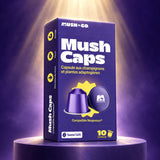
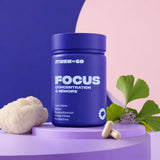
Chaga, Reishi and Oyster mushroom together in a single capsule. Three of the most widely consumed medicinal mushrooms in the world, in a vegan formula made in France.
Discover Immunity →
Brainstoorm
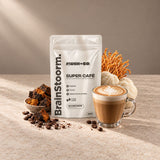
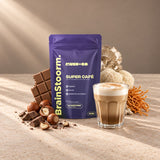
Lion's Mane, Cordyceps and Chaga at 1,000 mg each, maca, organic cacao, chicory, and 20 mg of caffeine per cup. No mushroom taste.
Discover Brainstoorm →What is chaga?
Chaga does not look like a mushroom, and with good reason.
On a birch trunk, chaga looks like a lump of burst charcoal, black and cracked, the size of a fist or a football. It is not a cap on a stem, like a porcini: it is a hard mass, called a sterile conk or sclerotium, formed by the fungus's mycelium and the tree's wood. Inside, the flesh is orange-brown and corky.
Chaga's true “fruit”, the part that releases spores, is rare and inconspicuous: it forms under the bark, often when the tree is already dead. Chaga is in fact a parasite. It causes heart rot in the birch, weakening it over many years.
In Russia and Siberia, chaga has been drunk as a decoction for centuries, sometimes in place of tea in the countryside. It entered literature in 1968, when Aleksandr Solzhenitsyn gave it a passage in Cancer Ward. A novel is not proof, but it explains part of the mushroom's reputation in the West.
Chaga is one of the species we cover in our list of medicinal mushrooms worth knowing, alongside reishi, lion's mane and cordyceps.
Harvesting and sustainability
A slow-growing mushroom that copes badly with a rush.
Chaga takes several years to reach a harvestable size. It grows on only a small proportion of birch trees, and almost all the chaga sold is still picked in the wild. Its recent popularity therefore comes at a cost: in some forests in Scandinavia and North America, intensive picking has made good specimens scarce.
- Responsible harvesting leaves part of the mass on the tree, so that it can grow back.
- Only living birches yield sought-after chaga: on a dead tree, the conk deteriorates.
- Cultivated versions exist, either on inoculated birches or as mycelium grown on grain. Their composition is not identical to that of wild chaga.
- Origin also matters for safety: a mushroom absorbs what it finds in its environment, hence the value of heavy metal testing.
This last point is essential: some of chaga's compounds come from the tree itself. Chaga grown without birch is not necessarily worse, but it does not have the same profile. An honest label says what the product contains, and where it comes from.
What it contains
Melanin, betulin, polysaccharides: three families to know.
Chaga interests researchers because it concentrates a wide range of molecules. They do not all pass into water in the same way, which explains the differences between a decoction, a raw powder and an extract.
Melanin
The pigment that makes the crust black. It is what gives chaga its very high antioxidant scores in the lab. It passes well into hot water.
Triterpenes
Betulin, betulinic acid, inotodiol, lanosterol. Betulin comes from birch bark, which chaga accumulates. These molecules dissolve poorly in water and better in alcohol.
Polysaccharides
Complex sugars, including beta-glucans, as in most medicinal mushrooms. These are what a long decoction extracts.
Polyphenols
Other antioxidants, in amounts that vary with the tree, the region and the preparation.
Chaga also contains a lot of oxalates, compounds that can form kidney stones in people who are prone to them. This matters for heavy users, and we come back to it in the precautions section.
The ORAC trap
“The most antioxidant food in the world”: a claim to handle with care.
You will often read that chaga is the most antioxidant food in the world, with ORAC figures to back it up. ORAC is a lab test that measures an extract's ability to neutralise free radicals in a test tube. Chaga gets spectacular scores, largely thanks to its melanin.
The problem is that this test says nothing about what happens in the body. What you swallow is not necessarily absorbed, and an antioxidant that is absorbed does not necessarily act where you would want it to. That is why the US Department of Agriculture, the USDA, withdrew its ORAC database in 2012, explaining that these values had no demonstrated link with health and were being misused by marketing.
Remember that chaga is very rich in antioxidants.
So be wary of comparisons such as “50 times more antioxidant than blueberries”. They measure a chemical reaction, not an effect on your health. What counts is the quality of the chaga, how it is prepared and the dose.
What the research says
Chaga: four studies, and their limitations.
Research on chaga is plentiful, but it is done almost entirely on cells or animals. Here are four representative pieces of work. The full references are at the bottom of the page.
Park et al., 2004 · South Korea
Human lymphocytes, taken and then cultured, were pretreated with a chaga extract before being exposed to oxidative stress. The damage to their DNA was lower than in untreated cells. Limitation: a lab experiment on isolated cells, not in people who drink chaga.
Glamočlija et al., 2015 · Serbia
Chaga samples of different origins were analysed and tested in the lab. Their composition and activity varied markedly from one sample to the next. Limitation: in vitro tests, but a useful message for consumers: not all chaga is equal.
Géry et al., 2018 · France
A team from the University of Caen analysed the chemistry of chaga extracts and tested their effect on cancerous and healthy lung cells in culture. Some extracts were more toxic to the former. Limitation: cells in a Petri dish, with no conclusion possible for a treatment in humans.
Kikuchi et al., 2014 · Japan
A clinical case: a 72-year-old woman who had been taking four to five teaspoons of chaga powder a day for six months developed oxalate-related kidney injury. Limitation: a single case, but a reminder that high doses over a long period are not harmless.
In short: interesting lab results, a rich composition, and a mushroom to enjoy in moderation, taking breaks: it is high doses over long periods that call for caution.
The benefits, one by one
Chaga mushroom benefits: lead by lead.
Chaga is being studied along many lines. Here are the most frequently cited leads, with the type of study behind them.
| Area | Type of study | What the research shows |
|---|---|---|
| Antioxidant | Lab, cells | Very rich in antioxidants |
| Immune defences | Cells, animals | The polysaccharides interest researchers |
| Blood sugar | Animals | Effects observed in mice |
| Inflammation | Cells, animals | Lab leads |
| Skin | Lab, cosmetics | Melanin and antioxidants used in cosmetics |
Ranking drawn up by our editorial team.
Chaga and skin. The question comes up often. Chaga extracts are used in some cosmetic products for their antioxidants and their colour. As a drink, chaga is enjoyed for its woody taste and its wealth of antioxidants.
Chaga and winter. Chaga is traditionally drunk during the cold season, like other mushrooms. For a complete approach to this time of year, our guide to preparing your immune defences before winter points out that sleep, vitamin D and diet do most of the work. Reishi, often paired with chaga, has been the subject of more human trials.
How to prepare it
A slow decoction, never a rolling boil.
Chaga comes in three forms: chunks, raw powder, or concentrated extract. Each has its use.
| Form | How to use it | Good to know |
|---|---|---|
| Chunks | In a long decoction, over a low heat | The chunks can be reused two or three times |
| Raw chaga powder | As a strained infusion, or mixed into a drink | Raw powder swallowed straight is poorly digested: a decoction extracts more |
| Extract | Diluted in hot water or a drink | More concentrated; the process (water, alcohol, dual extraction) changes the profile |
| In a blend | Mushroom coffee, capsules | Convenient, fixed dose; check the amount of chaga stated |
For a homemade decoction, here is the traditional method, simple and with no special equipment.
Crush
A few dice-sized chunks, or one to two teaspoons of crushed chaga, per litre of water.
Simmer
Heat over a low flame, without boiling hard, for one to several hours. The water turns dark brown, almost black.
Strain
Strain, drink hot or cold, and keep in the fridge for two or three days. Dry the chunks for a second decoction.
The taste is mild, woody and slightly vanilla-like, far from the bitterness of reishi. Half a spoonful of honey or a dash of plant milk is enough. Avoid drinking large amounts every day over long periods, because of the oxalates.
Choosing your chaga
What a good label should tell you.
Chaga is sold in very different forms, and quality varies a great deal, as the Glamočlija study showed. A few questions help you sort the good from the bad.
- Is the origin stated, along with the type of harvest: wild, on cultivated birch, or mycelium on grain?
- Is it raw chaga or an extract? If it is an extract, are the process and the ratio specified?
- Is the amount of chaga per serving written in milligrams, and not just “a mushroom blend”?
- Does the manufacturer publish test results: heavy metals, contaminants, polysaccharide content?
- Does the product steer clear of promises to cure? A seller who promises to treat a disease with chaga is not serious.
At Mush n Go, we publish our laboratory analyses for that reason. It is also something some customers point out.
“[…] being able to access the mushrooms' laboratory analyses and actually check the stated doses”
★★★★★ Axel B. · 27 August 2026
“The coffee is really good, a bit different from traditional coffee, it has a very mild little roasted taste […]”
★★★★★ Nancy D. · 31 August 2026
Trustpilot reviews published about Brainstoorm, quoted as written.
In our formulas
Chaga at Mush n Go: where, and how much.
We use chaga in two formulas. Our recipes are blended in Toulouse, but our mushrooms do not come from France: chaga grows in boreal forests.
In Brainstoorm
1,000 mg of chaga per cup, alongside 1,000 mg of lion's mane and 1,000 mg of cordyceps, with maca, ashwagandha, roasted chicory and organic cacao. 20 mg of caffeine per cup.
In Immunity
In Immunity, chaga is combined with Reishi and oyster mushroom, in capsules. A formula designed for the cold season, to fit into a routine that includes sleep and a varied diet.
Chaga's role in Brainstoorm is also about taste: its woody flavour goes well with chicory and cacao, with no mushroom taste. To discover the species in detail, see our chaga page, or all of our mushrooms. And if you are unsure about the format, our comparison of the best mushroom coffee details the doses in each brand.
Precautions
Natural does not mean free of precautions.
Taken occasionally as a drink, chaga is generally well tolerated. The risks described mainly concern high doses taken over a long time, and certain medical situations. We will devote a full article to the dangers of chaga; in the meantime, here are the essentials.
Avoid chaga, or ask your doctor's advice, if:
- You have kidney stones or kidney disease, or are at risk of oxalate stones: chaga is very rich in oxalates.
- You take an anticoagulant or an antiplatelet drug, or are due to have surgery: effects on blood clotting have been observed in the lab.
- You have diabetes and are on treatment: effects on blood sugar have been observed in animals.
- You have an autoimmune disease or take immunosuppressive treatment.
- You are pregnant or breastfeeding: safety data are lacking.
- You are being treated for cancer: do not add any supplement without the agreement of your medical team.
For an overview of the precautions common to mushrooms and plants, read our article on the risks of mushrooms and adaptogenic plants.
Your questions
Chaga: your questions.
What are the benefits of chaga?
Chaga is very rich in antioxidants, melanin, triterpenes such as betulin, and polysaccharides. In the lab and in animals, these compounds have shown interesting effects. It is traditionally drunk as a decoction, and today it is also found in mushroom coffee and capsules.
What is chaga?
Chaga, Inonotus obliquus, is a parasitic fungus of birch trees that grows in the cold forests of the Northern Hemisphere. The part used is a hard black mass, the sterile conk, which forms on the trunk. It is traditionally drunk as a decoction in Russia and Scandinavia.
How do you prepare chaga?
The simplest way is a decoction: a few chunks or one to two teaspoons of crushed chaga per litre of water, over a low heat for one to several hours. Strain it, and the chunks can be reused two or three times. Extracts simply dissolve in hot water.
What does chaga taste like?
A mild, woody, slightly vanilla-like taste, with an earthy hint. It is much less bitter than reishi. It goes well with chicory, cacao or a little honey.
Is chaga dangerous?
In moderate amounts, it is generally well tolerated. It is very rich in oxalates, and one case of kidney injury has been described after six months of high daily doses. It is not advised for people with kidney problems, on anticoagulant or diabetes treatment, or who are pregnant or breastfeeding, unless a doctor advises otherwise.
Chaga powder or extract: which to choose?
Raw powder has to be infused for a long time to release its compounds, whereas an extract is already concentrated and dissolves easily. For an extract, check the process stated: water mainly extracts the polysaccharides, alcohol the triterpenes. In both cases, the amount in milligrams should be written on the label.
Is chaga good for the skin?
Its antioxidants and melanin are used in some cosmetic products. As a drink, chaga is enjoyed for its woody taste and its wealth of antioxidants.
Can you drink chaga every day?
A cup of decoction or a moderate dose, yes, for most healthy adults. Avoid very large amounts over long periods, because of the oxalates, and take breaks. Ask your doctor's advice if you are on any treatment.
Does chaga contain caffeine?
No, chaga contains no caffeine. Its very dark decoction looks like coffee or black tea, but it is not a stimulant. A mushroom coffee that contains chaga may, however, contain caffeine: check the label.
Sources
- Park Y. K., Lee H. B., Jeon E.-J., Jung H. S., Kang M.-H. (2004). Chaga mushroom extract inhibits oxidative DNA damage in human lymphocytes as assessed by comet assay. BioFactors, 21(1-4).
- Glamočlija J. et al. (2015). Chemical characterization and biological activity of Chaga (Inonotus obliquus), a medicinal "mushroom". Journal of Ethnopharmacology, 162.
- Géry A. et al. (2018). Chaga (Inonotus obliquus), a future potential medicinal fungus in oncology? A chemical study and a comparison of the cytotoxicity against human lung adenocarcinoma cells (A549) and human bronchial epithelial cells (BEAS-2B). Integrative Cancer Therapies, 17(3).
- Kikuchi Y. et al. (2014). Chaga mushroom-induced oxalate nephropathy. Clinical Nephrology, 81(6).
- Szychowski K. A. et al. (2021). Inonotus obliquus – from folk medicine to clinical use. Journal of Traditional and Complementary Medicine, 11(4).
- USDA, Nutrient Data Laboratory (2012). Oxygen Radical Absorbance Capacity (ORAC) of Selected Foods, Release 2: database withdrawn.
- Solzhenitsyn A. (1968). Cancer Ward. Novel.
Keep reading
Further reading.
Chaga is just one of the species in our range. Discover our other guides, or take a look at Immunity.

Discover our mushroom and adaptogenic plant supplements
Our vegan formulas, made in Toulouse by a French manufacturer.