


















Edible mushroom
Maitake (Grifola frondosa): the mushroom that dances
By the Mush n Go team · Updated 22 October 2026
Maitake (Grifola frondosa), also known as hen of the woods, is a large edible mushroom that grows at the foot of old oaks. Highly prized in Japan, where its name means “dancing mushroom”, it is studied above all for its beta-glucans. It is not in our formulas: here is what you need to know.
The cooking guide
Cleaning it, pan-frying it, roasting it in the oven or slipping it into a broth: all our tips for getting maitake right, fresh or dried.
See the cooking guide →
Immunity
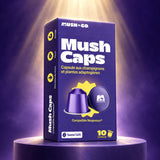
Maitake is not in our formulas. Immunity brings together three other mushrooms rich in beta-glucans: Chaga, Reishi and Oyster mushroom.
Discover Immunity →Identity card
Grifola frondosa: maitake in brief.
A large cluster of small, overlapping grey-brown caps, at ground level, against the trunk of an old oak: maitake looks like none of the mushrooms in our usual baskets. Here are the essentials before going further.
A long history
From the Japanese undergrowth to market stalls worldwide.
Long rare and sought after, maitake has become, in just a few decades, one of the best-known cultivated mushrooms in Asia.
A legend
In Japan, mai-také means “dancing mushroom”. According to tradition, foragers danced for joy when they found it, so highly was it prized.
An ancient use
In China and Japan, it has long been part of the cuisine and of traditional practices, like many forest mushrooms.
The 1980s
Its cultivation develops on a large scale in Japan, and Japanese researchers take a close interest in its beta-glucans.
Today
It is found fresh or dried in Asian grocery shops and at some markets, and as a powder or extract in food supplements.
Look-alikes
Three mushrooms that look like it, and how to tell them apart.
In the forest, maitake has a few look-alikes. None is a dangerous poison, but it is best to know how to recognise them.
Maitake
A cluster of small, fan-shaped grey-brown caps, on a highly branched stem, at the foot of an oak.
The umbrella polypore
Polyporus umbellatus, sometimes also called hen of the woods. Its caps are round, smaller and each centred on its own stem.
The giant polypore
Meripilus giganteus. Larger, it blackens when touched and turns tough as it ages. Edible when young, but far less delicate.
The cauliflower fungus
Sparassis crispa, the “wood cauliflower”. Pale yellow, shaped like a curly sponge, it tends to grow at the foot of pines.
If you forage yourself, have your harvest checked by a pharmacist or a mycological society before eating it.
How to cook it
Cook maitake like a treasure.
Firm at the heart and tender at the edges, maitake takes on an almost crispy texture when cooked. Do not rinse it under the tap: brush it, cut off the tough base, and pull it apart by hand into small clusters.
| Method | Cooking time | Tip |
|---|---|---|
| Pan-fried | 6 to 8 minutes | High heat, a few mushrooms at a time, then butter, garlic and thyme at the end |
| Oven-roasted | 15 to 20 minutes at 200 °C | In large clusters, with olive oil and salt: the edges turn crispy |
| As tempura | 2 to 3 minutes | The great Japanese classic, in small clusters in a very light batter |
| In broth | 10 minutes | Dried, then rehydrated for 20 to 30 minutes, it flavours a miso soup or a vegetable broth |
Always eat it cooked: like most mushrooms, it is less digestible raw. It loves garlic, butter, thyme, soy sauce and eggs. Pan-fried and served on a risotto or fresh pasta, it makes an autumn dish in fifteen minutes.
What it provides
A light mushroom, but a well-filled one.
Like most mushrooms, maitake is made up largely of water. According to the US nutrition database USDA, it provides about 31 kcal per 100 g raw, with fibre, a little protein and B vitamins.
- Very little fat and few calories.
- Fibre, including the beta-glucans in its cell wall.
- B vitamins, like most mushrooms.
- Vitamin D when it has been exposed to ultraviolet light, like other mushrooms.
Beta-glucans and D-fraction
What interests researchers.
Like many mushrooms, maitake contains beta-glucans: long chains of sugars that make up the walls of its cells. They are a particular kind of fibre, also found in chaga, reishi and oyster mushroom.
In the 1980s, Professor Hiroaki Nanba's team in Japan isolated a purified fraction of them, named “D-fraction”. It is now the most studied maitake extract, and it is often the one found in the best-documented supplements.
What the studies say
Lots of lab work, few human trials.
Research on maitake is plentiful in the laboratory and in animals, and much rarer in humans. The existing clinical trials are small, carried out in a medical setting, with concentrated extracts: no conclusion can be drawn from them for a portion on your plate.
Wu et al., 2021 · review
A review taking stock of the compounds in maitake, polysaccharides, proteins and phenolic compounds, and of the activities studied, mainly in the laboratory and in animals.
Santé.fr, 2025 · France
The French public health information service points out that mushroom beta-glucans have mainly been studied in vitro or in animals, and that human trials remain small.
In short: a good cooking mushroom, and an open research topic. Be wary of products that credit it with specific effects: science does not demonstrate them to date.
Fresh, dried or as an extract
Which form to choose?
Maitake comes in three forms, which differ in taste, use and shelf life.
| Fresh | Dried | Powder or extract | |
|---|---|---|---|
| Where to find it | Asian grocery shops, some markets, in autumn | Asian grocery shops, online | Organic shops, online |
| Use | Pan-fried, oven, tempura | Broths, sauces, stews | Food supplement |
| Storage | 3 to 5 days in the fridge, in a paper bag | Several months in a dry jar | As per the label |
| Preparation | Brush, separate, cook | Rehydrate for 20 to 30 minutes | None |
For supplements, read the label closely. A good product states the part used (fruiting body or mycelium), the type of extract, its beta-glucan content and the dose in milligrams per serving.
Why it is not in our formulas
Maitake and Mush n Go.
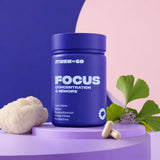
Maitake is not in any of our formulas. We prefer to dose a few mushrooms, chosen for a specific need, at high levels, rather than line up ten species at a few milligrams each. If it is beta-glucans you are interested in, they are at the heart of our Immunity formula, with three other mushrooms.
Immunity
Chaga, Reishi and Oyster mushroom combined in a single capsule. One a day, in the morning, during the changes of season.
Discover Immunity →
Brainstoorm
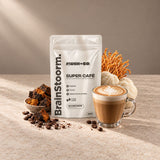
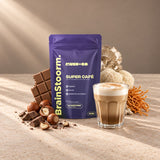
Our super mushroom coffee: Lion's Mane, Cordyceps and Chaga at 1,000 mg each, and only 20 mg of caffeine per cup.
Discover Brainstoorm →Precautions
Is maitake dangerous?
Cooked and eaten in normal amounts, maitake is a well-tolerated edible mushroom. A few precautions nevertheless apply to it, as to other mushrooms.
- Always eat it cooked, and start with a small portion if you have never tried it.
- If you have a known mushroom allergy, avoid it.
- As a food supplement, ask your doctor for advice if you are on medication, particularly for diabetes, blood pressure or anticoagulation.
- During pregnancy and breastfeeding, avoid supplements without medical advice.
- If you forage it, always have your harvest checked.
Your questions
Everything people ask us about maitake.
What is maitake?
Maitake (Grifola frondosa) is a large, clustered edible mushroom that grows at the foot of old oaks. It is also called hen of the woods or cluster polypore. It is widely eaten in Japan.
What are the benefits of maitake?
It is first and foremost a good food, light and rich in fibre. Its beta-glucans are widely studied, but mostly in the laboratory and in animals: human trials are rare and do not allow any specific effect to be attributed to it.
How do you cook maitake?
Brush it without washing it, separate it into small clusters and brown it for 6 to 8 minutes in a frying pan over a high heat. It is also delicious oven-roasted, as tempura or in a broth.
Can you eat maitake raw?
It is best avoided. Like most mushrooms, it is less digestible raw. A few minutes of cooking are enough.
Where can you find maitake?
Fresh or dried in Asian grocery shops, at some markets in autumn, and online. In the forest, it grows at the foot of old oaks from late summer to autumn.
How do you take maitake as a supplement?
By following the dose and timing shown on the label, ideally with a product that states the part used, the type of extract and its beta-glucan content. Ask for advice if you are on medication.
Does maitake have side effects?
Cooked, it is well tolerated. Like any mushroom, it can cause digestive discomfort or an allergy. As a supplement, caution is needed with certain medications, particularly for diabetes or anticoagulation.
What is the difference between maitake and shiitake?
They are two edible mushrooms from Japan, but different ones. Shiitake has a single cap and grows on dead wood; maitake forms a large cluster at the foot of oaks. Read the benefits of shiitake.
Is there maitake in Mush n Go products?
No. Our formulas rely on Lion's Mane, Cordyceps, Chaga, Reishi and Oyster mushroom, dosed for a specific need. For beta-glucans, see Immunity.
Sources
- Wu J.-Y., Siu K.-C., Geng P. (2021). Bioactive ingredients and medicinal values of Grifola frondosa (Maitake). Foods, 10(1).
- Mayell M. (2001). Maitake extracts and their therapeutic potential. Alternative Medicine Review, 6(1).
- U.S. Department of Agriculture. FoodData Central: Mushrooms, maitake, raw.
- Service public d'information en santé (2025). “Que penser des cafés dits « aux champignons » ?” Santé.fr, 24 March 2025.
Keep exploring
More mushrooms to discover.
Maitake is just one of the many mushrooms studied today. Browse our guide to mushrooms and adaptogenic plants, or discover the ones in our formulas.
