























Cortisol Test: 8am Blood Test, Saliva and Home Kits, What They Really Measure
By the Mush n Go editorial team - 10 November 2026
By the Mush n Go editorial teamPublished 10 November 202615 min read
Cortisol
A cortisol test is most often done with a blood sample at 8am, when levels are at their highest. But a single figure says little: cortisol changes from hour to hour. To look for an excess, doctors use saliva at 11pm or a 24-hour urine collection. Home tests measure one moment, not a state of stress.
The complete guide: how to lower cortisol naturally →

Anti-Stress
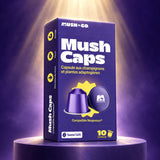
Ashwagandha and reishi, holy basil, schisandra and vitamin B6, which contributes to normal functioning of the nervous system.
Discover Anti-Stress →
Sleep+
Reishi, valerian, magnesium bisglycinate and melatonin — one capsule thirty minutes before bed.
Discover Sleep+ →A level that moves
Cortisol is not measured like cholesterol, it changes from hour to hour.
Cortisol is a hormone made by the adrenal glands, two small glands that sit on top of the kidneys. It is often called the “stress hormone”, but its role is much broader: it helps mobilise sugar, regulate blood pressure, modulate inflammation and set the rhythm of the day. You cannot live without cortisol.
Its production follows a 24-hour rhythm, controlled by the brain. It is at its lowest around midnight, rises again in the second half of the night, peaks on waking, then falls slowly until the evening. On top of this rhythm, every stressor, whether exercise, a meal or bad news, causes small spikes.
Around midnight
The lowest point of the day, in someone who sleeps at regular times.
Late night
Production gradually rises again, to prepare for waking.
On waking
The peak. The level rises sharply again in the 30 to 45 minutes after getting up: this is the “cortisol awakening response”.
In the afternoon
The decline continues, with small rises after meals or moments of tension.
In the evening
The level is low again. High cortisol late in the evening is one of the signs doctors look for.
The practical consequence: a result only means something in relation to the time the sample was taken. A cortisol level that is “normal” at 8am would be too high at midnight. That is why cortisol is never measured at a random time of day. To understand the link with your morning cup, see our article on coffee and cortisol.
The four measurements
Blood, saliva, urine, hair: each test answers one question.
There is not one cortisol test, but several. They do not measure the same thing, or over the same period. The right test depends on what you are looking for: a deficiency, an excess, or a trend over several months.
| Test | When | What it shows | Use |
|---|---|---|---|
| Blood test | At 8am, fasting | Total cortisol at one moment, at the peak | Looking for a deficiency (adrenal insufficiency) |
| Saliva | At 11pm, at home | Free, active cortisol, at a time when it should be low | Looking for an excess (Cushing's syndrome) |
| 24-hour urine | Collection over one day | The amount of free cortisol excreted in 24 hours | Looking for an excess, confirming |
| Hair | One sample | An average over several months, roughly one month per centimetre | Mainly research, not routine diagnosis |
There are also dynamic tests, carried out under medical supervision: the dexamethasone suppression test for an excess, and the Synacthen® test for a deficiency.
Remember one simple idea: the morning blood test is good at spotting cortisol that is too low, but poor at spotting cortisol that is too high. For an excess, it is the evening and the whole day that tell the story.
Cortisol at 8am: normal ranges
Normal cortisol levels at 8am: a wide range.
A blood cortisol test is usually done between 7am and 9am, fasting, after a normal night. The laboratory gives its result with its own reference values, because they depend on the technique used. Always compare your figure with the ranges printed on your report, not with those on a website.
The range is wide because healthy people are very different from one another, and because the same person varies from one day to the next. A figure at the top of the range is not “bad”, and a figure at the bottom is not “weak”. What matters is being clearly outside it, and above all having symptoms that go with it.
Watch the units: the same result can be written as 400 nmol/L or 14.5 µg/dL. A lot of worry comes from comparing two different units.
What the experts say
Cortisol testing: four key reference texts.
Recommendations on measuring cortisol come from endocrinology societies and from the researchers who study it. Here are four texts that set the rules. The full references are at the bottom of the page.
Nieman et al., 2008 · Endocrine Society
These guidelines on Cushing's syndrome propose one of the following tests to look for excess cortisol: late-night salivary cortisol, measured at least twice; 24-hour urinary free cortisol, measured at least twice; or the 1 mg dexamethasone suppression test. They advise against a single morning blood cortisol for this screening.
Bornstein et al., 2016 · Endocrine Society
For adrenal insufficiency, the guideline names the synthetic ACTH stimulation test as the reference test. A low morning cortisol points in that direction, but is not enough to make the diagnosis. It also points out that some medicines, such as the contraceptive pill, alter total cortisol.
Stalder et al., 2016 · International consensus
Researchers set rules for measuring cortisol on waking in saliva. Their finding: a delay of just a few minutes between waking and taking the sample is enough to skew the result. Without very strict timing, measurements taken at home are not very reliable.
Cadegiani and Kater, 2016 · Brazil
This systematic review examined 58 studies on “adrenal fatigue”. The authors found no evidence that this condition exists: the results were contradictory and the methods often weak. It concludes that this diagnosis should not be made on the basis of cortisol tests.
The common thread in these texts: a cortisol test is used to detect a specific disease of the adrenal or pituitary glands. It was not designed to measure everyday stress.
What skews the result
The pill, timing, the needle: the most common pitfalls.
A cortisol result can fall outside the normal range without any disease being involved. Before you worry about a figure, check whether one of these situations applies to you.
- The pill and oestrogens. They increase the protein that carries cortisol in the blood. Total cortisol then looks high, while active cortisol is normal. Pregnancy does the same.
- Corticosteroids. Tablets, inhalers, creams, injections: they can lower your own production, or be confused with cortisol by some testing techniques.
- The time. A sample taken at 10am instead of 8am gives a lower figure. Night work shifts the whole rhythm.
- The stress of the blood test. Waiting, the needle, or a short night beforehand can push the level up in some people.
- An acute illness. Fever, infection, recent surgery, severe pain: cortisol rises, that is its job.
- Alcohol, severe depression, significant obesity. They can raise cortisol moderately, without any adrenal disease.
Always tell the laboratory and your doctor about your treatments, including those you do not think of as medicines: the pill, patches, nasal sprays, creams. If you use oestrogen-based contraception, your doctor may suggest a different test, or ask you to stop it a few weeks beforehand.
Home tests
Home cortisol test: what you are really buying.
Pharmacies, health shops and online retailers sell kits to measure your own cortisol. Most do not give an immediate result: you collect saliva, a drop of blood from your finger or dried urine, then send the sample to a laboratory. The result arrives a few days later, often with a graph of your day.
What is reliable
The analysis itself, when it is done by a laboratory. Saliva measures free cortisol well, and the sample is simple to take, with no needle.
Where it falls down
Timing. A waking sample taken fifteen minutes late changes the result. And a single day says nothing about your weeks.
What is misleading
The interpretation. Reports sometimes talk about “adrenal fatigue” or “hormonal burnout”, notions with no medical validation.
What it costs
These kits are not reimbursed. A test prescribed by your doctor and done in a laboratory is, and it will be interpreted alongside your symptoms.
Our honest view: a home test can satisfy your curiosity, but it does not replace a proper check-up. If it comes back “abnormal”, you will have to repeat the test in a laboratory anyway. If it comes back “normal” while you feel unwell, it should not stop you seeing a doctor. Either way, your doctor holds the key.
Interpreting a result
High or low cortisol: when it is normal, when to worry.
Here is how doctors reason, greatly simplified. This table does not replace your doctor's interpretation, which will take your history and treatments into account.
| Result | Common explanation | What prompts a visit to the doctor |
|---|---|---|
| Slightly high at 8am | The pill, stress of the blood test, short night, acute illness | Weight gain around the trunk, purple stretch marks, high blood pressure, easy bruising |
| High in the evening, several times | Shifted rhythm, night work, alcohol, or a genuine excess to investigate | Always seek medical advice: this is the signal doctors look for |
| Slightly low at 8am | Late sample, recent corticosteroids, individual variation | Intense fatigue, weight loss, fainting spells, low blood pressure, salt cravings |
| Very low at 8am | Possible adrenal insufficiency, or recently stopped corticosteroids | Prompt medical advice, stimulation test |
A single result with no symptoms rarely leads to a diagnosis. Doctors almost always confirm with a second test.
To put words to the symptoms of excess cortisol and what can keep it going, our article high cortisol: symptoms and solutions covers the subject. Low cortisol will have an article of its own.
What a test cannot tell you
Your stress does not fit into a number.
This is probably the most important point in this article. Many people want to test their cortisol because they feel exhausted and tense, and they sleep badly. That is understandable: we would like proof, a number that explains everything. Cortisol is not that number.
In most stressed or tired people, cortisol stays within the normal range. Chronic stress can change the shape of the curve over the day, but these differences show up as averages across groups of people, not reliably in one individual. The idea of “adrenal fatigue”, very widespread online, is recognised neither by endocrinology societies nor by the 2016 systematic review cited above.
A test can tell you
Whether your adrenal glands produce clearly too much or clearly too little cortisol, which is a medical condition that needs treating.
A test cannot tell you
Whether you are “too stressed”, whether your fatigue comes from cortisol, or whether a routine is working for you.
If you have felt at the end of your tether for weeks, the right starting point is a medical appointment, not a kit. Fatigue, sleep, mood, workload, deficiencies: your doctor can explore many more avenues. Our guide persistent fatigue: what to do helps you prepare for that appointment.
Preparing for your test
Three rules for a result that actually means something.
If your doctor prescribes a cortisol test, a few simple precautions make the result much more reliable. They apply to the laboratory as well as to a saliva sample taken at home.
The exact time
Blood test between 7am and 9am, saliva at the time indicated, often 11pm. Note the actual time the sample was taken.
A normal day
Avoid intense exercise, alcohol and a sleepless night the day before. For saliva: no food, tooth brushing or smoking in the 30 minutes beforehand.
All your treatments
Mention the pill, corticosteroids even as a cream or spray, and supplements. Never stop them without medical advice.
For the 24-hour urine collection, you discard the first urine of the morning, then collect all urine up to and including the first of the next morning, keeping the container cool. A missed collection skews the total: it is better to start again on another day.
When to see a doctor
The signs that call for prompt medical advice.
Cortisol disorders are rare, but they do exist, and they can be treated. Some signs should prompt you to see a doctor, whether or not you have done a test.
See your doctor, without waiting for a home test, if:
- You are gaining weight mainly around your belly and face, with wide purple stretch marks, bruises that appear easily or weakness in your thighs.
- You feel overwhelming fatigue with weight loss, nausea, dizziness when standing up, salt cravings or darkening skin.
- You have recently stopped a corticosteroid treatment taken for several weeks and feel very unwell.
- You are pregnant: cortisol rises normally during pregnancy, and tests must be interpreted by a specialist.
- You feel at the end of your tether, hopeless, or have dark thoughts: talk to a doctor. If you are having suicidal thoughts, call Samaritans on 116 123, free, 24 hours a day.
Sudden fatigue with vomiting, abdominal pain and very low blood pressure, in someone with known adrenal insufficiency or who has just stopped corticosteroids, is an emergency: call 112.
After a normal result
Normal cortisol, but still on edge: where to start.
This is the most common situation. The test is reassuring, and yet the stress is there. The good news: the levers that matter most need no test. Regular sleep, daylight in the morning, moderate physical activity, caffeine kept for the morning, moments of real disconnection. Our article how to lower cortisol ranks them by level of evidence.
Some people add a plant-based routine to this foundation. Ashwagandha is the most studied: several trials have measured their participants' cortisol, with results and limitations that we detail in our article ashwagandha benefits and studies. It is in this spirit that we formulated Anti-Stress: ashwagandha standardised for withanolides, reishi, holy basil, schisandra and vitamin B6, which contributes to normal functioning of the nervous system and to the reduction of tiredness and fatigue.
- A supplement replaces neither sleep nor medical advice. It adds to a routine, it does not replace it.
- Repeating a cortisol test to “see if it works” makes no sense: the variation from one day to the next is greater than the expected effect.
- Judge instead by how you feel over the weeks: sleep, irritability, energy at the end of the day.
To find out more about the plant, see our ashwagandha page. And if your stress mainly affects your nights, our guide better sleep: 15 evening habits is a good place to start.
Your questions
Cortisol test: your questions.
How is a cortisol test done?
Most often with a blood test between 7am and 9am, when cortisol is at its highest. To look for an excess, doctors prefer a saliva sample at around 11pm or a 24-hour urine collection, repeated at least twice.
What is a normal cortisol level at 8am?
Most often between about 150 and 550 nmol/L, but reference values depend on the laboratory's technique. Always compare your result with the ranges printed on your report, and pay attention to the units: 1 µg/dL equals 27.6 nmol/L.
Do you need to fast for a cortisol test?
For the morning blood test, you are generally advised to be fasting and rested. For saliva, avoid eating, drinking anything other than water, brushing your teeth or smoking in the 30 minutes before the sample.
Are home cortisol tests reliable?
The analysis is often done by a real laboratory, but the result depends heavily on the exact time of the sample and reflects only one day. These tests cannot be used to make a diagnosis. An abnormal result will need to be repeated on prescription.
What is salivary cortisol?
It is free cortisol, the active form, measured in saliva. Taken at around 11pm, when it should be at its lowest, it is used to look for excess cortisol. Unlike blood cortisol, it is not affected by the pill.
What is urinary free cortisol used for?
It measures the cortisol excreted in urine over 24 hours, and so the production of a whole day. It is used to look for Cushing's syndrome. The collection must be complete, and the test is usually repeated.
Can a cortisol test measure stress?
Not reliably in one person. In most stressed people, cortisol stays within the normal range, and it varies a lot from one day to the next. The tests are used to detect adrenal diseases, not to measure a level of stress.
Does the pill affect a cortisol test?
Yes, for the blood test. Oestrogens increase the protein that carries cortisol, which raises total cortisol without changing active cortisol. Tell your doctor about your contraception, as they may suggest a saliva or urine test.
Does adrenal fatigue show up on a blood test?
No. Adrenal fatigue is not recognised as a disease by endocrinology societies, and a review of 58 studies published in 2016 found no evidence that it exists. Genuine adrenal insufficiency, on the other hand, is diagnosed with specific tests.
Sources
- Nieman L. K. et al. (2008). The diagnosis of Cushing's syndrome: an Endocrine Society clinical practice guideline. Journal of Clinical Endocrinology & Metabolism, 93(5).
- Bornstein S. R. et al. (2016). Diagnosis and treatment of primary adrenal insufficiency: an Endocrine Society clinical practice guideline. Journal of Clinical Endocrinology & Metabolism, 101(2).
- Stalder T. et al. (2016). Assessment of the cortisol awakening response: expert consensus guidelines. Psychoneuroendocrinology, 63.
- Cadegiani F. A., Kater C. E. (2016). Adrenal fatigue does not exist: a systematic review. BMC Endocrine Disorders, 16(1):48.
- Stalder T. et al. (2017). Stress-related and basic determinants of hair cortisol in humans: a meta-analysis. Psychoneuroendocrinology, 77.
Keep reading
Further reading.
Cortisol is easier to understand than to measure. Discover our other guides on stress, or take a look at Anti-Stress.

Discover our mushroom and adaptogenic plant supplements
Our vegan formulas, made in Toulouse by a French manufacturer.