








How to lower cortisol: symptoms and natural solutions
By Mush n Go - 06 March 2026

Stress
How to lower cortisol
symptoms and natural solutions
By the Mush n Go editorial teamUpdated 24 September 202614 min read
Stress and hormones
Cortisol is not a hormone to suppress: it is what wakes you up in the morning. The problem is not its level, it is its rhythm — a peak between 6 and 8 am, then a decline until evening. When the curve flattens, you wake up exhausted and go to bed tense. Three levers have solid data: sleep, moderate physical activity and caffeine load. Ashwagandha is the only active whose cortisol-lowering effect has actually been measured.
Cortisol follows a curve
It is not a stress hormone, it is a waking hormone.
Cortisol is produced by the adrenal glands, under the control of a loop that starts in the hypothalamus: the hypothalamic-pituitary-adrenal axis. Its production follows a very clear circadian rhythm. It rises sharply in the thirty minutes after waking — that is the cortisol awakening response — peaks between 6 and 8 am, then declines through the day to its lowest point around midnight.
It is this cycle that makes you alert in the morning and ready for sleep at night. So the goal is never "to have less cortisol": it is to recover a curve that rises and falls at the right time.
On waking
A fast rise over thirty minutes. It is what gets you out of bed.
6 to 8 am
The day's peak. Adding a coffee at that moment adds a rise on top of a rise.
In the afternoon
Gradual decline. A relative dip around 3-4 pm is normal.
In the evening
The lowest level, a condition for falling asleep. A curve that never comes down is what keeps you awake.
Signs of a disrupted rhythm
Ten signals, none of them specific.
- You wake up exhausted, even after eight hours' sleep.
- You get a clear energy dip mid-afternoon, followed by a second wind in the evening.
- You take a long time to fall asleep even though you are tired.
- You wake around 3 am for no apparent reason.
- You are putting on weight around the middle without changing your diet.
- You crave sugar at the end of the day.
- You are irritable over small things.
- You catch everything going around.
- You find it hard to concentrate, with a sense of fog.
- You recover badly after exercise.
None of these signs is specific to cortisol: they are also found in iron deficiency, hypothyroidism, sleep apnoea or depression. That is precisely why you get them investigated rather than treating them alone.
How to measure it
Two methods and one precaution.
In other words: have it done if your doctor thinks it useful, and do not order an online test to steer a supplement regimen yourself. The levers described below apply with or without a measurement.
What flattens the curve
Six causes and their real weight.
| Cause | Effect on the rhythm | What you can do |
|---|---|---|
| Sleep debt | The strongest. Shifts and flattens the whole curve | Regular hours, including at weekends |
| Caffeine, especially in the morning | A measured rise in the following hour, and an effect on sleep up to 6 hours later | Divide the dose, and stop before 2 pm |
| Overtraining | Raises cortisol instead of lowering it | Moderate the intensity, add rest days |
| Screens in the evening | Delays the evening decline | Switch off an hour before bed |
| Very sugary meals | Blood-sugar swings that tax the stress axis | Protein-based breakfasts rather than sweet ones |
| Lasting psychological stress | The underlying cause, the one that resists tricks | Support, not a supplement |
What the studies say
Five pieces of work where cortisol was measured.
We only include human trials where cortisol was actually assayed — not reasoning about a mechanism. It is a strict filter, and it removes much of what is written on the subject.
Chandrasekhar et al., 2012 · India
64 adults reporting stress, 300 mg of ashwagandha root extract twice a day for 60 days, double-blind. Serum cortisol fell by 27.9 % in the treated group against 7.9 % on placebo. Modest sample.
Lopresti et al., 2019 · Australia
60 adults, 240 mg of standardised ashwagandha extract a day for 60 days against placebo. Lower morning cortisol in the treated group. Confirms the previous result at a lower dose.
Lovallo et al., 2005 · United States
Salivary cortisol measured after caffeine intake in everyday conditions. Caffeine raises cortisol in the following hour, including in regular consumers. So the first coffee of the day adds to the natural peak.
Park et al., 2010 · Japan
280 participants, 24 forests. Salivary cortisol measured after time spent in a forest is lower than after the same time in an urban environment. A short, measured, reproducible effect.
Pascoe et al., 2017 · Australia
Systematic review and meta-analysis of physiological stress markers under mindfulness practices. Cortisol is among the markers that shift. Considerable heterogeneity between protocols.
What you will not find here: a human trial showing that reishi lowers cortisol. There is no solid one, and we would rather say so. References at the bottom of the page.
1. Sleep
The heaviest lever, and the least marketable.
No supplement makes up for sleep debt, because it is sleep itself that puts the cortisol curve back in place. Seven to nine hours, with regular hours, including on Saturdays: it is the weekend shift that resets the clock every Monday.
Three settings matter more than the rest: a bedroom at 18-19 °C, complete darkness, and screens off an hour before. If falling asleep is still hard despite that, read mushrooms for sleep?
2. Physical activity
Moderate, otherwise it does the opposite.
What helps
Brisk walking, swimming, cycling, yoga: 30 to 45 minutes, three to five times a week. The effect comes as much from consistency as from intensity.
What makes it worse
Overtraining. Repeated intense effort without recovery raises cortisol instead of lowering it. If your sleep deteriorates as you add sessions, that is the signal.
3. Breathing and nature
Two short habits, both measured.
Paced breathing
Five seconds in, five seconds out, for five minutes. Three times a day. It is free, it is short, and it activates the parasympathetic side.
Twenty minutes outside
Park's study, across 280 participants and 24 forests, measures lower salivary cortisol after time in a forest than in a city. A park will do.
Mindfulness
Ten minutes a day is enough in most protocols in Pascoe's meta-analysis. Results are heterogeneous, but trying costs nothing.
4. Caffeine
The morning reflex that works against you.
Lovallo's study shows that caffeine raises cortisol in the following hour, including in people who drink it daily. Taken between 7 and 8 am, an espresso therefore adds a rise to the natural peak — at exactly the moment you need it least.
Does that mean quitting coffee? No. It means shifting and dividing: wait an hour after waking, and lower the dose per cup. A cup of Brainstoorm brings 20 mg of microencapsulated caffeine against roughly 80 mg for an espresso. If you want to explore the other routes, we compared them in coffee alternatives.
5. Adaptogens, honestly
One documented active and a lot of shortcuts.
On cortisol specifically, only one active has several human trials in which the hormone was assayed: ashwagandha. Chandrasekhar measures a 27.9 % fall in serum cortisol over 60 days at 600 mg a day; Lopresti finds lower morning cortisol at 240 mg a day over the same period. These are small samples, but the result points the same way twice.
Reishi, on the other hand, is very often presented as "the anti-cortisol champion". That claim rests on no human trial in which cortisol was measured. What is documented for reishi is self-reported fatigue and wellbeing scores in Tang's trial, across 132 participants. That is different, and we see no point in writing it otherwise.
No mushroom has an authorised health claim in Europe. In our formulas it is vitamin B6 that carries authorised statements: it contributes to normal psychological function, to the normal functioning of the nervous system and to the reduction of tiredness.
A typical day
What it looks like put end to end.
7 am — on waking
Five minutes of paced breathing before getting up. A large glass of water. No coffee just yet: let the natural peak do its work.
8 am — breakfast
Protein-based rather than sweet, to avoid blood-sugar swings. That is where the morning cup goes, at a reduced load.
1 pm — the break
Ten minutes' walk outside. The best-measured habit of the lot, and the easiest to keep.
6 pm — activity
Thirty to forty-five minutes of moderate effort. No intense session if your sleep is already suffering.
9 pm — the descent
Screens off, low light, bedroom at 18-19 °C. That is the window in which the curve should come down.
When to see a doctor
The signals that go beyond this article.
See a doctor, rather than supplementing yourself, if:
- You are gaining weight rapidly around the abdomen and face, with purple stretch marks or muscle weakness: these are signs to get investigated.
- Your blood pressure is high with no identified cause.
- Your fatigue has lasted more than three months despite adequate sleep.
- You already take a corticosteroid, an anxiolytic or an antidepressant.
- You are pregnant or breastfeeding: ashwagandha is not advised.
- You have a thyroid disorder: ashwagandha calls for monitoring.
A supplement is never the first answer to lasting fatigue. It sits alongside regulated sleep and regular activity, not in their place.
Our formulas
What we put in the capsule.
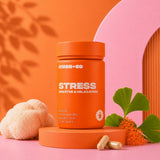
Our Anti-Stress formula is built around the best-documented active on cortisol: 5,000 mg of ashwagandha in dry plant equivalent (root extract standardised in withanolides, 50:1 ratio), 3,000 mg of reishi in dry plant equivalent (15:1 ratio), 400 mg of holy basil, 90 mg of schisandra and 2 mg of vitamin B6 in its active P5P form. Thirty capsules, one to two a day, developed in Toulouse.

Anti-Stress
Ashwagandha and reishi, holy basil, schisandra and vitamin B6, which contributes to the reduction of tiredness.
Discover Anti-Stress →
Brainstoorm
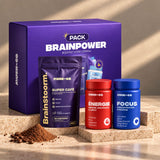
20 mg of microencapsulated caffeine instead of 80, with 200 mg of ashwagandha and 25 mg of rhodiola in the same cup.
Discover Brainstoorm →« I was sceptical because I thought I needed a horse dose for it to work, but halfway through the course, taking the recommended maximum, I genuinely felt calmer and my stress and anxiety have almost gone! I recommend it. »
★★★★★ Richard W. · verified review of Anti-Stress
« Great! A very gentle effect and yet clearly there... »
★★★★★ Ronald M. · verified review of Anti-Stress
Verified customer reviews from the product page, translated from French and left unedited. These are individual experiences.
Your questions
What you ask us about cortisol.
How do I know if my cortisol is too high?
The signs listed — fatigue on waking, weight around the middle, worse sleep, irritability — are not specific to any cause. Only a test prescribed by a doctor can settle it: blood in the morning between 6 and 8 am, or saliva across four samples, which tells you more about rhythm. Reference values differ between laboratories.
How long does it take to lower cortisol?
The ashwagandha trials run 60 days. On lifestyle levers — sleep, activity, caffeine — the first noticeable changes appear in two to three weeks. There is no result in a few days.
Does caffeine raise cortisol?
Yes. Lovallo's study measures a rise in cortisol in the hour after intake, including in regular consumers. Taken between 7 and 8 am, a coffee adds to the natural waking peak: shifting it by an hour and dividing the dose does more than stopping.
Does reishi lower cortisol?
That is not demonstrated in humans. No trial has measured cortisol under reishi. What is documented for this species is self-reported fatigue and wellbeing scores. On cortisol itself, the documented active is ashwagandha.
What ashwagandha dose for cortisol?
The two available trials use 240 mg and 600 mg of standardised extract a day, for 60 days. Standardisation matters as much as the dose: look for a root extract standardised in withanolides.
Can a supplement replace an anxiolytic?
No, and you must never stop a prescribed treatment to try one. A food supplement sits alongside medical care, never in its place.
Does exercise lower cortisol?
Moderate, regular activity does. Overtraining does the opposite: repeated intense effort without recovery raises cortisol. Thirty to forty-five minutes, three to five times a week, is the usual reference.
Should you avoid coffee on an empty stomach when stressed?
Waiting an hour after waking is a reasonable reference: the natural cortisol peak is already doing the work at that point. We covered the question in our article on coffee on an empty stomach.
Sources
The references cited in this article.
- Chandrasekhar K., Kapoor J., Anishetty S. (2012). A prospective, randomized double-blind, placebo-controlled study of safety and efficacy of a high-concentration full-spectrum extract of ashwagandha root in reducing stress and anxiety in adults. Indian Journal of Psychological Medicine, 34(3), 255-262.
- Lopresti A.L. et al. (2019). An investigation into the stress-relieving and pharmacological actions of an ashwagandha (Withania somnifera) extract. Medicine, 98(37), e17186.
- Lovallo W.R. et al. (2005). Caffeine stimulates cortisol secretion in the home environment. Psychosomatic Medicine, 67(5), 734-739.
- Park B.J. et al. (2010). The physiological effects of Shinrin-yoku (taking in the forest atmosphere or forest bathing). Environmental Health and Preventive Medicine, 15(1), 18-26.
- Pascoe M.C. et al. (2017). Mindfulness mediates the physiological markers of stress: systematic review and meta-analysis. Journal of Psychiatric Research, 95, 156-178.
- Tang W. et al. (2005). A randomized, double-blind and placebo-controlled study of a Ganoderma lucidum polysaccharide extract in neurasthenia. Journal of Medicinal Food, 8(1), 53-58.
To go further
What to read next.

Discover our mushroom and adaptogenic plant supplements
Our vegan formulas, made in Toulouse by a French manufacturer.