









Matcha or mushroom coffee: which should you choose?
By the Mush n Go editorial team - 28 September 2026
Author: Mush n Go editorial teamPublished 28 September 202613 min read
Matcha and mushroom coffee
Matcha and mushroom coffee both promise gentler energy than coffee. Matcha pairs caffeine with L-theanine and has a vegetal taste. Mushroom coffee keeps the coffee flavour, contains little caffeine and is built on lion's mane. The right choice depends on your palate and on how you handle caffeine.

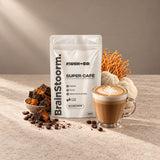
Brainstoorm
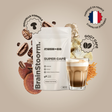
Europe's highest-dosed mushroom coffee: lion's mane, cordyceps and chaga at 1,000 mg each, 3,000 mg of maca, chicory and ashwagandha. 20 mg of caffeine per cup.
Discover Brainstoorm →
Coffee Pack
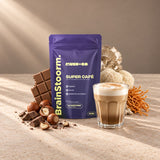
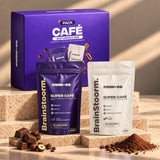
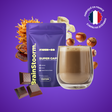
Brainstoorm Coffee and Brainstoorm Chocolate-Hazelnut, with rhodiola and cocoa. Switch depending on your mood, hot or iced.
Discover the pack →Matcha in brief
Matcha tea, the whole leaf as a powder.
Matcha is not an ordinary tea. Instead of steeping the leaves and then throwing them away, they are ground into a very fine powder and drunk whole, whisked into water. So you are consuming the leaf itself, with everything it contains.
In a few years matcha has become a very fashionable drink, from café lattes to pastries. Its effects are the most common question: we go through them below, along with what the research actually says.
Mushroom coffee in brief
Mushroom coffee, the coffee flavour, only gentler.
Mushroom coffee starts from a different idea: keep the taste and the ritual of coffee, but cut the caffeine sharply and add functional mushrooms and adaptogenic plants long used in Asian traditions.
Our Brainstoorm is a good example. Each 6 g cup contains 6,040 mg of active ingredients: lion's mane, cordyceps and chaga at 1,000 mg each, 3,000 mg of maca, chicory and ashwagandha. Caffeine is limited to 20 mg of microencapsulated NewCaff® caffeine. And there is no mushroom taste at all: you are drinking coffee, rounded and lightly roasted.
The Chocolate-Hazelnut version, with 6,225 mg of active ingredients per 8 g serving, adds rhodiola and cocoa, with the same amount of caffeine. Both can be made hot or cold, with water or with milk.
New to the idea? Our article on what mushroom coffee is explains it all from the start.
The effects of matcha
Matcha and its effects: what we actually know.
Online, matcha is credited with practically every virtue. The reality is more interesting and more modest.
The caffeine and L-theanine pairing. That is its real peculiarity. Matcha contains caffeine, but also L-theanine, an amino acid almost unique to tea and especially abundant in shade-grown leaves. Several studies have looked at the effect of this pairing on attention, with encouraging results. That explains the reputation for energy that feels “calmer” than coffee's.
Catechins. Like green tea, matcha is rich in catechins, among them EGCG, polyphenols widely studied in the lab for their antioxidant properties. Because you drink the whole leaf, you take in more of them than with a classic infusion.
The ritual. It is often forgotten, but preparing matcha with a whisk takes a few minutes and forces a pause. That moment plays its part in how you feel afterwards.
Matcha or green tea? It is the same plant, but not the same drink. Green tea is steeped and the leaves are discarded; matcha is drunk whole. The result: a denser drink, richer in caffeine, theanine and catechins for the same volume, and with a far more pronounced taste. Leaves destined for matcha are also shaded before harvest, which raises their theanine and chlorophyll content — hence that deep green.
What matcha is not: a fat burner, a medicine or a detox cure. Research on those claims remains inconclusive in humans.
What the research says
Matcha, theanine, lion's mane: three studies worth knowing.
Neither matcha nor mushroom coffee has been the subject of large clinical trials. Their key ingredients have. Here are three papers that serve an honest comparison.
Owen et al., 2008 · United Kingdom
27 adults received 50 mg of caffeine together with 100 mg of L-theanine, or a placebo. The pairing was associated with greater accuracy on tasks requiring attention switching and with less distractibility. This is the most cited study on the principle behind matcha.
Dietz et al., 2017 · Netherlands
A small placebo-controlled study tested matcha, as a drink and as a snack bar, on mood and cognitive performance. Improvements appeared on some measures of attention and memory, not on mood.
Docherty et al., 2023 · United Kingdom
Around forty healthy young adults took lion's mane or a placebo for 28 days. The researchers observed a faster response on an attention test after a single dose, with no clear overall effect: a pilot study that calls for larger work.
In short: real signals on both sides, in small groups. Neither drink has a decisive “proof”, and that is fine. You will find the full references at the foot of the page. To learn more about the mushroom, read our guide to Lion's mane: effects and dosage.
The caffeine question
Matcha and coffee: how much caffeine?
This is usually the real question behind “matcha or coffee”. And the answer is surprising: matcha is not a caffeine-free drink. Depending on how much powder you use and its quality, a bowl of matcha can hold as much caffeine as a small coffee, sometimes more.
| Drink | Caffeine | Worth knowing |
|---|---|---|
| Espresso (60 ml) | About 80 mg | EFSA reference value |
| Filter coffee (200 ml) | About 90 mg | EFSA reference value |
| Steeped tea (220 ml) | About 50 mg | EFSA reference value |
| Matcha | Variable | Depends on the amount of powder (often 1 to 2 g) and on quality |
| Brainstoorm | 20 mg | Microencapsulated NewCaff® caffeine, per cup |
EFSA values are averages: the real content varies with the bean, the leaf, the brewing method and the cup size.
So if you are after gentle energy because caffeine makes you jittery, matcha is not necessarily the best answer: L-theanine softens it, but the caffeine is there. Mushroom coffee, at 20 mg a cup, changes the picture far more. Conversely, if you tolerate caffeine well and enjoy the taste of tea, matcha is an excellent choice.
The comparison
Matcha or mushroom coffee: the face-off.
Here are the two drinks side by side, point by point, with regular coffee as the benchmark.
| Matcha | Mushroom coffee (Brainstoorm) | Regular coffee | |
|---|---|---|---|
| Taste | Vegetal, umami, sometimes bitter | Mild coffee, no mushroom taste | Coffee |
| Caffeine | Variable, often comparable to a small coffee | 20 mg per cup | 80 to 90 mg per cup |
| Active ingredients | L-theanine, catechins | Lion's mane, cordyceps, chaga, maca, ashwagandha | Caffeine, coffee polyphenols |
| Preparation | Whisk, water at 70-80 °C | Spoon, water or milk, hot and cold | Machine or filter |
| Equipment | Bamboo whisk and bowl recommended | None | Coffee machine |
| In the evening | Not advised if you are sensitive | Little caffeine, but test against your own sensitivity | Not advised |
The two drinks can also coexist within the same day. We will come back to that.
Preparation and taste
Two rituals, two gestures.
Matcha takes a little technique, mushroom coffee almost none. Here is how to get both right.
Sift
For matcha, sift 1 to 2 g of powder into a bowl, so half to one teaspoon, to avoid lumps.
Pour
Add about 70 to 80 ml of water at 70-80 °C. Boiling water scorches the powder and brings out bitterness.
Whisk
Whisk briskly in a “W” motion for around fifteen seconds, until a fine foam forms.
With Brainstoorm it is simpler: a 6 g serving into a cup of hot water or milk, stir and it is done. For the iced version, dissolve the serving in a little hot water, then add cold milk and ice.
On taste, this is usually where opinions part ways. Matcha has a grassy flavour you either love or cannot stand at all, and mid-quality matcha can be distinctly bitter. Mushroom coffee, on the other hand, reassures coffee lovers: from the first sip they are on familiar ground.
“I was sceptical and I have ended up delighted. Less caffeine, and I still have energy and an even mood”
★★★★★ Maïté S., 4 April 2026
“What I appreciate most is the steadier energy it gives: no jitters and no crash.”
★★★★★ Nawel F., 7 January 2026
Genuine Brainstoorm customer reviews from Trustpilot, quoted verbatim, translated from French.
Matcha coffee and latte
Matcha coffee, latte, iced: the recipes.
“Matcha coffee” most often means a matcha latte or a mix of matcha and espresso, sometimes called “dirty matcha”. Here are four simple ideas, on the matcha side and the mushroom side.
Matcha latte
Whisk 1 to 2 g of matcha in a little hot water, then pour in 200 ml of warm or cold milk. A little honey if you like.
Dirty matcha
An iced matcha latte topped with an espresso. Careful: the two caffeine sources add up.
Brainstoorm latte
A serving of Brainstoorm in 200 ml of frothed milk with a pinch of cinnamon.
Iced mocha
Brainstoorm Chocolate-Hazelnut dissolved in a little hot water, then cold milk and ice.
More drink ideas? Our article on mushroom and adaptogenic plant drinks and their recipes offers several, from lattes to smoothies.
Side effects
Matcha: side effects worth knowing.
Matcha is well tolerated by most adults, at one to two bowls a day. A few precautions are still worth knowing, precisely because the whole leaf is consumed.
Matcha and mushroom coffee: what to watch.
- Caffeine adds up: count matcha alongside coffee, tea and soft drinks within the 400 mg daily limit.
- On an empty stomach, matcha can irritate a more sensitive stomach. Have it with a little food instead.
- Tea lowers the absorption of plant-based iron. If you are short of iron, avoid drinking it with meals.
- During pregnancy and breastfeeding, limit caffeine and seek advice about supplements.
- With mushrooms, ask your doctor if you are on treatment, particularly anticoagulants.
A word on quality: because the leaf is consumed whole, everything it absorbed while growing ends up in the bowl. Favour matcha with traceable origins and lab analyses. For mushrooms, we set out the precautions in our article on the risks of mushrooms and adaptogenic plants.
Which to choose?
Matcha or mushroom coffee: to each their own.
There is no absolute winner. There are different profiles. Here is how to decide based on your habits.
Choose matcha if…
You enjoy tea and vegetal flavours, you tolerate caffeine well and the whisk ritual appeals to you.
Choose mushroom coffee if…
You enjoy the taste of coffee, caffeine makes you jittery, or you want to cut down on cups without changing your ritual.
For focus
On one side the caffeine and theanine pairing from matcha, on the other lion's mane at 1,000 mg in Brainstoorm. For a targeted course there is our Focus formula, caffeine-free.
For a sensitive stomach
Less caffeine often means less discomfort. Mushroom coffee has the edge here.
And why not both? Many of our customers alternate: Brainstoorm in the morning for the coffee flavour, matcha in the early afternoon for a change. What matters is keeping an eye on your total caffeine across the day.
8 am
A cup of Brainstoorm, hot, with breakfast.
11 am
A large glass of water and a break away from screens.
2 pm
Matcha latte, whisked in hot water and topped with milk.
After 4 pm
No more caffeine: herbal tea or water.
Choosing well
Five criteria for a good purchase.
Whether it is matcha or mushroom coffee, quality varies enormously from product to product. Here is what to look at before buying.
- The colour of the matcha : a deep green points to freshness and well-shaded leaves. A dull or yellowish green often signals a more bitter product.
- Traceability : origin, grower and analyses should be available, for matcha as for mushrooms.
- The dose of active ingredients : with mushroom coffee, look for the dose in milligrams per cup for each mushroom, not just a list. Brainstoorm states 1,000 mg of lion's mane, cordyceps and chaga.
- The stated caffeine : a clear content per cup, so you know what you are drinking.
- The guarantee : so you can try without risk. With us, 60 days money-back guarantee, with or without a subscription, and free delivery above a minimum order that depends on your country.
You will often come across two categories of matcha. So-called “ceremonial” grade, from the first harvests, is meant to be drunk on its own, whisked into water: it is milder, dearer and more fragile. “Culinary” grade, more pronounced, suits lattes, baking and smoothies, where milk and sugar soften its bitterness. These labels are not regulated: rely instead on colour, origin and analyses.
On mushroom coffees we have also published a full guide, six criteria for choosing well.
Your questions
Matcha or coffee: your questions.
What are the effects of matcha?
Matcha pairs caffeine with L-theanine, a combination studied for its effect on attention, and is rich in catechins, antioxidant polyphenols. Human studies remain small: it is a good drink, not a medicine.
Does matcha have more caffeine than coffee?
It all depends on the dose of powder. A bowl of matcha can hold as much caffeine as a small coffee, sometimes more. A 200 ml filter coffee holds about 90 mg according to EFSA, and a cup of Brainstoorm 20 mg.
Matcha or mushroom coffee for focus?
Matcha bets on the caffeine and L-theanine pairing, mushroom coffee on lion's mane with little caffeine. If caffeine makes you jittery, mushroom coffee is usually more comfortable. In both cases the research is still preliminary.
What is matcha coffee?
Most often it is a matcha latte, that is whisked matcha topped with milk, or a mix of matcha and espresso known as “dirty matcha”. In the second case the two caffeine sources add up.
Does matcha have side effects?
In reasonable amounts it is well tolerated. Any unwanted effects come mainly from the caffeine: jitters, trouble sleeping, stomach discomfort on an empty stomach. It can also lower the absorption of plant-based iron taken in the same meal.
Can I drink matcha every day?
Yes, one to two bowls a day suits most adults, taking into account your total daily caffeine, which according to EFSA should not exceed 400 mg.
Does mushroom coffee taste of mushrooms?
No, Brainstoorm does not: it tastes like mild coffee. The mushrooms are there as a dosed powder, with no forest aroma. The Chocolate-Hazelnut version is milder still.
What is the difference between matcha and green tea?
It is the same plant, the tea bush. Green tea, though, is steeped and the leaves discarded, whereas matcha is a powder of shade-grown leaves that is drunk whole. So it is more concentrated in caffeine, theanine and catechins, and its taste is more pronounced.
Can I drink matcha in the evening?
Better to avoid it at the end of the day if you are sensitive to caffeine. Have it in the morning or the early afternoon instead.
Can matcha be combined with mushroom coffee?
Yes, some like to bring their flavours together in a latte. Just remember to add up the caffeine. The simplest approach is to alternate them across the day.
Sources
- Owen G. N. et al. (2008). The combined effects of L-theanine and caffeine on cognitive performance and mood. Nutritional Neuroscience, 11(4).
- Dietz C., Dekker M., Piqueras-Fiszman B. (2017). An intervention study on the effect of matcha tea, in drink and snack bar formats, on mood and cognitive performance. Food Research International, 99.
- Docherty S. et al. (2023). The acute and chronic effects of lion's mane mushroom supplementation on cognitive function, stress and mood in young adults: a double-blind, parallel groups, pilot study. Nutrients, 15(22).
- EFSA, NDA Panel (2015). Scientific opinion on the safety of caffeine. EFSA Journal, 13(5).
Keep reading
Where to go next.
Want to go deeper? Discover our other guides or browse our mushroom coffee collection.

Discover our mushroom and adaptogenic plant supplements
Our vegan formulas, made in Toulouse by a French manufacturer.