
















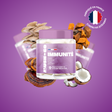


Adaptogenic mushrooms and plants: the complete guide
The guide to functional mushrooms
By the Mush n Go team · Updated 18 September 2026
These days, adaptogenic mushrooms and plants are everywhere: in coffees, hot chocolates, capsules and morning drinks. Behind the word lies a real history, identified molecules and research that keeps moving. This guide explains what they are, how they work, how to choose them and the precautions to know. At Mush n Go, five of them sit at the heart of our formulas, from the Brainstoorm coffee to our capsule courses.

Brainstoorm
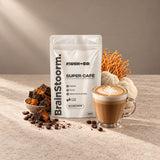
Our super mushroom coffee: Lion's Mane, Cordyceps and Chaga at 1,000 mg each, maca, ashwagandha, and only 20 mg of caffeine per cup. No mushroom taste at all.
Discover Brainstoorm →
Discovery Pack
Our four capsule courses and two Brainstoorm: everything you need to find the routine that suits you, mushroom by mushroom.
Discover the pack →The definition
A functional mushroom, what is it?
An adaptogen is a natural substance studied for its ability to help the body cope with different forms of stress: fatigue, physical effort, changes of rhythm. It is neither a molecule nor a botanical family, but a concept born in Soviet pharmacology.
The researchers who formalised it set three conditions. An adaptogen must have low toxicity at usual doses. It must increase the body's resistance in a “non-specific” way, that is, in the face of varied constraints. And it must have a normalising effect: helping a return towards balance, without pushing in one direction or the other.
The plants most often cited in this category are ashwagandha, rhodiola and Siberian ginseng. Mushrooms came into the conversation later. People also talk about functional mushrooms or medicinal mushrooms, two expressions that refer to the same species.
Adaptogen is not an official label. It is a scientific and traditional notion: it tells you the spirit in which an ingredient is studied, not what it guarantees.
Where the word comes from
From Chinese medicine to Soviet laboratories.
A very old history, in Asia and in the forests of the north. And a very recent one: that of the word itself.
2,000 years ago
The Shennong Bencao Jing, a classic of the Chinese pharmacopoeia, ranks lingzhi, our reishi, among the “superior” substances, those taken to maintain vitality.
Centuries past
In Siberia and in northern Europe, chaga harvested from birch trees is prepared as a decoction. In Tibet, wild cordyceps is a treasure of the high plateaus.
1947
The Soviet pharmacologist Nikolai Lazarev coins the term “adaptogen” to describe substances that increase the body's resistance.
1969
Israel Brekhman and Igor Dardymov publish the definition that will become the reference, after years of work on eleutherococcus, Siberian ginseng.
Today
“Adaptogenic mushrooms” has moved from specialist shops into everyday vocabulary, and searches for it keep climbing across Europe.
Our 5 mushrooms
The adaptogenic mushrooms and plants in our formulas.
Dozens of species are studied. We have kept five, each for a precise reason. Here is their quick identity card.
| Mushroom | Molecules studied | Area | In our products |
|---|---|---|---|
| Lion's Mane Hericium erinaceus |
Hericenones, erinacines, beta-glucans | Concentration, memory | Focus, Brainstoorm |
| Cordyceps Cordyceps militaris |
Cordycepin, adenosine, polysaccharides | Energy, effort | Energy, Muscle Recovery, Brainstoorm |
| Reishi Ganoderma lucidum |
Ganoderic acids, beta-glucans | Relaxation, sleep | Anti-Stress, Sleep+, Immunity |
| Chaga Inonotus obliquus |
Polyphenols, melanins, betulin | Antioxidants, defences | Immunity, Muscle Recovery, Brainstoorm |
| Oyster mushroom Pleurotus ostreatus |
Pleuran, a beta-glucan | Natural defences | Immunity |
Lion's Mane
The lion's mane mushroom, white with long spines. The most studied for cognition, with clinical trials in Japan and the United Kingdom. All about Lion's Mane.
Cordyceps
The mushroom of the high plateaus, now cultivated. Studied in athletes for tolerance to intense effort. All about cordyceps.
Reishi
The “mushroom of immortality” of Chinese tradition, bitter and lacquered. The mushroom of relaxation and of the evening. All about reishi.
Chaga
A black growth that develops on the birches of cold forests, rich in pigments and polyphenols. All about chaga.
Oyster mushroom
The most familiar of the five, sold in the fresh produce aisle. Its fibre, pleuran, has been tested in athletes and in children. All about the oyster mushroom.
The other functional mushrooms
Shiitake, maitake, tremella: the other names.
The list of medicinal mushrooms does not stop at ours. You will come across these four on the shelves and in articles. They are not part of our formulas, but they are worth knowing.
Shiitake
Lentinula edodes. The most widely cultivated mushroom in Asia, delicious in cooking. It gave its name to lentinan, a beta-glucan much studied in Japan.
Maitake
Grifola frondosa, the “hen of the woods”. A large rosette-shaped mushroom that grows at the foot of oaks, both edible and studied for its polysaccharides.
Tremella
Tremella fuciformis, the “snow mushroom”. Gelatinous and translucent, it is used above all in China in desserts, and in cosmetics for its ability to hold water.
Trametes
Trametes versicolor, the “turkey tail”. A small striped bracket fungus found on stumps. In Japan, an extract of this mushroom, PSK, has been studied since the 1970s.
Why not in our products? We prefer to dose a few chosen mushrooms heavily for a precise need, rather than line up ten species at a few milligrams each.
How they work
Beta-glucans, triterpenes and signature molecules.
A mushroom works through what it contains, and above all through what we know how to extract from it. Three families of compounds come up again and again in research.
Beta-glucans are polysaccharides, long chains of sugars that form the cell wall of mushrooms. They are the most studied compounds, in particular for the way they interact with immune system cells. They dissolve in hot water, and it is for them that water extraction exists.
Triterpenes are bitter molecules, barely soluble in water. Reishi is the star here, with its ganoderic acids. Chaga contains betulin, inherited from birch bark. To recover them, an alcohol extraction is added: this is what is called dual extraction.
Signature molecules are specific to a species. The hericenones and erinacines of Lion's Mane, the cordycepin of cordyceps, the pleuran of the oyster mushroom. They are what explains why each mushroom has its own field of research.
| Family | Where it is found | How to extract it |
|---|---|---|
| Beta-glucans | All mushrooms, in particular reishi, oyster mushroom, chaga | Hot water, for a long time |
| Triterpenes | Reishi, chaga | Alcohol, alongside water |
| Hericenones, erinacines | Lion's Mane | Fruiting body for some, mycelium for others |
| Cordycepin | Cordyceps militaris | Present in the cultivated mushroom |
The cell wall of mushrooms is made of chitin, the same material as the shell of insects. Our bodies digest it poorly: that is why an extract is more interesting than a simple dried mushroom powder.
What the studies say
Four pieces of work to understand the subject.
Are adaptogenic mushrooms and plants effective? It depends on the mushroom, the form and the dose. Human research exists, often small in size. Four references set the frame.
Brekhman and Dardymov, 1969 · USSR
The review article that fixes the definition of the adaptogen: a substance with low toxicity, which increases the non-specific resistance of the body and exerts a normalising effect. It is the basis of all the vocabulary used today.
Mori et al., 2009 · Japan
30 adults aged 50 to 80 with mild cognitive decline, 3 g a day of Lion's Mane powder or a placebo for 16 weeks. The Lion's Mane group achieved better cognitive scores, which fell again after they stopped taking it.
Bergendiova et al., 2011 · Slovakia
50 athletes, 100 mg a day of pleuran, the beta-glucan of the oyster mushroom, or a placebo for 3 months. The pleuran group reported fewer episodes of upper respiratory tract symptoms.
Panossian and Wikman, 2010 · Sweden
A large review of how adaptogens act on the body in the face of stress, in particular through the hormonal stress axis. It deals mainly with plants: the concept is still being built.
In short: serious leads for some mushrooms, on precise forms and doses. The full references are at the bottom of the page, and each mushroom page sets out its own studies.
Fruiting body or mycelium
The part of the mushroom changes everything.
The visible part is called the fruiting body. Underground, or in wood, lives the mycelium: a network of very fine filaments. Both are used in supplements, and they are not always equivalent.
| Fruiting body | Mycelium | |
|---|---|---|
| What it is | The visible part, the one that is harvested and cooked | The network of filaments that feeds the mushroom |
| Cultivation | Longer, on wood or a suitable substrate | Faster, often on cereals |
| Composition | Rich in beta-glucans and signature molecules | May contain a share of starch coming from the cereal |
| Traditional use | Yes, it is the part used for centuries | More recent use, linked to industrial cultivation |
Mycelium has its value: the erinacines of Lion's Mane are found mainly there. But when a product says “mycelium grown on grain”, part of the weight may come from the grain itself. That is why the words “fruiting body” and the beta-glucan content are two precious pieces of information on a label.
Extracts and ratios
What does “10:1 extract” mean?
This is the question that puzzles people most. An extraction ratio indicates how much dried mushroom it took to obtain one kilo of extract. A 10:1 extract therefore comes from ten kilos of dried mushroom.
The ratio alone is not enough: the solvent and the part of the mushroom count just as much. Hence the value of a beta-glucan percentage shown alongside it.
The raw material
Dried mushrooms, ideally fruiting bodies, ground into a fine powder.
The extraction
Hot water for the polysaccharides, plus alcohol for the triterpenes when the species calls for it.
The concentration
The liquid is filtered then dried into a concentrated powder, easier to dose and to absorb.
What matters most is the final dose. In one cup of Brainstoorm, you get 1,000 mg of Lion's Mane, 1,000 mg of Cordyceps and 1,000 mg of Chaga, plus 3,000 mg of maca. In total, 6,040 mg of actives per cup, three times the market average.
How to take them
Coffee, drink or capsules: which form should you choose?
The right form is the one you will actually take every day: regularity counts, over several weeks.
The mushroom coffee
The easiest form to adopt: you keep your morning ritual. Our mushroom coffee contains 20 mg of caffeine per cup, against around 80 mg for a regular coffee.
The mushroom drink
Hot chocolate, latte, cold drink: Brainstoorm Chocolate hazelnut brings together our three mushrooms, maca, ashwagandha, rhodiola and cocoa, with 6,225 mg of actives.
Capsules
For a targeted 30-day course, with no taste and no preparation. Each formula combines mushrooms and plants around one precise need.
Pure powder
Handy to slip into a smoothie. But the taste is often earthy and bitter, and the dose is harder to keep up day after day.
The adaptogenic mushroom and plant drink is the fastest-growing form across Europe. Our Brainstoorm is made hot or cold, with water or milk, and has no mushroom taste at all. The recipes are developed and produced in Toulouse, France, by a French contract manufacturer.
Which mushroom for which need
Find your routine at a glance.
This table helps you go from a need to a product, without getting lost in Latin names.
| Your need | The mushrooms | Our product |
|---|---|---|
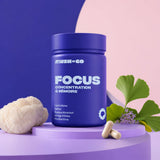
| Concentration | Lion's Mane | Focus, with saffron, bacopa, ginkgo and maritime pine |
| Energy without caffeine | Cordyceps | Energy, with maca, ginger and vitamin C |
| Everyday stress | Reishi | Anti-Stress Complex, with ashwagandha, holy basil, schisandra and vitamin B6 |
| Sleep | Reishi | Sleep+, with valerian, magnesium and melatonin |
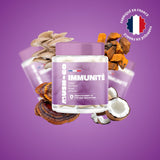
| Natural defences | Chaga, Reishi, Oyster mushroom | Immunity |
| Sport and recovery | Cordyceps, Chaga | Muscle Recovery, with turmeric and boswellia |
| In the morning, in one cup | Lion's Mane, Cordyceps, Chaga | Brainstoorm, coffee or chocolate hazelnut |
Still unsure? The Discovery Pack brings together our four courses and two Brainstoorm. The Limitless Pack combines Focus, Energy, Sleep+ and Anti-Stress for a routine from morning to night. Also worth reading: High cortisol: symptoms and natural solutions.
A common confusion
Adaptogenic is not hallucinogenic.
The question comes up often. The answer is clear: adaptogenic mushrooms and plants are not hallucinogenic. There is no connection, botanically or chemically.
So-called “magic” mushrooms contain psilocybin, a psychoactive molecule classified as a controlled substance across Europe. Lion's Mane, cordyceps, reishi, chaga and the oyster mushroom contain none of it. They do not alter perception and have been eaten for centuries, some of them in cooking.
The fly agaric, sometimes sold online, is not an adaptogen: it is toxic. Always check the Latin name.
What our customers say
Three mushrooms, one cup, your feedback.
Lion's Mane, Cordyceps and Chaga come together in Brainstoorm. A few reviews left on Trustpilot.
“More mental clarity, more energy, and the famous 4pm slump... gone!”
★★★★★Virginie L., 29 August 2026 · Brainstoorm
“What I like most is the steadier energy it gives: no jitters and no energy dip.”
★★★★★Nawel F., 7 January 2026 · Brainstoorm
“I was sceptical and in the end I'm won over. Less caffeine and yet I'm full of beans and even-tempered”
★★★★★Maïté S., 4 April 2026 · Brainstoorm
“i feel more focused and a lot less on edge”
★★★★★Roxane T., 24 October 2025 · Brainstoorm
Verified customer reviews, published on Trustpilot. Every experience is personal.
Starting well
The mistakes that make people think it does not work.
Most disappointments do not come from the product, but from the way it was taken. Four mistakes come up again and again.
- Impatience. Functional mushrooms work by building up, not like caffeine. Judging after a few days, or stopping before three weeks, amounts to not having tried. Allow six weeks for a first course.
- Too low a dose. Below 500 mg of extract per serving, there is little reason for the expected effect to appear. Usual benchmarks sit rather around 1 to 2 g a day, all forms taken together.
- Irregular use. Three days a week will not give you a third of the result: it is regularity that builds the effect. Choose the moment that is easiest to keep to, even if it is not the perfect one.
- Testing everything at once. Five mushrooms started on the same day, and nobody knows any more which one does what. Start with a single one, keep it up for four weeks, then add.
If you are on medication — anticoagulant, immunosuppressant, antidiabetic — talk to your doctor or your pharmacist before adding a functional mushroom to your routine.
Choosing them well
Five criteria for mushrooms worth buying.
Not all products are equal. Online, in a pharmacy or in a health-food shop, look at these five points.
- The dose per serving: milligrams shown for each mushroom, not just one overall “blend”. With us, 1,000 mg of each mushroom per cup of Brainstoorm.
- The part used: fruiting body, mycelium or both. The information must appear on the packaging.
- The type of extract: an extract, with its ratio or its beta-glucan content, rather than a simple dried mushroom powder.
- The manufacturing: an identified place of manufacture. With us, the recipes are developed and produced in Toulouse, France, by a French contract manufacturer, vegan, GMO-free and gluten-free.
- The guarantee: enough to try it without risk. With us, a 60-day money-back guarantee, a one-time purchase or a monthly subscription (−30%) as you prefer, and free delivery from €59 in France and from €69 to €89 across Europe, depending on the destination.
Risks and precautions
Are adaptogenic mushrooms and plants dangerous?
At usual doses they are well tolerated by the great majority of adults, with mainly mild digestive discomfort reported. But “natural” does not mean “no precautions needed”.
A few simple rules, valid for all functional mushrooms:
- During pregnancy and breastfeeding, ask your doctor's advice before taking anything.
- If you are on medication, in particular anticoagulant, antidiabetic or immunosuppressant treatment, talk to your doctor or your pharmacist.
- Chaga is naturally rich in oxalates: it is not recommended for people with fragile kidneys or a history of stones.
- Stop taking it a few weeks before surgery, as a precaution.
- If you have a known allergy to mushrooms, do not take them.
- Stick to the dose shown on the label, and keep your supplements out of reach of children.
To go further, we have devoted a full article to the risks of adaptogenic mushrooms and plants, species by species.
Your questions
Everything we get asked about adaptogenic mushrooms and plants.
What are adaptogenic mushrooms and plants?
Mushrooms studied to help the body adapt to stress, according to the definition of the Soviet pharmacologists. The best known: Lion's Mane, cordyceps, reishi, chaga and the oyster mushroom.
Which adaptogenic mushrooms and plants are the best known?
Reishi, Lion's Mane, cordyceps and chaga are the four most often cited. Then come the oyster mushroom, shiitake, maitake, tremella and trametes.
What are the benefits of adaptogenic mushrooms and plants?
They depend on each species. Lion's Mane is mainly studied in connection with cognition, cordyceps with physical effort, reishi with relaxation, chaga and the oyster mushroom for their beta-glucans. Human studies remain modest.
Are adaptogenic mushrooms and plants effective?
Some have been the subject of encouraging clinical trials, at precise doses and durations. Choose products that show their dose in milligrams, and take them for several weeks.
Is there any risk with adaptogenic mushrooms and plants?
They are well tolerated by most adults. Caution is needed during pregnancy, if you are on medication, in particular anticoagulants, and in the case of fragile kidneys for chaga. Ask your doctor for advice if in doubt.
Are adaptogenic mushrooms and plants hallucinogenic?
No. They contain no psilocybin and have no effect on perception.
How should you take adaptogenic mushrooms and plants?
As a coffee, as a hot or cold drink, in capsules or as a powder. The best form is the one you will take every day. Our Brainstoorm is made hot or cold, with water or milk.
What is an adaptogenic mushroom and plant drink?
It is a drink, often a coffee, a chocolate or a latte, enriched with mushroom extracts. Brainstoorm comes in a coffee version and a chocolate hazelnut version, with 20 mg of caffeine per cup.
Does mushroom coffee taste of mushrooms?
Not ours. Brainstoorm tastes like a coffee or a chocolate hazelnut, with no earthy note.
How long before you feel an effect?
Studies on mushrooms generally run for several weeks, up to 16 weeks for Lion's Mane. Allow at least three to four weeks of regular use before you judge.
Can you take several adaptogenic mushrooms and plants at the same time?
Yes, that is the principle behind our formulas: Brainstoorm and Immunity bring together three each. Stick to the dose for each product.
Where can you buy adaptogenic mushrooms and plants?
In a pharmacy, in a health-food shop or online. On mushngo.com you get free delivery from €59 in France and from €69 to €89 across Europe, depending on the destination, the choice between a one-time purchase and a monthly subscription (−30%), and a 60-day money-back guarantee.
Sources
- Brekhman I. I., Dardymov I. V. (1969). New substances of plant origin which increase nonspecific resistance. Annual Review of Pharmacology, 9.
- Mori K. et al. (2009). Improving effects of the mushroom Yamabushitake (Hericium erinaceus) on mild cognitive impairment: a double-blind placebo-controlled clinical trial. Phytotherapy Research, 23(3).
- Bergendiova K., Tibenska E., Majtan J. (2011). Pleuran (β-glucan from Pleurotus ostreatus) supplementation, cellular immune response and respiratory tract infections in athletes. European Journal of Applied Physiology, 111(9).
- Panossian A., Wikman G. (2010). Effects of adaptogens on the central nervous system and the molecular mechanisms associated with their stress-protective activity. Pharmaceuticals, 3(1).
- Wasser S. P. (2002). Medicinal mushrooms as a source of antitumor and immunomodulating polysaccharides. Applied Microbiology and Biotechnology, 60(3).
Put it into practice
Adaptogenic mushrooms and plants, in your routine.
In your morning coffee or in capsules: our formulas bring together the mushrooms in this guide, vegan, with recipes developed and produced in Toulouse, France, by a French contract manufacturer, and backed by a 60-day money-back guarantee.
Brainstoorm
Our super mushroom coffee: Lion's Mane, Cordyceps and Chaga at 1,000 mg each, maca, ashwagandha, and only 20 mg of caffeine per cup. No mushroom taste at all.
Discover Brainstoorm →Discovery Pack
Our four capsule courses and two Brainstoorm: everything you need to find the routine that suits you, mushroom by mushroom.
Discover the pack →The other ingredients
Keep exploring.
Each mushroom has its own full page, with its history, its studies and its precautions. Discover them, browse our mushroom coffee or the page listing all our active ingredients.
