





Functional mushroom
Reishi: the emperors' ling zhi, for your evenings
By the Mush n Go team · Updated 18 September 2026
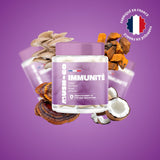
The Reishi, or ling zhi (Ganoderma lucidum), is the mushroom of calm routines. Revered in China for two thousand years, too tough and too bitter to cook, it is taken as an extract. At Mush n Go you will find it in three capsule formulas: Sleep+ for the evening, Anti-Stress Complex for the day, and Immunity all year round.

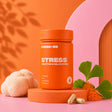
Anti-Stress Complex
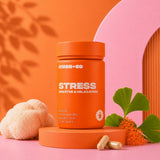
Reishi paired with Ashwagandha, Holy basil, Schisandra and Vitamin B6. One to two capsules in the morning.
Discover Anti-Stress Complex →
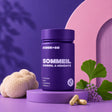
Sleep+
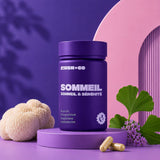
Reishi with Valerian, magnesium bisglycinate and melatonin. 1 to 2 capsules 30 minutes to 1 hour before bed.
Discover Sleep+ →The profile
Reishi in brief.
With its red, glossy cap, as though varnished, Reishi looks like no other mushroom. Here are the essentials before we go further.
A long history
From imperial paintings to the bedside table.
Few mushrooms hold a place as high in a culture as ling zhi does in China. Long rare and reserved for the powerful, it became accessible only a few decades ago.
Ancient China
The Shennong Bencao Jing, one of the oldest treatises of Chinese materia medica, ranks it among the “superior” substances, those taken over the long term.
Imperial art
Ling zhi becomes a symbol of long life. It appears in paintings, embroidery and courtly objects, and the ruyi sceptre takes up its shape.
1970s
Large-scale cultivation takes off, notably in Japan. Reishi, until then gathered in the wild, finally becomes accessible.
2012
Mycologists show that the Asian ling zhi is a species distinct from the European Ganoderma, and name it Ganoderma lingzhi.
Today
It is one of the most sought-after functional mushrooms in Europe, and reishi supplements have become a fixture on shelves across the continent.
Ling zhi and Ganoderma
One mushroom, several names.
Reishi, ling zhi, lingzhi, varnished conk, Ganoderma lucidum: if you have come across all of these names, that is normal. They all refer to the same mushroom, seen from different countries.
Reishi is its Japanese name, the one most used in Europe. Ling zhi (or lingzhi) is its Chinese name, often translated as “mushroom of the spirit” or “divine herb”. Varnished conk is one of its English names, and it describes its glossy cap well.
Scientifically, things are a little more subtle. The name Ganoderma lucidum was long used for every reishi in the world. Genetic analyses have since shown that the ling zhi cultivated in Asia is a close but distinct species, Ganoderma lingzhi. The true Ganoderma lucidum is rather a European one. In trade, both names are still used, and almost every published study still uses the name Ganoderma lucidum.
What matters in practice: whatever the name on the label, the useful markers remain the part used, the type of extraction and the dose.
Red reishi
Why people talk about red reishi.
Chinese tradition distinguishes six ling zhi by colour: red, black, blue, white, yellow and purple. Each had its own reputation in the ancient texts. Today these colours correspond to different species or varieties, and most are very rare.
Red
The best known, the most cultivated and by far the most studied. It is the one simply called “reishi”.
Black and purple
Other species of Ganoderma, used in Asia but little studied and rarely sold in Europe.
Blue, white, yellow
Found mainly in the ancient texts. They are practically absent from the market.
The right reflex
When a label says “reishi” with no further detail, it is almost always red reishi.
“Red reishi” is therefore not a premium version: it is quite simply classic Reishi, the one in the studies and in the vast majority of supplements.
The molecules
Triterpenes and polysaccharides: what it contains.
If Reishi holds such interest for researchers, it is because of two large families of compounds that behave in entirely different ways.
Triterpenes, including the ganoderic acids, are responsible for its strong bitterness. They are fat-like molecules that dissolve poorly in water. The more bitter a Reishi, the more it generally contains. They are studied in the laboratory in connection with numerous properties, and more than a hundred different kinds have been described.
Polysaccharides, and in particular beta-glucans, are fibres found in most mushrooms. Soluble in hot water, they are the ones drawn out by decoction. Their content often serves as a quality marker: a serious extract states its percentage on the label.
What to take away: to obtain both families, you need both extraction methods. That is what explains the idea of “dual extraction” you will come across with serious brands.
What the studies say
Plenty of laboratory work, a few human trials.
Reishi is among the most studied mushrooms in the world, but the vast majority of the work has been carried out in the laboratory or in animals. Human trials do exist, remain small, and often involve very concentrated extracts. Here are the ones that shed most light on its use.
Wachtel-Galor et al., 2004 · Hong Kong
A small group of healthy volunteers, 1.44 g per day of ling zhi extract for 4 weeks. The researchers followed several blood markers and found no sign of liver or kidney toxicity over that period.
Tang et al., 2005 · China
132 adults with neurasthenia, a state of persistent fatigue, 5.4 g per day of a Reishi polysaccharide extract for 8 weeks, against placebo. Fatigue and well-being scores improved more in the Reishi group.
Cui et al., 2012 · China
A study in rats: a Reishi extract lengthened the animals' total sleep time. It is one of the works behind Reishi's evening reputation, but it remains to be confirmed in humans.
In short: a mushroom well tolerated at the doses studied, promising leads, but few solid human trials. That is why, in our formulas, we pair it with other ingredients chosen for the same moment of the day. The full references are at the bottom of the page.
Why an extract
A mushroom that is not eaten.
Unlike Lion's Mane or the oyster mushroom, Reishi is nothing like a culinary mushroom. Its flesh is as hard as wood and very bitter. Ground into a raw powder, it remains largely indigestible: its compounds are locked inside very tough cell walls. Hence the importance of extraction.
| Raw powder | Extract | |
|---|---|---|
| What it is | The mushroom dried and ground | The mushroom put through hot water, sometimes alcohol too, then dried |
| Absorption | Low, the cell walls hold out | Better, the compounds are released |
| Concentration | 1 g of powder = 1 g of mushroom | A 10:1 extract concentrates 10 g of mushroom into 1 g |
| Traditional use | Rare | Yes: long decoction was the rule |
| In the studies | Rarer | The vast majority of trials |
A good Reishi extract states the part used (fruiting body), its ratio or its beta-glucan content, and ideally its extraction method.
The dose
What dose of Reishi per day?
There is no official dose. Traditional use and the studies do, however, give some markers, which differ greatly according to the form.
| Form | Daily marker | What that represents |
|---|---|---|
| Dried mushroom, as a decoction | Several grams | Traditional use, as a long infusion |
| Concentrated extract | 1 to 1.5 g | The order of magnitude in trials on classic extract |
| Polysaccharide extract | Up to 5.4 g | The high dose used in Tang's 2005 trial |
| Our capsules | Depending on the formula | Sleep+: 1 to 2 capsules in the evening; Anti-Stress Complex: 1 to 2 in the morning; Immunity: 1 to 2 in the morning |
One detail that changes absorption: the triterpenes in Reishi are fat-soluble. Taking your capsule with a light fat — a plant drink, a little MCT coconut oil, a few nuts — improves how they pass through, whereas taking it with water alone leaves part of them behind. The polysaccharides, for their part, are recovered very well in hot water: that is the whole point of dual extraction.
Always follow the directions for use on your product's label, and do not combine several formulas without first checking their composition.
Reishi and sleep
The evening ritual, in three steps.
It is the most sought-after use: reishi and sleep are almost always mentioned in the same breath. In Asia, Reishi was long associated with calm and rest, and it is within that tradition that we placed it in Sleep+. But a mushroom alone does not make a good night: what counts is the routine around it.
30 min to 1 hr before
1 to 2 capsules of Sleep+ with a glass of water, at the moment you begin to slow down.
Low light
Screens put away, soft light, a cool room. The brain needs clear signals to prepare for the night.
Same time
Go to bed and get up at regular times, weekends included. It is the most powerful ritual of all.
In Sleep+, Reishi is not alone: it is paired with Valerian, the traditional evening plant, with magnesium bisglycinate, a well-tolerated form of magnesium, and with melatonin, the hormone your body releases naturally when night falls. As the formula contains melatonin, avoid taking it before an activity that requires alertness, such as driving.
To go further, read our guide to adaptogenic mushrooms and sleep, or our comparison of the best mushroom for sleep.
A typical day
Reishi, from morning to night.
Reishi is often presented as an evening mushroom, but it accompanies the day as well. Here is how our customers most often fit it in.
8 a.m.
One to two capsules of Anti-Stress Complex at breakfast, for busy days when you want to keep a cool head.
8 a.m.
Or 1 to 2 capsules of Immunity, as a course when autumn arrives and through the winter, with Chaga and oyster mushroom.
During the day
For momentum, over to Cordyceps and Lion's Mane, for example in a cup of Brainstoorm.
10.30 p.m.
1 to 2 capsules of Sleep+, 30 minutes to 1 hour before turning off the light.
Reishi or ashwagandha
Two flagship ingredients, two profiles.
This is a common hesitation. They are two traditional ingredients associated with calm (one a functional mushroom, the other an adaptogenic plant), but they do not come from the same world and are not taken in quite the same way.
| Reishi | Ashwagandha | |
|---|---|---|
| Nature | A mushroom | A root, from the nightshade family |
| Tradition | Chinese and Japanese medicine | Ayurveda, in India |
| Human research | Still limited | More extensive, with more trials |
| At Mush n Go | Sleep+, Anti-Stress Complex, Immunity | Anti-Stress Complex, Brainstoorm |
No need to choose: Anti-Stress Complex brings them together in the same capsule. The detail is in our article Reishi or ashwagandha.
The right pairings
Reishi plays as a team.
On its own it already has a long history. Paired with other ingredients, it finds its place in a more complete routine. Here are the pairings in our formulas, and why.
+ Valerian and magnesium
The evening trio in Sleep+, completed by melatonin, to be taken 30 minutes to 1 hour before bed.
+ Ashwagandha
The ayurvedic root of calm, brought together with Reishi in Anti-Stress Complex.
+ Holy basil and Schisandra
Two traditional plants, one Indian, one Chinese, which complete Anti-Stress Complex alongside Vitamin B6.
+ Chaga and oyster mushroom
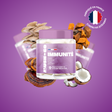
Three mushrooms brought together in Immunity: birch Chaga, the oyster mushroom and Reishi.
Who it is for
Reishi is made for you if…
- You want to build a real evening ritual, and not just “take something to sleep”.
- You are going through busy days and looking to keep your calm.
- You prefer ingredients with a long history of use.
- You are looking for a natural supplement to take over time.
- You like to understand what you take, dose by dose.
Choosing well
Six criteria so you do not get it wrong.
- The part used: the fruiting body for preference, and clearly stated.
- The extraction: an extract rather than a raw powder, which your body absorbs poorly.
- The concentration: a stated ratio or beta-glucan content.
- The moment: an evening formula for sleep, a daytime formula for everything else.
- The manufacturing: an identified place. The recipes are developed and produced in Toulouse, France, by a French contract manufacturer, and are vegan, non-GMO and gluten-free.
- The guarantee: enough to try without risk. With us, a 60-day money-back guarantee, and the choice between a one-time purchase and a monthly subscription (−30%).
| Sleep+ | Anti-Stress Complex | Immunity | |
|---|---|---|---|
| The moment | 30 min to 1 hr before bed | In the morning | In the morning |
| Reishi with | Valerian, magnesium, melatonin | Ashwagandha, Holy basil, Schisandra, B6 | Chaga, oyster mushroom |
| The dose | 1 to 2 capsules | 1 to 2 capsules | 1 to 2 capsules |
| Who it is for | An evening ritual | Busy days | A seasonal course |
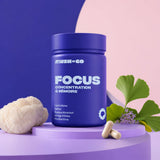
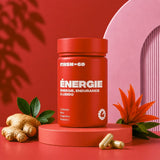
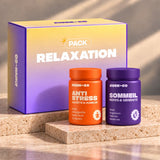
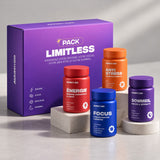
The Relaxation Pack brings together Anti-Stress Complex and Sleep+ to cover the day and the night. The Limitless Pack adds Focus and Energy to it.
As an infusion
And reishi tea?
It is the oldest form. In China, Reishi is prepared as a decoction: slices of dried mushroom simmer slowly over a low heat, sometimes for more than an hour, and you obtain a brown, woody and very bitter drink. Many add honey, ginger or a date.
For daily intake the method remains impractical: it takes time, the taste does not suit everyone, and the dose varies from one cup to the next. That is why most people today take it as an extract, in capsules, with a known dose.
Side effects and precautions
Reishi and risk: what you should know.
Reishi is generally well tolerated at the usual doses. The side effects reported are most often mild: digestive discomfort, a dry mouth or throat, sometimes dizziness or itching. Rare cases of liver injury have been described with powders, which is a reason to respect the doses and to choose a quality product.
- Avoid it if you have a known mushroom allergy.
- Ask your doctor for advice if you are pregnant, breastfeeding, or following anticoagulant, antihypertensive, antidiabetic or immunosuppressive treatment.
- The same caution applies with an autoimmune disease and before surgery: tell your medical team.
- Sleep+ contains melatonin: it is not advised before an activity that requires alertness.
- Respect the dose stated on the label, and keep it out of the reach of children.
For an overview, read our article on the risks of adaptogenic mushrooms.
Your questions
Everything you ask us about Reishi.
What is Reishi used for?
Reishi is mostly taken by people who want to build a calm routine, in the evening as well as during the day. It has been used in Asia for two thousand years and is now one of the most widely consumed functional mushrooms in Europe.
Reishi, ling zhi, Ganoderma lucidum: what is the difference?
None in use: reishi is the Japanese name, ling zhi the Chinese name, and Ganoderma lucidum the historic scientific name. Since 2012 the Asian species has also carried the name Ganoderma lingzhi.
What is red reishi?
It is classic Reishi, the one found in trade and in the studies. Chinese tradition distinguishes six colours of ling zhi, but red is by far the most cultivated.
Does Reishi help you sleep?
It is traditionally associated with calm and rest, and animal work has explored its effect on sleep. Human trials are still rare. In Sleep+ we pair it with Valerian, magnesium and melatonin.
When should you take Reishi?
In the evening, 30 minutes to 1 hour before bed, for Sleep+. In the morning for Anti-Stress Complex and Immunity. What matters is keeping to the same moment every day.
What dose of Reishi per day?
Trials have used from 1.44 g of extract up to 5.4 g of polysaccharide extract per day. For our capsules, follow the directions for use of each formula.
What are the side effects of Reishi?
They are generally mild: digestive discomfort, dry mouth, sometimes dizziness. Medical advice is recommended during pregnancy and breastfeeding, with an autoimmune disease, or with anticoagulant, antihypertensive or antidiabetic treatment.
Is Reishi dangerous?
No, at the usual doses it is generally well tolerated. Rare cases of liver injury have been reported with powders: choose a product with a stated dose and respect it.
How long before you feel a difference?
How people feel varies from one person to another. Allow at least a 30-day course before judging. All our formulas come with a 60-day money-back guarantee.
Can it be taken with other mushrooms?
Yes. Immunity already pairs it with Chaga and oyster mushroom. Many of our customers have a Brainstoorm coffee in the morning and Sleep+ in the evening.
Is Reishi vegan?
Yes, it is a mushroom. All our Reishi formulas are vegan, non-GMO and gluten-free.
Where can you buy quality Reishi?
Directly on mushngo.com, with free delivery from €59 in France and €69 to €89 across Europe, depending on the destination, a one-time purchase or a monthly subscription (−30%) as you prefer, and a 60-day money-back guarantee. The recipes are developed and produced in Toulouse, France, by a French contract manufacturer.
Sources
- Wachtel-Galor S. et al. (2004). Ganoderma lucidum ('Lingzhi'): acute and short-term biomarker response to supplementation. International Journal of Food Sciences and Nutrition, 55(1).
- Tang W. et al. (2005). A randomized, double-blind and placebo-controlled study of a Ganoderma lucidum polysaccharide extract in neurasthenia. Journal of Medicinal Food, 8(1).
- Cui X. Y. et al. (2012). Extract of Ganoderma lucidum prolongs sleep time in rats. Journal of Ethnopharmacology, 139(3).
- Cao Y., Wu S.-H. and Dai Y.-C. (2012). Species clarification of the prize medicinal Ganoderma mushroom “Lingzhi”. Fungal Diversity, 56.
Put it into practice
Reishi, the Mush n Go version.
You now know all about Reishi and what to look for on a label. Here is where to find it with us, with vegan formulas whose recipes are developed and produced in Toulouse, France, by a French contract manufacturer, backed by a 60-day money-back guarantee.
Anti-Stress Complex
Reishi paired with Ashwagandha, Holy basil, Schisandra and Vitamin B6. One to two capsules in the morning.
Discover Anti-Stress Complex →Sleep+
Reishi with Valerian, magnesium bisglycinate and melatonin. 1 to 2 capsules 30 minutes to 1 hour before bed.
Discover Sleep+ →The other ingredients
Keep exploring.
Reishi is only one of the ingredients in our formulas. Discover the other mushrooms and the plants that go with it, or browse all our active ingredients.
In this file


Sleep+
Relax and enjoy peaceful nights, for deep and restorative sleep.

Anti-Stress Complex
Say goodbye to stress and welcome serenity, for total peace of mind.

Limitless Pack
Maximizes concentration, energy, reduces stress and improves sleep for optimal performance.

Discovery Pack
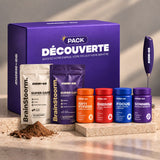
Become the best version of yourself to achieve all your goals with efficiency and serenity

Relaxation Pack
Reduces stress and improves sleep for increased relaxation and well-being.