












Adaptogenic plant
Siberian ginseng: eleuthero, the adaptogen from the taiga
By the Mush n Go team · Updated on 18 September 2026
The Siberian ginseng, or eleuthero (Eleutherococcus senticosus), is a thorny shrub from the forests of the Russian Far East. Only its nickname has anything to do with ginseng, but it has a history of its own: it is around this plant that Soviet researchers built the very notion of an adaptogen. At Mush n Go, it is part of our energy and recovery range, with Energy and Muscle Recovery.

Energy
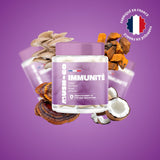
Our energy formula: Cordyceps, Maca, Ginger and Vitamin C. Caffeine-free, as a 30-day course, for the weeks when you have to keep going.
Discover Energy →
Muscle Recovery
Our recovery formula: Cordyceps, Chaga, Turmeric and Boswellia. One capsule after training.
Discover the formula →The fact file
Eleuthero in brief.
A shrub covered in fine thorns, leaves divided into five leaflets, black berries in autumn. Here is the essential about this plant, still little known in Western Europe.
Its Latin name already tells you about the plant: senticosus means “thorny”, and its stems are indeed bristling with fine needles. In its home range it forms dense thickets under birches, oaks and conifers, and withstands very harsh winters. It was that robustness that first intrigued Soviet researchers.
A Soviet story
From the taiga to the laboratories of Vladivostok.
Few plants have a history so tied to geopolitics. Siberian ginseng owes its fame to the Cold War, and to a country looking for an alternative to Asian ginseng, which was rare and very expensive.
Tradition
The root is known in traditional Chinese medicine under the name ci wu jia, and used by the peoples of the taiga.
1947
The Soviet pharmacologist Nikolai Lazarev proposes the word “adaptogen” to describe substances that help the body cope with a stress.
1950s-1960s
In Vladivostok, Israel Brekhman and his team study the plants of the ginseng family. Eleuthero, abundant and inexpensive, becomes their main subject.
1969
Brekhman and Dardymov publish, in a major American pharmacology journal, the definition of adaptogens that is still the reference today.
1970s-1980s
According to the accounts of the time, eleuthero is given to athletes, factory workers, soldiers and even Soviet cosmonauts, as part of vast programmes.
Today
It appears in the European Pharmacopoeia, and the European authorities recognise it as a traditional herbal medicine. Outside Russia and Asia it remains a niche plant, far less known than ginseng.
One important nuance: a large part of the Soviet work was published in Russian, without today's standards for placebo-controlled trials. It launched the subject, but it is not enough to settle it.
Not a true ginseng
Siberian ginseng or Panax: the real difference.
The name is confusing, and that is no accident: “Siberian ginseng” is above all a trade name. In the United States, a 2002 law even reserves the word “ginseng” for species of the genus Panax alone, and the plant is sold there under the name “eleuthero”.
| Siberian ginseng | “True” ginseng (Panax) | |
|---|---|---|
| Latin name | Eleutherococcus senticosus | Panax ginseng (Asia), Panax quinquefolius (America) |
| The plant | Thorny shrub 2 to 3 metres tall | Small herbaceous woodland plant |
| Molecules | Eleutherosides | Ginsenosides |
| Cultivation | Abundant, easily gathered or grown | Slow to grow, several years before harvest |
| Price | Affordable | High, above all for older roots |
| In common | The Araliaceae family, and a reputation as a tonic plant | |
The two plants are therefore not interchangeable. On a label, always look for the Latin name: it is the only way to know what you are buying.
The eleutherosides
What is in the root.
Where Asian ginseng contains ginsenosides, eleuthero contains a family of molecules that bears its name: the eleutherosides. They are not chemical cousins of the ginsenosides, but compounds of varied natures grouped under a single name.
The two most important are eleutheroside B, also called syringin, and eleutheroside E, a lignan. They are the ones that serve as quality markers: the European Pharmacopoeia sets a minimum content of eleutherosides B and E for the root, and serious extracts state their content.
The root also contains polysaccharides, phenolic acids such as chlorogenic acid, and coumarins. As often with plants, it is the whole that is studied, not an isolated molecule.
What to take away in practice: an extract standardised in eleutherosides is a measurable product. A plain root powder is not.
What an adaptogen is
Adaptogen: a word born with this plant.
There is a lot of talk about adaptogens today, about ashwagandha, rhodiola or maca. Yet the word comes from Soviet research on eleuthero. Brekhman and Dardymov set out three conditions for a substance to deserve the name.
- It must have low toxicity and must not disturb the normal working of the body.
- Its action must be non-specific: helping to cope with varied constraints, physical as well as mental.
- Its effect must tend to bring the body back towards balance, whichever way the imbalance goes.
It is a historical and pharmacological definition, not a recognised claim: in Europe, the word “adaptogen” on its own guarantees no effect. But it explains why eleuthero is taken as a course, over several weeks, rather than as a one-off stimulant. It contains no caffeine, either.
What the studies say
A rich history, more nuanced modern trials.
Eleuthero has been studied for decades, but the quality of the work varies a great deal. Here are the references that count, favourable and disappointing alike.
Brekhman and Dardymov, 1969 · USSR
The founding article, published in the Annual Review of Pharmacology. It summarises the Soviet work on eleuthero and ginseng and sets out the definition of adaptogens.
Dowling et al., 1996 · United States
A placebo-controlled trial in trained runners, with several weeks of eleuthero intake. No measurable difference in performance, submaximal or maximal.
Goulet and Dionne, 2005 · Canada
A review of the studies on endurance. Conclusion: the best-conducted trials do not allow it to be said that eleuthero improves sporting performance.
Panossian and Wikman, 2009 · Sweden
A review of the clinical trials on adaptogens and fatigue, covering eleuthero, rhodiola and schisandra. It highlights interesting leads, but also studies of very uneven quality.
In short: a historic plant, well tolerated, but whose effects have not been confirmed by modern sports trials. That is why we use it as part of a team, alongside ingredients such as Cordyceps or Maca, and never as a promise of performance. The full references are in the at the bottom of the page.
The dose
What dose of Siberian ginseng per day?
There is no single dose: everything depends on the form. The traditional markers are expressed in dried root, and extracts are concentrates of it.
| Form | Daily marker | What that represents |
|---|---|---|
| Dried root | 2 to 3 g | The benchmark used by the German Commission E |
| Standardised extract | As stated on the label | The equivalent of a few grams of root, in measured eleutherosides |
| Duration | A few weeks | Limited courses, broken up by pauses, according to traditional use |
| Our formulas | 1 intake a day | In combination, according to the directions for use of each product |
Always follow the directions for use stated on the label of your product, and do not stack several eleuthero supplements.
And as a tea? The dried root is traditionally prepared as a decoction, that is boiled for about ten minutes rather than simply infused. It is a pleasant way to discover the plant, with a woody, slightly sweet taste, but the amount of eleutherosides per cup remains impossible to know. For a regular course, a measured extract is simpler and more reliable.
How to take it
Morning rather than evening.
Eleuthero is taken as a course, not like a coffee. And since it goes with active days, it is better kept for the first part of the day.
In the morning
At breakfast, with a large glass of water. Avoid the end of the day if you are a light sleeper.
Every day
Same moment, same dose, for the whole length of the course.
Then a break
A 30-day course, then a break before starting again, as traditional use has it.
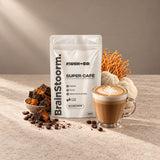
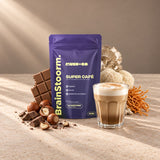
With Energy, it is taken in the morning, caffeine-free: you can keep your usual coffee, or replace it with Brainstoorm, our mushroom coffee at 20 mg of caffeine per cup. Muscle Recovery, for its part, is taken after training.
Sport and recovery
A typical training day.
Eleuthero has long been associated with sport, ever since the Soviet programmes. Here is how our sporty customers most often organise their routine, on training days.
7:30 am
One Energy capsule at breakfast: Cordyceps, Maca, Ginger and Vitamin C, caffeine-free.
12:30 pm
A full lunch, with carbohydrates and protein. No supplement replaces a good plate of food before exercise.
6 pm
Training. Regular hydration, and no tonic supplement just before sleeping.
After exercise
One Muscle Recovery capsule: Cordyceps, Chaga, Turmeric and Boswellia, with your meal or your snack.
In the evening
Nothing tonic. For those who want a complete routine, this is the moment for Sleep+.
An honest reminder: recovery comes first from sleep, food and building up training gradually. A supplement comes on top of those basics, never in their place. If you are preparing for a competition, talk to your sports doctor, and always check the composition of what you take.
The right combinations
Eleuthero plays as a team.
The modern trials showed it: on its own, it works no miracles. Here are the ingredients that surround it in our energy and recovery range, and why.
+ Cordyceps
The athletes' mushroom, present both in Energy and in Muscle Recovery. everything about Cordyceps.
+ Maca and Ginger
The Andean root and the tonic spice, brought together in Energy. Find out more about Maca.
+ Turmeric and Boswellia
Two great classics of the post-exercise moment, at the heart of Muscle Recovery. Turmeric: benefits, dosage and precautions.
+ Rhodiola
Another adaptogenic plant from cold regions, present in Brainstoorm Chocolate-hazelnut. the benefits and dosage of rhodiola.
On the market
Maca, ginger, royal jelly: the classic duos.
In pharmacies as online, Siberian ginseng is rarely sold on its own. It appears above all in tonic combinations, two of which come up again and again: the trio maca, ginger and Siberian ginseng, and the duo Siberian ginseng and royal jelly.
The logic is always the same: bring together several ingredients traditionally associated with vitality, rather than betting everything on a single plant. It is ours too. Our Energy formula brings together Cordyceps, Maca, Ginger and Vitamin C, and our energy and recovery range makes room for eleuthero.
Maca and ginger
A root from the high Andean plateaus and a warming spice. Two plant ingredients, found in our Energy formula.
Royal jelly
A product of the hive, often paired with eleuthero. It is not vegan: you will not find it in our formulas.
Whatever the combination, the same questions arise: what dose of each ingredient, what form, and which extract. A list of ingredients is never enough to judge a product.
Who it is for
An energy and recovery routine is made for you if…
- You are going through busy weeks, at work as at home, and are looking for a caffeine-free routine.
- You train regularly and look after your recovery as much as your sessions.
- You prefer time-limited courses to a continuous intake.
- You want vegan formulas, whose recipes are developed and produced in Toulouse, France, with clearly listed ingredients.
- You are not on long-term treatment (if you are, talk to your doctor first).
Choosing it well
Six criteria so you do not get it wrong.
- The Latin name: Eleutherococcus senticosus, clearly stated. Confusions with other plants have been documented in the past.
- The part used: the root or the rhizome, not the leaves or the stems.
- Standardisation: a stated eleutheroside content.
- The formula: a single plant, or combined with other actives depending on your goal, energy or recovery.
- The manufacturing: an identified place of manufacture. With us, the recipes are developed and produced in Toulouse, France, by a French contract manufacturer, vegan, GMO-free and gluten-free.
- The guarantee: enough to try it risk-free. With us, 60 days satisfied or your money back, and the choice between a one-off purchase and a monthly subscription (−30%).
| Energy | Muscle Recovery | |
|---|---|---|
| The moment | Morning, with breakfast | After training |
| The ingredients | Cordyceps, Maca, Ginger, Vitamin C | Cordyceps, Chaga, Turmeric, Boswellia |
| Caffeine | None | None |
| Who it is for | Busy weeks, at work as in sport | Regular athletes, on exercise days |
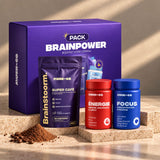
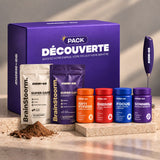
Energy also combines with Focus in the Entrepreneur Pack, and is part of the Limitless Pack for a complete routine.
Side effects and precautions
What to know before you start.
Eleuthero is generally well tolerated at the usual doses. The adverse effects reported are rare: sleep disturbance if it is taken late, headaches, mild digestive discomfort.
- Avoid it in the evening, especially if you are sensitive to stimulants or a fragile sleeper.
- Ask your doctor for advice in case of high blood pressure, anticoagulant, antidiabetic or heart treatment: interactions and interference with certain blood tests have been reported.
- It is not advised during pregnancy and breastfeeding, for lack of sufficient data, nor in children.
- Take time-limited courses, broken up by pauses.
- Stick to the dose stated on the label, and keep it out of reach of children.
Your questions
Everything we are asked about Siberian ginseng.
What is eleuthero?
It is a thorny shrub from the forests of the Russian Far East and north-eastern Asia, Eleutherococcus senticosus. Its root has long been used in Asia, and it was heavily studied in the Soviet Union from the 1950s onwards.
Are Siberian ginseng and eleuthero the same thing?
Yes. Eleuthero comes from the Latin name, Siberian ginseng is its trade name, and in the United States it is sold as “eleuthero”.
What is the difference from ginseng?
True ginseng belongs to the genus Panax and contains ginsenosides. Siberian ginseng is another plant, from the same botanical family, which contains eleutherosides. The two are not interchangeable.
What are the benefits of Siberian ginseng?
It is traditionally used during periods of temporary tiredness, and the European authorities recognise it as a traditional herbal medicine for that use. The modern trials, notably in sport, are more nuanced than its reputation. To go further, discover the causes of brain fog and how to get out of it.
What dose of Siberian ginseng per day?
The traditional markers are around 2 to 3 g of dried root a day, or the equivalent as an extract. Always follow the directions for use of your product.
When should eleuthero be taken?
In the morning, at breakfast. Avoid taking it in the evening, as it can make falling asleep harder in sensitive people.
What are the side effects?
They are rare at the usual doses: sleep disturbance if it is taken late, headaches, digestive discomfort. Medical advice is recommended in case of high blood pressure, long-term treatment, pregnancy or breastfeeding.
How long does a course last?
Generally a few weeks, followed by a break. Our Energy and Muscle Recovery formulas are taken as a 30-day course, as a one-off purchase or on a monthly subscription (−30 %).
Does it contain caffeine?
No. Eleuthero contains no caffeine, and neither do our Energy and Muscle Recovery formulas.
Is Siberian ginseng useful for sport?
It was long given to Soviet athletes, but modern placebo-controlled trials have not confirmed any effect on performance. We use it in combination, never as a promise of performance.
Is there an organic eleuthero?
Yes, you can find one. The organic label concerns cultivation; it is standardisation in eleutherosides and the stated dose that tell you about the active content.
Can Siberian ginseng be taken with coffee?
Yes, in healthy adults, but avoid stacking stimulants at the end of the day. If you want to cut the caffeine, Brainstoorm brings only 20 mg per cup.
Where can I buy our eleuthero formulas?
Directly on mushngo.com, with free delivery from €59 in France and €69 to €89 across Europe, depending on the destination, a one-off purchase or a monthly subscription (−30 %) as you prefer, and 60 days satisfied or your money back. Our formulas are vegan, GMO-free and gluten-free, and the recipes are developed and produced in Toulouse, France, by a French contract manufacturer.
Sources
- Brekhman I. I., Dardymov I. V. (1969). New substances of plant origin which increase nonspecific resistance. Annual Review of Pharmacology, 9.
- Dowling E. A. et al. (1996). Effect of Eleutherococcus senticosus on submaximal and maximal exercise performance. Medicine & Science in Sports & Exercise, 28(4).
- Goulet E. D. B., Dionne I. J. (2005). Assessment of the effects of Eleutherococcus senticosus on endurance performance. International Journal of Sport Nutrition and Exercise Metabolism, 15(1).
- Panossian A., Wikman G. (2009). Evidence-based efficacy of adaptogens in fatigue, and molecular mechanisms related to their stress-protective activity. Current Clinical Pharmacology, 4(3).
Put it into practice
Siberian ginseng, the Mush n Go version.
You now know all about Siberian ginseng and what to look for on a label. Here is where to find it with us, with vegan formulas whose recipes are developed and produced in Toulouse, France, by a French contract manufacturer, and guaranteed 60 days satisfied or your money back.
Energy
Our energy formula: Cordyceps, Maca, Ginger and Vitamin C. Caffeine-free, as a 30-day course, for the weeks when you have to keep going.
Discover Energy →Muscle Recovery
Our recovery formula: Cordyceps, Chaga, Turmeric and Boswellia. One capsule after training.
Discover the formula →The other ingredients
Keep exploring.
Eleuthero is only one of the actives in our formulas. Discover the other plants and mushrooms, or browse the page listing all our active ingredients.


