






Edible mushroom
Oyster mushroom: from the market to the pan, and all the way to your capsules
By the Mush n Go team · Updated 18 September 2026
The oyster mushroom, or pearl oyster mushroom (Pleurotus ostreatus), is one of the most cooked mushrooms in Europe after the button mushroom. It is on the market almost all year round, cooks in five minutes and also interests researchers for its beta-glucans. On this page you will find everything: how to choose it, clean it and cook it, what not to confuse it with, and what the science says. At Mush n Go you will find it in Immunity, alongside Chaga and Reishi.
The cooking guide
Choosing, cleaning, pan-frying, roasting or making an omelette: all our tips for getting fresh oyster mushrooms right, and the king oyster mushroom too.
See the cooking guide →
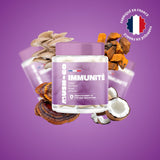
Immunity
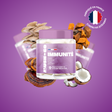
The oyster mushroom paired with Chaga and Reishi, three mushrooms in a single capsule. One a day, in the morning, through the change of seasons.
Discover Immunity →The profile
The oyster mushroom in brief.
Before we go into detail, here are the essentials about this shell-shaped mushroom, which grows in tight clusters on the wood of trees.
A long history
From the winter forest to the market stall.
The oyster mushroom was long a foraged mushroom, valued because it grows when almost every other one has gone. Its cultivation then changed everything.
Foraging
In Europe as in Asia, it has always been gathered from the trunks of broadleaf trees, often in the depths of winter, in cold, damp weather.
20th century
The first cultivation trials on wood took place in Germany at the start of the century. It is then grown on straw, on sawdust, and even on coffee grounds.
1990s
Slovak researchers take an interest in the beta-glucans in its cap and isolate pleuran, which becomes a subject of study in its own right.
Today
It is one of the most widely cultivated mushrooms in the world, and questions about choosing and cooking it are among the most common asked about edible mushrooms.
A small curiosity: the oyster mushroom is one of the few mushrooms able to trap tiny soil worms, nematodes, and feed on them. A strategy that lets it find the nitrogen the wood does not give it.
The different oyster mushrooms
One family, several flavours.
At the market, the words “oyster mushroom” cover several species of the genus Pleurotus. They are cooked in the same way, but have neither the same texture nor the same season.
| Common name | Latin name | Worth knowing |
|---|---|---|
| Oyster mushroom, grey oyster mushroom | Pleurotus ostreatus | The most common, wild in winter and cultivated all year round. It is the one in Immunity. |
| King oyster mushroom | Pleurotus eryngii | Grows on the roots of sea holly, in dry grassland and steppe country. Cultivated, it is sold with a thick, fleshy stem. |
| Lung oyster mushroom | Pleurotus pulmonarius | Close to the oyster mushroom, paler and thinner, it grows rather in summer. |
| Golden oyster mushroom | Pleurotus citrinopileatus | Lemon yellow, in clusters, with a more pronounced aroma. Mostly cultivated. |
| Pink oyster mushroom | Pleurotus djamor | Bright pink, of tropical origin. It loses its colour on cooking. |
The name “poplar oyster” is confusing: it is sometimes used for an oyster mushroom growing on poplar, but also for the poplar mushroom, or pioppino (Cyclocybe aegerita), an entirely different mushroom, with a ring and a central stem.
Do not confuse it
The jack-o'-lantern mushroom is not one.
The oyster mushroom you buy at the market or in the supermarket is cultivated: no risk of confusion. But in the woods a misleading name regularly claims victims. The “olive tree oyster”, also called the jack-o'-lantern mushroom, is a toxic mushroom.
Its real name is Omphalotus olearius. It grows in clusters at the foot of olive trees, but also of oaks and sweet chestnuts, especially around the Mediterranean. It contains illudins, substances that cause vomiting, diarrhoea and sometimes violent abdominal pain a few hours after the meal. Because of its colour, it is more often confused with the chanterelle than with the true oyster mushroom.
| Oyster mushroom | Jack-o'-lantern mushroom | |
|---|---|---|
| Colour | Grey, beige or brown, white gills | Bright orange to orange-brown, orange gills |
| Where it grows | On the trunk or branches of broadleaf trees | At the foot of trees, on stumps and roots |
| Stem | Short, off-centre, sometimes absent | Longer, often central |
| Particularity | A mild, slightly aniseed smell | Its gills can give off a faint glow in the dark |
| Edible | Yes, cooked | No, toxic |
A second look-alike deserves a mention: angel wing (Pleurocybella porrigens), white and thin, which grows on conifer wood. Long considered edible, it was linked in Japan to serious poisoning in people with kidney failure. It is no longer eaten.
The golden rule remains the same for all wild mushrooms: at the slightest doubt, have your foraging checked by a pharmacist or a mycological society before cooking it.
Choosing and cleaning
Choosing your oyster mushrooms well, in three steps.
The oyster mushroom is fragile. It does not keep long and does not like water. Three steps are enough to prepare it properly.
Choose
Firm, dry caps with intact edges, with no damp patches and no strong smell. The small clusters are the most tender.
Keep
In the fridge, in a paper bag or a cloth, never in plastic. Two to three days at most.
Clean
Not under the tap: it drinks water like a sponge. Wipe it with a damp cloth or a brush, then cut off the base of the stem.
To prepare it, separate the caps by hand rather than with a knife: they tear into strips along the gills, and take on colour better in the pan. Keep any stems that are too firm for a stock or a stuffing. With the king oyster mushroom it is the other way round: its stem is the best part, to be cut into chunks or thick slices.
Cooking
How do you cook oyster mushrooms without ruining them?
The oyster mushroom is nearly 90% water. The whole challenge of cooking it is to drive off that water so the mushrooms turn golden rather than boiled. The secret comes down to three rules: a very hot pan, a few mushrooms at a time, and salt at the end. To go further, discover our complete guide to functional mushrooms.
| Method | Cooking time | The tip |
|---|---|---|
| In the pan | 5 to 8 minutes | High heat, a drizzle of oil, then a knob of butter, garlic and parsley at the end |
| In the oven | 15 to 20 minutes at 200 °C | In a single layer on a tray, with olive oil, thyme and salt |
| In the wok | 3 to 4 minutes | In strips, with ginger, soy sauce and spring onion |
| King oyster mushroom | 3 to 4 minutes a side | In one-centimetre slices, scored with a knife and seared like scallops |
| In an omelette | 5 minutes, then the eggs | Fry the oyster mushrooms on their own first, or their water will soak the omelette |
Do not salt at the start: salt draws out the water and the mushrooms end up boiling in their own juices. If the pan is too small, cook in two batches. And always eat it cooked: like most mushrooms, raw oyster mushroom is less digestible and can cause discomfort. To go further, discover microdosing functional mushrooms.
As for pairings, it loves garlic, shallot, thyme, cream and parmesan. It slips into a risotto, a pan of vegetables, pasta, a tart or an Asian broth. Pan-fried then served on a slice of toast with a soft-boiled egg, it makes a complete meal in ten minutes. And the oyster mushroom omelette remains the great classic of autumn evenings.
What it provides
A light mushroom, but not an empty one.
Like most mushrooms, the fresh oyster mushroom is made up mainly of water. Per 100 g it provides around thirty kilocalories, about 3 g of protein and 2 g of fibre, with very little fat. It also supplies B-group vitamins, niacin (vitamin B3) in particular, as well as potassium.
It stands out above all for two compounds: its beta-glucans, fibres housed in the mushroom's cell wall, and ergothioneine, a sulphur-containing amino acid that mushrooms make and that the oyster mushroom contains in notable quantity. Both are the subject of a great deal of research.
What to take away: in the kitchen, the oyster mushroom is an excellent food, light and tasty. But one portion at dinner once a week does not provide the amounts of beta-glucans used in the studies, which is where extracts come in.
The molecules
Beta-glucans and pleuran: what makes it unique.
If the oyster mushroom interests researchers, it is first of all for its beta-glucans. All mushrooms contain them, but their structure changes from one species to another, and it is that structure which determines how they interact with the body.
The one in the oyster mushroom has a name of its own: pleuran. It is an insoluble beta-glucan, extracted from the cap of Pleurotus ostreatus, studied since the 1990s in Slovakia, where it has long been marketed. It has been the subject of human trials, in adults as well as in children, which we set out just below.
The oyster mushroom also contains natural lovastatin, the same molecule as a medicine used against cholesterol. Researchers identified it in the fruiting body as early as the 1990s. The quantities are small and vary with cultivation: we therefore do not make an argument of it, but it is a reason to ask your doctor for advice if you are already on that kind of treatment.
Finally, ergothioneine completes the picture. What matters in practice: the part used and the extraction method determine which molecules you actually take in.
What the studies say
Pleuran, studied in humans.
Most of the research on the oyster mushroom concerns pleuran, its beta-glucan. Two placebo-controlled trials come up most often. They are modest in size, but their conditions are precise.
Bergendiova et al., 2011 · Slovakia
50 athletes, 100 mg of pleuran a day for 3 months, against placebo. The researchers followed symptoms of upper respiratory tract infections and several markers of cellular immunity. Fewer episodes were reported in the pleuran group.
Jesenak et al., 2013 · Slovakia
175 children prone to recurrent respiratory infections, a pleuran syrup for 6 months, against placebo. The number of infections reported during the study was lower in the pleuran group.
Lovastatin, 1995 · Slovenia
Gunde-Cimerman and Cimerman showed the presence of lovastatin in the fruiting body of oyster mushrooms. A laboratory work, which describes a molecule without measuring any effect in humans.
In short: serious leads, studied with a precise extract and known doses, but nothing that would allow promises. This work explains why the oyster mushroom has its place in a seasonal formula, alongside other traditional mushrooms. The full references are at the bottom of the page.
Plate or capsule
Why take it as an extract?
As you will have gathered, the fresh oyster mushroom is above all a pleasure at the table. For regular intake it is another story: it keeps for two days, it is 90% water, and you would have to eat a good portion every day to come close to the quantities studied.
An extract solves those three problems. The mushroom is dried, then extracted in hot water to concentrate its beta-glucans into a small amount of powder that fits into a capsule. That is the approach we chose in Immunity, with two other mushrooms from very old traditions.
+ Chaga
The black mushroom of the birches of the far north, used as a decoction for centuries in Russia and Scandinavia. Discover it on our Chaga page.
+ Reishi
The mushroom of the Chinese tradition, nicknamed the “mushroom of immortality”. It is also in Sleep+ and Anti-Stress Complex. See our Reishi page.
+ A simple routine
One to two capsules in the morning with a glass of water, without changing anything about your meals. Fresh oyster mushroom stays on the menu whenever you feel like it.
+ A clean formula
Vegan, non-GMO, gluten-free, with recipes developed and produced in Toulouse, France, by a French contract manufacturer, with a 60-day money-back guarantee, as a one-time purchase or on subscription (−30%).
The quantity
What quantity of oyster mushroom?
There is no official dose. The markers change completely depending on whether you eat it or take it as an extract.
| Form | Marker | What that represents |
|---|---|---|
| Fresh oyster mushroom | 150 to 200 g per person | A main-course portion, cooked |
| Dried oyster mushroom | 15 to 20 g per person | About ten times less than fresh, to be rehydrated for 20 minutes in lukewarm water |
| Pleuran (extract) | 100 mg per day | The dose used in adults in the trial on athletes |
| Immunity | 1 to 2 capsules a day | With Chaga and Reishi, in the morning with a glass of water |
Always follow the directions for use on your product's label. Allow at least a month of regular intake before forming an opinion.
Who it is for
Immunity is made for you if…
- You want a simple routine to get through autumn and winter.
- You like mushrooms in the kitchen and want to go further than the plate.
- You are looking for a short formula: three mushrooms, nothing else.
- You prefer a capsule to a product that is complicated to prepare.
- You want to know what you are taking, and to choose between a one-time purchase and a subscription.
Choosing well
Five criteria for a quality supplement.
- The exact species: Pleurotus ostreatus, written out in full.
- The part used: the fruiting body, where the pleuran and the beta-glucans that have been studied are found.
- The form: a concentrated extract rather than a simple dried-mushroom powder.
- The manufacturing: an identified place. The recipes are developed and produced in Toulouse, France, by a French contract manufacturer, and are vegan, non-GMO and gluten-free.
- The guarantee: enough to try without risk. With us, a 60-day money-back guarantee, and the choice between a one-time purchase and a monthly subscription (−30%).
Precautions
Is the oyster mushroom toxic?
No. The oyster mushroom is an edible mushroom, cultivated and eaten all over the world. The rare problems come from confusion in the woods, from eating it raw, or from an allergy.
- Never eat a wild oyster mushroom without certain identification, and beware of the toxic jack-o'-lantern mushroom.
- Always eat it cooked, and avoid it if you have a known mushroom allergy.
- Growers exposed to its spores over long periods can develop a respiratory allergy: that is an occupational risk, not a dietary one.
- Ask your doctor for advice if you are pregnant, breastfeeding, on cholesterol treatment or on a treatment that acts on the immune system.
- Respect the dose stated on the label, and keep the supplement out of the reach of children.
Your questions
Everything you ask us about the oyster mushroom.
Is the oyster mushroom toxic?
No, the oyster mushroom is edible and sold everywhere, cultivated. The danger comes above all from the jack-o'-lantern mushroom (Omphalotus olearius), a toxic orange mushroom that is not a true oyster mushroom, and from eating it raw, which is less digestible.
How do you cook oyster mushrooms?
In the pan, over high heat, with a drizzle of oil, in small quantities so they brown instead of boiling. Allow 5 to 8 minutes, add butter, garlic and parsley at the end, and salt last.
Should you wash oyster mushrooms?
No, not under water: they soak it up and turn spongy. Wipe them with a damp cloth or a brush and cut off the base of the stem. Cultivated oyster mushrooms are generally very clean.
Can you eat the oyster mushroom raw?
Better not to. Like most mushrooms, the raw oyster mushroom is less digestible and can cause discomfort. A few minutes of cooking is enough.
What is the difference between the oyster mushroom and the king oyster mushroom?
They are two species of the same genus. The oyster mushroom (Pleurotus ostreatus) has a large cap and a short stem. The king oyster mushroom (Pleurotus eryngii) has a thick, fleshy, firmer stem, which is cooked in slices.
How do you keep oyster mushrooms?
Two to three days in the fridge in a paper bag. To keep them longer, fry them then freeze them, or dry them: dried, they keep for several months in a dry place.
What are the benefits of the oyster mushroom?
It is a light food, a source of protein, fibre and B vitamins. Its beta-glucans, and pleuran in particular, have been the subject of human trials, which we summarise above. These studies remain modest: we present them as leads, not as promises.
Can you grow oyster mushrooms at home?
Yes, it is one of the easiest mushrooms to grow. Ready-to-use kits are available, and oyster mushroom mycelium develops on straw, on cardboard or on coffee grounds, away from direct light.
What is in Immunity?
Three mushrooms: Chaga, Reishi and oyster mushroom. It is taken at the rate of one to two capsules in the morning with a glass of water. The formula is vegan, non-GMO and gluten-free, and the recipes are developed and produced in Toulouse, France, by a French contract manufacturer.
How long should you take Immunity?
Many of our customers take it through the change of seasons, over one to three months. Allow at least a month of regular intake before judging. All our formulas come with a 60-day money-back guarantee.
Can Immunity be combined with other formulas?
Yes. Immunity is taken in the morning, and many customers pair it with Brainstoorm, which also contains Chaga, or in the evening with Sleep+. If you are on any treatment, ask your doctor for advice.
Where can you buy a quality oyster mushroom supplement?
Directly on mushngo.com, with free delivery from €59 in France and €69 to €89 across Europe, depending on the destination, a one-time purchase or a monthly subscription (−30%) as you prefer, and a 60-day money-back guarantee. The recipes are developed and produced in Toulouse, France, by a French contract manufacturer.
Sources
- Bergendiova K., Tibenska E., Majtan J. (2011). Pleuran (β-glucan from Pleurotus ostreatus) supplementation, cellular immune response and respiratory tract infections in athletes. European Journal of Applied Physiology, 111(9).
- Jesenak M. et al. (2013). Immunomodulatory effect of pleuran (β-glucan from Pleurotus ostreatus) in children with recurrent respiratory tract infections. International Immunopharmacology, 15(2).
- Gunde-Cimerman N., Cimerman A. (1995). Pleurotus fruiting bodies contain the inhibitor of 3-hydroxy-3-methylglutaryl-coenzyme A reductase: lovastatin. Experimental Mycology, 19(1).
Put it into practice
Oyster mushroom, the Mush n Go version.
You now know all about the oyster mushroom and what to look for on a label. Here is where to find it with us, with vegan formulas whose recipes are developed and produced in Toulouse, France, by a French contract manufacturer, backed by a 60-day money-back guarantee.
The cooking guide
Choosing, cleaning, pan-frying, roasting or making an omelette: all our tips for getting fresh oyster mushrooms right, and the king oyster mushroom too.
See the cooking guide →Immunity
The oyster mushroom paired with Chaga and Reishi, three mushrooms in a single capsule. One a day, in the morning, through the change of seasons.
Discover Immunity →The other ingredients
Keep exploring.
The oyster mushroom is only one of the mushrooms in our formulas. Discover the others, or browse the full list of our active ingredients.

