



















Functional mushroom
Chaga: the birch mushroom, of the boreal forests
By the Mush n Go team · Updated 18 September 2026
The Chaga (Inonotus obliquus) is the black mushroom of the birches of the Far North. It has been drunk in Siberia and Finland for centuries, as an infusion, like a tea. At Mush n Go you take it in capsules with Immunity or Muscle Recovery, or in your coffee with Brainstoorm, at 1,000 mg per cup.

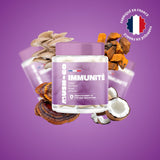
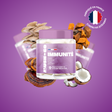
Immunity
Chaga combined with Reishi and Oyster mushroom: three mushrooms in one capsule, 1 to 2 capsules in the morning, as a seasonal course.
Discover Immunity →
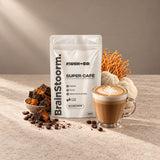
Brainstoorm
1,000 mg of chaga per cup, with Lion's Mane and Cordyceps. Coffee or chocolate-hazelnut flavour, only 20 mg of caffeine.
Discover Brainstoorm →The fact file
Chaga in brief.
At first glance you take it for a lump of charcoal stuck to the bark, or for an old wound on the tree. Here is the essential information about this mushroom that resembles no other.
A long history
From the peoples of Siberia to the laboratories.
Chaga does not have the imperial aura of Reishi. It is a mushroom of farmers, hunters and foresters, drunk daily in regions where tea was rare and expensive.
Prehistory
You often read that Ötzi, the iceman found in the Alps, was carrying chaga. That is false: the analyses identified birch polypore and tinder fungus, two other mushrooms.
Siberia
The peoples of the taiga have been brewing it for centuries. In Russia it long served as the poor man's tea, in the countryside where real tea cost too much.
Russian and then Finnish researchers take an interest in its composition. During wartime shortages it is said to have served as a coffee substitute in Finland as well.
Today
Chaga has become one of the most sought-after functional mushrooms in Europe: you now find it in health-food shops and online, in chunks, as powder and as extract.
A sclerotium, not a cap
What you see on the birch is not a cap.
This is chaga's great peculiarity, and it changes everything. The black mass that is harvested is not a fruiting body, that is, not the equivalent of the cap of a porcini or a Reishi. It is a sclerotium: a very dense mass of mycelium mixed with birch wood, which grows slowly over years.
Chaga's true fruiting body does exist, but almost nobody has seen it. It appears only after the tree dies, under the bark, as a thin brown crust that lasts only a few weeks. It has no traditional use at all.
Take care too not to confuse it with a burl, that rounded woody growth you sometimes see on trunks. A burl is covered in bark and is part of the tree; chaga, on the other hand, is black, cracked like burnt charcoal, and orange-brown when you break it open.
| Sclerotium | Fruiting body | |
|---|---|---|
| What it is | The black mass on the living trunk | A thin crust under the bark |
| When | All year round, for years | After the tree dies, a few weeks |
| Composition | Mycelium, birch wood, melanin | Reproductive tissue of the mushroom |
| Traditional use | Yes, as an infusion for centuries | None |
| In supplements | The reference form | Practically never |
For chaga, the question "fruiting body or mycelium" therefore does not arise as it does for other mushrooms: the right answer is the sclerotium harvested on birch.
Harvesting in the boreal forest
A mushroom that is not cultivated.
Chaga needs a living birch, and time. That is what makes it a product apart, gathered in the wild and not farmed.
The forest
Chaga grows in the boreal forests, where birches dominate, from northern Russia to Canada, by way of Finland.
The time
It develops slowly, over several years, starting from a wound in the bark. A large sclerotium may have taken more than ten years to form.
The gathering
Harvesters detach it with an axe, leaving part of it on the tree so that it can grow back. Many prefer winter, when the forests are accessible.
The preparation
It is then dried, ground, and extracted in hot water to concentrate its compounds.
There is also "chaga" produced in the laboratory, from mycelium grown on grain. That is a different product: it does not grow on birch, and so does not have quite the same composition. Betulin, for example, comes from the tree. Always ask about the origin.
Wild harvesting also has its limits: chaga grows slowly and is found on only a small proportion of birches. Responsible gathering, which gives the forest time to renew itself, is one of the quality criteria.
The molecules
What the birch passes on to it.
Chaga has an unusual composition, because it lives in part off the wood of its tree. Several families of compounds are found in the sclerotium.
Polyphenols and melanin give chaga its black colour. They are what explain its reputation as a mushroom rich in antioxidants, a reputation based above all on laboratory measurements.
It is also what explains its ORAC score, the laboratory index that measures a food's capacity to neutralise free radicals in vitro: about 146,700 units per 100 g of chaga, against 15,405 for açaí, 4,669 for blueberry, 4,479 for pomegranate and 1,253 for green tea. To be taken with the same caution as the rest: the ORAC index is measured in a test tube, not in the body, and health authorities have stopped using it as a nutritional argument. It places a composition, it does not predict an effect.
A useful marker when buying, which follows directly from this composition: a serious extract states its polysaccharide and triterpene content, and keeps the characteristic black colour of the sclerotium. A grey or beige powder is very likely mycelium grown on grain rather than birch chaga.
Triterpenes, including betulin and betulinic acid, come in part from birch bark, which is very rich in them. It is a signature of chaga grown on birch, and is barely found in mycelium grown on grain.
Polysaccharides, including beta-glucans, are present as in most mushrooms, and are recovered in hot water.
What to take away: chaga's origin, wild and on birch, counts as much as its dose.
What the studies say
A lot of laboratory work, and we are telling you so.
Let us be frank: there is no solid clinical trial on chaga in humans today. The bulk of the research has been done in the laboratory, on cells or in animals. What we know for certain concerns its composition, its history and its safety of use.
Peintner et al., 1998 · Austria
The analysis of the mushrooms found on Ötzi, the iceman. The researchers identify birch polypore and tinder fungus. No chaga, contrary to a very widespread idea.
Glamočlija et al., 2015 · Serbia
A chemical characterisation of chaga samples of different origins, with activity tests in the laboratory. It describes the presence of phenolic compounds and triterpenes in the sclerotium.
Kikuchi et al., 2014 · Japan
A clinical case: a 72-year-old woman who had been taking 4 to 5 teaspoons of chaga powder a day for six months developed kidney damage linked to oxalates. A useful reminder: doses matter.
In short: a long tradition of use, a well-described composition, and human research still to be built. That is why we use chaga at a reasonable, stated dose, and never in "mega-doses". The full references are at the bottom of the page.
The dose
What dose of chaga per day?
There is no official dose. Traditional use and the products on the market do, however, give markers, which depend on the form.
| Form | Daily marker | What that represents |
|---|---|---|
| Chunks, as an infusion | One to two cups | Traditional use in Siberia and Finland |
| Concentrated extract | 500 mg to 1 g | The most common range in supplements |
| Raw powder | In moderation | Harder to dose, and rich in oxalates: never exceed the stated dose |
| Brainstoorm | 1,000 mg per cup | With 1,000 mg of Lion's Mane and 1,000 mg of Cordyceps |
Always follow the directions for use stated on your product's label. For Immunity: 1 to 2 capsules in the morning. For Muscle Recovery: 1 to 3 capsules in the morning.
Chaga tea
The infusion of the Far North, step by step.
It is the oldest way of consuming chaga, and it remains very pleasant. Unlike Reishi, its infusion is not bitter: it has a mild, woody taste, with a slightly vanilla note.
The chunks
A few small pieces of dried chaga, the size of a sugar cube, or a spoonful of powder.
The hot water
Water just below the boil, not boiling. Let it steep for a long time: from 15 minutes for the powder to several hours for the chunks.
The tasting
A coffee-coloured drink, plain or with a little honey. The chunks can be reused two or three times.
Chaga tea has one flaw: the dose varies enormously from one cup to the next. If you want a known amount every day, the extract in a capsule or in a drink remains simpler.
Chaga and coffee
Why put it in your cup?
Chaga has an advantage that is rare among mushrooms: its taste naturally marries with that of coffee. The Finns are even said to have used it as a coffee substitute during the war. It was only logical to put it in the cup you already drink every morning. To go further, discover our mushroom drink recipes.
An espresso provides about 80 mg of caffeine, a large mug far more. Brainstoorm takes the problem differently: 20 mg of microencapsulated NewCaff® caffeine, released gradually, and 6,040 mg of actives per cup, including 1,000 mg of chaga, 1,000 mg of lion's mane, 1,000 mg of Cordyceps and 3,000 mg of Maca. That is three times more than competing mushroom coffees, which hover around 3,000 mg. The Chocolate-hazelnut version adds rhodiola and cocoa, for 6,225 mg of actives.
And no, there is no mushroom taste at all. The Coffee flavour is mild, with a note of chicory; the Chocolate-hazelnut drinks like a hot chocolate. Hot or cold, with water or milk. All of it produced in Toulouse.
A typical day
Chaga, from waking up to the workout.
To give you a concrete idea, here is how our customers most often fit it into their day, depending on the season and their profile.
7:30 am
A cup of Brainstoorm at breakfast, in place of the usual coffee: 1,000 mg of chaga, and the same habit as before.
8 am
When autumn arrives, 1 to 2 Immunity capsules with a glass of water, as a seasonal course, with Reishi and Oyster mushroom.
8:30 am
On training days, 1 to 3 Muscle Recovery capsules, which combine chaga with Cordyceps, Turmeric and Boswellia.
At the weekend
A homemade chaga tea, brewed unhurriedly in a teapot, for the pleasure of the woody taste.
What they say about it
Trustpilot reviews, reproduced as they are.
"I was sceptical and in the end I am won over. Less caffeine and yet I am full of beans, with a steady mood"
★★★★★Maïté S., 4 April 2026 · Brainstoorm
"normal coffee gave me stomach ache, now my stomach has settled and I feel great"
★★★★★Sonia L., 27 August 2026 · Brainstoorm
The right combinations
Chaga plays as a team.
Combined with other ingredients, it finds its place in a more complete routine. Here are the combinations in our formulas, and why.
+ Reishi and Oyster mushroom
Three mushrooms brought together in Immunity: birch chaga, Reishi and Oyster mushroom.
+ Lion's Mane and Cordyceps
Brainstoorm's mushroom trio, 1,000 mg of each per cup, with Lion's Mane and Cordyceps.
+ Turmeric and Boswellia
Two traditional plants brought together with chaga and Cordyceps in Muscle Recovery, for the post-training routine.
+ Maca and chicory
The Andean root and chicory, which give Brainstoorm its rounded taste and its coffee note.
Who it is for
Chaga is made for you if…
- You like wild ingredients, with a real history of use.
- You want a seasonal routine, as autumn arrives and through the winter.
- You play sport and look after your post-effort routine.
- You want to cut down on coffee without giving up the taste of the morning.
- You like to understand what you take, dose by dose.
Choosing it well
Six criteria so you do not get it wrong.
- The origin: wild sclerotium harvested on birch, in the boreal forest.
- The format: a hot-water extract rather than a raw powder, to release its compounds better.
- The real dose: milligrams per serving, reasonable ones, not "mega-doses".
- The traceability: an origin and a part used clearly stated on the label.
- The manufacturing: an identified place. With us, the recipes are developed and produced in Toulouse, France, by a French contract manufacturer, vegan, GMO-free and gluten-free.
- The guarantee: enough to try it risk-free. With us, 60 days satisfied or your money back, and the choice between a one-off purchase and a monthly subscription (−30%).
| Immunity | Brainstoorm | Muscle Recovery | |
|---|---|---|---|
| Form | Capsules | Coffee or chocolate | Capsules |
| The moment | In the morning | In place of your coffee | After training |
| Chaga with | Reishi, Oyster mushroom | Lion's Mane, Cordyceps, Maca, Ashwagandha | Cordyceps, Turmeric, Boswellia |
| Caffeine | None | 20 mg per cup | None |
The Discovery Pack is a good way in if you want to taste several of our formulas before choosing.
Chaga, oxalates and the thyroid
Chaga and risk: what you need to know.
Chaga has been drunk for centuries and is generally well tolerated at the usual doses. It does, however, have one feature that cannot be passed over in silence: it is rich in oxalates, the same compounds as in spinach or rhubarb. At a high dose and over time, oxalates can be deposited in the kidneys. That is what happened in the Japanese case described above, with several spoonfuls of powder a day for months.
Chaga and the thyroid: this is a frequent question. To date, no direct interaction between chaga and the thyroid has been established. Chaga is, however, studied in the laboratory in connection with immunity, and many thyroid disorders, such as Hashimoto's or Graves' disease, are autoimmune in origin. As a precaution, if this concerns you or if you take thyroid medication, talk to your doctor before starting.
The right reflexes before taking chaga:
- Avoid it if you have a history of kidney stones, kidney failure or a mushroom allergy.
- Ask your doctor for advice if you are pregnant, breastfeeding, or following an anticoagulant, antidiabetic or immunosuppressant treatment: work in animals and in the laboratory suggests an effect on coagulation and blood sugar.
- The same caution applies with an autoimmune disease, and before surgery.
- Stick to the dose stated on the label, drink enough water, and keep it out of the reach of children.
For an overview, read our article on the risks of adaptogenic mushrooms and plants.
Your questions
Everything we get asked about chaga.
What is chaga used for?
Chaga is mostly taken as a seasonal or daily routine, as an infusion or an extract. It has been drunk for centuries in Siberia and Finland, and is now one of the most widely consumed functional mushrooms in Europe.
Why is it called the birch mushroom?
Because it grows almost exclusively on living birches. From them it draws part of its compounds, such as betulin, present in the white bark of the tree.
Is chaga really a mushroom?
Yes, but the part harvested is not a fruiting body: it is a sclerotium, a dense mass of mycelium and wood. The true fruiting body appears only after the tree dies and is not used.
Is chaga dangerous?
No, at the usual doses it is generally well tolerated. It is, however, rich in oxalates: avoid high doses over long periods, and seek medical advice in case of kidney problems or anticoagulant or antidiabetic treatment.
Chaga and the thyroid: is there a risk?
No direct interaction has been established. As many thyroid disorders are autoimmune, medical advice is recommended before starting if this concerns you or if you are on treatment.
What are the side effects of chaga?
They are rare at the usual doses, most often mild digestive discomfort. The main point to watch concerns oxalates, at high doses and over time.
What dose of chaga per day?
Supplements most often offer 500 mg to 1 g of extract per day. A cup of Brainstoorm provides 1,000 mg of chaga. For the capsules, follow the directions for use of each formula.
How do you prepare chaga tea?
Steep a few chunks in water just below the boil, from fifteen minutes for the powder to several hours for the chunks. The taste is mild and woody, with no bitterness.
When should you take chaga?
In the morning, as a capsule or in your coffee, or after training with Muscle Recovery. What matters is consistency.
Can you take chaga with coffee?
Yes, and that is precisely the principle behind Brainstoorm: chaga, lion's mane and Cordyceps are directly in your cup, with only 20 mg of caffeine.
Is chaga vegan?
Yes, it is a mushroom. All our chaga formulas are vegan, GMO-free and gluten-free.
Where can you buy quality chaga?
Directly on mushngo.com, with free delivery from €59 in France and €69 to €89 across Europe, depending on the destination, a one-off purchase or a monthly subscription (−30%) as you prefer, and 60 days satisfied or your money back. The recipes are developed and produced in Toulouse, France, by a French contract manufacturer.
Sources
- Peintner U., Pöder R. and Pümpel T. (1998). The iceman's fungi. Mycological Research, 102(10).
- Kikuchi Y. et al. (2014). Chaga mushroom-induced oxalate nephropathy. Clinical Nephrology, 81(6).
- Glamočlija J. et al. (2015). Chemical characterization and biological activity of Chaga (Inonotus obliquus), a medicinal "mushroom". Journal of Ethnopharmacology, 162.
Put it into practice
Chaga, the Mush n Go version.
You now know all about chaga and what to look for on a label. Here is where to find it with us, with vegan formulas whose recipes are developed and produced in Toulouse, France, by a French contract manufacturer, and guaranteed 60 days satisfied or your money back.
Immunity
Chaga combined with Reishi and Oyster mushroom: three mushrooms in one capsule, 1 to 2 capsules in the morning, as a seasonal course.
Discover Immunity →Brainstoorm
1,000 mg of chaga per cup, with Lion's Mane and Cordyceps. Coffee or chocolate-hazelnut flavour, only 20 mg of caffeine.
Discover Brainstoorm →The other ingredients
Keep exploring.
Chaga is only one of the ingredients in our formulas. Discover the other mushrooms and the plants that go with it, or browse all our active ingredients.
In this dossier


Brainstoorm
The energy of coffee, without the downsides

Immunity
Strengthen your natural defenses with our Immunity formula, your daily shield against external aggressions.

Muscle Recovery
Recover quickly and exceed your limits, with a solution designed for active people

Discovery Pack
Become the best version of yourself to achieve all your goals with efficiency and serenity