








Maca coffee: benefits, taste and recipe
By the Mush n Go editorial team - 02 October 2026
By the Mush n Go editorial teamPublished on 2 October 202610 min read
Maca and coffee
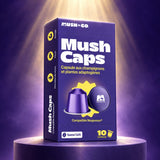
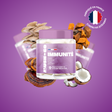
Maca coffee is a coffee with maca powder added: a caffeine-free root from the Andes, with a malty, nutty taste that goes well with the bitterness of coffee. People generally use 1 to 3 g a day. Studies on maca mainly look at perceived energy, mood and desire, with small sample sizes. To save you measuring by the spoonful, Mush Caps contains the equivalent of 2,500 mg per capsule, with three mushrooms and 17 mg of caffeine.

Mush Caps
The equivalent of 2,500 mg of maca per capsule, with lion's mane, cordyceps, chaga, ashwagandha and 17 mg of microencapsulated caffeine. Available from 2 October.
Reserve my Mush Caps →
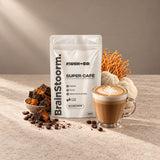
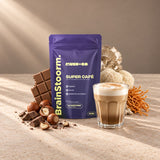
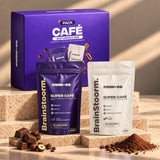
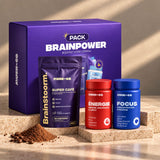
Brainstoorm
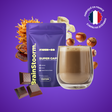
The same recipe by the spoonful: 3,000 mg of maca per cup, three mushrooms and 20 mg of NewCaff® caffeine, hot or iced.
Discover Brainstoorm →What maca is
A root from the Andes, without a trace of caffeine.
Maca, Lepidium meyenii, is a plant in the Brassicaceae family, like the radish or the turnip. It is the root that is eaten, grown on the high plateaus of Peru at more than 4,000 metres above sea level. Andean people have eaten it for centuries, cooked, as a porridge or as a drink.
In Europe, it is mostly found as a powder, dried or “gelatinised”, meaning cooked and then dried to make it easier to digest. Its appeal in a cup of coffee comes down to two things: a taste that suits it, and the absence of caffeine, which lets you enrich the cup without making it more jittery.
The taste
Malty, slightly nutty, with a note of caramel. It softens the bitterness of coffee instead of fighting it.
Caffeine
None. Maca is not a stimulant: it does not replace caffeine, it sits alongside it without adding any more.
The form
Raw or gelatinised powder, concentrated extract, or already measured out in a ready-to-use drink.
Why with coffee
Two ingredients that stay out of each other's way.
Coffee wakes you up through its caffeine. Maca does not work that way, which is why the two are so readily combined: you keep the ritual and the taste of coffee, and add a root that is often taken in the morning. Sportspeople sometimes add it to their pre-exercise drink, as we explain in our article on natural pre-workout.
Pairing maca with coffee also has a practical advantage: the powder has a strong taste that does not go down well in plain water, whereas it melts into a milky coffee or a latte.
What the studies say
Four reference points, and what they are worth.
Maca has been studied in humans for around twenty years, mostly in Peru. Trials exist, but they involve small groups and short durations. Here are the most cited, with their limits.
Gonzales et al., 2002 · Peru
57 men, 1.5 or 3 g of maca a day for 12 weeks versus placebo. Higher self-reported sexual desire from week 8, with no change in testosterone levels.
Stone et al., 2009 · United Kingdom
8 cyclists, 2 g of maca extract a day for 14 days. Time over 40 km improved compared with their own starting point. A pilot study with a very small sample.
Brooks et al., 2008 · Australia
14 postmenopausal women, 3.5 g a day for 6 weeks. More favourable self-reported anxiety and mood scores, with no measured effect on hormones.
Gonzales-Arimborgo et al., 2016 · Peru
175 adults, 3 g of red or black maca a day for 12 weeks. More favourable self-reported mood and energy scores than with placebo. Self-reported criteria.
What can be taken from this: the doses studied range from 1.5 to 3.5 g a day, over several weeks. A single cup does not reproduce these trials; it is regularity that counts.
Which maca to choose
Yellow, red or black, raw or gelatinised.
Maca is sold in several colours, which correspond to the shade of the root. They have been compared in a few studies, without any one colour clearly standing out for everyday use in coffee.
| Form | What you need to know | In coffee |
|---|---|---|
| Yellow maca | The most common and the mildest in taste, around half of all harvests. | The easiest |
| Red and black maca | Rarer and more expensive, studied separately in a few Peruvian trials. | Stronger taste |
| Gelatinised powder | Cooked and then dried: the starch is pre-digested, and it is easier on the stomach. | The one to favour |
| Concentrated extract | A small quantity is equivalent to several grams of dried root. This is the form used in Mush Caps. | Precise dosage |
How much to use
One spoonful, no more.
For a homemade maca coffee, a level teaspoon of powder weighs around 3 g, which is the upper dose used in the studies. Start with half a teaspoon to let your palate and your stomach get used to it, then adjust.
Start small
Half a teaspoon, or about 1.5 g, for a week. The taste is more noticeable than you might imagine.
Increase if you like it
Up to a level teaspoon, around 3 g. Beyond that, the taste takes over from the coffee, with no reason to go there.
Stay regular
The studies were carried out over 6 to 12 weeks. A daily serving in the morning is better than a large dose from time to time.
The homemade recipe
The maca coffee latte, in four steps.
The powder
Half a teaspoon to one teaspoon of gelatinised maca in the bottom of the cup, with a splash of hot water to mix it without lumps.
The coffee
An espresso or a short coffee on top, stirring as you pour. Maca dissolves better in a hot liquid.
The milk
Frothed milk, dairy or plant-based. Oat and almond go very well with the malty taste of maca.
The finishing touch
A pinch of cinnamon or cocoa if you like. No need for sugar: maca already softens the cup.
Precautions
When it is best to hold off.
Maca is a food that has been eaten for a long time and is well tolerated at the usual doses. A few situations still call for caution.
Avoid, or check with your doctor: during pregnancy and breastfeeding, for lack of sufficient data; if you have a thyroid disorder, because the raw root contains glucosinolates, like other brassicas; if you are currently on hormone treatment. Mush Caps also contains caffeine and other plants: it is not recommended for children or for pregnant or breastfeeding women.
The capsule version
Mush Caps: maca already measured out for you.
Measuring out maca by the spoonful every morning is one more thing to do. Mush Caps puts it straight into a Nespresso® Original compatible capsule, with a coffee flavour and its crema. The capsule is based on roasted chicory, enriched with mushrooms and adaptogenic plants. To find out all about this format, read our guide to the Nespresso® compatible mushroom coffee capsule.
*dry equivalent. Other ingredients: xylitol, coffee flavouring. Contains caffeine (17 mg per capsule).
Vitamin B5 contributes to the reduction of tiredness and fatigue and to normal energy-yielding metabolism. Mush Caps is available from 2 October, never on subscription, with a 60-day money-back guarantee. If you prefer chicory on its own, our article on the Nespresso® compatible chicory capsule covers the essentials. And for maca without coffee, see our maca collection.

Your questions
All about maca coffee.
Does maca contain caffeine?
No. Maca is a caffeine-free root. It does not replace the wake-up effect of coffee, but it can be added to it without making the cup more jittery.
Can you put maca in your coffee?
Yes. Mix half a teaspoon to one teaspoon of powder, ideally gelatinised, into a little hot water, then pour your coffee on top. It melts particularly well into a milky coffee or a latte.
What does maca coffee taste like?
A malty, slightly nutty taste, with a note of caramel. Maca softens the bitterness of coffee, so much so that many people drink it without sugar.
How much maca per day?
Human studies generally use 1.5 to 3 g of maca a day, for several weeks. A level teaspoon of powder weighs around 3 g.
Yellow, red or black maca: which should you choose?
Yellow maca is the most common and the mildest in taste, and the simplest for coffee. Red and black maca are rarer and have been studied separately in a few Peruvian trials, without any one colour standing out for everyday use.
When should you drink maca coffee?
In the morning or early afternoon, like a coffee. Maca has no caffeine, but the coffee that goes with it does: best avoided after 2 pm if your sleep is fragile.
Does Mush Caps contain maca?
Yes, the equivalent of 2,500 mg of maca as dried root per capsule, with lion's mane, cordyceps, chaga, ashwagandha and 17 mg of microencapsulated caffeine. It is compatible with Nespresso® Original machines.
Sources
- Gonzales G. F. (2012). Ethnobiology and ethnopharmacology of Lepidium meyenii (Maca), a plant from the Peruvian highlands. Evidence-Based Complementary and Alternative Medicine, 2012:193496.
- Gonzales G. F., Córdova A., Vega K. et al. (2002). Effect of Lepidium meyenii (Maca) on sexual desire and its absent relationship with serum testosterone levels in adult healthy men. Andrologia, 34(6).
- Stone M., Ibarra A., Roller M., Zangara A., Stevenson E. (2009). A pilot investigation into the effect of maca supplementation on physical activity and sexual desire in sportsmen. Journal of Ethnopharmacology, 126(3).
- Brooks N. A., Wilcox G., Walker K. Z., Ashton J. F., Cox M. B., Stojanovska L. (2008). Beneficial effects of Lepidium meyenii (Maca) on psychological symptoms and measures of sexual dysfunction in postmenopausal women are not related to estrogen or androgen content. Menopause, 15(6).
- Gonzales-Arimborgo C., Yupanqui I., Montero E. et al. (2016). Acceptability, safety, and efficacy of oral administration of extracts of black or red maca (Lepidium meyenii) in adult human subjects: a randomized, double-blind, placebo-controlled study. Pharmaceuticals, 9(3):49.
- Commission Regulation (EU) No 432/2012 establishing a list of permitted health claims made on foods (vitamin B5).
Keep reading
More on the subject.
Maca is just one of the ingredients in our drinks. Discover the capsule, the other plants and mushrooms that go into it, or our full mushroom coffee range.
Nespresso® is a registered trademark of a third party, with no connection to Mush n Go.

Discover our mushroom and adaptogenic plant supplements
Our vegan formulas, made in Toulouse by a French manufacturer.