






The focus plant
Ginkgo biloba: the tree that came through 200 million years
By the Mush n Go team · Updated on 18 September 2026
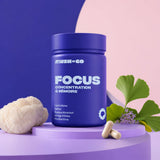
The ginkgo biloba, or maidenhair tree, is the last survivor of a lineage that appeared long before the dinosaurs. You come across it in parks, you recognise it by its fan-shaped leaves, and you find it in supplements as a standardised leaf extract, one of the most studied in the world. At Mush n Go, it is part of Focus, our focus formula, alongside Lion's Mane, Bacopa, Saffron and Maritime pine.

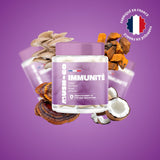
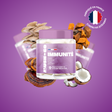
Focus
Ginkgo biloba combined with Lion's Mane, Bacopa, Saffron and Maritime pine. The 30-day course for periods of intense work.
Discover Focus →
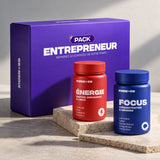
Entrepreneur Pack
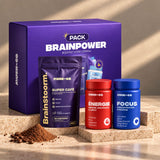
Focus for the head, Energy for the body: two capsule courses, caffeine-free, for the weeks that count.
Discover the pack →The fact file
Ginkgo biloba in brief.
One tree, one species, no living cousin. Here is the essential about the most singular plant in our formulas.
A living fossil
From the dinosaurs to Hiroshima, a survivor.
Botanists nickname it the “living fossil”. Ginkgo belongs to a group of plants whose almost identical leaf imprints are found in rocks more than 200 million years old. All the other species have disappeared. This one stayed.
Jurassic
Ginkgos are widespread over a large part of the globe. Their fossil leaves, fan-shaped, already look much like today's.
Ancient China
The species survives only in China, where it is planted around temples. It is probably those sacred gardens that saved it.
1712
The German physician Engelbert Kaempfer, who had stayed in Japan, describes it for Europeans in a book published that year. The spelling “ginkgo” is thought to come from a transcription error of the Japanese name.
1788
According to the story most often told, a Paris enthusiast buys five young plants from an English nurseryman for 25 guineas, that is about 40 crowns per tree. The nickname was born.
1945
In Hiroshima, several ginkgos one or two kilometres from the hypocentre sprout again from the base the following spring. They are still standing, and protected.
Today
A street tree in the big cities, and the most studied leaf in European herbal medicine: ginkgo biloba is among the most searched-for plants online.
The poet Goethe even devoted a poem to it in 1815, fascinated by this unique leaf split into two lobes. That is in fact what gave the species its name: biloba, “two-lobed”.
The ginkgo biloba tree
In town and in the garden, an indestructible tree.
What allowed ginkgo to come through the geological eras also makes it an excellent urban tree. It copes with pollution, road salt, compacted soils and the heat reflected off tarmac. It has very few pests and diseases. That is why you see it along so many avenues, in Paris, in Tokyo or in New York.
It has a rare feature: there are male trees and female trees. Only the female trees produce seeds, surrounded by a yellow flesh that gives off a smell of rancid butter when it falls. In town, therefore, mostly males are planted, often grafted to be sure of the sex, because a ginkgo only fruits after about twenty years.
| In the garden | The right marker | Why |
|---|---|---|
| Aspect | Full sun or partial shade | It grows faster and colours better in autumn in the sun |
| Soil | Any well-drained soil | It tolerates lime as well as acidity, but not standing water |
| Hardiness | Very good | It withstands the cold winters of most temperate regions |
| Growth | Slow at first | It settles in for a few years before really taking off |
| Height | Almost unnecessary | Remove only dead wood or a badly placed branch, in winter |
| Small garden | Compact varieties | Dwarf or columnar cultivars exist, and some can be grown in a large pot |
Choose a grafted male variety if you do not want smelly seeds on your terrace. And enjoy the show in autumn: the foliage turns golden yellow, then falls almost all at once, over a few days.
Leaves and fruit
The leaf, not the fruit.
The ginkgo biloba leaf is the part used in supplements. Fan-shaped, crossed by veins that divide in two, it looks like no other. It is the leaf that concentrates the sought-after flavonoids and terpene lactones. Also worth reading: Natural nootropics: the guide to focus.
The ginkgo “fruit” is not really one: ginkgo has no flowers, it is a seed surrounded by a fleshy envelope. Freed from that flesh and cooked, its kernel is eaten in Asia, roasted or in festive dishes, in small quantities. Raw or eaten in excess, it can be toxic, and the flesh around it contains ginkgolic acids that irritate the skin. This is not a food to improvise with.
And tea from leaves picked in the street? We advise against it. A raw leaf contains those same ginkgolic acids, which quality extracts precisely remove. It also brings very few flavonoids per cup, with no way of knowing how many. That is the whole point of the standardised extract.
The standardised extract
EGb 761: the benchmark of the research.
Almost all serious studies on ginkgo have used one and the same type of product: a standardised dry leaf extract, the best known of which carries the code name EGb 761. It was developed in Germany several decades ago and has served as a reference ever since.
Standardised means that its composition is fixed and checked from one batch to the next. An extract of this type brings about 24 % flavonoids (as glycosides) and 6 % terpene lactones, that is the ginkgolides and bilobalide, molecules found only in this tree. The ginkgolic acids, for their part, are reduced to trace levels.
Getting there takes a lot of leaves: several dozen kilos are needed to obtain one kilo of extract. That is what makes it possible to hold a studied dose in a single capsule.
| Standardised extract | Leaf powder | Home-made tea | |
|---|---|---|---|
| Flavonoids | About 24 %, measured | Low and variable | Unknown |
| Terpene lactones | About 6 %, measured | Low and variable | Unknown |
| Ginkgolic acids | Removed, at trace levels | Present | Present |
| Human studies | The great majority | Very few | None |
On a label, look for the mention of a standardised extract and its two percentages. A plain “ginkgo powder” tells you nothing about what you are taking.
What the studies say
A lot of research, and results to be read with nuance.
Ginkgo is among the most studied plants in the world. That also means its limits are known. Here are four notable trials, with their exact conditions, the favourable ones as well as the disappointing ones.
Kennedy, Scholey and Wesnes, 2000 · United Kingdom
20 healthy young adults, a single intake of 120, 240 or 360 mg of standardised extract, against placebo. The researchers measured better speed of attention in the hours following the intake, above all at the higher doses.
Solomon et al., 2002 · United States
230 healthy adults over 60, 120 mg a day for 6 weeks. No measurable difference from placebo on memory and learning tests.
DeKosky et al., 2008 · United States
The GEM trial: 3 069 people aged 75 and over, 240 mg a day, followed for six years on average. Ginkgo did not reduce the onset of severe cognitive disorders compared with placebo.
Snitz et al., 2009 · United States
An analysis of the same participants, focused on changes in memory, attention and language: no difference from placebo over time.
In short: ginkgo is not a miracle pill for memory, and those are not our words but those of the major trials. The most interesting research concerns attention, on one-off intakes, in healthy adults. That is why we use it as part of a team, in a complete formula, rather than on its own. The full references are in the at the bottom of the page.
The dose
What dose of ginkgo biloba per day?
There is no single dose, but the studies give clear markers. They only hold for a standardised extract: with a powder or a tea, those figures no longer mean anything.
| Form | Daily marker | What that represents |
|---|---|---|
| Standardised extract | 120 to 240 mg | The doses in most trials, often in two intakes |
| Studied one-off intake | 120 to 360 mg | The doses tested in one go in young adults |
| Tea from leaves | Not recommended | Unknown content, ginkgolic acids present |
| Focus | As stated on the label | Ginkgo combined with four other focus actives |
Always follow the directions for use stated on the label of your product, and do not stack several ginkgo supplements.
How to take it
One gesture, every morning.
Ginkgo is taken over time, not as a quick boost. Regularity matters more than the exact hour. The simplest way: hook it onto something you already do.
In the morning
At breakfast, with a large glass of water. Taken with a meal, it is also better tolerated by the stomach.
Every day
Same moment, same dose. That is how the studies were run.
At least 30 days
A full course of Focus before judging, and 4 to 8 weeks to form an opinion.
With Focus, ginkgo arrives in a single intake, with Lion's Mane, Bacopa, Saffron and Maritime pine. No caffeine: you can keep your usual coffee, or replace it with Brainstoorm, our mushroom coffee.
A typical day
Ginkgo, from waking up to the evening.
To give you a concrete idea, here is how our customers most often fit Focus into their day, during busy weeks.
7:30 am
1 to 2 Focus capsules at breakfast, with a large glass of water. It is the easiest moment not to forget.
9 am
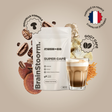
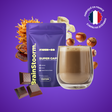
The morning coffee, classic or replaced by a cup of Brainstoorm, with only 20 mg of microencapsulated caffeine.
2 pm
No second intake needed. If you follow the Entrepreneur Pack, this is the moment for theEnergycapsule, caffeine-free.
In the evening
No ginkgo: this is the moment for Sleep+ for those who follow the Limitless Pack, from morning to evening.
The right combinations
Ginkgo plays as a team.
The major trials showed it: on its own, ginkgo has its limits. Combined with other ingredients, it fits into a more complete routine. Here are the ones we use it with, and why.
+ Lion's Mane
The mushroom of concentration, studied in connection with its hericenones. It is the heart of Focus. everything about Lion's Mane.
+ Bacopa monnieri
A plant from the ayurvedic tradition, taken over several weeks, which completes ginkgo in Focus.
+ Saffron and Maritime pine
Saffron, a precious spice studied in connection with mood, and maritime pine bark extract for its polyphenols.
+ Rosemary
Another plant associated with memory since Antiquity, which is not part of our formulas. Rosemary: benefits, dosage and precautions.
Who it is for
Ginkgo biloba is made for you if…
- You string together days of intellectual work, screens and meetings.
- You are preparing for exams, a competitive entrance test or a return to study.
- You are looking for a complete formula rather than an isolated plant.
- You prefer a caffeine-free course, to be taken over time.
- You are not on anticoagulant treatment (if you are, talk to your doctor first).
Choosing it well
Six criteria so you do not get it wrong.
- The part used : the leaf, never the seed.
- Standardisation : a leaf extract with its percentages of flavonoids and terpene lactones.
- Purity : ginkgolic acids reduced to trace levels.
- The formula : ginkgo on its own, or combined with other focus actives.
- The manufacturing : an identified place of manufacture. With us, the recipes are developed and produced in Toulouse, France, by a French contract manufacturer, vegan, GMO-free and gluten-free.
- The guarantee : enough to try it risk-free. With us, 60 days satisfied or your money back, and the choice between a one-off purchase and a monthly subscription (−30%).
| Focus on its own | Entrepreneur Pack | BrainPower Pack | |
|---|---|---|---|
| Contents | Focus | Focus + Energy | Focus, Energy + one Brainstoorm |
| Caffeine | None | None | 20 mg per cup of Brainstoorm |
| Who it is for | A targeted course for focus | Mind and body, through busy weeks | The complete routine, coffee included |
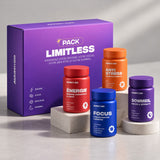
For a routine from morning to evening, the Limitless Pack brings together Focus, Energy, Sleep+ and Anti-Stress Complex. See also the BrainPower Pack.
Risks and precautions
Ginkgo biloba: the real points to watch.
“Ginkgo biloba danger” is one of the most frequent searches about the plant. The answer is nuanced: the leaf extract is generally well tolerated, but it is not harmless for everyone. The main subject is interactions.
The adverse effects reported are infrequent: mild digestive upset, headaches, skin reactions. Ginkgo can, however, influence blood clotting.
- Do not take it without medical advice if you are on anticoagulant or antiplatelet treatment (warfarin, long-term aspirin, clopidogrel and so on), or if you have a clotting disorder.
- Stop it before any surgical or dental procedure, and tell your practitioner.
- Ask your doctor for advice if you are pregnant, breastfeeding, epileptic or on long-term treatment.
- Never eat the seeds raw, and do not make tea with leaves you have picked.
- Stick to the dose stated on the label, and keep it out of reach of children.
Your questions
Everything we are asked about ginkgo biloba.
What is ginkgo biloba used for?
Ginkgo leaf extract is taken above all by people who want to support their focus day to day. It is one of the most studied plants in the world, with nuanced results: effects observed on attention in young adults, but no demonstrated effect on preventing memory decline in older people. To go further, discover the dosage and reviews of Lion's Mane.
What are the benefits of ginkgo biloba according to the studies?
The most encouraging work concerns speed of attention after an intake, in healthy adults. The large long-term trials in older people, for their part, showed no difference from placebo. We would rather tell you that frankly.
Is ginkgo biloba dangerous?
Not for most adults, at the stated dose. It is, however, not advised without medical advice in case of anticoagulant treatment, a clotting disorder, pregnancy, breastfeeding or epilepsy, and it must be stopped before an operation.
What dose of ginkgo biloba per day?
The studies used 120 to 240 mg of standardised extract a day. Follow the directions for use of your product, and avoid stacking several supplements containing ginkgo.
When should ginkgo biloba be taken?
In the morning, with breakfast, with a large glass of water. The essential thing is to take it every day at the same moment, for at least 30 days.
Why is it called the forty-crown tree?
According to the most widespread story, a Paris enthusiast is said to have bought five young ginkgos in England in 1788, for a sum equivalent to about 40 crowns per tree. The gold of its autumn foliage did the rest.
Can you eat the fruit of ginkgo biloba?
That “fruit” is in fact a seed. Its kernel is eaten cooked in Asia, in small quantities, but it is toxic raw or in excess, and its flesh irritates the skin. It is not the part used in supplements.
Can you make tea from ginkgo leaves?
We advise against it. Raw leaves contain ginkgolic acids, which quality extracts remove, and a cup brings an amount of actives that is impossible to know.
Does ginkgo biloba help against tinnitus?
It is a frequent question. Reviews of the research have not shown any convincing effect of ginkgo on tinnitus. In case of tinnitus, see an ENT doctor.
Organic ginkgo biloba or standardised extract?
The two do not compete, but it is standardisation that guarantees the active content. An organic powder that is not standardised tells you nothing about its flavonoid and terpene lactone content.
Can it be taken with coffee?
Yes. Focus contains no caffeine and goes perfectly well with your morning coffee, or with Brainstoorm, our mushroom coffee at 20 mg of caffeine per cup.
Where can I buy quality ginkgo biloba?
Directly on mushngo.com, in Focus, with free delivery from €59 in France and €69 to €89 across Europe, depending on the destination, a one-off purchase or a monthly subscription (−30 %) as you prefer, and 60 days satisfied or your money back. Our formulas are vegan, GMO-free and gluten-free, and the recipes are developed and produced in Toulouse, France, by a French contract manufacturer.
Sources
- Kennedy D. O., Scholey A. B., Wesnes K. A. (2000). The dose-dependent cognitive effects of acute administration of Ginkgo biloba to healthy young volunteers. Psychopharmacology, 151(4).
- Solomon P. R. et al. (2002). Ginkgo for memory enhancement: a randomized controlled trial. JAMA, 288(7).
- DeKosky S. T. et al. (2008). Ginkgo biloba for prevention of dementia: a randomized controlled trial. JAMA, 300(19).
- Snitz B. E. et al. (2009). Ginkgo biloba for preventing cognitive decline in older adults: a randomized trial. JAMA, 302(24).
Put it into practice
Ginkgo biloba, the Mush n Go version.
You now know all about ginkgo biloba and what to look for on a label. Here is where to find it with us, with vegan formulas whose recipes are developed and produced in Toulouse, France, by a French contract manufacturer, and guaranteed 60 days satisfied or your money back.
Focus
Ginkgo biloba combined with Lion's Mane, Bacopa, Saffron and Maritime pine. The 30-day course for periods of intense work.
Discover Focus →Entrepreneur Pack
Focus for the head, Energy for the body: two capsule courses, caffeine-free, for the weeks that count.
Discover the pack →The other ingredients
Keep exploring.
Ginkgo is only one of the actives in our formulas. Discover the other plants and mushrooms, or browse the page listing all our active ingredients.


