


















Coffee and anxiety: why coffee stresses some people
By the Mush n Go editorial team - 25 September 2026

Coffee and stress
Coffee and anxiety
why coffee stresses some people
By the Mush n Go editorial teamPublished 25 September 202613 min read
Coffee and stress
Yes, coffee can promote anxiety, especially at high doses. Caffeine blocks adenosine, the brain's fatigue signal, and pushes the body to release adrenaline: faster heart, clammy hands, mind on alert. Those are the physical signs of stress. Depending on your genes, your sleep and your anxious make-up, a single cup can be enough to trigger them.

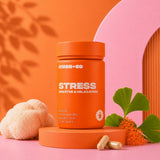
Anti-Stress
Ashwagandha, reishi, holy basil, schisandra and vitamin B6. Our formula for tense periods, one to two capsules in the morning, caffeine-free.
Discover Anti-Stress →
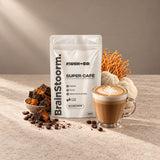
Brainstoorm
Our super mushroom coffee, with only 20 mg of slow-release NewCaff® caffeine, ashwagandha and three mushrooms. No mushroom taste at all.
Discover Brainstoorm →Why coffee stresses you
Coffee and anxiety: what happens in the body.
To understand why coffee stresses some people, you first have to understand why it wakes you up. All day long, your brain accumulates a molecule called adenosine. The more there is, the more tired you feel. It is one of the signals that pushes you towards bed in the evening.
Caffeine has a shape very close to adenosine's. It settles on its receptors and blocks them, without activating them. The fatigue signal no longer gets through. You feel more awake, more focused. So far, so good.
But that blockade has knock-on effects. It stimulates the release of adrenaline and noradrenaline, the alert hormones, and can push cortisol up. The heart speeds up, blood pressure rises a little, the muscles get ready for action. On a small scale, your body puts itself in the state it adopts in the face of danger.
In most people, at a moderate dose, that state stays pleasant: it is coffee's «kick». In others, or at a higher dose, it spills over. And because those sensations look exactly like those of anxiety, the brain can read them as such, or even amplify them. That is what explains how a simple coffee can, in some people, trigger a genuine surge of anxiety.
Adenosine blocked
The fatigue signal no longer gets through: you feel awake, sometimes wired.
Adrenaline released
Faster heart, shorter breath, clammy hands: the body switches to alert mode.
Cortisol stimulated
Mostly in occasional drinkers, less so in regular ones.
Sleep shortened
Taken too late, coffee nibbles at your nights, and tiredness raises the next day's anxiety.
Coffee or anxiety?
Symptoms that look alike.
That is exactly the trap: too much caffeine and an anxiety episode produce very similar sensations. So much so that the psychiatric classifications recognise a «caffeine-induced anxiety disorder». Here is how to tell them apart day to day.
| What you feel | More likely caffeine if… | More likely anxiety if… |
|---|---|---|
| Racing heart | It happens in the hour after a coffee | It also happens without coffee, facing a situation |
| Trembling hands | After several cups, or a very strong coffee | Paired with thoughts going round in circles |
| Jitteriness, restlessness | It fades as the coffee wears off | It persists over several days |
| Sleep problems | You drink coffee after 2 pm | You ruminate at bedtime, even without coffee |
| Irritability, headaches | In the morning, before the first coffee: that's withdrawal | Unrelated to your coffee timings |
The simplest way to settle it is often experience: cut caffeine clearly for two or three weeks and watch. If the anxiety eases, coffee was contributing. If it stays, look elsewhere, and talk to a professional.
Why some people and not others
We are not equal when it comes to caffeine.
Your colleague downs four espressos and sleeps like a baby, while a single coffee leaves you edgy? It is not a matter of willpower. Several factors explain those gaps.
The clearance genes. Caffeine is broken down by the liver, mainly through an enzyme called CYP1A2. Depending on the variants of the gene that codes for it, you clear caffeine fast or slowly. In «slow» metabolisers it stays longer in the blood, and its effects last.
The sensitivity genes. Regardless of clearance speed, some people have more reactive adenosine receptors. A study by Alsene and colleagues in 2003 showed that carriers of a particular variant of the ADORA2A gene reported more anxiety after taking caffeine.
Hormones and lifestyle. Pregnancy and the contraceptive pill slow caffeine clearance. Smoking, on the contrary, speeds it up, which explains why some ex-smokers suddenly become sensitive to coffee after quitting. Some medicines also interact with it.
An anxious make-up. People who already have an anxiety disorder or panic attacks are, on average, more sensitive to the effects of caffeine. In them, doses that others tolerate without trouble can be enough to trigger symptoms.
What the studies say
Four studies to understand the link.
The link between coffee and anxiety is one of the best documented in caffeine research. Here are four papers that shed light on it from different angles.
Alsene et al., 2003 · United States
Healthy adults received different doses of caffeine or a placebo. Those carrying a certain variant of the ADORA2A gene, the adenosine receptor, reported more anxiety after caffeine. Sensitivity has a genetic component.
Juliano and Griffiths, 2004 · review
This landmark review of withdrawal describes symptoms that appear 12 to 24 hours after stopping, peak between 20 and 51 hours and can last 2 to 9 days: headache, fatigue, irritability, low mood.
Drake et al., 2013 · United States
400 mg of caffeine taken at bedtime, 3 hours or 6 hours before all disrupted sleep. Even at 6 hours, sleep time dropped by more than an hour, without participants always noticing.
Chandrasekhar et al., 2012 · India
64 stressed adults took an ashwagandha root extract or a placebo for 60 days. The ashwagandha group scored better on the stress scales, with lower cortisol at the end of the study.
In short: caffeine acts on anxiety, especially in genetically sensitive people, and through sleep. Full references are at the bottom of the page.
The coffee, sleep, stress loop
The trap of the afternoon coffee.
This is probably the most underestimated mechanism. Caffeine has a half-life of several hours in adults: half of your 3 pm coffee is still in your blood in the early evening. It delays falling asleep, lightens deep sleep, multiplies micro-awakenings.
The next day, you are more tired. And a tired brain is a brain more reactive to stress: small annoyances weigh more, rumination returns more easily. So you have another coffee to get through. And the loop starts again.
The late coffee
A cup after lunch to get through the afternoon, sometimes a second around 4 pm.
The shortened night
Longer to fall asleep, lighter sleep, waking less rested than you should.
Amplified stress
Fatigue and jitteriness add up, and the first reflex is another coffee.
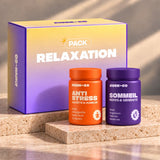
Breaking that loop is often the most effective step against coffee-related anxiety, even before cutting the amount. One simple rule: no caffeine after 2 pm. For the evenings, the reishi and valerian in Sleep + accompany a bedtime routine, and the Relax Pack brings together Anti-Stress and Sleep +.
What dose when you're anxious
How much coffee when you're stressed?
The European Food Safety Authority (EFSA) considers that, for a healthy adult, up to 400 mg of caffeine a day and 200 mg in a single intake raise no safety concern. During pregnancy, the benchmark drops to 200 mg a day.
But those thresholds are about safety, not comfort. If you are anxious, your personal threshold is probably far lower. Many sensitive people feel better below 100 to 150 mg a day, taken in the morning. To place yourself, here are the benchmarks published by EFSA.
| Drink or food | Serving | Caffeine |
|---|---|---|
| Filter coffee | 200 ml | About 90 mg |
| Espresso | 60 ml | About 80 mg |
| Energy drink | 250 ml | About 80 mg |
| Black tea | 220 ml | About 50 mg |
| Cola | 355 ml | About 40 mg |
| Dark chocolate | 50 g | About 25 mg |
| Brainstoorm | 1 cup | 20 mg, released gradually |
Actual contents vary with the bean, the grind and the brewing. A large mug of filter coffee can go well past 90 mg.
The test
Are you sensitive to caffeine?
There is no simple lab test to measure your caffeine sensitivity. But a few everyday signs are quite telling. If you recognise yourself in several of them, your coffee probably deserves a downward review.
- A single coffee is enough to leave you edgy, talkative or restless for several hours.
- You feel your heart beating harder or faster in the hour after your cup.
- A coffee after lunch stops you falling asleep in the evening.
- Your most stressful days are also the ones when you drink the most coffee.
- You get a headache at the weekend, when you have your first coffee later than usual.
Think too about hidden sources of caffeine, which add up without anyone noticing: iced tea, cola drinks, energy drinks, dark chocolate, some sports or slimming supplements, and a few headache medicines. Added to coffee, they can tip a «reasonable» day into excess. Read the labels: the caffeine content is often given in milligrams. To go further, discover coffee on an empty stomach.
Cutting back without rebound
Quitting coffee without making anxiety worse.
This is the most common mistake: deciding overnight to stop drinking coffee. Abrupt withdrawal causes headache, fatigue, irritability and low mood, sometimes for several days. Enough to mistake withdrawal for worsening anxiety, and go back to coffee telling yourself «it doesn't work». Better to step down gradually.
Week 1
Drop the afternoon coffee. Keep your morning cups, changing nothing else.
Weeks 2 and 3
Replace every other cup with a decaf, a chicory or a less loaded drink.
Week 4
Settle at the dose where you feel good, usually one or two cups in the morning.
During those weeks, drink plenty of water, move a little every day and mind your bedtimes. And note how you feel: that is the best way to know whether caffeine was to blame.
The alternatives
What to replace coffee with when you're anxious?
Cutting caffeine does not mean giving up the ritual of the warm cup. Several drinks take over very well.
Decaf
The taste of coffee with only a few milligrams of caffeine. Prefer a decaf made with water or CO2 if the process matters to you.
Chicory
Roasted, bitter, caffeine-free. Chicory is the closest thing to coffee in the mouth.
Green or white tea
Less caffeine than a coffee, plus L-theanine, an amino acid naturally present in tea leaves.
Mushroom coffee
Less caffeine, a chicory base, mushrooms and adaptogenic plants. What is mushroom coffee?
We reviewed all these options in our guide what to replace coffee with, with their strengths and their limits.
Plants and mushrooms for calm
Ashwagandha, reishi: allies of calm.
Ashwagandha is one of the so-called adaptogenic plants, and reishi one of the functional mushrooms. These ingredients are traditionally used to help the body cope with stress. They replace neither sleep nor medical support, but they have their place in an anti-stress routine, especially when you are cutting caffeine.
Ashwagandha is the most studied. A flagship root of the Ayurvedic tradition, it has been the subject of several clinical trials, including Chandrasekhar's in 2012, where stressed adults saw their stress scores improve against placebo. Reishi, the mushroom of the Asian tradition, has been linked to relaxation for centuries. Holy basil and schisandra complete that trio.
Those are precisely the ingredients of our Anti-Stress formula: ashwagandha, reishi, holy basil, schisandra and vitamin B6, in capsules, one to two in the morning. To compare the two flagship plants, read our article reishi or ashwagandha, and our guide to mushrooms and adaptogenic plants against stress.
A less jittery coffee
Keep the coffee, without the jitters.
If you are attached to your coffee, the simplest solution is often to change coffee rather than stop. That is the idea behind Brainstoorm, our super mushroom coffee.
- 20 mg of caffeine per cup, four times less than an espresso, in microencapsulated NewCaff® form released gradually.
- Ashwagandha, the adaptogenic plant we mentioned above.
- Lion's mane, cordyceps and chaga at 1,000 mg each, and 3,000 mg of maca: 6,040 mg of actives per cup.
- A chicory base, no mushroom taste, hot or cold.
« I feel more focused and far less on edge »
★★★★★ Roxane T. · 24 October 2025
« What I particularly appreciate is the steadier energy it gives: no jitters and no slump. »
★★★★★ Nawel F. · 7 January 2026
Genuine Trustpilot reviews of Brainstoorm, quoted as they stand. As a one-off purchase or a monthly subscription (−30 %), with a 60-day money-back guarantee.
When to see a doctor
When anxiety is not just about coffee.
Cutting coffee helps a lot of people. But anxiety often has several causes, and certain signs deserve medical advice, whatever your intake.
See your doctor if:
- You have panic attacks, with a feeling of suffocation, chest pain or fear of dying.
- Your palpitations persist, even after cutting or stopping caffeine.
- The anxiety has lasted several weeks and is affecting your work, your sleep or your relationships.
- You are on medication, in particular for anxiety, the heart or the thyroid, before adding a supplement.
- You are pregnant or breastfeeding: seek advice before any plant-based supplement.
Your questions
Everything people ask us about coffee and anxiety.
Can coffee cause anxiety?
Yes. Caffeine stimulates adrenaline and produces sensations close to anxiety: fast heart, trembling, jitteriness. At high doses, or in sensitive people, it can trigger or worsen existing anxiety.
Why does coffee stress me and not other people?
Caffeine sensitivity depends on genes, which set how fast you clear it and how reactive your receptors are, but also on hormones, smoking, medicines and an anxious make-up. Two people can react very differently to the same cup.
How long do coffee's effects on anxiety last?
Caffeine's effect peaks within the hour, then declines over several hours. In people who clear it slowly, the jitteriness can last a good part of the day.
Does quitting coffee reduce anxiety?
In people sensitive to caffeine, cutting coffee often reduces anxiety. Better to do it gradually, over three to four weeks, to avoid withdrawal symptoms that can themselves look like anxiety.
Can caffeine withdrawal cause anxiety?
It mostly causes headache, fatigue, irritability and low mood, appearing 12 to 24 hours after stopping and lasting a few days. Those symptoms are often mistaken for anxiety.
Can coffee trigger panic attacks?
In people who already have panic attacks, high doses of caffeine can make them more likely. If that is your case, cut your intake clearly and talk to your doctor.
Is decaf a good answer to anxiety?
It is a good way to keep the taste and the ritual of coffee, with very little caffeine. It remains slightly acidic, which can matter if you also have a sensitive stomach.
Is tea less stressful than coffee?
Generally, yes. A cup of black tea contains about half the caffeine of a filter coffee according to EFSA, and tea provides L-theanine. Be careful all the same with heavily brewed tea drunk in large amounts.
Which plant to take instead of coffee for stress?
Ashwagandha is the most studied adaptogenic plant in the field of stress. Reishi, holy basil and schisandra are also traditionally used. They are brought together in our Anti-Stress formula, caffeine-free.
Sources
- Alsene K., Deckert J., Sand P., de Wit H. (2003). Association between A2a receptor gene polymorphisms and caffeine-induced anxiety. Neuropsychopharmacology, 28(9).
- Juliano L.M., Griffiths R.R. (2004). A critical review of caffeine withdrawal: empirical validation of symptoms and signs, incidence, severity, and associated features. Psychopharmacology, 176(1).
- Drake C., Roehrs T., Shambroom J., Roth T. (2013). Caffeine effects on sleep taken 0, 3, or 6 hours before going to bed. Journal of Clinical Sleep Medicine, 9(11).
- Chandrasekhar K., Kapoor J., Anishetty S. (2012). A prospective, randomized double-blind, placebo-controlled study of safety and efficacy of a high-concentration full-spectrum extract of ashwagandha root in reducing stress and anxiety in adults. Indian Journal of Psychological Medicine, 34(3).
- EFSA NDA Panel (2015). Scientific Opinion on the safety of caffeine. EFSA Journal, 13(5):4102.
Keep reading
To go further.
Coffee is only one piece of the stress puzzle. Discover our other guides, or browse our guide to mushrooms and adaptogenic plants.

Discover our mushroom and adaptogenic plant supplements
Our vegan formulas, made in Toulouse by a French manufacturer.