
















Functional mushroom
Lion's mane: the monkey head mushroom, from the forest to your cup
By the Mush n Go team · Updated 18 September 2026
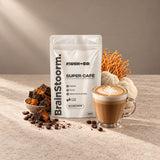
The Lion's Mane, or bearded tooth mushroom (Hericium erinaceus), is the mushroom of focus routines. It has been cooked in Asia for centuries and studied for thirty years for two families of molecules found almost nowhere else. At Mush n Go you take it in capsules with Focus, or in your coffee with Brainstoorm, at 1,000 mg per cup.

Focus
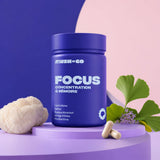
Lion's mane combined with Ginkgo, Bacopa, Saffron and Maritime pine. The 30-day course for periods of intense work.
Discover Focus →
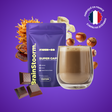
Brainstoorm
1,000 mg of lion's mane per cup, with Cordyceps and Chaga. Coffee or chocolate-hazelnut flavour, only 20 mg of caffeine.
Discover Brainstoorm →The fact file
Lion's mane in brief.
Before going into detail, here is the essential information about this mushroom like no other, recognisable among a thousand by its long white spines that fall like a mane.
A long history
From Japanese monks to European offices.
Lion's mane is anything but a recent fashion. It is one of the longest-eaten mushrooms in Asia, where it was for a long time reserved for the most prestigious tables.
Ancient China
Nicknamed "monkey head", it was served as a choice dish and appears in traditional Chinese practices.
Japan
Its name yamabushitake is said to come from the yamabushi, hermit monks of the mountains whose garments bore pompoms that resemble it.
1990s
Japanese researchers isolate the hericenones and then the erinacines, and lion's mane enters the laboratories.
Today
It is one of the most sought-after functional mushrooms in Europe: you now find it in health-food shops and online, as powder, as extract and in functional coffees.
The molecules
Hericenones and erinacines: what makes it unique.
If lion's mane interests researchers so much, it is because of two families of compounds found in practically no other mushroom.
Hericenones are found in the fruiting body, that is, the visible part of the mushroom, the one you pick and cook. Erinacines are found in the mycelium, the network of filaments that grows in the wood. Both families are studied in the laboratory in connection with NGF (Nerve Growth Factor), a protein involved in the upkeep of nerve cells.
Lion's mane also contains beta-glucans, fibres present in most mushrooms, which often serve as a quality marker: a serious extract states its beta-glucan percentage on the label.
What matters in practice: the part of the mushroom used is not a detail. It determines the molecules you actually consume.
What the studies say
Small but steady trials, for fifteen years.
Lion's mane has been the subject of several human trials. They are still small, but they have one thing in common: doses measured in grams, over several weeks. Here are the main ones, with their exact conditions.
Mori et al., 2009 · Japan
30 adults aged 50 to 80, 3 g per day of fruiting-body powder for 16 weeks, against placebo. Scores on the cognitive tests improved in the lion's mane group during the intake, then fell back after it stopped.
Nagano et al., 2010 · Japan
30 women, biscuits containing lion's mane (2 g per day) for 4 weeks. Participants reported better scores on mood and concentration questionnaires than the placebo group.
Saitsu et al., 2019 · Japan
31 adults over 50, 3.2 g per day for 12 weeks. An improvement was observed on a test of cognitive functions compared with placebo.
Docherty et al., 2023 · United Kingdom
41 healthy young adults, 1.8 g per day for 28 days. A faster processing speed was measured one hour after a single intake; the effects over 28 days were more nuanced.
In short: encouraging results, obtained with doses of 1.8 to 3.2 g per day and regular intake over several weeks. That is why we go for a stated dose and a daily intake, in your morning coffee. The full references are at the bottom of the page.
Fruiting body or mycelium
The question almost nobody asks.
On labels you will sometimes read "lion's mane" with no further detail. Yet there are two ways of producing it, and they do not give the same product.
| Fruiting body | Mycelium on grain | |
|---|---|---|
| What it is | The mushroom itself, harvested and then dried | The filaments, grown on a grain (often rice or oats) |
| Molecules | Hericenones, beta-glucans | Erinacines, but diluted in the grain |
| Starch | Low | High: the grain stays in the powder |
| Traditional use | Yes, in cooking and as a decoction | No, it is a recent industrial method |
| Human studies | Most of the trials cited above | Rarer |
A mycelium-based product is not necessarily bad, but its real mushroom content is harder to know. Always ask which part is used.
Extract, powder and ratios
Reading a label in thirty seconds.
The second difference between two products is the concentration. A dried and ground mushroom gives a powder. The same mushroom, run through hot water (and sometimes alcohol) and then dried, gives an extract, which is far more concentrated.
The ratio indicates that concentration. A 10:1 extract means it took 10 kg of dried mushroom to obtain 1 kg of extract. In practice, 500 mg of a 10:1 extract corresponds to about 5 g of dried mushroom. That is what makes it possible to fit a serious dose into a few capsules or into a single cup.
Three markers are enough to judge a label: the part used (fruiting body or mycelium), the ratio or the beta-glucan percentage, and the dose per serving in milligrams. If one of the three is missing, ask the brand.
The dose
What dose of lion's mane per day?
There is no official dose, but the studies and common use give clear markers. They depend on the form you take.
| Form | Daily marker | What that represents |
|---|---|---|
| Fruiting-body powder | 1 to 3 g | The doses used in most trials |
| Concentrated extract (10:1) | 250 to 500 mg | The equivalent of 2.5 to 5 g of dried mushroom |
| Fresh mushroom | 50 to 100 g | A portion in cooking, pan-fried like a piece of meat |
| Brainstoorm | 1,000 mg per cup | With 1,000 mg of Cordyceps and 1,000 mg of Chaga |
Always follow the directions for use stated on your product's label.
How to take it
One gesture, every morning.
Lion's mane is taken daily, over time. Consistency counts more than the exact hour, and the simplest thing is to attach it to a gesture you already make.
In the morning
At breakfast, to accompany the day. As a capsule with a glass of water, or in your coffee.
Every day
Same moment, same dose. That is what was done in every study.
At least 30 days
A full course before you judge, and 4 to 8 weeks to form an opinion.
That is exactly the idea behind Brainstoorm: instead of adding a capsule to your routine, lion's mane arrives in the cup you already drink. One scoop, water or milk, hot or cold, and it is ready.
Lion's mane and coffee
Why put it in your cup?
Most people who take an interest in lion's mane have one thing in common: they already drink coffee, often several cups a day, and are looking to get through their days better. Rather than adding one more product, we chose to slip it into the gesture they already make every morning.
A classic coffee provides about 80 mg of caffeine per espresso, and sometimes far more in a mug. It works for waking up, but the momentum often drops in the middle of the afternoon. Brainstoorm takes the problem differently: 20 mg of microencapsulated NewCaff® caffeine, released gradually, and 6,040 mg of actives per cup, including 1,000 mg of lion's mane, 1,000 mg of Cordyceps, 1,000 mg of Chaga and 3,000 mg of Maca. That is three times more than competing mushroom coffees, which hover around 3,000 mg.
And for those who fear the taste: there is no mushroom taste at all. The Coffee flavour is mild, with a note of chicory, perfect with milk; the Chocolate-hazelnut flavour drinks like a hot chocolate. Hot or cold, with water or milk, ready in ten seconds with a frother.
A typical day
Lion's mane, from waking up to the evening.
To give you a concrete idea, here is how our customers most often fit it into their day, depending on their profile.
7:30 am
A cup of Brainstoorm at breakfast, in place of the usual coffee: 1,000 mg of lion's mane, and the same habit as before.
9 am
On busy weeks, 1 to 2 Focus capsules with a glass of water to accompany long sessions of work or revision.
2 pm
If the urge for a second coffee comes along, a second cup of Brainstoorm in its cold version, with only 20 mg of caffeine.
In the evening
No lion's mane: this is the time for Reishi and Sleep+ for those who want a complete routine, from morning to night.
What they say about it
Trustpilot reviews, reproduced as they are.
"More mental clarity, more energy, and the famous 4 pm slump... gone!"
★★★★★Virginie L., 29 August 2026 · Brainstoorm
"I feel more focused and much less on edge"
★★★★★Roxane T., 24 October 2025 · Brainstoorm
The right combinations
Lion's mane plays as a team.
On its own, it already has a lot to offer. Combined with other ingredients, it fits into a more complete routine. Here are the combinations we use in our formulas, and why.
+ Cordyceps
Brainstoorm's energy and focus duo: Cordyceps for the body, lion's mane for the head.
+ Ginkgo and Bacopa
Two traditional plants of concentration, brought together with lion's mane in Focus.
+ A little caffeine
20 mg of microencapsulated caffeine in Brainstoorm, against about 80 mg in an espresso: the morning momentum without the spike.
+ Ashwagandha
The plant of calm, present in Brainstoorm and in Anti-Stress Complex, to keep a cool head on busy days.
Who it is for
Lion's mane is made for you if…
- You string together days of intellectual work, screens and meetings.
- You are preparing for exams or have gone back to studying.
- You want to cut down on coffee without losing your morning momentum.
- You are looking for a natural supplement to take over time, not a quick jolt.
- You like to understand what you take, dose by dose.
Choosing it well
Six criteria so you do not get it wrong.
- The part used: fruiting body preferably, and clearly stated.
- The concentration: an extraction ratio or a stated beta-glucan percentage.
- The real dose: milligrams per serving, not just a list of ingredients.
- The format: capsules for a targeted course, coffee or a drink for a daily gesture.
- The manufacturing: an identified place of manufacture. With us, the recipes are developed and produced in Toulouse, France, by a French contract manufacturer, vegan, GMO-free and gluten-free.
- The guarantee: enough to try it risk-free. With us, 60 days satisfied or your money back, and the choice between a one-off purchase and a monthly subscription (−30%).
| Focus (capsules) | Brainstoorm (coffee) | |
|---|---|---|
| The moment | With a glass of water, in the morning | In place of your coffee |
| Lion's mane with | Ginkgo, Bacopa, Saffron, Maritime pine | Cordyceps, Chaga, Maca, Ashwagandha |
| Caffeine | None | 20 mg per cup |
| Who it is for | A targeted course for focus | A daily gesture, without changing anything |
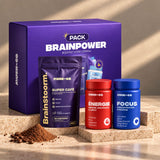
Many of our customers combine the two: Brainstoorm in the morning, Focus during busy weeks. The BrainPower Pack brings together Focus, Energy and a pouch of Brainstoorm.
In the kitchen
And fresh, can you eat it?
Yes, and it is even a treat. Fresh lion's mane can sometimes be found at specialty mushroom growers. Cut into thick slices and pan-fried in butter, it takes on a melting texture and a taste reminiscent of crab or langoustine. It goes well with garlic, thyme and a squeeze of lemon.
For daily consumption, however, cooking remains impractical: the fresh mushroom keeps only a few days, and you would need a good portion every day. That is why most people take it as an extract, in capsules or in a drink.
The precautions
What to know before you start.
Lion's mane is an edible mushroom, generally well tolerated. A few people report mild digestive discomfort in the first few days.
- Avoid it if you have a known mushroom allergy.
- Ask your doctor for advice if you are pregnant, breastfeeding or following a treatment.
- Stick to the dose stated on the label, and keep it out of the reach of children.
Your questions
Everything we get asked about lion's mane.
What is lion's mane used for?
Lion's mane is mostly taken by people who want to support their focus day to day: students, entrepreneurs, intellectual professions. It has been studied since the 1990s for its hericenones and erinacines, and it is today one of the most consumed functional mushrooms in Europe.
What is the difference between lion's mane, bearded tooth and Hericium?
None: it is the same mushroom. Lion's mane is its common English name, bearded tooth another one, and Hericium erinaceus its scientific name. It is also called monkey head mushroom.
What dose of lion's mane per day?
The studies used 1.8 to 3.2 g of fruiting body per day. With a concentrated extract, a few hundred milligrams are enough for an equivalent amount. A cup of Brainstoorm provides 1,000 mg of lion's mane.
When should you take lion's mane?
In the morning, at breakfast, to accompany the day. What matters is taking it every day at the same moment.
How long before you feel a difference?
Sensations vary from one person to another. The studies lasted 4 to 16 weeks: count on at least a 30-day course before you judge. All our formulas are guaranteed 60 days, satisfied or your money back.
Is lion's mane dangerous?
No, it is an edible mushroom, eaten in cooking for centuries and generally well tolerated. It is simply not advised for people allergic to mushrooms, and medical advice is recommended during pregnancy, breastfeeding or a course of treatment.
Can you take lion's mane with coffee?
Yes, and that is precisely the principle behind Brainstoorm: lion's mane, Cordyceps and Chaga are directly in your cup, with only 20 mg of caffeine.
Is lion's mane hallucinogenic?
No. Lion's mane has nothing to do with hallucinogenic mushrooms: it contains no psychoactive substance and is eaten in cooking like any other specialty mushroom.
Capsules or coffee: which to choose?
The capsules (Focus) suit a targeted course, without caffeine. The coffee (Brainstoorm) suits you if you want a daily gesture that replaces your usual coffee. You can also combine the two. To go further, discover our mushroom drink recipes.
Do you need breaks between two courses?
Nothing requires it. Many of our customers take Brainstoorm every day, like a coffee, and make Focus a 30-day course they repeat during busy periods. Some prefer a week off every two or three months: it is a matter of habit, simply follow the directions for use on the label.
Is lion's mane suitable for children?
Our formulas are designed for adults. For a teenager or a child, ask a healthcare professional for advice before any intake.
Is lion's mane vegan?
Yes, it is a mushroom. All our lion's mane formulas, Focus as well as Brainstoorm, are vegan, GMO-free and gluten-free.
Where can you buy quality lion's mane?
Directly on mushngo.com, with free delivery from €59 in France and €69 to €89 across Europe, depending on the destination, a one-off purchase or a monthly subscription (−30%) as you prefer, and 60 days satisfied or your money back. The recipes are developed and produced in Toulouse, France, by a French contract manufacturer.
Sources
- Mori K. et al. (2009). Improving effects of the mushroom Yamabushitake (Hericium erinaceus) on mild cognitive impairment: a double-blind placebo-controlled clinical trial. Phytotherapy Research, 23(3).
- Nagano M. et al. (2010). Reduction of depression and anxiety by 4 weeks Hericium erinaceus intake. Biomedical Research, 31(4).
- Saitsu Y. et al. (2019). Improvement of cognitive functions by oral intake of Hericium erinaceus. Biomedical Research, 40(4).
- Docherty S. et al. (2023). The Acute and Chronic Effects of Lion's Mane Mushroom Supplementation on Cognitive Function, Stress and Mood in Young Adults. Nutrients, 15(22).
Put it into practice
Lion's mane, the Mush n Go version.
You now know all about lion's mane and what to look for on a label. Here is where to find it with us, with vegan formulas whose recipes are developed and produced in Toulouse, France, by a French contract manufacturer, and guaranteed 60 days satisfied or your money back.
Focus
Lion's mane combined with Ginkgo, Bacopa, Saffron and Maritime pine. The 30-day course for periods of intense work.
Discover Focus →Brainstoorm
1,000 mg of lion's mane per cup, with Cordyceps and Chaga. Coffee or chocolate-hazelnut flavour, only 20 mg of caffeine.
Discover Brainstoorm →The other mushrooms
Keep exploring.
Lion's mane is only one of the functional mushrooms in our formulas. Discover the others, or read our detailed lion's mane guide.


Brainstoorm
The energy of coffee, without the downsides

Focus
Improve your focus, productivity and memory.

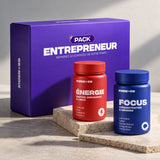
Entrepreneur Pack
Take Back Control of Your Time

Limitless Pack
Maximizes concentration, energy, reduces stress and improves sleep for optimal performance.

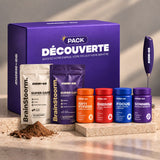
Discovery Pack
Become the best version of yourself to achieve all your goals with efficiency and serenity

E-Gift Card
Give your loved ones a wellbeing course