





Adaptogenic plant
Ashwagandha: Indian ginseng, from Ayurveda to your morning cup
By the Mush n Go team · Updated 18 September 2026
The ashwagandha (Withania somnifera) is the great plant of the Ayurvedic tradition. Its root has been used in India for centuries, and it is today one of the most studied adaptogenic plants in the world, with dozens of human trials. At Mush n Go you take it in capsules with Anti-Stress Complex, or in your coffee with Brainstoorm, alongside Lion's Mane, Cordyceps and Chaga.

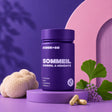
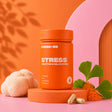
Anti-Stress Complex
Ashwagandha paired with Reishi, Holy basil, Schisandra and vitamin B6. One to two capsules in the morning, for busy stretches.
Discover Anti-Stress →
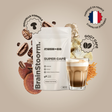
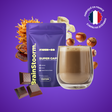
Brainstoorm
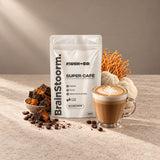
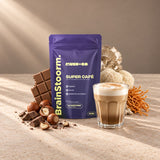
Ashwagandha with 1,000 mg of Lion's Mane, Cordyceps and Chaga, and 3,000 mg of Maca. Coffee or chocolate-hazelnut taste, only 20 mg of caffeine.
Discover Brainstoorm →The fact file
Ashwagandha in brief.
The essentials on this unassuming shrub, a cousin of the tomato, of which mainly the root is used.
A long history
From Ayurvedic texts to the laboratory.
Ashwagandha is no passing fad. It is a central plant in Ayurveda, India's traditional medicine, where it holds a place comparable to that of ginseng in China.
Ancient India
Ayurvedic texts class it among the rasayana, the plants of vitality taken over the long term. The powdered root was often taken in warm milk, with honey or ghee.
Botany
Its Latin name somnifera means “sleep-bringing”. It recalls the plant's traditional evening use, long before any study.
20th century
Chemists isolate the withanolides, a family of molecules named after the plant, and modern research begins.
Today
It is one of the most searched-for plants in Europe: you now find it in pharmacies, health-food shops and online, as powder and as standardised extract.
The molecules
The withanolides: what makes it unique.
If ashwagandha interests researchers so much, it is above all because of a family of compounds that bears its name: the withanolides. These are steroidal lactones, plant molecules whose structure recalls that of certain hormones, without being hormones.
The best known is withaferin A. It is found mainly in the leaves, whereas the root contains more of the other withanolides, such as withanolide A.
That is why the part used matters. The Ayurvedic tradition uses the root, and most human trials have been run with root extracts. Some manufacturers add the leaves, which are richer in withaferin A, in order to display a higher withanolide percentage. It is not the same product, and it is not the traditional use either.
What to take away in practice: a high withanolide percentage does not tell you everything. Look first at which part of the plant it comes from.
KSM-66 and extracts
Ashwagandha KSM-66, powder or extract: the differences.
Looking for ashwagandha, you will quickly come across “KSM-66”. It is not another plant: it is a brand of extract, produced in India by the company Ixoreal. It is a root-only extract, described as “full spectrum”, standardised to at least 5 % withanolides. It has been used in a large number of clinical trials. Other patented extracts exist, often based on root and leaves.
| Root extract (KSM-66 type) | Root powder | Root + leaf extract | |
|---|---|---|---|
| What it is | The root, extracted then concentrated | The dried, ground root | Root and leaves extracted together |
| Withanolides | Standardised, often around 5 % | Rarely stated, lower | Higher, thanks to the leaves |
| Usual dose | 300 to 600 mg a day | Several grams a day | Often 125 to 250 mg a day |
| Traditional use | Yes, it is the traditional part | Yes, it is the original form | No for the leaves |
| Human studies | The most numerous | Rarer | A few trials |
An extract without a brand name can be perfectly good. What counts is that the label states the part used, the concentration and the dose per serving.
What the studies say
Dozens of trials, with clearly identified doses.
Ashwagandha is among the best documented adaptogenic plants in humans. The trials remain modest in size, but they have one thing in common: root extracts, between 250 and 600 mg a day, over several weeks. Here are four placebo-controlled trials, with their exact conditions.
Chandrasekhar et al., 2012 · India
64 adults describing themselves as stressed, 300 mg of root extract twice a day for 60 days. Stress questionnaire scores and blood cortisol fell more than in the placebo group.
Wankhede et al., 2015 · India
57 men aged 18 to 50 starting strength training, 300 mg of root extract twice a day for 8 weeks. Gains in strength and muscle size were greater than on placebo.
Langade et al., 2019 · India
60 adults with insomnia, 300 mg of root extract twice a day for 10 weeks. The researchers measured faster sleep onset and better sleep quality than on placebo.
Salve et al., 2019 · India
60 healthy adults, 250 or 600 mg of root extract a day for 8 weeks. Perceived stress scores fell in both groups, more so at 600 mg.
In short: encouraging results, obtained with root extracts, at a regular dose, over 8 to 10 weeks. The full references are at the bottom of the page.
The studied uses
Ashwagandha benefits: what has been explored.
Search for “ashwagandha benefits” and you will find everything under the sun. Here are the subjects that have actually been studied, without exaggeration.
Everyday stress
This is the most studied subject: perceived stress questionnaires and cortisol levels, in adults who describe themselves as stressed, over 6 to 10 weeks.
Sleep
True to its name somnifera, it has been tested in people who sleep badly, with measurements of sleep onset and sleep quality.
Sport and strength training
Several trials have followed athletes in training, measuring strength, muscle mass and recovery.
Balance for women
More recent studies have looked at women, particularly around the menopause. We come back to this just below.
One thing is certain: ashwagandha is not a quick pick-me-up, it is a plant you take over time. To go further on the evening side, read our article ashwagandha and sleep, and on stress, our guide to understand cortisol better.
Ashwagandha and women
The benefits of ashwagandha for women.
The question comes up often. Several trials have been run in women only, on subjects such as the menopause, intimate wellbeing or stress. They are still few in number and small in size, which calls for caution.
Two practical points are clear, however. First, ashwagandha is not recommended during pregnancy and breastfeeding: this is a consistent recommendation, echoed by health agencies including the French ANSES. Second, if you are on hormone treatment, thyroid treatment in particular, ask your doctor before starting, because the plant has been associated with changes in thyroid hormones.
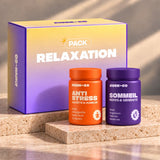
For everyone else, use is the same as in men: a root extract, morning or evening, over several weeks. Many of our female customers take it through the Relaxation Pack, which brings together Anti-Stress Complex for the day and Sleep+ for the evening.
Sport and strength training
Ashwagandha and strength training: what we know.
More and more athletes are adding it to their routine. The Wankhede trial cited above is the main marker; other work has looked at endurance and recovery.
The right habit: take it every day, rest days included, as in the studies. If you are looking for a formula designed for after the session, our capsule Muscle Recovery combines Cordyceps, Chaga, Turmeric and Boswellia.
The dose
Ashwagandha: dosage and daily dose.
There is no official dose, but the studies give clear markers. They depend on the form you take.
| Form | Daily marker | What that represents |
|---|---|---|
| Root extract (KSM-66 type) | 300 to 600 mg | The doses used in most trials, often split into two servings |
| Root + leaf extract | 125 to 250 mg | More concentrated, follow the label |
| Root powder | 3 to 6 g | The Ayurvedic use, in warm milk |
| Anti-Stress Complex | 1 to 2 capsules | In the morning, with a glass of water |
Always follow the directions for use printed on your product label, and do not stack several ashwagandha supplements.
How to take it
One gesture, every day.
Ashwagandha is taken daily, over several weeks. The simplest way is to hook it onto something you already do.
Morning or evening
In the morning to accompany the day, in the evening if you pair it with your bedtime routine. With a meal, it is better tolerated.
Every day
Same moment, same dose. That is what was done in all the studies cited.
At least 8 weeks
The trials lasted 8 to 10 weeks: allow one to two courses before you make up your mind.
That is the idea behind Brainstoorm: instead of adding another capsule, ashwagandha arrives in the cup you already drink. One dose, water or milk, hot or cold, and it is ready.
Ashwagandha and coffee
Why put it in your cup?
Coffee and ashwagandha may sound like a surprising duo. That is exactly the point: many coffee drinkers want the morning lift without the edginess that sometimes comes with it. Rather than add one more product, we slipped ashwagandha into the gesture they already make.
A classic coffee brings around 80 mg of caffeine per espresso, and sometimes far more in a mug. Brainstoorm takes the problem from another angle: 20 mg of microencapsulated NewCaff® caffeine, released gradually, and 6,040 mg of actives per cup in the Coffee version, including 1,000 mg of Lion's Mane, 1,000 mg of Cordyceps, 1,000 mg of Chaga and 3,000 mg of Maca, together with ashwagandha. That is three times more than competing mushroom coffees, which sit at around 3,000 mg.
The Chocolate-hazelnut version goes up to 6,225 mg of actives and adds rhodiola. No mushroom or plant taste at all: the Coffee is smooth, with a note of chicory, and the Chocolate-hazelnut drinks like a hot chocolate. The recipes are developed and produced in Toulouse, France, by a French contract manufacturer.
What they say about it
Trustpilot reviews, reproduced as they are.
These reviews are about Brainstoorm, which contains ashwagandha. They describe a personal experience, which varies from one person to another.
"I feel more focused and much less on edge"
★★★★★Roxane T., 24 October 2025 · Brainstoorm
“I was sceptical and in the end I'm won over. Less caffeine and yet I'm full of beans and even-tempered”
★★★★★Maïté S., 4 April 2026 · Brainstoorm
The right combinations
Ashwagandha plays as a team.
Here are the combinations we use in our formulas, and why.
+ Reishi
The mushroom of the evening tradition, brought together with ashwagandha in Anti-Stress Complex. Discover the benefits and dosage of Reishi.
+ Holy basil and Schisandra
Two traditional adaptogenic plants, one Indian, one Chinese, that round out the Anti-Stress Complex formula.
+ Lion's Mane and Cordyceps
In Brainstoorm, ashwagandha sits alongside Lion's Mane and Cordyceps: a cool head, with extra drive.
+ Maca
The Andean root, at 3,000 mg per cup of Brainstoorm. Two roots, two traditions. Discover maca, its benefits and its dosage.
Banned in Europe?
Is ashwagandha banned in Europe?
No. It is a question we are asked a great deal, and one people type into Google in several languages. The answer is simple: ashwagandha is authorised in food supplements in most European countries. In France, for example, its root appears on the list of plants authorised in food supplements set by the decree of 24 June 2014.
The confusion comes from two things. First, Denmark decided to remove ashwagandha from food supplements, after a risk assessment carried out by its technical university. That is a national decision, and it does not apply in the rest of Europe. Second, the ANSES, the French health agency, published a vigilance opinion on ashwagandha supplements, based on nutrivigilance reports. It did not ban the plant: it recommends that certain people do not take it and calls for the doses to be respected.
Our position: an active plant is taken at the stated dose, by healthy adults, with medical advice in the situations listed below.
Risks and precautions
Ashwagandha: risks, side effects and contraindications.
Ashwagandha is generally well tolerated at the doses used in the studies. The side effects reported are most often mild: digestive discomfort, drowsiness, headaches. Rare cases of liver injury have been described in the medical literature in people taking ashwagandha supplements, which is what lies behind the searches around “ashwagandha liver danger”.
In these situations, do not take it, or only after medical advice:
- Pregnancy and breastfeeding, and in children and adolescents.
- Thyroid disease or thyroid treatment.
- Liver disease, or a history of reaction to a supplement.
- Ongoing treatment, in particular sedatives, antidiabetics, anticoagulants, immunosuppressants or antidepressants.
- Autoimmune disease, or hormone-dependent cancer.
- Before an operation: stop it a few weeks beforehand, and tell your doctor.
Stop taking it and seek advice in case of unusual tiredness, nausea, dark urine or yellowing of the skin. Respect the stated dose, and keep the product out of reach of children.
Choosing well
Six criteria so you do not get it wrong.
- The part used: the root, clearly stated, as in the tradition and in most studies.
- The concentration: a standardised extract, with a stated withanolide percentage.
- The real dose: milligrams per serving, not just a list of ingredients.
- Organic: “organic ashwagandha” is a much-searched term. It is a plus for the farming, not a guarantee of concentration.
- The manufacturing: an identified place. The recipes are developed and produced in Toulouse, France, by a French contract manufacturer, and are vegan, GMO-free and gluten-free.
- The guarantee: enough to try it risk-free. With us, 60 days satisfied or your money back, and the choice between a one-off purchase and a monthly subscription (−30%).
| Anti-Stress Complex (capsules) | Brainstoorm (coffee) | |
|---|---|---|
| The moment | 1 to 2 capsules in the morning | In place of your coffee |
| Ashwagandha with | Reishi, Holy basil, Schisandra, vitamin B6 | Lion's Mane, Cordyceps, Chaga, Maca |
| Caffeine | None | 20 mg per cup |
| Who it is for | A targeted course for busy stretches | A daily gesture, without changing anything |
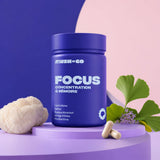
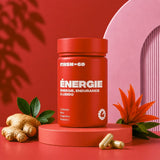
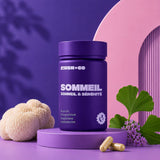
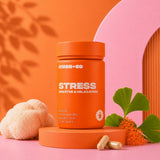
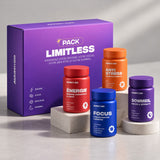
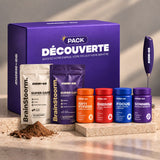
Anti-Stress Complex is also found in the Relaxation Pack (with Sleep+), in the Limitless Pack (with Focus, Energy and Sleep+) and in the Discovery Pack.
Your questions
Everything you ask us about ashwagandha.
What is ashwagandha used for?
It is a plant of the Ayurvedic tradition, taken over time by people going through busy stretches. The studies have mostly looked at perceived stress, sleep and sport, with root extracts over 8 to 10 weeks.
Is ashwagandha dangerous?
At the doses used in the studies, it is generally well tolerated in healthy adults. It is not recommended during pregnancy and breastfeeding, in children, in case of thyroid or liver disease, or alongside certain treatments. Rare cases of liver injury have been reported: respect the doses and stop at any unusual symptom.
Why do people say ashwagandha is banned?
It is not: its root is authorised in food supplements across most of Europe. The rumour comes from the ban decided in Denmark and from the vigilance opinion published by the French ANSES, which recommends that certain groups avoid it.
What is ashwagandha KSM-66?
It is a brand of ashwagandha root extract, standardised to at least 5 % withanolides, used in a large number of clinical trials. It is not a different variety of plant.
What is the dosage of ashwagandha?
The studies used 250 to 600 mg of root extract a day, often split into two servings. For Anti-Stress Complex, it is one to two capsules in the morning. Always follow your product label.
When should you take ashwagandha, morning or evening?
Both work. In the morning to accompany the day, in the evening if you build it into your bedtime routine. What matters is regularity, at the same moment every day.
How long before you feel a difference?
Experiences vary. The trials lasted 8 to 10 weeks: allow at least one full course before you judge. All our formulas come with a 60-day money-back guarantee.
What are the benefits of ashwagandha for women?
Trials have been run in women, particularly around the menopause, but they remain few in number. Ashwagandha is not recommended during pregnancy and breastfeeding, and medical advice is useful if you are on hormone or thyroid treatment.
Does ashwagandha help with strength training?
A 2015 trial in men starting strength training measured greater gains in strength than on placebo, with 600 mg of extract a day for eight weeks. That is a marker, not a promise: training and diet remain the essentials.
Can you take ashwagandha with coffee?
Yes, and that is exactly the principle behind Brainstoorm: ashwagandha, the mushrooms and maca go straight into your cup, with only 20 mg of caffeine.
Where can you buy quality ashwagandha?
Directly on mushngo.com, with free delivery from €59 in France and €69 to €89 across Europe, depending on the destination, a one-off purchase or a monthly subscription (−30%) as you prefer, and 60 days satisfied or your money back. The recipes are developed and produced in Toulouse, France, by a French contract manufacturer.
Sources
- Chandrasekhar K., Kapoor J., Anishetty S. (2012). A prospective, randomized double-blind, placebo-controlled study of safety and efficacy of a high-concentration full-spectrum extract of Ashwagandha root in reducing stress and anxiety in adults. Indian Journal of Psychological Medicine, 34(3).
- Wankhede S. et al. (2015). Examining the effect of Withania somnifera supplementation on muscle strength and recovery: a randomized controlled trial. Journal of the International Society of Sports Nutrition, 12.
- Langade D. et al. (2019). Efficacy and Safety of Ashwagandha (Withania somnifera) Root Extract in Insomnia and Anxiety: A Double-blind, Randomized, Placebo-controlled Study. Cureus, 11(9).
- Salve J. et al. (2019). Adaptogenic and Anxiolytic Effects of Ashwagandha Root Extract in Healthy Adults: A Double-blind, Randomized, Placebo-controlled Clinical Study. Cureus, 11(12).
Put it into practice
Ashwagandha, the Mush n Go version.
You now know all about ashwagandha and what to look for on a label. Here is where to find it with us, with vegan formulas whose recipes are developed and produced in Toulouse, France, by a French contract manufacturer, backed by a 60-day money-back guarantee.
Anti-Stress Complex
Ashwagandha paired with Reishi, Holy basil, Schisandra and vitamin B6. One to two capsules in the morning, for busy stretches.
Discover Anti-Stress →Brainstoorm
Ashwagandha with 1,000 mg of Lion's Mane, Cordyceps and Chaga, and 3,000 mg of Maca. Coffee or chocolate-hazelnut taste, only 20 mg of caffeine.
Discover Brainstoorm →The other ingredients
Keep exploring.
Ashwagandha is only one of the actives in our formulas. Discover the other plants and mushrooms, or read our guide to adaptogenic mushrooms and plants and stress.


Brainstoorm
The energy of coffee, without the downsides

Anti-Stress Complex
Say goodbye to stress and welcome serenity, for total peace of mind.

Limitless Pack
Maximizes concentration, energy, reduces stress and improves sleep for optimal performance.

Discovery Pack
Become the best version of yourself to achieve all your goals with efficiency and serenity

Relaxation Pack
Reduces stress and improves sleep for increased relaxation and well-being.