



















Sleep hormone
Melatonin: the hormone of the night, from the body clock to the pillow
By the Mush n Go team · Updated 18 September 2026
The melatonin is the hormone your brain makes when the light fades. It does not knock you out: it tells your body the time. Taken as a supplement, it has its place for falling asleep and for jet lag, provided you choose the dose and the moment well. At Mush n Go you find it in Sleep+, alongside Reishi, Valerian and magnesium bisglycinate.

Sleep+
Our evening formula: Reishi, Valerian, Magnesium bisglycinate, Acacia fibre and Melatonin. One capsule 30 minutes to 1 hour before bedtime.
Discover Sleep+ →
Relaxation Pack
Anti-Stress Complex in the morning, Sleep+ in the evening. The two moments that count, brought together in one routine, with or without a subscription.
Discover the bundle →The fact file
Melatonin in brief.
Melatonin, what exactly is it? A small molecule, made every night by your own body, and one we also know how to produce in the laboratory. Here are the essentials before going any further.
From Descartes to the pharmacy
A small gland, a long investigation.
It took three centuries to get from the gland to the molecule.
17th century
Descartes sees the pineal gland as the “seat of the soul”, the meeting point between body and mind. The idea will not survive, but the gland intrigues.
1917
Two American researchers, McCord and Allen, observe that an extract of ox pineal gland lightens the skin of tadpoles. The active principle remains unknown.
1958
The dermatologist Aaron Lerner, at Yale University, isolates the molecule responsible and names it melatonin, from melas, “black” in Greek, and from serotonin.
1980s-1990s
Its real role becomes clear: a night signal, driven by light, which sets the internal clock. The first supplements appear in the United States.
Today
“Melatonin” is one of the most searched-for sleep terms in Europe. It exists as a low-dose food supplement and as a prescription medicine.
How it works
The hormone that tells your body the time.
Your body has a central clock, the suprachiasmatic nucleus, which beats to a rhythm of around 24 hours. To stay on time, it needs a marker: light.
By day, the light striking the retina, in particular its blue part, tells the clock that it is daytime. The pineal gland stays almost silent.
In the evening, when the light fades, the brake is released. The pineal gland turns serotonin into melatonin and releases it into the blood. The level climbs in the early evening, peaks in the middle of the night, then falls back in the early morning.
At night, it binds to its receptors, MT1 and MT2. The message is simple: it is night. The temperature drops slightly, and so does alertness.
| Moment | Melatonin level | What happens |
|---|---|---|
| Daytime | Very low | Light holds back the pineal gland, alertness is high |
| Early evening | Rising | The light fades, secretion starts, the urge to sleep settles in |
| Middle of the night | At its highest | The night signal is at its maximum, body temperature at its lowest |
| Early morning | Falling | Daylight stops the secretion and resets the clock |
Bright light in the evening, a screen or a powerful ceiling light, can delay the rise of melatonin.
Melatonin and sleep
A signal, not a sleeping pill.
This is the most frequent misunderstanding: taking melatonin like a sleeping pill, waiting to drop off twenty minutes later.
A sleeping pill acts on the alertness circuits to force sleep. Melatonin, for its part, tells the body what time it is. This is called a chronobiotic effect: it acts on when you feel sleepy, far more than on how deep that sleep is.
That is what explains its two best-recognised uses. In Europe, the food safety authority has validated two claims. Melatonin contributes to the reduction of time taken to fall asleep, when 1 mg is taken shortly before bedtime. It also contributes to the alleviation of subjective feelings of jet lag, from 0.5 mg taken at bedtime on the first day of travel and on the days following arrival.
What to take away: it mainly helps those whose clock has shifted. If you wake at 4 a.m. with your mind racing, the cause is often elsewhere: stress, alcohol, rumination. Hence the value of an approach that also works on relaxation.
Natural melatonin production also falls with age, which partly explains lighter sleep after 55.
What the studies say
Real but modest effects: four pieces of work to know.
Melatonin is one of the most studied sleep supplements in the world. The results are solid on jet lag, more nuanced on insomnia. Here are four reference works, with their exact conditions.
Herxheimer and Petrie, 2002 · Cochrane review
A synthesis of 10 trials on jet lag. In 8 of them, melatonin taken at bedtime on arrival reduced the effects of the time shift after a flight crossing 5 time zones or more. Doses of 0.5 to 5 mg were of similar effectiveness; above 5 mg, no additional benefit.
Ferracioli-Oda et al., 2013 · United States
A meta-analysis of 19 studies, that is 1,683 participants with primary sleep disorders. Melatonin reduced the time taken to fall asleep by about 7 minutes and lengthened sleep time by about 8 minutes compared with placebo, with sleep quality judged better.
Zhdanova et al., 2001 · United States
30 people over 50, with or without insomnia, testing several doses. In the insomniacs, 0.3 mg improved sleep efficiency by bringing the blood level back close to normal. At 3 mg, the level was still high the next day and body temperature fell.
Erland and Saxena, 2017 · Canada
An analysis of 31 melatonin supplements sold in shops. The actual content varied from 83 % below to 478 % above the stated dose, and a quarter of the products also contained serotonin.
In short: a useful but modest effect on falling asleep, a clearer effect on jet lag, and two practical lessons. The first: a small dose is often enough. The second: manufacturing quality counts as much as the dose. The full references are at the bottom of the page.
1 mg, 2 mg or 5 mg?
The right dose is often the smallest one.
Melatonin 1 mg, 1.9 mg, 2 mg, 5 mg: the dosages on offer vary a great deal from one country and one sales channel to another. Here is how to find your way, without getting lost in the detail.
| Dose | What we know about it | Where you find it |
|---|---|---|
| 0.3 to 0.5 mg | Close to the natural night-time level; 0.5 mg is the reference dose for jet lag | Low-dose supplements |
| 1 mg | The dose associated in Europe with reducing the time taken to fall asleep | Food supplements, gummies, sprays |
| 1.9 mg | A dose just under the 2 mg threshold, common for supplements in France and several other EU countries | Supplements in pharmacies and in shops |
| 2 mg PR | Prolonged release, over several hours, for the sleep of the over-55s | Medicine, on prescription |
| 5 mg and above | No more effective for jet lag, more possible side effects | Mostly sold outside the European Union |
In France and in many European countries, melatonin food supplements stay below 2 mg a day; above that you are in medicine territory. There is no “magic” maximum dose: the right dose is the lowest one that works for you.
Why not take more, just to be sure? Because too strong a dose can leave the level high the next morning, and your head heavy. That is what Zhdanova's study observed at 3 mg.
For the melatonin in our capsules, the exact dose is on the label of Sleep+. Respect it, and do not stack it with another melatonin product.
Spray, gummies, capsules
Which form to choose for you?
The molecule is the same everywhere. What changes: how fast it acts, how precise the dose is and what comes with it.
| Form | Strength | Point to watch |
|---|---|---|
| Spray | Practical, fast-acting, adjustable dose | The number of sprays has to be counted |
| Drops | A very fine dose, easy to adjust | Has to be measured with care |
| Gummies | Pleasant to take | Often sugary, and tempting for children |
| Fast-melt tablet | Dissolves under the tongue, fast | Shorter effect |
| Prolonged release | Spreads over several hours | Mostly available as a medicine |
| Capsule | Fixed dose, easy to combine with other actives | Choose a formula with the composition stated |
Sprays and gummies are fashionable. But melatonin has a short half-life, under an hour: a fast form helps you fall asleep, not necessarily stay asleep. We chose the capsule for Sleep+, because it makes it possible to combine melatonin with plants, a mushroom and a mineral, in a single serving.
When to take it
The moment counts as much as the dose.
Taken at the wrong moment, melatonin can shift your rhythm in the wrong direction. Three simple rules.
The right moment
30 minutes to an hour before the bedtime you are aiming for, not in the middle of the night nor on waking.
The right setting
Dim light, screens at a distance: bright light contradicts the signal you are sending.
Regularity
The same hour every evening, so the clock has a stable marker, over limited periods.
With Sleep+, it is simple: one capsule 30 minutes to 1 hour before bedtime, with a glass of water. Avoid taking it with alcohol, which degrades sleep quality, and do not drive after taking it.
Awake at 3 in the morning? Do not take another dose: you would risk getting up groggy.
Jet lag
Jet lag, its home ground.
This is melatonin's best-documented use. After several time zones, your clock stays on departure time. Melatonin helps reset it faster.
Before departure
If the trip is a long one, shift your bedtimes a little in the days beforehand, in the direction of travel.
On the day
Drink water, limit alcohol in flight, and set your watch to destination time as soon as you board.
The first evening
Melatonin is taken at bedtime, local time. That is the use validated in Europe, from 0.5 mg.
The following days
Carry on for a few evenings at bedtime, and get natural light in the morning, which is the most powerful of all signals.
The effect is clearest from five time zones onwards. For a London–Lisbon hop, your clock manages on its own.
Helping it naturally
Helping your own melatonin, first of all.
Your body knows how to make its own melatonin. These simple habits help it, with or without a supplement.
- Natural light in the morning, outdoors if possible, even on a grey day, for at least 15 to 30 minutes.
- Dim, warm lights in the evening, and screens put down an hour before sleep.
- A dark, cool, quiet bedroom: blackout curtains or an eye mask if needed.
- Regular bed and wake times, weekends included, to within an hour.
- The last coffee before early afternoon, and a light dinner, not too late.
- A little tryptophan on the plate: pulses, eggs, dairy, seeds, nuts.
Tart cherries, pistachios or tomatoes contain a little melatonin, but nowhere near the doses in supplements. And the melatonin in supplements is almost always synthetic, identical to your body's own: pure, and precisely dosed.
The right combinations
Melatonin plays as a team.
Melatonin tells the time. But good sleep also asks for a relaxed body: in Sleep+, it is never alone. Also worth reading: High cortisol: symptoms and natural answers.
+ Valerian
The European root of sleep, traditionally used in the evening to encourage relaxation. Valerian: benefits, dosage and precautions.
+ Magnesium bisglycinate
A form of magnesium bound to glycine, known for being gentle on the stomach. the benefits and dosage of magnesium bisglycinate.
+ Reishi
The mushroom of calm evenings, at the heart of Sleep+ and of Anti-Stress Complex. everything about Reishi.
+ Ashwagandha
The Ayurvedic root of stress management, in Anti-Stress Complex, for the daytime part of the routine. everything about ashwagandha.
Who it is for
A sleep routine is for you if…
- You take a long time to fall asleep, even when you are tired.
- Your hours move around: jet lag, late evenings, an irregular rhythm.
- You want a complete evening formula rather than melatonin on its own.
- The day's stress follows you all the way into bed.
- You want to know what you are taking, ingredient by ingredient.
| Sleep+ on its own | Relaxation Pack | Limitless Pack | |
|---|---|---|---|
| Contents | Sleep+ | Anti-Stress Complex + Sleep+ | Focus, Energy, Sleep+ and Anti-Stress Complex |
| Moment | In the evening | Morning and evening | All day long |
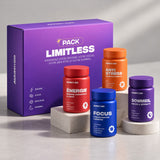
| Who it is for | A routine targeted at falling asleep | The day's stress and the night's sleep | The complete routine, from focus to rest |
The recipes for all our formulas are developed and produced in Toulouse, France, by a French contract manufacturer, and they are vegan, GMO-free and gluten-free, with a 60-day money-back guarantee and the choice between a one-off purchase and a monthly subscription (−30 %). See the Limitless Pack.
Risks and side effects
What to know before taking it.
Melatonin is well tolerated by most adults, at a low dose and over limited periods. But “natural” does not mean without rules. The side effects most reported are next-day drowsiness, headaches, dizziness and nausea, more frequent when the dose is high.
In France, the health agency ANSES reviewed in 2018 the reports linked to melatonin supplements and recommended that certain people abstain from them or seek medical advice. Here are the points to remember.
Melatonin is taken at a moderate dose, at the right moment, and never on top of another product that contains it.
- Not recommended during pregnancy and breastfeeding, and in children and adolescents without medical advice.
- Ask your doctor for advice in case of inflammatory or autoimmune disease, epilepsy, asthma or mood disorders.
- Caution alongside treatment: anticoagulants, antiepileptics, antidepressants such as fluvoxamine, blood-pressure medicines, sleeping pills or anxiolytics.
- Do not drive and do not use machinery after taking it, and avoid alcohol the same evening.
- Respect the dose stated on the label, keep the product out of reach of children, and see a doctor if sleep problems last more than a few weeks.
And overdose? Too strong a dose mainly causes marked drowsiness, a heavy head and headaches. If a child swallows several gummies or tablets by mistake, call a poison centre without delay.
Your questions
Everything you ask us about melatonin.
What is melatonin?
It is a hormone made by the pineal gland, at the centre of the brain, when the light fades. It signals to the body that it is night and helps set the internal clock to a 24-hour rhythm.
Does melatonin really help you sleep?
It mainly helps you fall asleep more easily. In Europe, it contributes to the reduction of time taken to fall asleep from 1 mg taken shortly before bedtime. It is not a sleeping pill: it acts on when you sleep more than on how deeply. To go further, discover mushrooms for better sleep.
Is melatonin dangerous?
At a low dose and over a limited period, it is well tolerated by most adults. It is not recommended during pregnancy, breastfeeding, or in children, and it calls for medical advice in case of chronic illness or ongoing treatment.
What are the side effects of melatonin?
The most frequent are next-day drowsiness, headaches, dizziness and nausea. They are more likely with high doses. If you feel them, reduce the dose or stop, and talk to your doctor.
Melatonin 1 mg, 2 mg or 5 mg: which should you choose?
Start with the lowest. 0.5 to 1 mg is often enough, and a stronger dose is not necessarily more effective. In France and many European countries, supplements stay below 2 mg a day; 2 mg prolonged-release melatonin is a medicine.
When should you take melatonin?
30 minutes to an hour before the bedtime you are aiming for, always at the same hour. For jet lag, at bedtime, local destination time, on the first evening and on the following days.
Can you take melatonin every evening?
Yes, over a limited period, for example the time it takes to reset a rhythm. If you need it for months, talk to your doctor: a sleep problem that lasts deserves to have its cause looked into.
Can you die from a melatonin overdose?
At supplement doses, an overdose mainly causes strong drowsiness, headaches and a feeling of a heavy head. In a child, accidental ingestion means calling a poison centre.
Is melatonin covered by health insurance?
No, food supplements are not reimbursed. For a prescription melatonin medicine, check with your pharmacist or your health insurer.
Is there melatonin in Mush n Go products?
Yes, in Sleep+, with Reishi, Valerian, Magnesium bisglycinate and Acacia fibre. One capsule 30 minutes to 1 hour before bedtime. The exact dose of each ingredient is on the label.
Where can you buy Sleep+?
Directly on mushngo.com, on its own or in the Relaxation Pack, with free delivery from €59 in France and from €69 to €89 elsewhere in Europe, depending on the destination, a one-off purchase or a monthly subscription (−30 %) as you prefer, and 60 days satisfied or your money back. The recipes for our formulas are developed and produced in Toulouse, France, by a French contract manufacturer.
Sources
- Herxheimer A., Petrie K. J. (2002). Melatonin for the prevention and treatment of jet lag. Cochrane Database of Systematic Reviews, (2), CD001520.
- Ferracioli-Oda E., Qawasmi A., Bloch M. H. (2013). Meta-analysis: melatonin for the treatment of primary sleep disorders. PLoS ONE, 8(5), e63773.
- Zhdanova I. V. et al. (2001). Melatonin treatment for age-related insomnia. Journal of Clinical Endocrinology and Metabolism, 86(10).
- Erland L. A. E., Saxena P. K. (2017). Melatonin natural health products and supplements: presence of serotonin and significant variability of melatonin content. Journal of Clinical Sleep Medicine, 13(2).
- Anses (2018). Opinion on the risks linked to the consumption of food supplements containing melatonin.
Put it into practice
Melatonin, the Mush n Go version.
You now know all about melatonin and what to look for on a label. Here is where to find it with us, with vegan formulas whose recipes are developed and produced in Toulouse, France, by a French contract manufacturer, backed by a 60-day money-back guarantee.
Sleep+
Our evening formula: Reishi, Valerian, Magnesium bisglycinate, Acacia fibre and Melatonin. One capsule 30 minutes to 1 hour before bedtime.
Discover Sleep+ →Relaxation Pack
Anti-Stress Complex in the morning, Sleep+ in the evening. The two moments that count, brought together in one routine, with or without a subscription.
Discover the bundle →The other ingredients
Keep exploring.
Melatonin is only one of the actives in our formulas. Discover the other ingredients for the evening and for relaxation, or browse the page for all our active ingredients.


Sleep+
Relax and enjoy peaceful nights, for deep and restorative sleep.

Limitless Pack
Maximizes concentration, energy, reduces stress and improves sleep for optimal performance.

Discovery Pack
Become the best version of yourself to achieve all your goals with efficiency and serenity

Relaxation Pack
Reduces stress and improves sleep for increased relaxation and well-being.