

















The focus plant
Bacopa monnieri: the brahmi of Ayurveda, from tradition to science
By the Mush n Go team · Updated on 18 September 2026
The bacopa (Bacopa monnieri), which India calls brahmi, is a small wetland plant used for centuries in ayurvedic medicine to support the mind. It is also one of the focus plants best studied in humans, with trials running over several months. Benefits, dosage, when to take it, side effects: here is what you need to know. At Mush n Go, bacopa is part of our formula Focus.

Focus
Our focus formula: Lion's Mane, Saffron, Bacopa monnieri, Ginkgo biloba and Maritime pine. The 30-day course for periods of intense work.
Discover Focus →
Entrepreneur Pack
Focus for concentration and Energy, caffeine-free, to keep up the pace. The duo for busy weeks, with or without a subscription.
Discover the pack →The fact file
Bacopa in brief.
A creeping plant with slightly fleshy leaves, small white flowers and its feet in the water. Nothing spectacular at first sight. Here is the essential before going further.
The brahmi of Ayurveda
A plant of the mind for centuries.
Its Indian name, brahmi, refers to Brahma, the creator god of the Hindu tradition. In ayurvedic medicine it is classed among the medhya rasayana, the plants that nourish the intellect. A reputation built long before the laboratories.
Tradition
The great texts of Ayurveda list brahmi among the plants of memory and learning. It is prepared as a powder, as a decoction or in ghee, Indian clarified butter.
Transmission
The plant went with the study of sacred texts, which were learned by heart. It also goes into preparations intended for children and for older people.
1960s
Chemists at the Central Drug Research Institute in Lucknow, India, isolate the bacosides, the molecules that will focus researchers' attention.
2001-2014
Controlled clinical trials multiply in Australia and the United States, up to a meta-analysis bringing nine of them together.
Today
Bacopa is now one of the most searched-for ayurvedic plants online, alongside ashwagandha and rhodiola. An ayurvedic plant that has become a classic of focus routines.
Plant, flower or supplement?
Three “bacopas” that have nothing in common.
Type “bacopa” into a search engine and you will land on garden centres and aquarium forums as often as on supplements. That is normal: the same name covers very different plants. Before talking about benefits, let us put things in order.
| Bacopa monnieri | Balcony bacopa | Aquarium bacopa | |
|---|---|---|---|
| Botanical name | Bacopa monnieri | Chaenostoma cordatum, formerlySutera cordata | Bacopa caroliniana, B. australis, B. crenata… |
| Where to find it | Supplements, ayurvedic powders | Garden centres, in spring | Pet shops and aquarium stores |
| Use | Courses, in extract capsules | Decorative trailing plant, white, blue or pink flowers | Aquarium plant, submerged or marginal |
| Edible? | Yes, as a dosed extract | No | No |
The bacopa you buy in a pot for window boxes, with its cascades of small white, blue or pink flowers, is not even a true bacopa: it is a Chaenostoma, a South African plant sold under that trade name. Perennial in mild regions, often grown as an annual, it flowers from May until the frosts and is not edible.
In aquariums you come across several true species of Bacopa, including Carolina bacopa, and sometimes Bacopa monnieri itself, which copes well with living underwater. But an aquarium plant is never meant to be eaten. For a course, the only thing that counts is an extract of Bacopa monnieri that is identified and dosed.
Another trap: in India the name brahmi sometimes also refers to Asiatic pennywort (Centella asiatica), a different plant. Always go by the Latin name on the label.
The bacosides
The molecules that make the difference.
Bacopa contains many compounds, but research has concentrated on one family: the bacosides. These are triterpenoid saponins, complex molecules that the plant produces in its leaves and stems.
Bacoside A is not a single molecule but a mixture of several closely related compounds. It is the one most often cited in the studies and on the labels of standardised extracts.
The other constituents matter too: other saponins such as the bacopasides, flavonoids, alkaloids in small amounts. In the laboratory and in animals, these compounds are studied in connection with their antioxidant properties and with their action on the communication systems between neurons, notably that of acetylcholine, the chemical messenger associated with learning.
What follows from this for you is very concrete: the bacoside content varies a great deal from one plant to another, depending on the region, the season and the part harvested. That is why clinical trials almost always use standardised extracts, with a guaranteed percentage of bacosides, rather than loose dried plant.
The benefits of bacopa
What tradition credits it with, and what we actually know.
“Bacopa benefits” is one of the most frequent searches about the plant. The honest answer comes in two parts: a thousand-year-old tradition, and human research that is more solid than for many plants, but that has its limits.
On the tradition side, Ayurveda uses brahmi for memory, learning and calm of mind. It is given to students and to older people alike, as a long course, never as a one-evening remedy.
On the research side, bacopa has a rare feature: it has been tested in healthy adults, double-blind against placebo, over periods of three months. The most consistent results concern the memorisation of new information and speed of information processing, that is, how quickly you analyse what you see. Some studies have also measured a fall in anxiety scores.
On the limits side, the trials remain modest in size, often a few dozen participants, and the effects measured are real but measured. Above all, they do not appear straight away: most studies find nothing clear-cut before several weeks of daily intake.
What to take away: bacopa is not a quick boost. It is a background plant, to be taken regularly, and it has its place in a focus routine designed over several weeks.
What the studies say
Four studies worth knowing about bacopa.
Clinical research on bacopa has developed a great deal in Australia, notably around Con Stough's team in Melbourne. Here are the exact conditions of the most cited work.
Stough et al., 2001 · Australia
46 healthy adults, 300 mg of standardised extract a day or a placebo, for 12 weeks. The bacopa group improved its speed of visual information processing, its learning and its memory consolidation, with anxiety scores falling. Nothing significant was visible at 5 weeks.
Roodenrys et al., 2002 · Australia
76 adults aged 40 to 65, for 12 weeks. Bacopa did not change the other tests, but the participants forgot less of the information they had newly learned.
Calabrese et al., 2008 · United States
Volunteers aged 65 and over, 300 mg of standardised extract a day for 12 weeks. Better delayed recall of a word list, better attention, and anxiety and low-mood scores down compared with placebo.
Kongkeaw et al., 2014 · Meta-analysis
Nine placebo-controlled trials, 518 participants in total. The authors conclude that there is an effect on attention and on speed of information processing.
In short: consistent results from one study to the next, over three-month courses, and one important lesson: with bacopa, patience is part of the method. The full references are in the at the bottom of the page.
Dosage and length of course
How much, and for how long.
The dosage of bacopa depends on the form. For a standardised extract, the most studied dose is around 300 mg a day. Raw plant powder, by contrast, is taken in much larger quantities in the ayurvedic tradition, with an active content that is hard to know.
The right serving
Follow the dose stated on the label of your supplement. In the studies, the figure is 300 mg of standardised extract a day.
Regularity
Every day, at the same time, with a meal. Bacopa works over time, not at the moment you take it.
Length
Allow at least 8 to 12 weeks before judging. A 30-day course can be repeated, then punctuated with breaks.
Why so long? In the Stough study, no clear effect appeared at 5 weeks, whereas effects were measurable at 12. Researchers think the bacosides act gradually, a little like training. If you stop after ten days telling yourself that “it does not work”, you simply have not given bacopa the time.
With Focus, a course lasts 30 days. For an exam period or a demanding project, the most logical thing is to run two or three courses back to back, then take a break of a few weeks.
Morning or evening?
The right moment to take your bacopa.
“Bacopa morning or evening”: the question comes up often, and the answer is simpler than you might think. Unlike caffeine, bacopa does not act within the hour. The time of day therefore matters less than regularity.
The real criterion is the meal. The bacosides are better tolerated when they arrive in a busy stomach. Taking bacopa on an empty stomach is the leading cause of the small digestive discomforts reported in the studies: nausea, cramps, faster transit.
Morning, with breakfast, is the most practical choice for a focus formula, especially if it contains other ingredients designed for the day, such as Lion's Mane or ginkgo. That is what we recommend for Focus.
Evening, with dinner, can suit people who feel slightly drowsy at the start of the course. The link between bacopa and sleep remains little studied, but the ayurvedic tradition sees it as a soothing plant. If what you are looking for above all is support for your nights, look instead at Sleep+.
Spotting a good extract
Five criteria for a bacopa supplement.
Between ayurvedic powder, pharmacy capsules, organic bacopa and combined formulas, the choice is wide. These five markers help you compare.
- The Latin name : Bacopa monnieri must appear in full. “Brahmi” alone is not enough, since the name can refer to another plant.
- An extract, not just a powder : a dry extract, ideally standardised in bacosides, with its percentage, comes closest to what has been tested in the studies.
- A dose in milligrams : the quantity of extract per serving must be legible, not lost in a list of ingredients.
- The manufacturing : an identified place of manufacture. With us, the recipes are developed and produced in Toulouse, France, by a French contract manufacturer, vegan, GMO-free and gluten-free.
- The guarantee : enough to try it over time without risk. With us, 60 days satisfied or your money back, which leaves time for two courses, as a one-off purchase or on a monthly subscription (−30 %).
Bacopa and ginkgo
Bacopa plays as a team.
Pairing bacopa with ginkgo biloba is one of the most searched-for combinations. It makes sense: both plants are studied in connection with memory, but by different routes, and both are taken as courses. Here are the ingredients that go with bacopa in our range. Also worth reading: Natural nootropics: the guide to focus.
+ Ginkgo biloba
The most studied leaf extract in the world, above all for blood circulation. It completes bacopa in Focus. the benefits and dosage of ginkgo biloba.
+ Lion's Mane
The mushroom of concentration, studied in connection with its hericenones, at the heart of Focus and Brainstoorm. the benefits and dosage of Lion's Mane.
+ Saffron
A precious spice, studied in connection with mood, which joins bacopa in Focus. the benefits and dosage of saffron.
+ Rosemary
The memory herb of the European tradition, a Mediterranean cousin of Indian brahmi. the benefits and dosage of rosemary.
Already taking ginkgo on its own? Ask your doctor for advice if you are on any treatment, notably an anticoagulant, before combining several supplements containing the same plants.
Who it is for
A course of bacopa is made for you if…
- You are preparing for exams, a competitive entrance test or a certification, with a lot to remember.
- You string together days of intellectual work, screens and meetings.
- You are looking for a caffeine-free routine, to be taken over several weeks.
- You prefer a plant studied in humans to a vague promise.
- You have the patience to wait for the effects, without looking for an immediate boost.
| Focus on its own | Entrepreneur Pack | BrainPower Pack | |
|---|---|---|---|
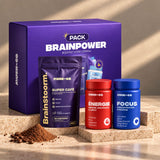
| Contents | Focus | Focus + Energy | Focus, Energy + one Brainstoorm |
| Caffeine | None | None | 20 mg per cup of Brainstoorm |
| Who it is for | A targeted course for focus | Mind and body, through busy weeks | The complete routine, coffee included |
For all our formulas, the recipes are developed and produced in Toulouse, France, by a French contract manufacturer, vegan, GMO-free and gluten-free, with 60 days satisfied or your money back and the choice between a one-off purchase and a monthly subscription (−30 %). See the Entrepreneur Pack or the BrainPower Pack.
Risks and contraindications
Side effects: what you need to know.
“Bacopa danger” and “bacopa side effects” are frequent searches, and that is a good thing. At the doses studied, bacopa is generally well tolerated in adults. The side effects reported in the trials are mainly digestive: nausea, stomach cramps, more frequent stools. They are most often mild and lessen when it is taken with a meal.
Some people also describe a dry mouth or slight tiredness at the start of the course. If that is your case, move the intake to dinner or ask for advice.
Bacopa is not a harmless product for everyone. Ask your doctor or pharmacist for advice in the following situations.
- During pregnancy and breastfeeding, for lack of sufficient safety data. No bacopa in children without medical advice.
- In case of a thyroid disorder or thyroid treatment: work in animals suggests that bacopa could influence thyroid hormones.
- In case of a slow heart rate, stomach ulcer or chronic digestive disorders, because bacopa acts on the acetylcholine system.
- If you take sedatives, antidepressants, medicines for high blood pressure or any treatment acting on the nervous system.
- Before surgery, and in every case, follow the dose stated and keep the product out of reach of children.
Your questions
Everything we are asked about bacopa.
What are the benefits of bacopa?
Bacopa has been used for centuries in Ayurveda for memory and calm of mind. In humans, 12-week trials have observed better memorisation of new information and faster information processing. The effects are gradual and measured. To go further, discover the dosage and reviews of Lion's Mane.
What is Bacopa monnieri?
It is a small creeping wetland plant, native notably to India, called brahmi in Ayurveda. Its stems and leaves contain bacosides, the most studied molecules in the plant.
Is bacopa dangerous?
At the doses studied, it is generally well tolerated in adults. The most frequent side effects are digestive. It is not advised without medical advice during pregnancy, breastfeeding, in children, in case of a thyroid disorder or of any treatment acting on the nervous system.
Should bacopa be taken in the morning or in the evening?
The most important thing is to take it every day with a meal. The morning is the most practical in a focus formula. The evening can suit you if you feel slightly drowsy at the start of the course.
How long does it take to feel the effects?
Several weeks. In the studies, the effects were not clear-cut at 5 weeks and became measurable at 12. Allow at least two to three months of regular intake before judging.
What dose of bacopa per day?
The most studied dose is 300 mg of standardised extract a day. For a supplement, always follow the dose stated on the label, which takes the other ingredients in the formula into account.
What are the contraindications of bacopa?
Pregnancy, breastfeeding and childhood without medical advice, thyroid disorders, a slow heart rate, stomach ulcer, and taking medicines that act on the nervous system or on blood pressure. If in doubt, ask your doctor.
Can bacopa and ginkgo biloba be combined?
Yes, it is a classic combination in focus formulas, and it is the choice we made in Focus. If you are on anticoagulant treatment, ask your doctor first, because of the ginkgo.
Does bacopa help you sleep?
The ayurvedic tradition sees it as soothing, and some people feel slightly drowsy. But it is not a sleep plant in the strict sense, and research on this point remains limited.
Is window-box bacopa the same as the one in supplements?
No. The trailing bacopa on balconies, with white, blue or pink flowers, is a South African ornamental plant, Chaenostoma cordatum. It is not edible. Supplements use Bacopa monnieri.
Does bacopa raise blood pressure?
Nothing in the human studies indicates that. If you are being treated for high blood pressure, still ask your doctor for advice before starting a course, as with any supplement.
Where can I find bacopa at Mush n Go?
In Focus, our focus formula, with Lion's Mane, Saffron, Ginkgo biloba and Maritime pine, as a 30-day course. Free delivery from €59 in France and €69 to €89 across Europe, depending on the destination, a one-off purchase or a monthly subscription (−30 %) as you prefer, and 60 days satisfied or your money back.
Sources
- Stough C., Lloyd J., Clarke J., Downey L.A., Hutchison C.W., Rodgers T., Nathan P.J. (2001). The chronic effects of an extract of Bacopa monniera (Brahmi) on cognitive function in healthy human subjects. Psychopharmacology, 156(4).
- Roodenrys S., Booth D., Bulzomi S., Phipps A., Micallef C., Smoker J. (2002). Chronic effects of Brahmi (Bacopa monnieri) on human memory. Neuropsychopharmacology, 27(2).
- Calabrese C., Gregory W.L., Leo M., Kraemer D., Bone K., Oken B. (2008). Effects of a standardized Bacopa monnieri extract on cognitive performance, anxiety, and depression in the elderly: a randomized, double-blind, placebo-controlled trial. Journal of Alternative and Complementary Medicine, 14(6).
- Kongkeaw C., Dilokthornsakul P., Thanarangsarit P., Limpeanchob N., Norman Scholfield C. (2014). Meta-analysis of randomized controlled trials on cognitive effects of Bacopa monnieri extract. Journal of Ethnopharmacology, 151(1).
Put it into practice
Bacopa, the Mush n Go version.
You now know all about bacopa and what to look for on a label. Here is where to find it with us, with vegan formulas whose recipes are developed and produced in Toulouse, France, by a French contract manufacturer, and guaranteed 60 days satisfied or your money back.
Focus
Our focus formula: Lion's Mane, Saffron, Bacopa monnieri, Ginkgo biloba and Maritime pine. The 30-day course for periods of intense work.
Discover Focus →Entrepreneur Pack
Focus for concentration and Energy, caffeine-free, to keep up the pace. The duo for busy weeks, with or without a subscription.
Discover the pack →The other ingredients
Keep exploring.
Bacopa is only one of the plants in our formulas. Discover the other ingredients, or browse the page listing all our active ingredients.


Focus
Improve your focus, productivity and memory.

Entrepreneur Pack
Take Back Control of Your Time

Limitless Pack
Maximizes concentration, energy, reduces stress and improves sleep for optimal performance.

Discovery Pack
Become the best version of yourself to achieve all your goals with efficiency and serenity

BrainPower Pack
A sharp mind, steady energy, Naturally