
















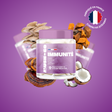


Root of the Andes
Maca: the root of the high Andean plateaus, grown at 4,000 metres
By the Mush n Go team · Updated 18 September 2026
The maca (Lepidium meyenii) is a root, a cousin of the radish, grown on the high plateaus of Peru, where almost no other crop holds out. For Andean people it is first of all a food, eaten for centuries, cooked, dried or as flour. At Mush n Go you take it in your coffee with Brainstoorm, at 3,000 mg per cup, or in capsules with Energy, alongside Cordyceps.

Energy
Maca paired with Cordyceps, Ginger and vitamin C. Caffeine-free, the 30-day course for the stretches when you are pushing hard.
Discover Energy →
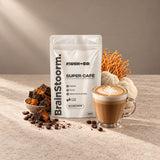
Brainstoorm
3,000 mg of maca per cup, with 1,000 mg of Lion's Mane, Cordyceps and Chaga. Coffee or chocolate-hazelnut taste, only 20 mg of caffeine.
Discover Brainstoorm →The fact file
Maca in brief.
The essentials on this round root, the size of a large radish, which grows higher than any vegetable in your garden.
A long history
From the Incas to kitchens the world over.
Maca is nothing like a recent fashion. On the Peruvian altiplano it has been grown and eaten for centuries, and it is one of the few plants that made it possible to feed the people of the very high country.
Inca period
Grown on the Junín plateaus, it is one of the precious resources of the high country, dried to be stored and traded for the produce of the valleys.
17th century
Spanish chroniclers already describe this root that Andean people eat cooked and to which they attribute virtues for vigour.
1990s
Maca leaves the Andes: exports take off, the powder reaches North America and then Europe, and research accelerates in Lima.
Today
It is one of the best-known “superfoods”, and one of the most searched-for roots in Europe's health-food aisles.
A crop of the high ground
Growing above the clouds.
Above 4,000 metres, life is hard for a plant: frost almost every night, violent winds, burning sun by day and poor soils. Maca grows there all the same, where maize and even the potato give up.
Its cultivation follows a long cycle. The seeds are sown in the rainy season, the root swells for seven to nine months, then it is harvested by hand. It then dries in the sun and the cold for several weeks, right there on the plateaus. Once dried it becomes hard as stone and keeps for years: that is what made it a precious food reserve.
Another particularity: a plot of maca exhausts the land. Farmers then leave it to rest for several years, as pasture, before growing it again. It is a demanding crop, which partly explains its price.
Yellow, red or black
Yellow, red, black maca: the differences.
In a single field, maca grows in several colours, from cream to an almost black purple. Producers sort them at harvest. Three large families are found in the trade, and “black maca” alone is a search in its own right.
| Yellow maca | Red maca | Black maca | |
|---|---|---|---|
| Frequency | The most widespread, more than half the harvest | Less common | The rarest |
| Taste | Mild, malty, the easiest | A little sweeter | More pronounced, slightly bitter |
| Common use | The “classic” maca of the studies and the recipes | Often chosen by women | Often chosen by men and by athletes |
| Research | Most human trials | Mostly animal studies | Mostly animal studies |
The differences between colours come mainly from animal studies carried out in Lima. In humans, most trials have used yellow maca or a mix of colours.
Gelatinised or raw
The question almost nobody asks.
On labels you will read “raw maca” or “gelatinised maca”. The word is misleading: there is no gelatine involved. Gelatinised maca has simply been heated under pressure, which transforms its starch and makes it easier to digest.
| Gelatinised maca | Raw maca | |
|---|---|---|
| What it is | Dried root, pressure-cooked then ground | Dried, ground root, uncooked |
| Digestion | Easier, less bloating | Sometimes difficult for sensitive stomachs |
| Concentration | Higher: the starch removed leaves more room for the actives | Lower |
| Traditional use | Yes: in the Andes, maca is always eaten cooked | No, it is a modern form |
Raw maca appeals to those who want “unprocessed” products. But the Andean tradition never eats it raw: it is boiled, roasted or cooked into a porridge.
What it contains
A food first and foremost.
Before being a supplement, maca is a nourishing food. Dried, it is made up mostly of carbohydrates, with protein, fibre and minerals such as iron, calcium and potassium. That is why, in the Andes, people eat far larger portions of it than we do in Europe.
It also contains molecules found practically nowhere else: the macamides and the macaenes. They are what interests researchers most. Like cabbage or broccoli, it finally contains glucosinolates, the sulphur compounds of the brassica family.
One point often misunderstood: maca contains no hormones. The trials that measured hormone levels, in men as in women, observed no change. We come back to this just below.
What the studies say
Small trials, doses in grams.
Maca has been studied mainly by Professor Gustavo Gonzales's team in Lima, then by other teams. Human trials remain few and small, but they have one thing in common: doses of 1.5 to 3.5 g a day, over a few weeks. Here are three trials, with their exact conditions.
Gonzales et al., 2002 · Peru
Around fifty men aged 21 to 56, 1.5 g or 3 g of maca a day for 12 weeks, against placebo. Participants on maca reported higher sexual desire from the eighth week onwards, with no change in their testosterone.
Brooks et al., 2008 · Australia
14 postmenopausal women, 3.5 g of maca a day for 6 weeks, against placebo, in crossover. Scores on mood and intimate wellbeing questionnaires improved, with no change in the hormones measured.
Stone et al., 2009 · Pilot trial
8 cyclists, 2 g of maca extract a day for 14 days. The researchers measured a faster time on a 40 km time trial compared with the start. A pilot trial, to be read with caution.
In short: encouraging but preliminary results, obtained with 1.5 to 3.5 g a day. With 3,000 mg of maca per cup, Brainstoorm sits within that range. The full references are at the bottom of the page.
The studied uses
Maca benefits: what has been explored.
Search for “maca benefits” and you will read a bit of everything. Here are the subjects that have actually been studied, without exaggeration.
Everyday vitality
This is the traditional use in the Andes: a staple food, eaten every day by those who work at altitude.
Maca for men
Several trials have followed adult men, on desire and fertility. Testosterone levels, for their part, did not move.
Maca for women
Trials have looked at the menopause, with mood and wellbeing questionnaires, again with no measured effect on hormones. To go further, discover the symptoms of high cortisol and the natural answers.
Sport
A few small trials have looked at endurance in athletes. The results are interesting but still very preliminary.
One thing is certain: maca is neither a stimulant nor a hormone. It is a traditional food taken over time, within a routine. And unlike coffee, it contains no caffeine.
The dose
What dose of maca per day?
There is no official dose, but the studies and common use give clear markers. They depend on the form you take.
| Form | Daily marker | What that represents |
|---|---|---|
| Maca powder (gelatinised or raw) | 1.5 to 3 g | The doses in most trials, about a teaspoon |
| Concentrated extract | A few hundred mg | Depending on the ratio stated on the label |
| In the Andes | Far more | A food portion, cooked, as porridge or as a drink |
| Brainstoorm | 3,000 mg per cup | With 1,000 mg of Lion's Mane, Cordyceps and Chaga |
Always follow the directions for use stated on your product's label.
How to take it
One gesture, every morning.
Maca is taken daily, over several weeks. The simplest way is to hook it onto something you already do.
In the morning
At breakfast, in a drink, a yoghurt or a smoothie. Or as a capsule with a glass of water.
Every day
Same moment, same dose. That is what was done in the studies cited.
6 to 12 weeks
The length of the trials. Allow at least a 30-day course before you judge.
On the taste side, maca powder has a malty flavour that recalls caramel or biscuit. It goes very well with cocoa, banana, cinnamon and coffee. That is precisely what gave us the idea for Brainstoorm.
Maca and coffee
Why put it in your cup?
Maca has a malty taste that sits naturally with coffee and chocolate. Rather than ask you to add a spoonful of powder every morning, we slipped it into the cup you already drink, at a study dose.
A classic coffee brings around 80 mg of caffeine per espresso. Brainstoorm takes the problem from another angle: 20 mg of microencapsulated NewCaff® caffeine, released gradually, and 6,040 mg of actives per cup in the Coffee version, including 3,000 mg of maca, 1,000 mg of Lion's Mane, 1,000 mg of Cordyceps and 1,000 mg of Chaga, with ashwagandha and chicory. That is three times more than competing mushroom coffees, which sit at around 3,000 mg in total.
The Chocolate-hazelnut version goes up to 6,225 mg of actives per 8 g serving, with the addition of rhodiola and cocoa. No mushroom taste at all, hot or cold, with water or milk. The recipes are developed and produced in Toulouse, France, by a French contract manufacturer.
What they say about it
Trustpilot reviews, reproduced as they are.
These reviews are about Brainstoorm, which contains 3,000 mg of maca per cup. They describe a personal experience, which varies from one person to another.
"More mental clarity, more energy, and the famous 4 pm slump... gone!"
★★★★★Virginie L., 29 August 2026 · Brainstoorm
“i used to get stomach ache with normal coffee, now my stomach has settled and I feel great”
★★★★★Sonia L., 27 August 2026 · Brainstoorm
The right combinations
Maca plays as a team.
Here are the combinations we use in our formulas, and why.
+ Cordyceps
The mushroom of active days, brought together with maca in Energy and in Brainstoorm. Discover Cordyceps, its benefits and its dosage.
+ Ginger and vitamin C
The two other ingredients in Energy. A caffeine-free formula, for the stretches when you are pushing hard.
+ Lion's Mane
The mushroom of focus routines, at 1,000 mg per cup of Brainstoorm. Discover the benefits and dosage of Lion's Mane.
+ Ashwagandha
The Ayurvedic root, present in Brainstoorm. Two roots, two continents. Discover ashwagandha, its benefits and its dosage.
Risks and precautions
Maca and risk: what to know before you start.
Maca is a food eaten for centuries in the Andes, generally well tolerated at the doses used in the studies. The side effects reported are mostly digestive, particularly with raw maca: bloating, discomfort. A few people also report difficulty falling asleep if they take it in the evening.
In these situations, ask your doctor for advice before taking it:
- Pregnancy and breastfeeding: the data are missing, it is better to abstain.
- Thyroid disease: like cabbage, maca contains glucosinolates.
- Hormone-related disease or treatment, even though the trials measured no hormonal change.
- Any ongoing treatment, whatever it is.
- For children and adolescents, our formulas are designed for adults.
Respect the dose stated on the label, and keep the product out of reach of children.
Choosing well
Six criteria so you do not get it wrong.
- The origin : a maca from the Peruvian Andes, clearly stated.
- The format : gelatinised if you have a sensitive stomach, raw if you prefer an unheated powder.
- The colour : yellow for classic maca, red or black if you are after a particular variety.
- The real dose : milligrams per serving, not just a list of ingredients.
- Organic : “organic maca” is a much-searched term. It is a plus for the farming, not a guarantee of dose.
- The guarantee : enough to try it without risk. With us, 60 days satisfied or your money back, a one-off purchase or a monthly subscription (−30 %) as you prefer, and formulas whose recipes are developed and produced in Toulouse, France, by a French contract manufacturer, vegan, GMO-free and gluten-free.
| Energy (capsules) | Brainstoorm (coffee) | |
|---|---|---|
| The moment | With a glass of water, in the morning | In place of your coffee |
| Maca with | Cordyceps, Ginger, vitamin C | Lion's Mane, Cordyceps, Chaga, Ashwagandha |
| Caffeine | None | 20 mg per cup |
| Who it is for | A 30-day course, caffeine-free | A daily gesture, 3,000 mg of maca per cup |
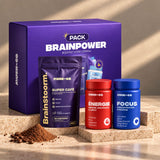
Energy is also found in the Entrepreneur Pack (with Focus), in the BrainPower Pack (with Focus and one Brainstoorm) and in the Limitless Pack (with Focus, Anti-Stress Complex and Sleep+).
Your questions
Everything you ask us about maca.
What is maca used for?
In the Andes it is first of all a staple food, eaten every day. The studies have looked at the wellbeing of men and women, at the menopause and at sport, with 1.5 to 3.5 g a day over a few weeks.
What is the difference between yellow, red and black maca?
It is the same plant, harvested in several colours. Yellow is the most common and the most studied in humans. Red and black, rarer, have mostly been studied in animals.
What are the risks of maca?
It is a traditional food, generally well tolerated. The side effects are mostly digestive, with raw maca. Seek medical advice in case of pregnancy, breastfeeding, thyroid disease or hormone-related treatment.
Does maca contain hormones?
No. The trials that measured hormones in men and in women observed no change. The molecules unique to maca are the macamides and the macaenes.
Gelatinised or raw maca: which should you choose?
Gelatinised maca has been heated to remove the starch: it is easier to digest and more concentrated. Raw maca is not heated, but can trouble sensitive stomachs. In the Andes, maca is always eaten cooked.
What dose of maca per day?
The studies used 1.5 to 3.5 g a day. One cup of Brainstoorm provides 3,000 mg of maca.
How long does maca take to work?
Experiences vary. The trials lasted 2 to 12 weeks, and the first changes reported in men appeared around the eighth week. Allow at least a 30-day course before you judge.
Is maca good for men?
Several trials have been run in adult men, notably on desire, with no change in testosterone. These are small trials: read them as leads, not as promises.
What does maca taste like?
A malty taste, slightly nutty, with a note of caramel. The black is more pronounced. In Brainstoorm you do not notice it: it melts into the coffee or the chocolate-hazelnut.
Does maca contain caffeine?
No, none at all. Energy is caffeine-free. Brainstoorm contains 20 mg of caffeine per cup, provided by microencapsulated NewCaff® caffeine, not by the maca.
Is maca vegan?
Yes, it is a root. Energy and Brainstoorm are vegan, GMO-free and gluten-free.
Where can you buy quality maca?
Directly on mushngo.com, with free delivery from €59 in France and €69 to €89 across Europe, depending on the destination, a one-off purchase or a monthly subscription (−30%) as you prefer, and 60 days satisfied or your money back. The recipes are developed and produced in Toulouse, France, by a French contract manufacturer.
Sources
- Gonzales G.F. et al. (2002). Effect of Lepidium meyenii (MACA) on sexual desire and its absent relationship with serum testosterone levels in adult healthy men. Andrologia, 34(6).
- Brooks N.A. et al. (2008). Beneficial effects of Lepidium meyenii (Maca) on psychological symptoms and measures of sexual dysfunction in postmenopausal women are not related to estrogen or androgen content. Menopause, 15(6).
- Stone M. et al. (2009). A pilot investigation into the effect of maca supplementation on physical activity and sexual desire in sportsmen. Journal of Ethnopharmacology, 126(3).
Put it into practice
Maca, the Mush n Go version.
You now know all about maca and what to look for on a label. Here is where to find it with us, with vegan formulas whose recipes are developed and produced in Toulouse, France, by a French contract manufacturer, backed by a 60-day money-back guarantee.
Energy
Maca paired with Cordyceps, Ginger and vitamin C. Caffeine-free, the 30-day course for the stretches when you are pushing hard.
Discover Energy →Brainstoorm
3,000 mg of maca per cup, with 1,000 mg of Lion's Mane, Cordyceps and Chaga. Coffee or chocolate-hazelnut taste, only 20 mg of caffeine.
Discover Brainstoorm →The other ingredients
Keep exploring.
Maca is only one of the actives in our formulas. Discover the other plants and mushrooms, or read our guide to what to replace coffee with.


Brainstoorm
The energy of coffee, without the downsides

Entrepreneur Pack
Take Back Control of Your Time

Energy
Boost your natural energy for increased performance throughout the day.

Limitless Pack
Maximizes concentration, energy, reduces stress and improves sleep for optimal performance.

BrainPower Pack
A sharp mind, steady energy, Naturally