












Adaptogenic plant
Schisandra: the five-flavour berry, from the taiga to science
By the Mush n Go team · Updated on 18 September 2026
The schisandra (Schisandra chinensis), also written schizandra, is a climbing vine whose small red berries have a unique feature: on their own they bring together all five flavours. A pillar of Chinese medicine for two thousand years, studied closely by Soviet researchers in the 20thth century, it belongs to the family of so-called adaptogenic plants. At Mush n Go, you will find it in Anti-Stress Complex, our formula for everyday balance.

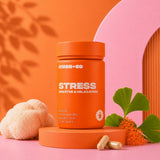
Anti-Stress Complex
Ashwagandha, Reishi, Holy basil, Vitamin B6, Schisandra and Acacia fibre. One to two capsules in the morning, to get through busy weeks.
Discover Anti-Stress →
Relaxation Pack
Anti-Stress Complex in the morning, Sleep+ in the evening. The complete duo for those who want to look after their days as well as their nights.
Discover the pack →The fact file
Schisandra in brief.
A vine of cold forests, clusters of bright red berries in autumn. Here is the essential.
From taiga hunters to laboratories
Two thousand years of history, two traditions.
Schisandra has a double history. In China it is a classic plant of the pharmacopoeia. In Russia it is a hunters' plant, rediscovered by science at the moment when the Soviet Union was looking for natural allies against fatigue.
The first centuries
The wu wei zi appears in the oldest Chinese treatise on materia medica, the Shennong Bencao Jing, among the so-called “superior” remedies, those that can be taken for a long time.
Russian explorers and botanists describe the vine in the Far East. Nanai hunters carried dried berries with them to keep going through long days of tracking with little food.
1940-1960
Soviet researchers study it as a tonic, along with eleuthero and rhodiola. It enters the State Pharmacopoeia of the USSR in the early 1960s.
The concept of the adaptogen, forged in the USSR, spreads to the West. Schisandra's lignans become a research subject in their own right in China, Korea and Japan.
Today
Schisandra remains a niche plant in Western Europe, far less known than ashwagandha. In Korea,omija-cha, the schisandra berry drink, is still drunk iced in summer.
The five flavours
One berry, five tastes.
In Chinese, wu wei zi literally means “the five-flavour fruit”. It is not a figure of speech: bite into a dried berry and you really do move from one taste to another.
| Flavour | Where to find it | Traditional Chinese reading |
|---|---|---|
| Sour | The pulp, the dominant flavour | Associated with the liver, it is the fruit's main flavour |
| Sweet | The skin | Associated with the spleen and digestion |
| Bitter | The seed | Associated with the heart |
| Pungent | The seed, once crushed | Associated with the lungs |
| Salty | The whole fruit, as an aftertaste | Associated with the kidneys |
What it contains
The lignans, schisandra's signature.
If schisandra interests researchers so much, it is because of a family of molecules found almost only in it and its close cousins: the dibenzocyclooctadiene lignans.
Schisandrin, also called schizandrin, is the most abundant in Schisandra chinensis. It is often the one used as a marker to measure the quality of an extract.
Schisandrin B, gomisin A and deoxyschisandrin complete the picture. They are heavily studied in the laboratory, notably for their action on the liver and on the enzymes that process medicines. A synthetic derivative inspired by these lignans, bifendate, is even used in China for liver disorders.
The rest of the fruit mainly provides organic acids, hence its sourness. The lignans are concentrated in the seed.
| Form | What you mainly get | Use |
|---|---|---|
| Whole dried berries | Organic acids, a few lignans | Snacking, infusions, cooking |
| Crushed berries or powder | The whole fruit, seeds included, so more lignans | Smoothies, decoctions, traditional use |
| Standardised dry extract | Lignans concentrated and measured | Food supplements |
| Tincture | Lignans and alcohol-soluble compounds | Traditional use in Russia |
The benefits of schisandra
What tradition credits it with, and what we actually know.
The benefits and virtues of schisandra are among the most asked questions about it. The honest answer comes in two parts: a very rich tradition, and human research that is real but still limited.
On the Chinese medicine side, the wu wei zi is an astringent plant: it is said to “hold in”. It is traditionally used to calm the mind, to accompany restless sleep, chronic cough and excessive sweating, and as a general tonic. Also worth reading: Reishi or ashwagandha: which natural anti-stress should you choose?.
On the Russian tradition side, it is above all a tonic. The Soviet studies looked at endurance, resistance to fatigue and attention. It was in that context that the term adaptogen was born: a substance supposed to help the body cope better with the various forms of stress.
On the modern research side, the lignans are heavily studied in the laboratory, notably for the liver. In humans, a few controlled trials exist, on the menopause, on muscle strength in older people or on attention in combination with other plants. We set them out just below.
Its image as an aphrodisiac comes from its reputation as a tonic, not from solid studies. To remember: schisandra is a serious traditional plant, well studied in the laboratory, not a miracle remedy. It is in that spirit that it has its place in a balance formula, alongside better documented ingredients such asashwagandha.
What the studies say
From Soviet archives to randomised trials.
The literature is abundant but uneven: a lot of older work published in Russian, and a few more rigorous recent trials. Here are the ones to know.
Panossian and Wikman, 2008 · Sweden
A broad synthesis of the Russian and Soviet research on Schisandra chinensis, published in the Journal of Ethnopharmacology. It retraces the traditional uses, the studies on endurance and attention, and the precautions adopted by Russian doctors.
Panossian and Wikman, 2010 · Sweden
A review devoted to adaptogens, schisandra, rhodiola and eleuthero foremost among them, and to their possible mechanisms on the stress response. The authors also underline the limits of many older studies.
Park and Kim, 2016 · South Korea
36 menopausal women, a schisandra extract or a placebo for 12 weeks. The schisandra group saw certain symptoms improve more, notably hot flushes, sweating and palpitations.
Cho et al., 2021 · South Korea
Older adults, a schisandra extract or a placebo for 12 weeks, combined with gentle physical activity. The schisandra group obtained better results on certain measures of leg muscle strength.
In short: a well-documented tradition, modern clinical trials that are encouraging but small, and a lot of laboratory work that cannot be transposed as it stands to humans. The full references are in the at the bottom of the page.
Schisandra and sleep
Tonic or soothing? Both.
“Schisandra and sleep”: the question comes up often, and for good reason. In Russia it is a tonic you take to keep going. In China it is used to calm the mind and to accompany restless nights. To go further, discover the symptoms of high cortisol and the natural ways out.
That ambivalence is precisely what defines an adaptogen in the theory of those who coined the word: a plant that would help the body return towards its balance, rather than push it in one direction. A theory more than a demonstrated fact.
In practice, common sense applies. Russian doctors advised against taking it in the evening in people prone to insomnia. That is why we recommend taking Anti-Stress Complex in the morning, and leaving the evening to a formula designed for the night, such as Sleep+, with Reishi, valerian and melatonin.
Berries, powder, tea
How to take schisandra, without getting it wrong.
Dried berries, powder, infusion, capsules: schisandra comes in every form.
The dried berries are nibbled a few at a time, as the taiga hunters did. Careful, the taste is surprising: very sour, then bitter and pungent when you bite into the seed.
The powder mixes into a smoothie, a yoghurt or a fruit juice, which mask its sourness. It contains the whole fruit, seeds included.
On the dose, the Chinese pharmacopoeia indicates a few grams of dried fruit a day, generally between 2 and 6 g. For a supplement, always go by the dose stated on the label: it depends on the concentration of the extract.
And for schisandra tea or infusion, here is the simplest method.
The right amount
One teaspoon of dried berries, lightly crushed to open the seeds, for a 250 ml cup.
The preparation
Hot, 10 minutes in simmering water. Or cold, Korean style: a night in the fridge, then a little honey.
The rhythm
One to two cups a day, rather in the morning or early afternoon, and not continuously for months on end.
Chinensis, rubriflora, sphenanthera
One genus, several species.
The genus Schisandra has about twenty species. They are not all equal, and they do not serve the same purposes. When schisandra is mentioned in a supplement, it is almost always Schisandra chinensis.
| Species | Origin | Main use |
|---|---|---|
| Schisandra chinensis | North-eastern China, Korea, Russian Far East | The “northern wu wei zi”, the one in supplements and in the studies |
| Schisandra sphenanthera | Central and southern China | The “southern wu wei zi”, described separately in the Chinese pharmacopoeia |
| Schisandra rubriflora | Himalaya, western China | Mainly ornamental, for its dark red flowers |
| Schisandra grandiflora | Himalaya | Ornamental, with large white or pinkish flowers |
| Schisandra henryi | Southern China | Studied in the laboratory, little used |
The two wu wei zi, northern and southern, do not have exactly the same lignan composition.
In the garden
Growing Schisandra chinensis at home.
Growing schisandra is easier than you might think in temperate Europe, above all in the north and east. It is a vine of cold forests: it withstands harsh winters, but hates dry heat and burning full sun.
One point to know before buying: most plants have separate male and female flowers, and you often need two plants to get fruit. Some varieties, such as the self-fertile 'Sadova', produce on their own. Check it on the label.
| Task | When | How |
|---|---|---|
| Planting | Autumn or early spring | In partial shade, in cool, humus-rich and rather acid soil, with a support to climb on |
| Watering | During dry summers | Keep the soil cool without waterlogging it; a mulch helps a great deal |
| Pruning | Late winter | Thin out stems that are too numerous and shorten the side shoots |
| Harvesting | September-October | Pick the clusters when the berries are bright red and soft, then dry them in the shade |
Choosing it well
Five criteria for a schisandra supplement.
- The species : Schisandra chinensis must be written out in full. Be wary of labels that mention only “schisandra”.
- The part used : the fruit. That is what concentrates the lignans and what matches the traditional uses.
- The dose : a serious supplement states an amount in milligrams per serving, not just a place in the ingredient list.
- The manufacturing : an identified place of manufacture. With us, the recipes are developed and produced in Toulouse, France, by a French contract manufacturer, vegan, GMO-free and gluten-free.
- The guarantee : enough to try it risk-free. With us, 60 days satisfied or your money back, and the choice between a one-off purchase and a monthly subscription (−30%).
You will also find schisandra in pharmacies, in ampoules or capsules, and organic schisandra as dried berries in specialist shops.
The right combinations
Schisandra plays as a team.
Traditionally, schisandra is rarely taken on its own. Here are the plants that go with it in our range or in the tradition, and why.
+ Ashwagandha
The flagship plant of Ayurveda, the best studied of the adaptogens, at the heart of Anti-Stress Complex. Ashwagandha: benefits, dosage and precautions.
+ Holy basil
Indian tulsi, a sacred plant of Ayurveda, which completes Anti-Stress Complex. the benefits and dosage of holy basil.
+ Rhodiola
The other adaptogen of cold regions, often paired with schisandra in the Russian studies, and present in Brainstoorm Chocolate-hazelnut. the benefits and dosage of rhodiola.
+ Siberian ginseng
Eleuthero, the third member of the adaptogenic trio studied by Soviet researchers. Siberian ginseng: benefits, dosage and precautions.
In Anti-Stress Complex, schisandra also meets Reishi, the mushroom of serenity in the Asian tradition.
Who it is for
A balance routine is made for you if…
- You go from one busy week to the next and find it hard to switch off in the evening.
- You are looking for a morning routine, caffeine-free, to follow over several weeks.
- You like adaptogenic plants, but prefer stated doses to berries taken at random.
- You want to look after your days as well as your nights.
- You want to understand what you are taking, ingredient by ingredient.
| Anti-Stress Complex on its own | Relaxation Pack | Limitless Pack | |
|---|---|---|---|
| Contents | Anti-Stress Complex | Anti-Stress Complex + Sleep+ | Focus, Energy, Sleep+ and Anti-Stress Complex |
| Moment | In the morning | Morning and evening | All day long |
| Who it is for | A targeted balance course | Busy days and restless nights | The complete routine, from focus to sleep |
For all our formulas, the recipes are developed and produced in Toulouse, France, by a French contract manufacturer, vegan, GMO-free and gluten-free, with 60 days satisfied or your money back, free delivery from €59 in France and €69 to €89 across Europe, depending on the destination, and the choice between a one-off purchase and a monthly subscription (−30 %). See the Relaxation Pack or the Limitless Pack.
Risks and contraindications
What to know before taking it.
At the usual doses, schisandra is well tolerated by most adults. But the question of risk deserves a real answer.
The side effects most often described are digestive: heartburn, reflux, stomach discomfort, partly linked to its acidity. Russian sources also reported possible restlessness or difficulty falling asleep when it was taken late.
Interactions are the most serious point. Schisandra's lignans act on certain liver enzymes that clear medicines, in particular cytochrome CYP3A4. They can therefore change the blood level of certain treatments, among them tacrolimus, an immunosuppressant used after a transplant.
Thyroid and blood pressure : there is no solid study showing an effect of schisandra on the thyroid, in either direction. Russian doctors did, however, advise against it in case of high blood pressure, nervous agitation or insomnia. If you are being followed for either, simply ask your doctor for advice before starting.
The situations where it is better to ask for advice or abstain.
- During pregnancy and breastfeeding, avoid it: tradition advises against it and safety data are lacking.
- Ask your doctor for advice if you take a long-term treatment, notably an immunosuppressant, an anticoagulant or an antiepileptic.
- Be careful in case of high blood pressure, epilepsy, reflux or stomach ulcer.
- Tell your doctor if you are being followed for your thyroid or for a liver disease.
- Follow the dose stated on the label of your supplement, and keep it out of reach of children.
Your questions
Everything we are asked about schisandra.
What are the benefits of schisandra?
Schisandra is a major plant of Chinese medicine, used as a tonic and to calm the mind, and an adaptogenic plant studied in Russia for fatigue. A few modern trials, on small groups, have explored the menopause and muscle strength. The results are encouraging, but still limited.
Why is it called the five-flavour berry?
Because its Chinese name, wu wei zi, means “the five-flavour fruit”. The berry is at once sour, sweet, bitter, pungent and salty, depending on whether you taste the skin, the pulp or the seed.
Is schisandra dangerous?
No, at the usual doses in a healthy adult. It can cause digestive upset, and it interacts with certain medicines, because it acts on the liver enzymes that clear them. It is not advised during pregnancy and breastfeeding.
What are the contraindications of schisandra?
Pregnancy, breastfeeding and certain treatments, notably immunosuppressants such as tacrolimus. Caution is also needed in case of high blood pressure, epilepsy, reflux or stomach ulcer. If in doubt, ask your doctor for advice.
Schisandra and the thyroid: are they compatible?
No solid study shows an effect of schisandra on the thyroid. As a precaution, if you take thyroid treatment, talk to your doctor before starting a course.
Does schisandra help you sleep?
Chinese medicine uses it to calm the mind, but the Russian tradition makes it a tonic. That is why we advise taking it in the morning, and leaving the evening to a dedicated formula such as Sleep+.
How do you make schisandra tea?
One teaspoon of lightly crushed dried berries per cup, 10 minutes in simmering water. Or a night in the fridge in cold water, with a little honey: that is the Koreanomija-cha .
What is the difference between Schisandra chinensis and Schisandra rubriflora?
Schisandra chinensis is the species used in herbal medicine and in supplements. Schisandra rubriflora is mainly grown for its red flowers, as an ornamental plant.
Can schisandra, rhodiola and ashwagandha be combined?
Yes, these are traditional combinations. Schisandra has often been studied with rhodiola and Siberian ginseng, and in Anti-Stress Complex it is combined with ashwagandha, reishi and holy basil.
Is schisandra in the Mush n Go products?
Yes, in Anti-Stress Complex, with Ashwagandha, Reishi, Holy basil, Vitamin B6 and Acacia fibre. You will also find it in the Relaxation Pack and the Limitless Pack. The exact dose is on the product label.
Where can I buy schisandra?
Directly on mushngo.com, in Anti-Stress Complex, with free delivery from €59 in France and €69 to €89 across Europe, depending on the destination, a one-off purchase or a monthly subscription (−30 %) as you prefer, and 60 days satisfied or your money back. For all our formulas, the recipes are developed and produced in Toulouse, France, by a French contract manufacturer.
Sources
- Panossian A., Wikman G. (2008). Pharmacology of Schisandra chinensis Bail.: an overview of Russian research and uses in medicine. Journal of Ethnopharmacology, 118(2).
- Panossian A., Wikman G. (2010). Effects of adaptogens on the central nervous system and the molecular mechanisms associated with their stress-protective activity. Pharmaceuticals, 3(1).
- Park J.Y., Kim K.H. (2016). A randomized, double-blind, placebo-controlled trial of Schisandra chinensis for menopausal symptoms. Climacteric, 19(6).
- Cho Y.H. et al. (2021). Effect of Schisandra chinensis Baillon extracts and regular low-intensity exercise on muscle strength and mass in older adults: a randomized, double-blind, placebo-controlled trial. The American Journal of Clinical Nutrition, 113(6).
Put it into practice
Schisandra, the Mush n Go version.
You now know all about schisandra and what to look for on a label. Here is where to find it with us, with vegan formulas whose recipes are developed and produced in Toulouse, France, by a French contract manufacturer, and guaranteed 60 days satisfied or your money back.
Anti-Stress Complex
Ashwagandha, Reishi, Holy basil, Vitamin B6, Schisandra and Acacia fibre. One to two capsules in the morning, to get through busy weeks.
Discover Anti-Stress →Relaxation Pack
Anti-Stress Complex in the morning, Sleep+ in the evening. The complete duo for those who want to look after their days as well as their nights.
Discover the pack →The other ingredients
Keep exploring.
Schisandra is only one of the plants in our formulas. Discover the other ingredients, or browse the page listing all our active ingredients.


Anti-Stress Complex
Say goodbye to stress and welcome serenity, for total peace of mind.

Limitless Pack
Maximizes concentration, energy, reduces stress and improves sleep for optimal performance.

Discovery Pack
Become the best version of yourself to achieve all your goals with efficiency and serenity

Relaxation Pack
Reduces stress and improves sleep for increased relaxation and well-being.