



















The evening mineral
Magnesium bisglycinate: the gentle form, from the day to the night
By the Mush n Go team · Updated on 18 September 2026
The magnesium bisglycinate, also called magnesium bisglycinate or magnesium glycinate, is the form of magnesium most often recommended today. An essential mineral, bound to an amino acid, glycine, so that it is better tolerated by the gut than the classic forms. At Mush n Go, it is part of the formula of Sleep+, alongside reishi, valerian and melatonin.

Sleep+
Reishi, Valerian, Magnesium bisglycinate, Acacia fibre and Melatonin. 1 to 2 capsules 30 minutes before bedtime, for a simple evening routine.
Discover Sleep+ →
Relaxation Pack
Anti-Stress Complex in the morning, Sleep+ in the evening. The two relaxation formulas together, as a one-off purchase or on subscription (−30 %).
Discover the pack →The fact file
Magnesium bisglycinate in brief.
Neither plant nor mushroom, but a mineral salt: one molecule of magnesium, two molecules of glycine. Here is the essential.
A long history
From a bitter spring to modern supplements.
Magnesium owes its name to Magnesia, a region of Thessaly, in Greece. A mineral long used before it was understood.
17th century
At Epsom, in England, a bitter spring draws the curious. A salt is drawn from it, magnesium sulfate, still sold today under the name Epsom salt.
1755
The Scottish chemist Joseph Black shows that “magnesia” is a substance distinct from lime. Magnesium enters the list of elements.
1808
Britain's Humphry Davy isolates the metal for the first time by electrolysis. A light metal, which burns with a brilliant white light.
1915
During the First World War, the French surgeon Pierre Delbet takes an interest in magnesium chloride. The “nigari” of grandmother's remedies comes from there.
Today
Bisglycinate has established itself as the benchmark form, and “magnesium bisglycinate” is now one of the most typed magnesium searches online.
The benefits of magnesium
A mineral that works everywhere.
Magnesium is involved in more than three hundred enzymatic reactions. It is present in every one of your cells, and even at the heart of the chlorophyll of green plants. Its trade is energy, nerves and muscles.
Energy. It contributes to normal energy-yielding metabolism, alongside ATP, the molecule that carries energy in your cells, and contributes to the reduction of tiredness and fatigue.
The nervous system. It contributes to the normal functioning of the nervous system and to normal psychological function. That is the most searched-for link today, with stress and sleep. Also worth reading: Reishi or ashwagandha: which natural anti-stress should you choose?.
The muscles. It contributes to normal muscle function. Calcium makes the muscle contract, magnesium helps it relax: the two go together.
Bones and teeth. About half of the magnesium in your body is stored in the skeleton, where it contributes to the maintenance of normal bones.
These roles hold for magnesium in general. The strength of bisglycinate is that it delivers it gently, without upsetting your stomach.
The signs of a shortfall
Magnesium shortfall: the signs to know.
“Symptoms of magnesium deficiency” is one of the most frequent searches on the subject. And for good reason: the signs are ordinary, and they are easily put down to something else.
The most often described: tiredness that drags on, irritability, less restorative sleep, cramps or the famous twitching eyelid. None is specific, and they can have a thousand other causes.
| Situation | Why the need rises | What you can do |
|---|---|---|
| Prolonged stress | Stress increases urinary losses of magnesium | Look after your plate, consider a course |
| Intense sport | Losses through sweat and increased muscle needs | Water rich in magnesium, nuts |
| Processed food | Refining grains removes most of the magnesium | Wholegrains, pulses |
| Older age | Less efficient intestinal absorption | Take stock with your doctor |
A point often overlooked: less than 1 % of the magnesium in your body circulates in the blood. A normal blood test therefore does not rule out slightly tight reserves. Conversely, a true magnesium deficiency, with heart rhythm disturbances or severe cramps, is a matter for a doctor, not for a supplement chosen on your own.
Bisglycinate, marine, chloride
Which magnesium is best? The comparison.
Marine, chloride, citrate, oxide, malate: all these forms provide magnesium, but not with the same concentration, nor the same digestive tolerance.
| Form | Elemental magnesium | Digestive tolerance | What it suits |
|---|---|---|---|
| Bisglycinate | About 14 % | Very good, little laxative effect | Long courses, evening intake, sensitive stomachs |
| Marine magnesium | High, often a mixture of oxide and hydroxide | Medium, laxative effect frequent | A lot of magnesium in a small tablet |
| Chloride | About 12 % | Poor, very bitter taste | The traditional course in sachets, known as “nigari” |
| Citrate | About 11 to 16 % | Acceptable, slightly laxative | A soluble, versatile form |
| Oxide | About 60 % | Medium, often laxative | Very highly dosed, inexpensive tablets |
| Malate | About 15 % | Good | Often chosen for a morning intake |
The marine magnesium is extracted from seawater. But “marine” describes the origin, not the chemical form: most often it is oxide or hydroxide. Very concentrated, it is generally less well absorbed than the organic forms such as citrate or bisglycinate, and its side effects are mainly digestive.
The magnesium chloride has its loyal followers, but its very bitter taste and its laxative effect often put people off after a few days.
The magnesium sulfate, or Epsom salt, is reserved for baths or occasional laxative use. And the magnesium stearate on labels is not a source of magnesium, but an anti-caking agent.
The percentages given are orders of magnitude, which vary with the hydration of the salt and the manufacturer. Only the dose of elemental magnesium written on the label really counts.
What the studies say
Sleep, stress, absorption: four studies worth knowing.
Careful: a study on magnesium is not necessarily a study on bisglycinate, as many trials used other forms. Here is the most useful work, with its exact conditions.
Abbasi et al., 2012 · Iran
46 older people with insomnia, 500 mg of magnesium a day as the oxide, or a placebo, for 8 weeks. The magnesium group saw several sleep measures improve, such as time to fall asleep, sleep duration and sleep efficiency.
Pouteau et al., 2018 · France
264 stressed adults with a low blood magnesium level, 300 mg of magnesium a day with or without 30 mg of vitamin B6, for 8 weeks. Stress fell markedly in both groups, and the combination with B6 did slightly better in the most stressed people.
Boyle, Lawton and Dye, 2017 · United Kingdom
A systematic review of 18 studies on magnesium, anxiety and stress. The authors speak of encouraging signs in people prone to anxiety, while underlining the uneven quality of the trials.
Schuette et al., 1994 · United States
A small study in patients who had had part of the intestine removed, and who absorb minerals poorly. Magnesium diglycinate was better absorbed there than the oxide, and better tolerated.
In short: interesting results on sleep and stress, above all in people whose intakes are low, and a glycinate form valued for its tolerance. Note that the dose in the sleep study exceeds the limit advised in a supplement without medical supervision. The full references are in the at the bottom of the page.
Foods rich in magnesium
Magnesium starts on the plate.
Before any supplement comes food. The foods rich in magnesium are those that have not been refined: seeds, nuts, wholegrains, pulses and green vegetables, where it hides in the chlorophyll.
| Food | Magnesium per 100 g, approximately | An idea for every day |
|---|---|---|
| Pumpkin seeds | 500 mg | A handful on a salad or a soup |
| Almonds | 250 mg | Twenty or so as a snack |
| Dark chocolate at 70 % | 200 mg | Two squares after lunch |
| Buckwheat | 200 mg | As a pancake or as cooked groats |
| Cooked spinach | 60 to 80 mg | As a side dish, twice a week |
| Cooked lentils and chickpeas | 30 to 50 mg | As a full meal, with grains |
| Banana | 30 mg | At breakfast or before sport |
Water rich in magnesium is another route. Some mineral waters exceed 100 mg per litre: the content is on the label. Those combining magnesium and sulfates also have a known effect against constipation.
Rounded values, from food composition tables. They vary with the variety, the cooking and the brand.
What dose per day
How much magnesium a day?
For magnesium, we always speak of elemental magnesium, that is the amount of mineral actually provided, not the weight of the salt. 1 000 mg of bisglycinate provide about 140 mg of magnesium: it is that second figure that counts.
| Marker | Value | What it means |
|---|---|---|
| Adequate intake, adult man | 350 mg a day | From all sources combined, according to EFSA |
| Adequate intake, adult woman | 300 mg a day | From all sources combined, according to EFSA |
| Nutrient reference value | 375 mg | The 100 % shown on labels in Europe |
| Limit for supplements | 250 mg a day | Added magnesium, above which digestive upset becomes more frequent |
The 250 mg limit concerns only added magnesium, not the magnesium in food. Your plate can do the bulk of the work, and the supplement fill the gap.
In our formulas, the exact amount of magnesium bisglycinate is stated on the label of Sleep+. Follow the recommended dose and avoid stacking several magnesium supplements without talking to a professional.
When and how to take it
The right moment, the right course.
“When should you take magnesium?” There is no compulsory hour, but bisglycinate has a natural affinity with the evening, thanks to its good tolerance and to the glycine it carries.
In the evening
This is the most common moment for bisglycinate, in a wind-down routine, 30 minutes to an hour before bedtime.
With water
A large glass of water, with a meal or away from one. If your stomach is sometimes sensitive, take it with a snack.
Over time
A magnesium course generally lasts one to three months. Its effects on your reserves build up gradually, not overnight.
A course makes most sense during busy periods: exams, a rush at work, getting back into sport. Then take a break, and let food take over.
With Sleep+, it is simple: 1 to 2 capsules, 30 minutes before bedtime, at the moment when your body is getting ready to rest.
Magnesium B6 and combinations
Magnesium plays as a team.
“Magnesium B6” is a pharmacy classic: vitamin B6 also contributes to the normal functioning of the nervous system. Here are the ingredients that go with bisglycinate in our range.
+ Vitamin B6
Present in Anti-Stress Complex. With Sleep+, the Relaxation Pack thus brings together magnesium in the evening and B6 in the morning.
+ Melatonin
The hormone of falling asleep, which contributes to the reduction of time taken to fall asleep, in Sleep+. the benefits and dosage of melatonin.
+ Valerian
The evening root of the European traditions, used for centuries, in Sleep+. the benefits and dosage of valerian.
+ Reishi
The mushroom of wind-down routines, present both in Sleep+ and in Anti-Stress Complex. Reishi: benefits, dosage and precautions.
On the daytime side, theashwagandha and holy basil in Anti-Stress Complex complete the picture.
Who it is for
A sleep routine is made for you if…
- You find it hard to switch off in the evening, your head still full of the day.
- You are going through a period of stress, intense work or change.
- You have already tried magnesium, but your stomach did not take it well.
- You want to know what you are taking, ingredient by ingredient.
| Sleep+ on its own | Relaxation Pack | Limitless Pack | |
|---|---|---|---|
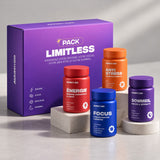
| Contents | Sleep+ | Anti-Stress Complex + Sleep+ | Focus, Energy, Sleep+ and Anti-Stress Complex |
| Moment | In the evening | Morning and evening | All day long |
| Who it is for | A targeted evening routine | The stress of the day and the rest of the night | The complete routine, from focus to sleep |
For all our formulas, the recipes are developed and produced in Toulouse, France, by a French contract manufacturer, vegan, GMO-free and gluten-free, with 60 days satisfied or your money back and the choice between a one-off purchase and a monthly subscription (−30 %). See the Limitless Pack.
Choosing it well
Five criteria for a magnesium supplement.
- The elemental dose : the number of milligrams of magnesium per serving, and not only the weight of bisglycinate. It is the only way to compare two products.
- The exact form : a bisglycinate described as “buffered” is mixed with magnesium oxide. That is not a flaw, but it is better to know.
- The ingredient list : short, legible, with no needless colourings. A complete formula must state each active and its amount.
- The manufacturing : an identified place of manufacture. With us, the recipes are developed and produced in Toulouse, France, by a French contract manufacturer, vegan, GMO-free and gluten-free.
- The guarantee : enough to try it risk-free. With us, 60 days satisfied or your money back, and the choice between a one-off purchase and a monthly subscription (−30%).
Side effects and precautions
What to know before a course.
Magnesium bisglycinate is one of the best tolerated forms. Its side effects, when they occur, are mainly digestive: loose stools, diarrhoea or discomfort, most often when the dose is too high or taken all at once.
And “too much magnesium”, what are the symptoms? When the kidneys work well, the excess leaves in the urine. A dangerous build-up remains rare and mainly concerns kidney failure.
Magnesium is a nutrient, but a supplement is still a supplement. A few simple rules apply.
- In case of kidney failure, do not take magnesium as a supplement without medical advice.
- Leave at least two hours between taking magnesium and certain medicines: antibiotics of the tetracycline or quinolone families, osteoporosis treatments, thyroid hormone.
- During pregnancy and breastfeeding, ask your doctor or your midwife for advice, all the more so for a formula that contains melatonin, such as Sleep+.
- In case of diarrhoea, reduce the dose or split the intakes, and see a doctor if it persists.
- Follow the dose stated on the label, do not stack several magnesium supplements, and keep them out of reach of children.
Your questions
Everything we are asked about magnesium bisglycinate.
What is magnesium bisglycinate?
It is a form of magnesium bound to two molecules of glycine, an amino acid. This so-called chelated form is valued for its good digestive tolerance. It is also called magnesium bisglycinate, glycinate or diglycinate.
What are the benefits of magnesium bisglycinate?
They are those of magnesium: it contributes to the reduction of tiredness and fatigue, to the normal functioning of the nervous system, to normal psychological function and to normal muscle function. Bisglycinate delivers that magnesium with less digestive discomfort than many other forms.
Bisglycinate or marine magnesium: which to choose?
Marine magnesium is very concentrated but often less well tolerated by the gut. Bisglycinate is less concentrated, so it comes in bigger or more numerous capsules, but it is gentler. For a long course or a sensitive stomach, bisglycinate is generally preferred.
What is the best time to take magnesium?
There is no compulsory hour. Bisglycinate is often taken in the evening, in a wind-down routine. Sleep+ is taken as 1 to 2 capsules, 30 minutes before bedtime.
What are the symptoms of a magnesium shortfall?
People often describe tiredness, irritability, less restorative sleep, cramps or a twitching eyelid. These signs are not specific: if in doubt or if the symptoms are marked, talk to your doctor.
Does magnesium bisglycinate have side effects?
It is very well tolerated. At a high dose, it can cause loose stools or diarrhoea. It is not advised without medical advice in case of kidney failure, and must be spaced apart from certain medicines.
Should magnesium be taken with vitamin B6?
It is not compulsory, but the combination is a classic. A 2018 French study tested it in stressed adults, with a slight advantage in the most stressed. In our range, B6 is in Anti-Stress Complex, magnesium in Sleep+: the two come together in the Relaxation Pack. To go further, discover the symptoms of high cortisol and the natural ways out.
Does magnesium make you lose weight?
No. Magnesium takes part in energy metabolism, but it has no direct effect on weight. No supplement replaces a balanced diet and physical activity.
Does magnesium help against cramps?
It contributes to normal muscle function, hence its reputation. But for night cramps in older people, the research syntheses are not very convincing. Frequent cramps deserve medical advice.
Where can I find magnesium bisglycinate at Mush n Go?
In Sleep+, with reishi, valerian, acacia fibre and melatonin, and in the Relaxation Pack. Free delivery from €59 in France and €69 to €89 across Europe, depending on the destination, a one-off purchase or a monthly subscription (−30 %) as you prefer, and 60 days satisfied or your money back.
Sources
- Abbasi B., Kimiagar M., Sadeghniiat K., Shirazi M. M., Hedayati M., Rashidkhani B. (2012). The effect of magnesium supplementation on primary insomnia in elderly: A double-blind placebo-controlled clinical trial. Journal of Research in Medical Sciences, 17(12).
- Pouteau E. et al. (2018). Superiority of magnesium and vitamin B6 over magnesium alone on severe stress in healthy adults with low magnesemia: A randomized, single-blind clinical trial. PLoS One, 13(12).
- Boyle N. B., Lawton C., Dye L. (2017). The effects of magnesium supplementation on subjective anxiety and stress: a systematic review. Nutrients, 9(5).
- Schuette S. A., Lashner B. A., Janghorbani M. (1994). Bioavailability of magnesium diglycinate vs magnesium oxide in patients with ileal resection. Journal of Parenteral and Enteral Nutrition, 18(5).
- EFSA, NDA Panel (2015). Scientific Opinion on Dietary Reference Values for magnesium. EFSA Journal, 13(7).
Put it into practice
Magnesium bisglycinate, the Mush n Go version.
You now know all about magnesium bisglycinate and what to look for on a label. Here is where to find it with us, with vegan formulas whose recipes are developed and produced in Toulouse, France, by a French contract manufacturer, and guaranteed 60 days satisfied or your money back.
Sleep+
Reishi, Valerian, Magnesium bisglycinate, Acacia fibre and Melatonin. 1 to 2 capsules 30 minutes before bedtime, for a simple evening routine.
Discover Sleep+ →Relaxation Pack
Anti-Stress Complex in the morning, Sleep+ in the evening. The two relaxation formulas together, as a one-off purchase or on subscription (−30 %).
Discover the pack →The other ingredients
Keep exploring.
Magnesium bisglycinate is only one of the actives in our formulas. Discover the other ingredients, or browse the page listing all our active ingredients.


Sleep+
Relax and enjoy peaceful nights, for deep and restorative sleep.

Limitless Pack
Maximizes concentration, energy, reduces stress and improves sleep for optimal performance.

Discovery Pack
Become the best version of yourself to achieve all your goals with efficiency and serenity

Relaxation Pack
Reduces stress and improves sleep for increased relaxation and well-being.