






The spice of mood
Saffron: red gold, from the crocus flower to science
By the Mush n Go team · Updated 18 September 2026
The saffron (Crocus sativus) is the most expensive spice in the world, and one of the oldest. Three red threads per flower, picked by hand at dawn. In the kitchen it colours paella and bouillabaisse. As a food supplement it is studied above all in connection with mood and sleep. Here are its benefits, its contraindications and the right way to take it. At Mush n Go, saffron is part of Focus, our focus formula.

Focus
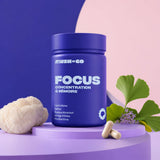
Our focus formula: Lion's Mane, Saffron, Bacopa monnieri, Ginkgo biloba and Maritime pine. The 30-day course for stretches of intense work.
Discover Focus →
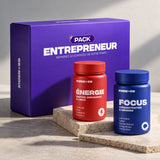
Entrepreneur Pack
Focus for concentration, Energy for vitality, caffeine-free. Two 30-day courses for the weeks that count.
Discover the bundle →The fact file
Saffron in brief.
A small mauve flower that comes out of the ground in autumn, without warning, and fades in two days. At the heart of every flower, three bright red threads: they, and they alone, become the spice.
Beware of false friends: “Indian saffron”, “bourbon saffron” or “saffron turmeric” all refer to turmeric, a yellow root from an entirely different family. And “bastard saffron” is safflower, a flower used to adulterate real saffron.
Three thousand years of history
A spice of frescoes, of kings and of merchants.
The word saffron comes from the Arabic za'farān, which evokes yellow. Long before reaching our kitchens, it was used to dye, to perfume and to treat.
Bronze Age
On the island of Santorini, frescoes at the Akrotiri site show young women picking crocus flowers. It is one of the oldest depictions of the saffron harvest.
Antiquity
Greeks, Romans and Persians use it in dyeing, in perfume and in baths. Legend credits Cleopatra with saffron baths before receiving her guests.
18th century
The Gâtinais, around Boynes in the Loiret, becomes one of Europe's great production centres. The crop then declines, before being revived in small saffron plots across the continent.
Today
“Saffron benefits” and “saffron supplement” are searched for tens of thousands of times a month across Europe. The spice of great dishes has become a subject of research.
Why so expensive?
The price of saffron, explained.
Saffron is bought by the gram. Its price is simply explained: everything is done by hand, and it takes a mad quantity of flowers.
A plant that cannot be sown. The saffron crocus is sterile. It produces no seeds and multiplies only through its bulbs, called corms, which have to be planted, lifted and replanted every few years.
A lightning harvest. Flowering lasts a few weeks, in October and November. Each flower is picked on the morning it opens.
The stripping. The three stigmas are then separated from the flower one by one, by hand, and dried. It takes around 150,000 flowers to obtain a kilo of dried saffron, and hundreds of hours of work.
The result: a good-quality saffron sells for several thousand euros a kilo, more still for European saffrons. Happily, the spice is so powerful that a pinch is enough for a dish for four.
| Saffron threads | Standardised extract | |
|---|---|---|
| What it is | The whole stigmas, simply dried | A powder obtained from the stigmas, standardised in actives |
| Active content | Variable with the origin, the harvest and the storage | Guaranteed: a percentage of safranal or crocins is stated |
| Typical dose | A pinch, about 0.1 g, for a dish | A few tens of milligrams a day |
| Use | Cooking, infusion, baking | Food supplements, courses of a few weeks |
Clinical studies almost always use a standardised extract, not culinary saffron. That is what makes it possible to know exactly how much active each volunteer received.
What it contains
Colour, bitterness, aroma: three molecules.
Each of saffron's three characters corresponds to a family of molecules. Knowing them means understanding both its quality in the kitchen and why researchers are interested.
The crocins are rare carotenoid pigments, soluble in water. They are what tint rice and sauces a golden yellow. That, incidentally, is why saffron is infused in a liquid before being added.
Picrocrocin carries saffron's characteristic bitterness. During drying and storage it turns partly into safranal.
Safranal is the volatile molecule that gives saffron its scent. It is also one of the compounds most closely followed in research, along with the crocins, and one of the markers used to standardise extracts.
| Molecule | What it provides | What damages it |
|---|---|---|
| Crocins | The orange-yellow colour | Light and damp |
| Picrocrocin | The bitterness, the flavour | Badly managed drying |
| Safranal | The aroma, the scent of hay | Heat and air, over time |
The international standard ISO 3632 classes saffron into categories according to its colouring power, its bitterness and its aroma, measured in the laboratory. Category I corresponds to the best quality.
The benefits of saffron
What tradition credits it with, and what we actually know.
“Saffron benefits” is by far the most frequent search about this spice. The honest answer comes in two parts: a very long tradition, and human research far more advanced than for most spices.
On the tradition side, saffron has been used for centuries in Persian and Ayurvedic medicine, notably for digestion, wellbeing and morale. It was readily called “the spice of happiness”.
On the research side, it is mood that has interested researchers most. Since the early 2000s, several randomised placebo-controlled trials have tested saffron extracts, most often around 30 mg a day, for four to eight weeks. Other work has looked at sleep, stress, premenstrual syndrome or eyesight, with more preliminary results. To go further, discover the symptoms of high cortisol and the natural answers.
And skin, hair, weight loss? On these subjects, the human data remain very thin.
What to take away: saffron is a remarkable spice, and one of the best-studied plant extracts for morale. It is not a medicine, and it does not replace medical care. But in a focus routine, alongside ingredients such as Lion's Mane, the mushroom of focus, it has every right to its place.
Saffron, mood and sleep
Four studies to know, with their exact conditions.
The first trials come from Iran, the leading producing country. Others followed in Australia, in healthy adults. Here is what they tested.
Akhondzadeh et al., 2005 · Iran
40 adults with a mild to moderate depressive episode, 30 mg of saffron extract a day or a placebo, for 6 weeks. The saffron group showed a markedly greater improvement in mood scores.
Hausenblas et al., 2013 · Meta-analysis
A synthesis of five randomised trials on saffron and depression. The authors conclude that the effect is greater than placebo, while stressing the small size of the studies and the need for larger work.
Kell et al., 2017 · Australia
128 healthy adults complaining of low mood, 22 mg or 28 mg a day of a standardised extract, or a placebo, for 4 weeks. The 28 mg dose was associated with a fall in anxiety and stress scores.
Lopresti et al., 2020 · Australia
63 adults complaining of poor-quality sleep, 14 mg of extract twice a day or a placebo, for 28 days. The saffron group reported better sleep quality.
In short: encouraging and consistent results, in groups that remain modest and over a few weeks. And one thing in common: doses of the order of 30 mg of extract a day, a very long way from dangerous quantities. The full references are at the bottom of the page.
Saffron as a supplement
How to take it, and how much.
A saffron food supplement has nothing to do with a pinch in a risotto. It provides a known, regular dose of actives, day after day, which no recipe can guarantee.
The right dose
Follow the one on the label. In the trials, the extracts are taken at between 20 and 30 mg a day, in one or two servings.
The right moment
In the morning for a focus routine, with breakfast. Some sleep studies split the dose between morning and evening.
The right duration
Allow at least three to four weeks: that is the minimum length of the studies. A 30-day course is a good starting point.
Saffron is often paired with rhodiola or, as in Focus, with focus plants. A good supplement states the quantity of saffron per serving and, ideally, its standardisation.
In cooking and in infusions
Saffron in the cup and on the plate.
The golden rule fits in one sentence: always infuse saffron before adding it. A few threads in two tablespoons of warm water, milk or stock, for at least 20 minutes, and you release its colour and its scent.
Saffron tea and infusion
Three to five threads in a cup of hot, not boiling, water, 5 to 10 minutes. On its own, or with a green tea, a cinnamon stick or a cardamom pod.
Saffron golden milk
A few threads infused in hot milk, plant-based or not, with a touch of honey. A traditional drink in India and Iran.
Rice and risottos
Paella, risotto alla milanese, Persian rice: saffron is infused in the stock then poured in during cooking.
Fish and desserts
Bouillabaisse, mussels, crème brûlée, poached pears, brioche: a pinch is enough to transform a dish.
Saffron syrup, honey and tea each have their followers. They are pleasures of taste above all: at those quantities you enjoy the aroma, but not the doses studied in research.
Choose whole threads over powder, which is easier to adulterate, and keep them in an airtight tin, away from the light.
Spotting a real saffron
The most adulterated spice in the world.
When a spice is worth more than silver by weight, the cheats are never far away. Cut powder, dyed threads, substitute flowers: here is how to avoid being taken in.
| Imitation | How to spot it | What it really is |
|---|---|---|
| Safflower | Thin, orange petals, no trumpet shape, little scent | A flower, nicknamed “bastard saffron” |
| Turmeric | Bright yellow powder, earthy taste, colours instantly | A root, sold as “Indian saffron” |
| Marigold (calendula) | Flat, orange-yellow petals, no saffron smell | A garden flower |
| Dyed threads | A uniform colour that runs straight away, too regular | Corn silk or coloured fibres |
The simplest test: drop a thread into a glass of warm water. A real saffron slowly releases a golden yellow halo, while the thread itself stays red. An immediate red or orange colour, or a thread that loses its colour entirely, should set off an alarm.
A real saffron stigma is two to three centimetres long, flares into a small trumpet at its tip and smells of honey and hay. An abnormally low price is almost always a warning signal.
The right combinations
Saffron plays as a team.
Saffron is rarely taken on its own. Here are the ingredients that most often go with it, in our range and elsewhere, and why.
+ Rhodiola
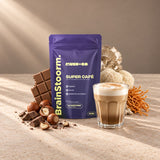
The rhodiola and saffron duo is a great classic among supplements for morale. Rhodiola is an adaptogenic plant of cold regions, present in Brainstoorm Chocolate-hazelnut. everything about rhodiola.
+ Lion's Mane
The mushroom of focus, studied in connection with its hericenones, at the heart of Focus and of Brainstoorm. everything about Lion's Mane.
+ Ashwagandha
The Ayurvedic plant of stress, in Anti-Stress Complex and Brainstoorm, for the stretches when your head is spinning too fast. the benefits and dosage of ashwagandha.
+ Turmeric
Another golden spice, often confused with saffron, studied in connection with its curcumin and present in Muscle Recovery. everything about turmeric.
In Focus, saffron also sits alongside Bacopa monnieri, an Ayurvedic plant taken over several weeks, and Ginkgo biloba, the most studied leaf extract in the world.
Who it is for
A focus routine is for you if…
- You string together days of intellectual work, screens and meetings.
- You are going through a busy stretch and want to keep a clear head and a steady mood.
- You are preparing for exams, a competitive entrance test or a return to study.
- You are looking for a caffeine-free course, to take over time.
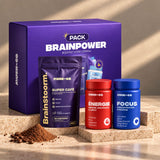
| Focus on its own | Entrepreneur Pack | BrainPower Pack | |
|---|---|---|---|
| Contents | Focus | Focus + Energy | Focus, Energy + one Brainstoorm |
| Caffeine | None | None | 20 mg per cup of Brainstoorm |
| Who it is for | A targeted course for focus | The head and the body, through busy weeks | The complete routine, coffee included |
The recipes for all our formulas are developed and produced in Toulouse, France, by a French contract manufacturer, and they are vegan, GMO-free and gluten-free, with a 60-day money-back guarantee and the choice between a one-off purchase and a monthly subscription (−30 %). See the Entrepreneur Pack or BrainPower Pack.
Contraindications
Benefits and contraindications: what you need to know.
At culinary doses and at supplement doses, around 30 mg a day, saffron is well tolerated by the vast majority of adults. The side effects reported in the trials remain rare and mild: nausea, headaches, dry mouth or a change in appetite.
The risk comes from very large quantities. From several grams a day, that is more than a hundred times the dose used in the studies, saffron can become toxic. That is one more reason never to exceed the stated dose and to be wary of very concentrated “home recipes”.
Cooking and dosed supplements are trouble-free for most adults. Some situations, however, call for medical advice.
- During pregnancy, keep to culinary quantities: at a high dose, saffron can stimulate the uterus. Also avoid supplements while breastfeeding.
- Ask for advice if you take an antidepressant or a treatment for mood, and in case of bipolar disorder.
- Be careful alongside anticoagulant or blood-pressure treatment, and before surgery.
- Avoid it if you have a known allergy to plants of the iris family.
- Respect the dose stated on your supplement's label, and keep it out of reach of children.
A supplement does not replace medical advice. If your mood is persistently low, talk to your doctor: that is the first step, and the most important one.
Your questions
Everything you ask us about saffron.
What are the benefits of saffron?
Saffron is traditionally used for digestion and for morale. In humans it is mood that has been most studied, with several randomised placebo-controlled trials at around 30 mg of extract a day. Studies have also explored stress and sleep, with encouraging but still preliminary results.
What are the contraindications of saffron?
Saffron as a supplement is not recommended during pregnancy and breastfeeding. Medical advice is recommended alongside antidepressant, anticoagulant or antihypertensive treatment, in case of bipolar disorder, or before surgery.
Does saffron help you sleep?
A 2020 Australian study observed better sleep quality in adults who slept badly, with 14 mg of extract twice a day for 28 days. It is an interesting lead, which needs to be confirmed in larger groups.
What dose of saffron per day?
As a supplement, the studies most often use 20 to 30 mg of extract a day. Always follow the dose on the label. In cooking, a pinch of about 0.1 g is enough for a dish for four.
Why is saffron so expensive?
Because everything is done by hand: the plant multiplies through bulbs, each flower is picked on the day it opens, and its three stigmas are removed one by one. It takes around 150,000 flowers for a kilo of dried saffron.
What is the difference between saffron and saffron extract?
Saffron threads are the whole spice, whose active content varies. The standardised extract is standardised in safranal or crocins, which guarantees a constant dose. It is the form used in the studies and in serious supplements.
Are turmeric and saffron the same thing?
No. Turmeric is a root of the ginger family, sometimes called “Indian saffron” or “bourbon saffron”. Saffron comes from the stigmas of a crocus flower. Both colour things yellow, but their molecules and their uses are different.
Do saffron tea and infusion have benefits?
They are excellent drinks, fragrant and caffeine-free. But a cup contains only a few threads, far less than the extract doses used in the studies. For a regular dose, a dosed supplement remains more reliable.
Rhodiola and saffron: why combine them?
This duo is frequent in supplements for morale: rhodiola is an adaptogenic plant traditionally used in the face of fatigue, saffron is studied in connection with mood. At Mush n Go, rhodiola is in Brainstoorm Chocolate-hazelnut and saffron in Focus. Also worth reading: Brain fog: causes and solutions.
Is saffron in Mush n Go products?
Yes, in Focus, our focus formula, alongside Lion's Mane, Bacopa monnieri, Ginkgo biloba and Maritime pine, as a 30-day course. Focus is also in the Entrepreneur Pack and the BrainPower Pack.
Where can you buy a saffron supplement?
Directly on mushngo.com, with free delivery from €59 in France and €69 to €89 across Europe, depending on the destination, a one-off purchase or a monthly subscription (−30%) as you prefer, and 60 days satisfied or your money back. The recipes are developed and produced in Toulouse, France, by a French contract manufacturer.
Sources
- Akhondzadeh S. et al. (2005). Crocus sativus L. in the treatment of mild to moderate depression: a double-blind, randomized and placebo-controlled trial. Phytotherapy Research, 19(2).
- Hausenblas H. A. et al. (2013). Saffron (Crocus sativus L.) and major depressive disorder: a meta-analysis of randomized clinical trials. Journal of Integrative Medicine, 11(6).
- Kell G. et al. (2017). affron®, a novel saffron extract (Crocus sativus L.), improves mood in healthy adults over 4 weeks in a double-blind, parallel, randomized, placebo-controlled clinical trial. Complementary Therapies in Medicine, 33.
- Lopresti A. L. et al. (2020). Effects of saffron on sleep quality in healthy adults with self-reported poor sleep: a randomized, double-blind, placebo-controlled trial. Journal of Clinical Sleep Medicine, 16(6).
Put it into practice
Saffron, the Mush n Go version.
You now know all about saffron and what to look for on a label. Here is where to find it with us, with vegan formulas whose recipes are developed and produced in Toulouse, France, by a French contract manufacturer, backed by a 60-day money-back guarantee.
Focus
Our focus formula: Lion's Mane, Saffron, Bacopa monnieri, Ginkgo biloba and Maritime pine. The 30-day course for stretches of intense work.
Discover Focus →Entrepreneur Pack
Focus for concentration, Energy for vitality, caffeine-free. Two 30-day courses for the weeks that count.
Discover the bundle →The other ingredients
Keep exploring.
Saffron is only one of the ingredients in our formulas. Discover the others, or browse the page for all our active ingredients.


Focus
Improve your focus, productivity and memory.

Entrepreneur Pack
Take Back Control of Your Time

Limitless Pack
Maximizes concentration, energy, reduces stress and improves sleep for optimal performance.

Discovery Pack
Become the best version of yourself to achieve all your goals with efficiency and serenity

BrainPower Pack
A sharp mind, steady energy, Naturally