



















Coffee and bloating: why coffee bloats you and what to do
By the Mush n Go editorial team - 26 September 2026

Coffee and digestion
Coffee and bloating
why coffee bloats you and what to do
By the Mush n Go editorial teamPublished 26 September 202615 min read
Coffee and digestion
Coffee makes you bloat because it wakes the whole digestive tract: it stimulates stomach acid and gut contractions, and the milk, sugar or sweeteners we add to it often ferment in sensitive people. Identify the real culprit and you can almost always keep your coffee without a swollen belly.

Brainstoorm
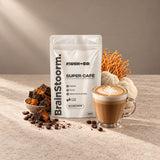
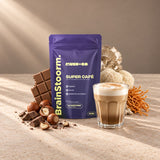
Our mushroom coffee: lion's mane, cordyceps and chaga at 1,000 mg each, maca, chicory and ashwagandha. Only 20 mg of caffeine per cup, with no mushroom taste.
Discover Brainstoorm →
Energy
Cordyceps, maca, ginger and vitamin C in capsules. The 30-day course for those who want to cut back on coffee without losing their momentum.
Discover Energy →Why coffee bloats
Coffee and bloating: a wake-up call for the whole belly.
Coffee is not just a hot drink. Barely swallowed, it sends a series of signals to your digestive system, from the stomach to the colon. In sensitive people, they translate into a tight belly, gas or an urgent trip to the bathroom.
In the stomach, coffee stimulates the secretion of gastrin, a hormone that triggers the production of gastric acid. It is not only the caffeine: other compounds in roasted coffee also play that role, which explains why decaf is not entirely free of it.
In the gut, coffee speeds up contractions, especially in the colon. That is the well-known effect of the morning coffee that «sends you to the toilet». When transit speeds up, the gas produced by fermentation moves faster and harder, and the bloated feeling becomes more obvious.
In the head, finally, caffeine acts on the nervous system. And the gut is closely linked to the brain: in stressed or anxious people, one coffee too many can amplify how digestive sensations are perceived. The belly is not necessarily more bloated, you just feel it more.
Stomach
More gastric acid, sometimes burning, heaviness or acid reflux after the cup.
Colon
Stronger contractions, faster transit, gas that makes itself felt within minutes.
Nervous system
Heightened alertness that can make the belly more sensitive, especially in stressful periods.
What we add
Milk, sugar, sweeteners, creams: often the real cause of the gas, far more than the coffee itself.
The usual suspects
The coffee, or what you put in it?
Before blaming the coffee, look at your cup. A short espresso has little to do with a large latte sweetened with hazelnut syrup. And in many cases, what bloats you is not the coffee, it is what comes with it.
| Suspect | Why it bloats | What you can test |
|---|---|---|
| Cow's milk | Poorly digested lactose ferments in the colon and produces gas | Lactose-free milk or a plant drink for two weeks |
| Sweeteners | Polyols such as sorbitol are poorly absorbed and ferment | Go back to a little sugar, or none at all |
| Plant drinks | Some contain fibres or fermentable sugars | Change drink: almond, rice or oat do not react the same way |
| Sugar and syrups | A lot of sugar at once can speed up transit in some people | Reduce the amount gradually |
| Caffeine | It stimulates gut contractions | Fewer cups, or switch to a lower-caffeine drink |
| Speed | Drinking fast, while walking, makes you swallow air | Sit down and take ten minutes over your cup |
Lactose is by far the most frequent suspect. Many adults digest milk less well than they did as children, without necessarily knowing it, and the morning milky coffee is often the largest dose of milk of the day.
Stomach, acidity and reflux
When it is the stomach that protests.
Not every coffee-related discomfort is bloating in the strict sense. Many people describe a high heaviness, just under the ribs, belching or a burning sensation. There, it is more the stomach that is involved.
Coffee increases acid secretion, and it is often accused of relaxing the sphincter between the oesophagus and the stomach, which would favour reflux. On that second point the studies are less clear-cut than people think: the link varies a lot from person to person. If you have reflux, your own experience counts more than generalities.
A few situations make the stomach more sensitive to coffee: drinking it on an empty stomach, in large amounts, very strong, or alongside a rich, fatty meal.
To remember: low bloating and gas point to the gut and to what ferments. Burning, belching and high heaviness point to the stomach and acidity. The two can coexist, but the solutions are not the same.
- For the gut: look at the milk, the sweeteners and the amount of caffeine.
- For the stomach: avoid coffee on an empty stomach, space out the cups, prefer it after breakfast.
- In both cases: fewer cups, drunk more slowly, already makes a big difference.
Decaf and the stomach
Is decaf gentler on the stomach?
It is often the first reflex: switch to decaf. And it is a reasonable route, with one important nuance.
Decaf stimulates the colon less than regular coffee. For people whose bloating mostly comes from overly fast transit, it can genuinely help. On the other hand, it is not neutral for the stomach: the compounds in roasted coffee that stimulate acidity are largely still there. If your problem is heaviness or burning, decaf will not solve everything.
| Regular coffee | Decaf | |
|---|---|---|
| Caffeine | About 80 to 90 mg per cup according to EFSA | Only a few milligrams |
| Effect on the colon | Marked in many people | Weaker |
| Gastric acidity | Stimulated | Still stimulated, in part |
| For whom | Stomachs that tolerate it well | Bellies sensitive to fast transit |
Another option is to keep a little caffeine, but far less, with a drink that is not based on coffee alone: that is the idea behind a mushroom coffee, which we detail below.
What the research says
Coffee and the gut: four papers worth knowing.
The effect of coffee on the digestive tract has been studied for decades. The results are fairly consistent for the gut, more nuanced for the stomach and reflux. Here are the most useful papers for understanding what happens.
Brown, Cann and Read, 1990 · United Kingdom
Published in the journal Gut, this study measured colon activity in volunteers after a coffee. In some of them, coffee increased the motor activity of the lower colon within minutes: that is the scientific basis of the «coffee that sends you to the toilet».
Rao et al., 1998 · United States
The researchers compared the effect on the colon of caffeinated coffee, decaf, a meal and a glass of water. Caffeinated coffee stimulated the colon as much as a full meal, and more than decaf, which itself remained more active than water.
Boekema et al., 1999 · Netherlands
A review that sorts facts from received ideas. Conclusion: coffee does stimulate acid secretion and colon motility, but its role in heartburn and dyspepsia remains variable from person to person.
Nehlig, 2022 · France
A recent review published in Nutrients, updating the whole body of knowledge on coffee and the digestive tract. It confirms the stimulation of the colon and of gastric secretion, and recalls that individual tolerance varies a great deal.
In short: coffee does wake the gut, caffeine adds to it, and decaf keeps part of it. But nobody reacts the same way. Full references are at the bottom of the page.
Timing matters
On an empty stomach, after a meal, in the afternoon: not the same effect.
The same cup does not have the same effect depending on when you drink it. Many people who complain of bloating have their first coffee on an empty stomach, quickly, before heading out.
On an empty stomach, nothing buffers the acidity or cushions the gut stimulation. That is when the stomach is most reactive. If that is you, simply try moving your coffee to after a slice of bread, a yoghurt or a few dried fruits.
Right after a heavy meal, coffee adds to an already busy digestion. The famous after-dinner espresso can accentuate heaviness in some people, especially after a fatty meal.
7.30 am
Breakfast first, even a light one, then your first cup sitting down, without rushing.
10 am
If you want a second, this is the right moment: far from waking up, far from lunch.
1.30 pm
After lunch, prefer a mint or ginger infusion to a strong coffee if you are prone to heaviness.
4 pm
A large glass of water and a few steps before pouring another. If the slump persists, choose a low-caffeine drink.
In the evening
No caffeine at all. Your belly, like your sleep, will thank you.
Finding your culprit
A simple test, over three weeks.
Rather than cutting everything at once, go about it methodically. Changing one thing at a time is the only way to know what really bloats you.
Week 1: observe
Note every coffee: the time, what it contains, what you ate, and how your belly feels two hours later.
Week 2: one single change
Start with the most likely: drop the cow's milk, or the sweetener, keeping the coffee identical.
Week 3: adjust
If nothing moves, reduce the caffeine: fewer cups, decaf or a low-caffeine drink.
That notebook will also be valuable if you go on to see a doctor.
The right habits
Keep your coffee, without the bloated belly.
Good news: in most cases you do not need to give up coffee. A few adjustments are often enough to get a calm belly back.
- Drink your coffee sitting down, slowly, rather than walking or standing at the counter.
- Do not have it on an empty stomach: something before, even light.
- Limit yourself to two or three cups a day, and stop in the early afternoon.
- Test lactose-free milk or another plant drink.
- Avoid sweeteners based on polyols (sorbitol, maltitol).
- Drink water between coffees: a coffee does not replace a glass of water.
- Walk for ten minutes after the meal rather than following it with an espresso.
- Avoid pairing your coffee with a fizzy drink or chewing gum.
Stress also plays an often underestimated role. A coffee gulped in front of your inbox at 8 am does not have the same effect as one taken calmly. If that resonates, our article on high cortisol and its symptoms gives concrete leads.
The alternatives
What to replace coffee with when it bloats?
If your tests show that caffeine itself is to blame, you do not have to give up a hot drink in the morning. Several options exist, with very different profiles.
| Drink | Caffeine | For the belly | Good to know |
|---|---|---|---|
| Filter coffee | About 90 mg (200 ml) | Stimulates stomach and colon | The benchmark, to dose to your tolerance |
| Espresso | About 80 mg (60 ml) | Same effect, more concentrated | Small volume, but no less caffeine |
| Decaf | Very low | Less effect on the colon | Still stimulates acidity |
| Tea | About 50 mg (220 ml) | Often better tolerated | More tannic, to avoid on an empty stomach for some |
| Chicory | None | Taste close to coffee | Contains inulin, a fibre that can ferment |
| Brainstoorm | 20 mg per cup | Far less caffeine | Mushrooms, maca, chicory and ashwagandha |
| Digestive infusions | None | Mint, ginger, fennel | Ideal after a meal |
Caffeine contents: indicative values published by EFSA, which vary with the bean, the brewing and the cup size. To go further, read our guide what to replace coffee with.
Mushroom coffee
Less caffeine, the ritual kept.
Mushroom coffee is a practical answer to a simple problem: keeping the taste and the ritual of coffee, with far less caffeine. Our Brainstoorm contains 20 mg of microencapsulated NewCaff® caffeine per cup, several times less than a filter coffee, and 6,040 mg of actives: lion's mane, cordyceps and chaga at 1,000 mg each, 3,000 mg of maca, chicory and ashwagandha.
For a belly sensitive to caffeine, that is a clear difference. Several of our customers have written to us about it, like Sonia, who sums up very well what many experience with regular coffee.
« regular coffee gave me stomach ache, now the bloating is gone and I feel good »
★★★★★ Sonia L., 27 August 2026
« What I particularly appreciate is the steadier energy it gives: no jitters and no slump. »
★★★★★ Nawel F., 7 January 2026
Let us be frank: these are personal experiences, not a promise. Every belly is different. Brainstoorm contains chicory, whose fibres can themselves ferment in very sensitive people. If that is your case, start with half a dose for a few days, in water or a plant drink rather than cow's milk.
It is prepared like an instant coffee, hot or cold, in water or milk, and has no mushroom taste at all. You can also discover it in the Choco-hazelnut version in the Coffee Pack, which brings both flavours together. To understand the approach in detail, read what a mushroom coffee really is.
Ginger, mint, fennel
The traditional allies of digestion.
Some plants traditionally accompany the end of meals. A few have been the subject of studies, often small ones. They do not replace medical advice, but they have their place in a routine that is kind to the belly.
Ginger
The most widely used root for digestion in the world. A small Taiwanese study (Hu et al., 2011) observed faster gastric emptying after taking ginger. It is in our Energy formula. All about ginger.
Peppermint
As an infusion after a meal, it is one of the most widespread uses. Be careful if you have reflux, though: in some people mint makes it worse.
Fennel
Its seeds are traditionally infused or chewed after a meal, in many cuisines, to accompany digestion.
One simple idea: replace the after-lunch coffee with a fresh ginger infusion. A few slices in simmering water, ten minutes, and a dash of lemon if you like. If you are looking for a caffeine-free capsule solution to keep your momentum through the day, our Energy formula combines cordyceps, maca, ginger and vitamin C, which contributes to the reduction of tiredness.
When to see a doctor
When bloating is no longer a coffee matter.
In the vast majority of cases, coffee-related bloating is harmless and resolves with a few adjustments. Some signs should nonetheless take you to your doctor without delay.
See a doctor if your bloating comes with any of these signs:
- Unexplained weight loss, fever or unusual fatigue.
- Blood in the stool, black stools or vomiting.
- Pain that wakes you at night or gets worse.
- Recent, persistent changes in bowel habits, especially after 50.
- Frequent heartburn, more than twice a week, or difficulty swallowing.
If you are pregnant, breastfeeding or on medication, also seek advice before changing your caffeine habits or starting a supplement. An intolerance or irritable bowel syndrome can also lie behind regular bloating.
Your questions
Coffee and bloating: your questions.
Why does coffee bloat my belly?
Coffee stimulates acid secretion in the stomach and colon contractions. In sensitive people that translates into gas and a tight belly. Milk, sweeteners or drinking fast can make it worse, and are often the real culprits.
Does milky coffee bloat more than black coffee?
Often, yes. The lactose in cow's milk is poorly digested by many adults and ferments in the gut. If your black coffee goes down fine but not your milky coffee, test a lactose-free milk or a plant drink.
Is decaf better for the stomach?
It stimulates the colon less than regular coffee, which can help if your bloating comes from fast transit. It still stimulates stomach acidity, though. With burning or heaviness, it does not solve everything.
Should you stop coffee when you bloat?
Not necessarily. Start by changing one thing at a time: the milk, the sweetener, the time of day, the amount. Many people get a calm belly back without giving up their coffee.
Why does coffee make you go to the toilet?
Because it stimulates colon activity, sometimes within minutes. Studies have shown that caffeinated coffee stimulates the colon as much as a meal, and more than decaf. This effect varies a great deal from person to person.
Does coffee on an empty stomach bloat?
On an empty stomach the stomach is more reactive and nothing cushions the effect of coffee. If you get heaviness or burning in the morning, have your coffee after breakfast, even a light one.
Which hot drink to choose when coffee no longer agrees with you?
It depends on the culprit. If it is caffeine: a decaf, a light tea or a mushroom coffee like Brainstoorm, at 20 mg of caffeine per cup. After a meal: a mint, fennel or ginger infusion. To go further, discover the link between coffee and anxiety.
Does mushroom coffee bloat?
It contains far less caffeine than a regular coffee, which suits many sensitive bellies. It also contains chicory, whose fibres can ferment in some people: start with half a dose if you are very sensitive.
Does ginger help against bloating?
Ginger is traditionally used for digestion, and a small study observed faster gastric emptying after taking it. The evidence remains limited, but a ginger infusion after a meal is a pleasant alternative to coffee.
Sources
- Brown S. R., Cann P. A., Read N. W. (1990). Effect of coffee on distal colon function. Gut, 31(4).
- Rao S. S. et al. (1998). Is coffee a colonic stimulant? European Journal of Gastroenterology & Hepatology, 10(2).
- Boekema P. J. et al. (1999). Coffee and gastrointestinal function: facts and fiction. A review. Scandinavian Journal of Gastroenterology, suppl. 230.
- Nehlig A. (2022). Effects of coffee on the gastro-intestinal tract: a narrative review and literature update. Nutrients, 14(2).
- Hu M.-L. et al. (2011). Effect of ginger on gastric motility and symptoms of functional dyspepsia. World Journal of Gastroenterology, 17(1).
- EFSA, NDA Panel (2015). Scientific opinion on the safety of caffeine. EFSA Journal, 13(5).
Keep reading
To go further.
Coffee and you is a relationship to fine-tune. Discover our other guides, or browse our mushroom coffee collection.

Discover our mushroom and adaptogenic plant supplements
Our vegan formulas, made in Toulouse by a French manufacturer.